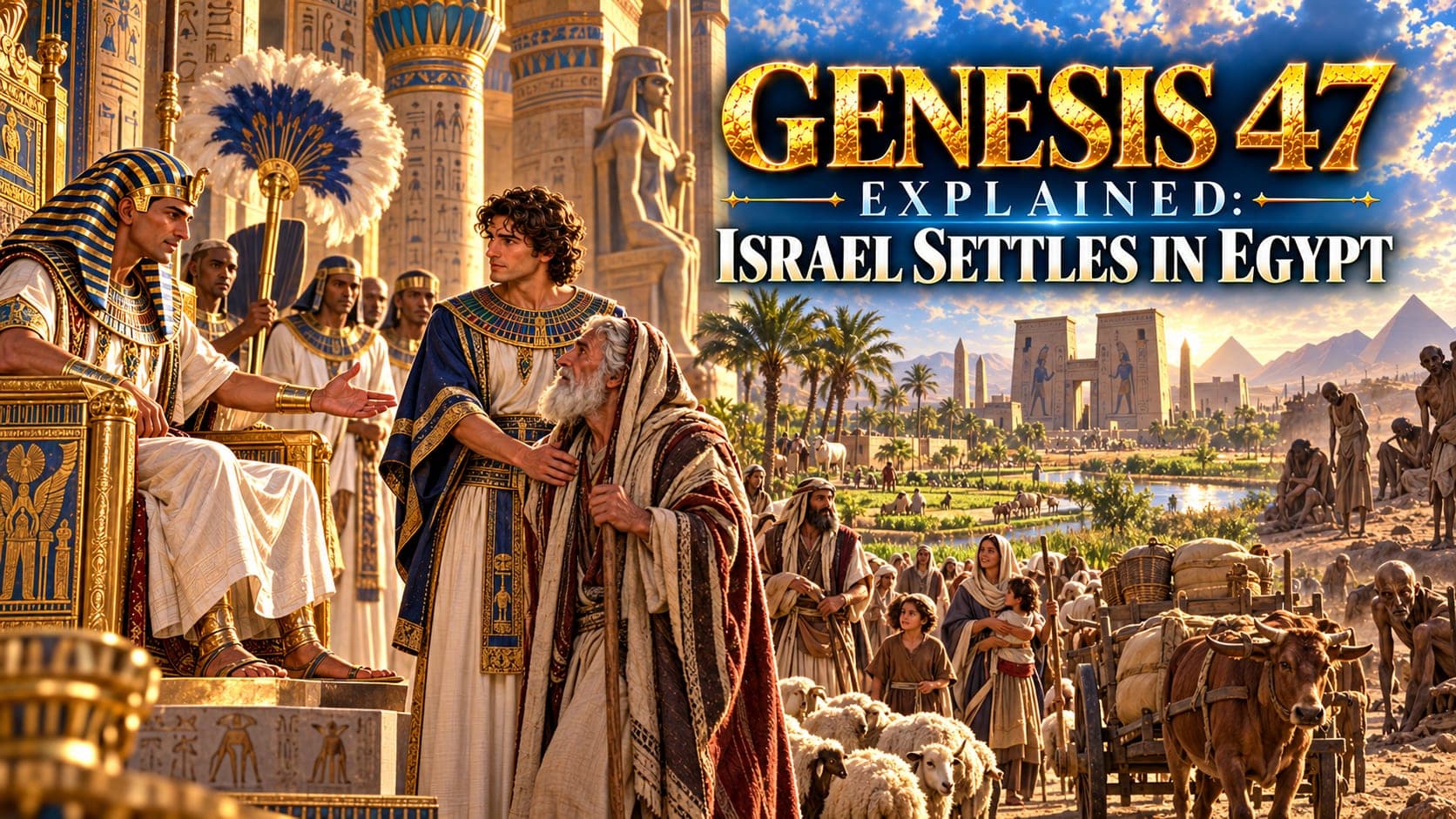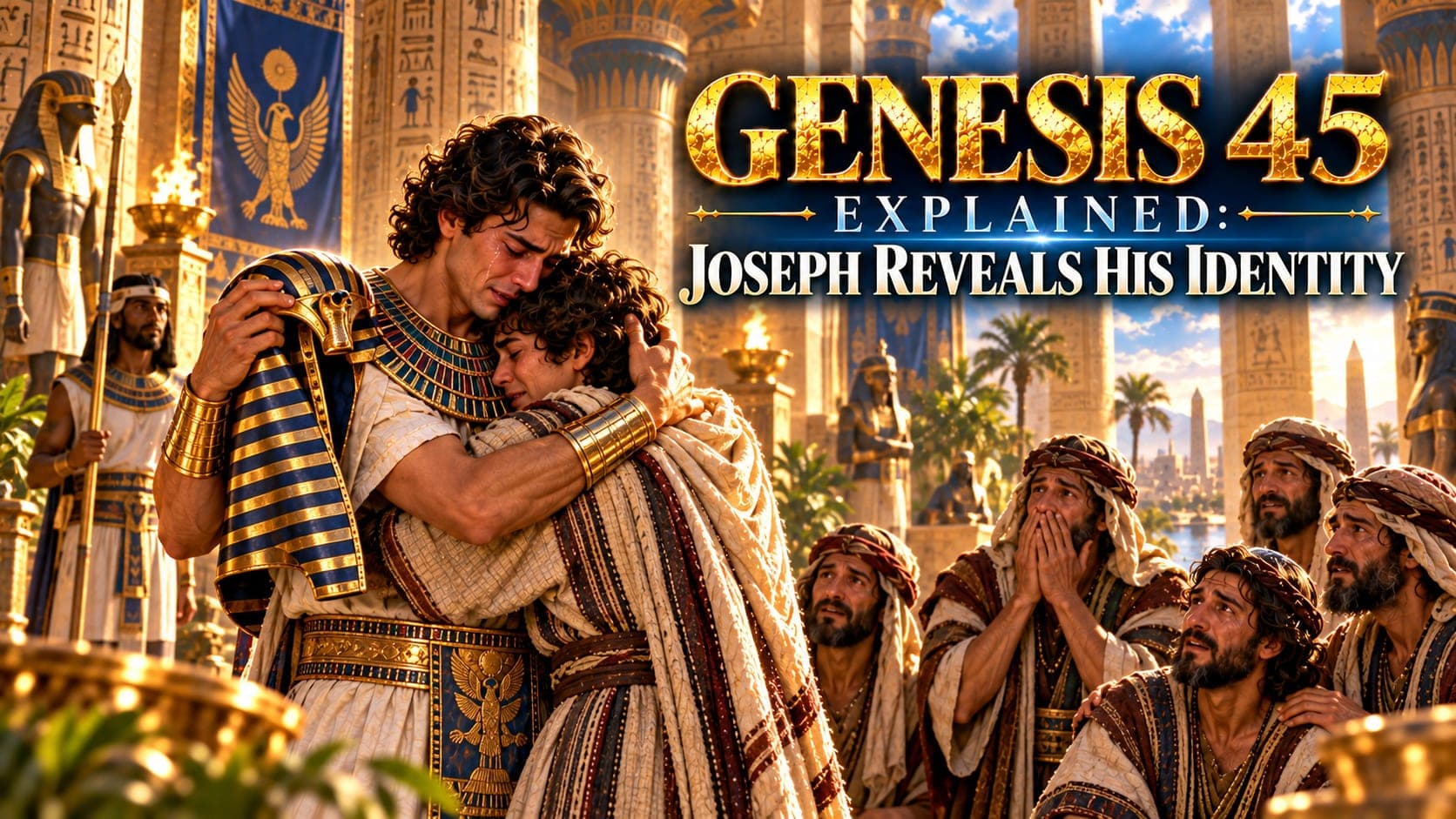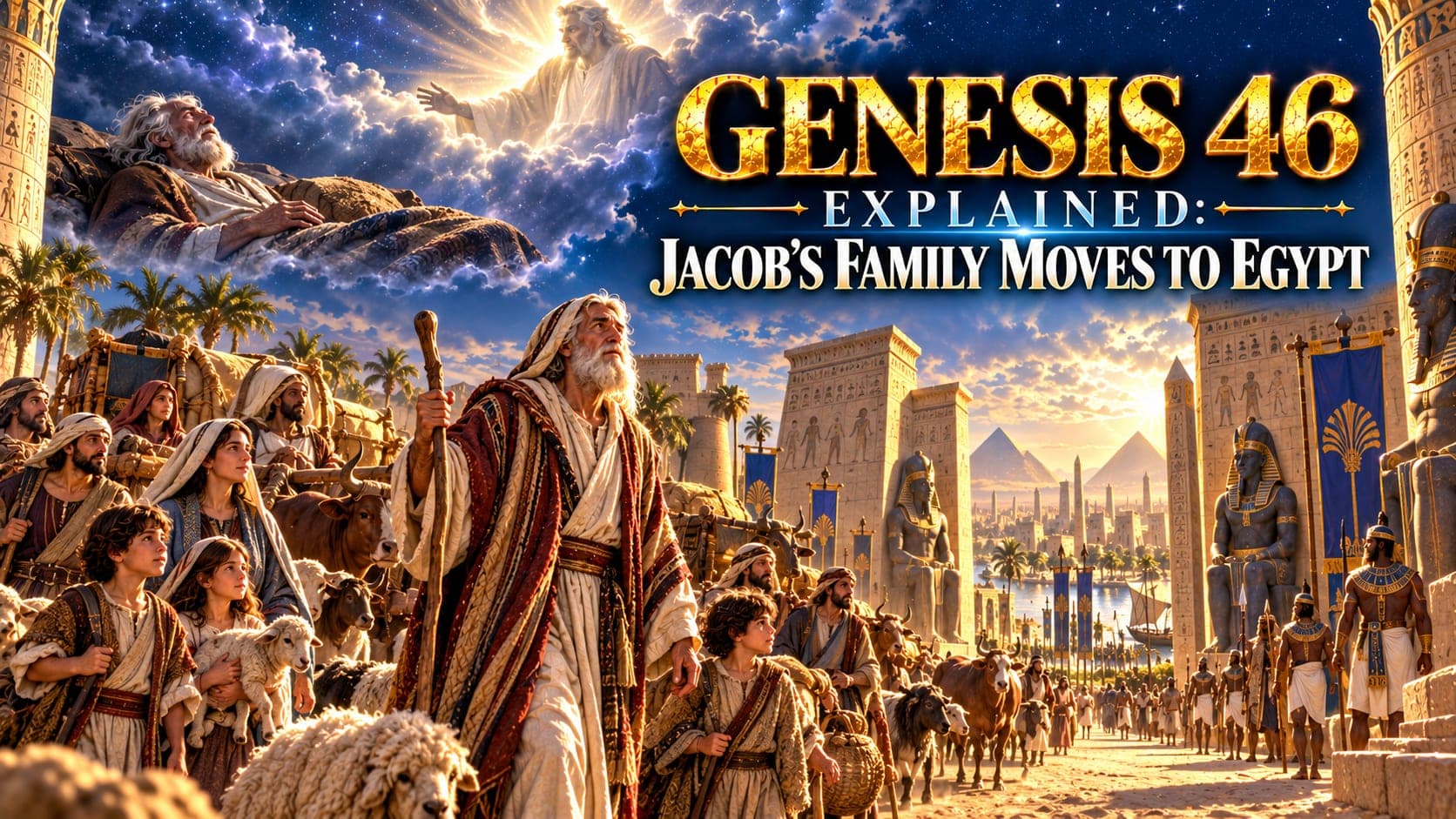
📖 Genesis 46 Explained: Jacob Goes Down to Egypt
An old man stops at the edge of the land God promised his grandfather, and offers a sacrifice before he crosses out of it.
Genesis 46 explained is the chapter where Jacob finally leaves Canaan for Egypt, the wagons from the last chapter actually rolling, a whole household of seventy on the move, and a father seeing a son he gave up for dead twenty two years ago.
Maybe you have stood at the edge of a decision you knew was right and still needed one more word from God before you could take the step.
- ❓ Why does Jacob stop to offer sacrifices before he even leaves Canaan?
- ❓ Why does this chapter stop the story cold for a list of names?
- ❓ Did seventy people really go down to Egypt, or is that number disputed?
- ❓ And why does Joseph coach his brothers on exactly what to tell Pharaoh?
📌 God does not send Jacob to Egypt without a word. He meets him first, by name, at the border.
This walkthrough goes through Genesis 46 in order: the vision at Beersheba, the journey itself, the family list that counts every soul who made the trip, the reunion between Joseph and his father, and the plan Joseph lays out before his brothers ever stand in front of Pharaoh.
Underneath a list of names is a promise that this move was never a retreat.
What Happened Just Before This Chapter
Genesis 45 ended with Jacob finally believing the news that Joseph was alive, not because his sons told him twice, but because he saw the wagons Joseph sent. "It is enough," he said. "I will go and see him before I die."
Genesis 46 picks up the moment that decision turns into movement. Everything is already agreed. Pharaoh has already commanded it. The wagons are already loaded. All that is left is the road itself, and the first stop on that road is a place that means something far older than this famine.
The full story of how Joseph ended up ruling Egypt in the first place, sold by his own brothers and raised up through a prison cell and a pair of dreams, is covered in the story of Joseph.
Genesis 46 Explained Verse by Verse
1. A Promise Renewed at Beersheba (verses 1 to 4)
Jacob does not head straight for Egypt. He stops first at a place with history.
"And Israel took his journey with all that he had, and came to Beersheba, and offered sacrifices unto the God of his father Isaac."
📌 Beersheba is not a random rest stop. It is where Isaac lived and worshipped, and where Jacob himself once fled from his brother Esau. Before he leaves the land God promised to his grandfather Abraham, Jacob pauses to worship the God of that promise, not just the God who has reunited him with a son.
Then, for the first time in this entire Joseph story, God speaks directly.
"And God spake unto Israel in the visions of the night, and said, Jacob, Jacob. And he said, Here am I."
💡 Calling a name twice is how God speaks to people at turning points throughout Scripture. It gets someone's full attention before the words that matter even arrive. Jacob's answer, "Here am I," is the same answer his grandfather Abraham once gave.
"And he said, I am God, the God of thy father: fear not to go down into Egypt; for I will there make of thee a great nation: I will go down with thee into Egypt; and I will also surely bring thee up again: and Joseph shall put his hand upon thine eyes."
⚠️ Notice the thing God actually addresses: fear, not logistics. Jacob already knows Joseph is alive and that Pharaoh has invited the whole family. What he needs settled is something bigger. Egypt is not Canaan. Leaving the land his father and grandfather walked could feel like walking away from the promise itself.
God answers that fear directly. He will go down with Jacob. He will bring the family back up again, a promise that will not be fulfilled for four hundred years and will take an entire book, Exodus, to play out. And He adds a detail only a dying man would care about: Joseph, not a stranger, will be the one to close his father's eyes when the time comes.
2. The Journey Into Egypt (verses 5 to 7)
With the word he needed, Jacob moves.
"And Jacob rose up from Beersheba: and the sons of Israel carried Jacob their father, and their little ones, and their wives, in the wagons which Pharaoh had sent to carry him."
The same wagons that convinced Jacob the news was real in Genesis 45 are now doing the actual work they were sent for, carrying an old man and the generation too young to walk that distance themselves.
"And they took their cattle, and their goods, which they had gotten in the land of Canaan, and came into Egypt, Jacob, and all his seed with him: His sons, and his sons' sons with him, his daughters, and his sons' daughters, and all his seed brought he with him into Egypt."
📌 This is not a man fleeing with nothing. Cattle, goods, sons, daughters, grandchildren, everything Jacob built over a lifetime in Canaan travels with him. God told him not to be afraid, and the move itself shows a household bringing its whole life along, not abandoning it in a panic.
3. Seventy Souls: The Family Who Came Down (verses 8 to 27)
The story stops here, for twenty verses, to do something that can feel like filler to a modern reader: it names names.
Reuben's sons, Simeon's sons, Levi's sons, Judah's sons, down through all twelve brothers, grouped by which mother bore them, Leah, Zilpah, Rachel, Bilhah. Then the chapter adds up the count.
"All the souls that came with Jacob into Egypt, which came out of his loins, besides Jacob's sons' wives, all the souls were threescore and six; And the sons of Joseph, which were born him in Egypt, were two souls: all the souls of the house of Jacob, which came into Egypt, were threescore and ten."
💡 Threescore and ten is seventy. Verse 26 counts sixty six people who traveled from Canaan as Jacob's own offspring, not counting Jacob himself and not counting the wives his sons married. Add Jacob, add Joseph, who was already living in Egypt rather than traveling with the caravan, and add Joseph's two sons born there, and the total reaches seventy, the number this chapter and the rest of Genesis treat as the family's official size on the day they entered the land.
This is not padding. A list like this is how an ancient reader checked that a promise was actually being kept. God told Abraham his descendants would become a nation too numerous to count. Genesis 46 marks the exact headcount at the moment that nation's story moves to a new country, so every reader after this can watch the growth for themselves.
📌 Notice who appears inside this list without comment. Dinah, Jacob's daughter, is named in verse 15 among the children of Leah, the only daughter counted by name in the whole genealogy. The text does not explain why she alone is singled out among the daughters it otherwise only mentions in general terms, but her presence here means she is not forgotten by the record even though her story in Genesis 34 ended in violence and grief.
4. Joseph Meets His Father (verses 28 to 30)
The caravan has a destination already picked out, and a brother sent ahead to mark the way.
"And he sent Judah before him unto Joseph, to direct his face unto Goshen; and they came into the land of Goshen."
It is Judah again, the same brother who stood surety for Benjamin and gave the longest speech of his life pleading for him in Genesis 44, now sent ahead to guide his father the rest of the way. The man who once helped sell Joseph is the one Jacob now trusts to lead the family to him.
"And Joseph made ready his chariot, and went up to meet Israel his father, to Goshen, and presented himself unto him; and he fell on his neck, and wept on his neck a good while."
📌 The most powerful man in Egypt does not wait for his father to be brought to him. Joseph readies his own chariot and goes out to meet him. Every other scene with Joseph's brothers in this story involves Joseph managing his composure in front of an audience. Here there is no test left to run and no secret left to keep. He simply weeps on his father's neck for a long while, the text making a point of saying how long.
Jacob's own words, when they finally come, are not about Egypt, Pharaoh, or famine at all.
"And Israel said unto Joseph, Now let me die, since I have seen thy face, because thou art yet alive."
💡 This is not despair. It is the opposite. Jacob had spent twenty two years believing his favorite son was torn apart by an animal. Every ambition he might still have had for his own life was already satisfied the moment he saw Joseph's face. He is not asking to die. He is saying that whatever happens next, grief has already lost.
5. A Trade Nobody Wants, and the Land It Buys Them (verses 31 to 34)
Before any brother stands in front of Pharaoh, Joseph gives them a script, and the script depends on something most people would never think to brag about.
"And Joseph said unto his brethren, and unto his father's house, I will go up, and shew Pharaoh, and say unto him, My brethren, and my father's house, which were in the land of Canaan, are come unto me; And the men are shepherds, for their trade hath been to feed cattle; and they have brought their flocks, and their herds, and all that they have."
"And it shall come to pass, when Pharaoh shall call you, and shall say, What is your occupation? That ye shall say, Thy servants' trade hath been about cattle from our youth even until now, both we, and also our fathers: that ye may dwell in the land of Goshen; for every shepherd is an abomination unto the Egyptians."
⚠️ Joseph tells his brothers to lead with the one detail that sounds like a liability. Shepherding was looked down on in Egyptian society, enough that the text calls it an abomination to them. Rather than hide that fact to look more impressive to Pharaoh, Joseph has his brothers state it plainly, because the very thing Egyptians find distasteful is exactly what will get the family settled on their own land in Goshen, away from Egyptian cities, with their flocks intact and their own customs left undisturbed.
📌 Joseph is thinking several steps ahead of his own brothers again, the same way he managed grain, dreams, and a famine years earlier in Genesis 41. He is not improvising a reunion. He is arranging a permanent home for a family of seventy inside a foreign empire, using the very prejudice that could have shut them out as the reason they get kept apart and protected instead.

Hard Questions Genesis 46 Raises
Does the Bible contradict itself on how many people went down to Egypt, seventy or seventy five? Genesis 46:27 and Exodus 1:5 both say seventy. Stephen, in his speech in Acts, gives a different number.
"Then sent Joseph, and called his father Jacob to him, and all his kindred, threescore and fifteen souls."
Threescore and fifteen is seventy five. Stephen is quoting from the Greek Septuagint translation of Genesis, which lists five additional descendants of Joseph through Manasseh and Ephraim that the Hebrew text used for Genesis 46 does not include in its count. Both numbers come from a real textual tradition. Christians generally hold that the Hebrew seventy is the number the original Genesis author intended, and that Stephen, speaking to a Greek speaking audience, simply used the version of Scripture they would have recognized. Neither number is invented, and the small gap reflects two authentic manuscript traditions rather than an error in either speaker's account.
Why does the genealogy include grandchildren who seem too young to have existed yet? Verse 12 lists Hezron and Hamul as sons of Pharez, Judah's grandson, even though Judah's own sons Er and Onan are described as already dead in Canaan earlier in the same verse. Hebrew genealogies often record a family's full line as it stood by the time the record was finalized, not strictly who existed on the single day the caravan crossed into Egypt. Some of these grandchildren were almost certainly born after the family settled in Goshen, and the list includes them because the real point of the count is the completed household God was building, not a single afternoon's headcount.
Why does Joseph tell his brothers to volunteer information Pharaoh never even asked about yet? Genesis 46:34 shows Joseph anticipating Pharaoh's question and preparing the brothers' answer in advance. The text does not record Joseph explaining his full reasoning to them, but the strategy becomes clear once Genesis 47 opens: Pharaoh grants the family Goshen specifically because of the answer Joseph scripted. Joseph is not leaving a sensitive conversation to chance.
Why does God need to tell Jacob not to be afraid, when Jacob already chose to go? Choosing to go and feeling settled about it are not the same thing. Jacob had already decided in Genesis 45:28 to see Joseph before he died, but leaving the Promised Land itself, the land God swore to Abraham and Isaac, could easily have felt like abandoning the covenant rather than simply reuniting with a son. God's words at Beersheba answer that specific fear, promising both that He will go with Jacob into Egypt and that the family will one day come back out.
Top 4 Bible Verses From Genesis 46
1. Genesis 46:3 and 4
"And he said, I am God, the God of thy father: fear not to go down into Egypt; for I will there make of thee a great nation: I will go down with thee into Egypt; and I will also surely bring thee up again: and Joseph shall put his hand upon thine eyes."
God addresses the one fear logistics could never settle, leaving the land of the promise, with a promise bigger than the move itself: He goes down with Jacob, and He will bring the family back up again.
2. Genesis 46:27
"And the sons of Joseph, which were born him in Egypt, were two souls: all the souls of the house of Jacob, which came into Egypt, were threescore and ten."
A headcount that lets every later reader watch a promise of a nation too numerous to count start from a very countable seventy.
3. Genesis 46:29
"And Joseph made ready his chariot, and went up to meet Israel his father, to Goshen, and presented himself unto him; and he fell on his neck, and wept on his neck a good while."
The most powerful man in Egypt drives out himself to meet an old shepherd, and for once in this whole story there is no test left to manage, only grief finally allowed to show.
4. Genesis 46:30
"And Israel said unto Joseph, Now let me die, since I have seen thy face, because thou art yet alive."
Not despair but the opposite, a father telling his son that whatever comes next, the worst thing grief could have told him turned out not to be true.

Frequently Asked Questions About Genesis 46
What happens in Genesis 46?
Jacob stops at Beersheba and offers sacrifices, where God speaks to him at night and tells him not to fear going down to Egypt. The chapter then lists every member of Jacob's household, seventy souls in total, before Joseph meets his father in Goshen and coaches his brothers on how to answer Pharaoh about their trade as shepherds.
Why did Jacob stop at Beersheba on his way to Egypt?
Beersheba was tied to his father Isaac's worship and his own earlier history in Canaan. Stopping there to offer sacrifices before leaving the Promised Land shows Jacob seeking God's presence at the border, not just taking Pharaoh's invitation at face value.
Where was Goshen, and why did Jacob's family settle there?
Goshen was a fertile region in the eastern part of Egypt, well suited for grazing flocks and herds. Genesis 46:34 shows Joseph arranging for his family to live there rather than among Egyptians generally, using their trade as shepherds, something Egyptians viewed as beneath them, as the very reason Pharaoh would grant them a separate territory.
How many people went to Egypt with Jacob?
Genesis 46:27 and Exodus 1:5 both say seventy. Acts 7:14 says seventy five, following the Greek Septuagint translation, which counts five additional descendants of Joseph that the Hebrew text used for Genesis does not list. Both figures come from real, ancient manuscript traditions.
Why does the Bible list so many names in Genesis 46?
The list functions as an official record of exactly who entered Egypt and when, letting later readers measure the nation God promised Abraham against its actual starting size. It is also the same family tree Exodus and later books build directly on top of.
Why did Joseph tell his brothers to say they were shepherds?
Shepherding was considered beneath Egyptian society, enough that Genesis 46:34 calls it an abomination to them. Joseph uses that very prejudice to secure his family their own separate land in Goshen rather than having them absorbed into Egyptian cities and customs.
What does "Now let me die, since I have seen thy face" mean?
Jacob is not asking to die. He is saying that everything grief ever told him about losing Joseph has now been proven false, and nothing that comes after this moment can take that away from him.
Why does God tell Jacob not to be afraid in Genesis 46?
Jacob had already agreed to go to Egypt, but leaving the land God promised to Abraham and Isaac carried its own weight separate from simply wanting to see Joseph again. God's words at Beersheba promise both His presence in Egypt and an eventual return, answering that deeper fear directly.
How does Genesis 46 connect to Exodus?
The seventy souls counted here are the same family Exodus 1 opens by naming again, right before describing how they multiplied into a nation under new, much harsher circumstances. God's promise in Genesis 46:4 to bring the family back out of Egypt is the promise the entire book of Exodus exists to keep.
What happens after Genesis 46?
Genesis 47 opens with Joseph presenting his brothers to Pharaoh exactly as he instructed them, Pharaoh granting the family the land of Goshen, and Jacob himself brought in to meet Pharaoh and give him a blessing.
Final Thoughts
Genesis 46 is a chapter that moves a whole family and still makes time to speak to one man's fear first.
📌 God addresses the fear underneath the decision, not just the decision itself. Jacob had already agreed to go. He still needed to hear, by name, that leaving the Promised Land was not the same as leaving the promise.
📌 A list of names is not filler. It is a receipt. Seventy souls entering Egypt is the number every later promise of a nation too numerous to count gets measured against.
📌 Wisdom sometimes means leading with the detail that looks like a weakness. Joseph has his brothers announce their despised trade on purpose, because that very prejudice is what keeps his family together and protected.
You may be standing at your own Beersheba right now, already decided on a next step and still waiting for enough peace to actually take it.
So here is your one next step.
Bring your own fear about the move you have already chosen honestly to God, the way Jacob did, before you take the first step of it.