📖 Genesis 45 Explained: Joseph Reveals Himself to His Brothers
Judah is still standing there, mid plea, when the whole room changes.
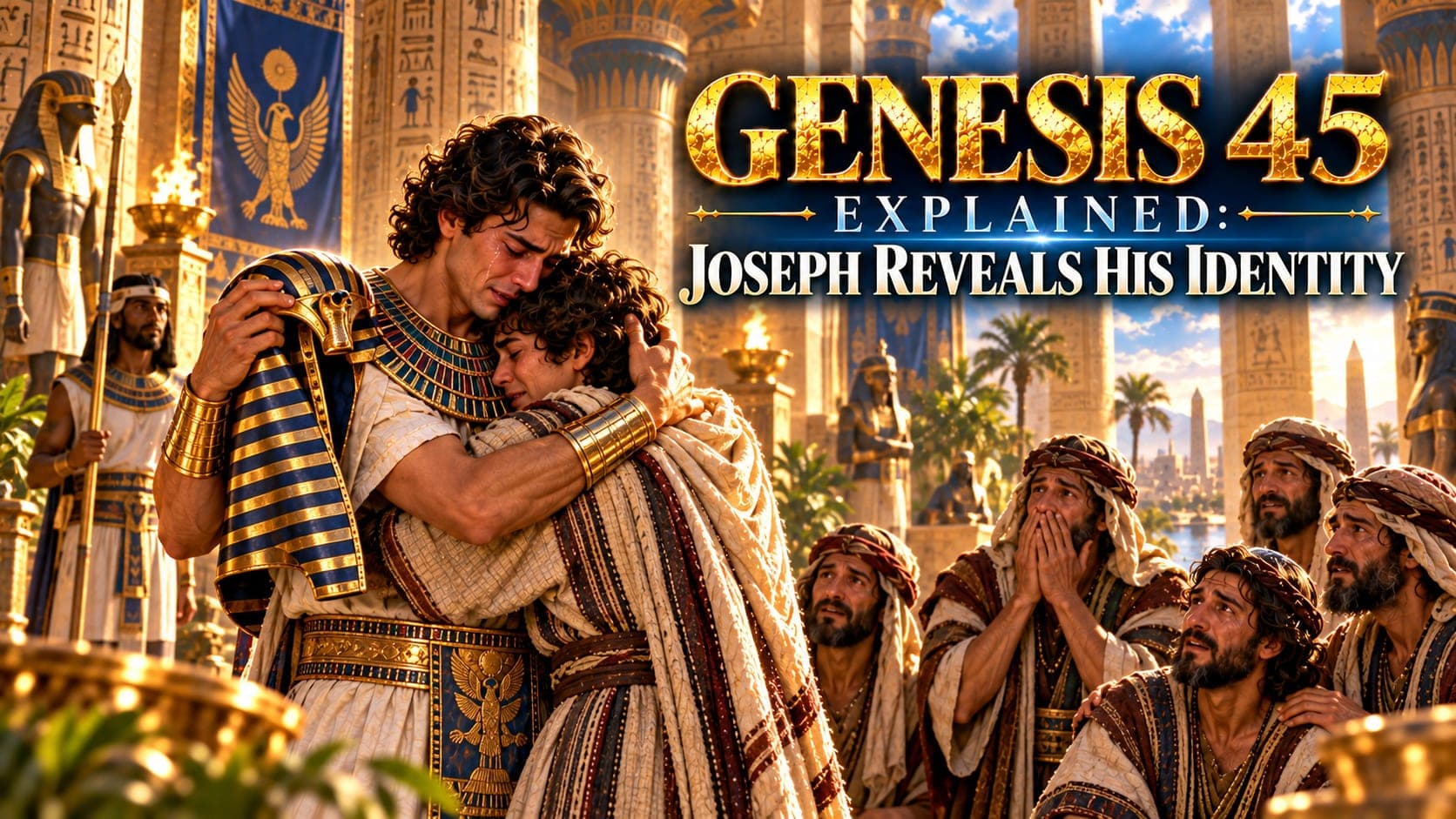
Genesis 45 explained is the chapter where Joseph finally stops testing his brothers and tells them the truth. Every Egyptian is sent out of the room. The acting is over. The governor of Egypt says four words no one in that room expected to hear again: I am Joseph.
Maybe you know what it is like to hold back the truth so long that saying it finally breaks you open.
- ❓ Why does Joseph send every Egyptian out before he speaks?
- ❓ How can he say God sent him to Egypt when his brothers are the ones who sold him?
- ❓ Why does Jacob refuse to believe his own sons at first?
- ❓ And why does Joseph warn his brothers not to quarrel on the road home?
📌 This chapter never uses the word forgiveness, and it is the clearest picture of it in the whole book of Genesis.
This walkthrough goes through Genesis 45 in order: the moment Joseph cannot hold himself back any longer, the words he chooses to explain what happened to him, the message he sends racing ahead to his father, the wagons Pharaoh sends to prove it is real, and the old man whose heart has to be convinced twice before he will believe his son is alive.
Twenty two years of silence end in this chapter, in less time than it takes to read it.
What Happened Just Before This Chapter
Genesis 44 ended in the middle of Judah's speech, with Joseph's silver cup found in Benjamin's sack and Judah begging to take Benjamin's place as a slave rather than watch Jacob lose his last favorite son. Judah had just finished saying he could not bear to see the grief that would come on his father.
Genesis 45 picks up at the exact moment that speech lands. Joseph has tested these brothers through an accusation of spying, three days in custody, a hostage held in Egypt, and a planted cup. He has watched them stand together instead of abandoning Benjamin the way they once abandoned him. The test is over before this chapter even states it plainly, because Joseph is the one who breaks first.
The full arc behind this moment, a favored son, a coat, a pit, and thirteen years as a slave and a prisoner before any of this power came to him, is covered in the story of Joseph.
Genesis 45 Explained Verse by Verse
1. Joseph Clears the Room (verses 1 to 3)
The chapter opens with a man who has run out of composure.
"Then Joseph could not refrain himself before all them that stood by him; and he cried, Cause every man to go out from me. And there stood no man with him, while Joseph made himself known unto his brethren."
📌 Every scene before this one has Joseph managing himself in front of an audience. He turned aside to weep in Genesis 42, left the room entirely in Genesis 43, and held a hard line through an entire speech in Genesis 44. Here, for the first time, he will not do any of that in front of witnesses. Whatever happens next is for his family alone, not for Egyptian ears.
"And he wept aloud: and the Egyptians and the house of Pharaoh heard."
The room is empty of witnesses and the weeping is still loud enough to carry through the walls. Twenty two years of grief do not stay quiet just because the door is shut.
"And Joseph said unto his brethren, I am Joseph; doth my father yet live? And his brethren could not answer him; for they were troubled at his presence."
💡 Notice the order of his words. Not an accusation, not even a greeting first, but his father's name. Joseph has already heard, back in the previous chapter, that Jacob is alive and grieving. He asks anyway, because hearing it stated to his face is not the same as hearing it reported secondhand through an interpreter.
His brothers say nothing. "Troubled" is too small a word for what ten men must feel standing in front of the brother they sold, now holding every bit of power over whether they live or die.
2. The Words Joseph Chooses to Explain What Happened (verses 4 to 8)
Joseph does not let the silence sit. He calls them closer instead of letting them keep their distance.
"And Joseph said unto his brethren, Come near to me, I pray you. And they came near. And he said, I am Joseph your brother, whom ye sold into Egypt. Now therefore be not grieved, nor angry with yourselves, that ye sold me hither: for God did send me before you to preserve life."
📌 Joseph names the crime himself, plainly, before he says anything else. "Whom ye sold into Egypt" is not softened or avoided. He does not pretend it did not happen or that it was someone else's fault. He states it, then immediately places it inside a bigger story they could not see from where they stood.
"For these two years hath the famine been in the land: and yet there are five years, in the which there shall neither be earing nor harvest. And God sent me before you to preserve you a posterity in the earth, and to save your lives by a great deliverance. So now it was not you that sent me hither, but God: and he hath made me a father to Pharaoh, and lord of all his house, and a ruler throughout all the land of Egypt."
Two years of famine already gone, five more still coming, seven years in total. That is the same number Pharaoh dreamed about in Genesis 41, now confirmed from inside the famine itself instead of from a dream waiting to be tested.
⚠️ Read carefully, Joseph says two things at once rather than one thing instead of the other. "Ye sold me" stays true. "It was not you that sent me hither, but God" is also true. He does not erase their guilt to make room for God's plan, and he does not let God's plan erase the fact of what they did. Both sentences stand in the same breath.
3. A Message Sent Racing Ahead to Jacob (verses 9 to 13)
Joseph moves straight from explanation to urgency, giving his brothers exact words to carry home.
"Haste ye, and go up to my father, and say unto him, Thus saith thy son Joseph, God hath made me lord of all Egypt: come down unto me, tarry not: And thou shalt dwell in the land of Goshen, and thou shalt be near unto me, thou, and thy children, and thy children's children, and thy flocks, and thy herds, and all that thou hast: And there will I nourish thee; for yet there are five years of famine; lest thou, and thy household, and all that thou hast, come to poverty."
📌 "Thy son Joseph" is the identity he leads with, not "lord of all Egypt." The title comes second, offered as proof of what God has done, not as the point of the message. The point is simpler: come near me, and let me take care of you.
Then he gives them the one piece of evidence words alone cannot fake.
"And, behold, your eyes see, and the eyes of my brother Benjamin, that it is my mouth that speaketh unto you. And ye shall tell my father of all my glory in Egypt, and of all that ye have seen; and ye shall haste and bring down my father hither."
💡 Joseph knows exactly how unbelievable his own story sounds. He points to his own mouth speaking Hebrew, without an interpreter standing between them this time, as proof no one can later claim was secondhand or exaggerated. They are not being asked to take someone's word for it. They watched it happen.
4. Tears, Kisses, and Brothers Who Can Finally Talk (verses 14 and 15)
Before any of that explaining happened, the first thing Joseph does is reach for Benjamin.
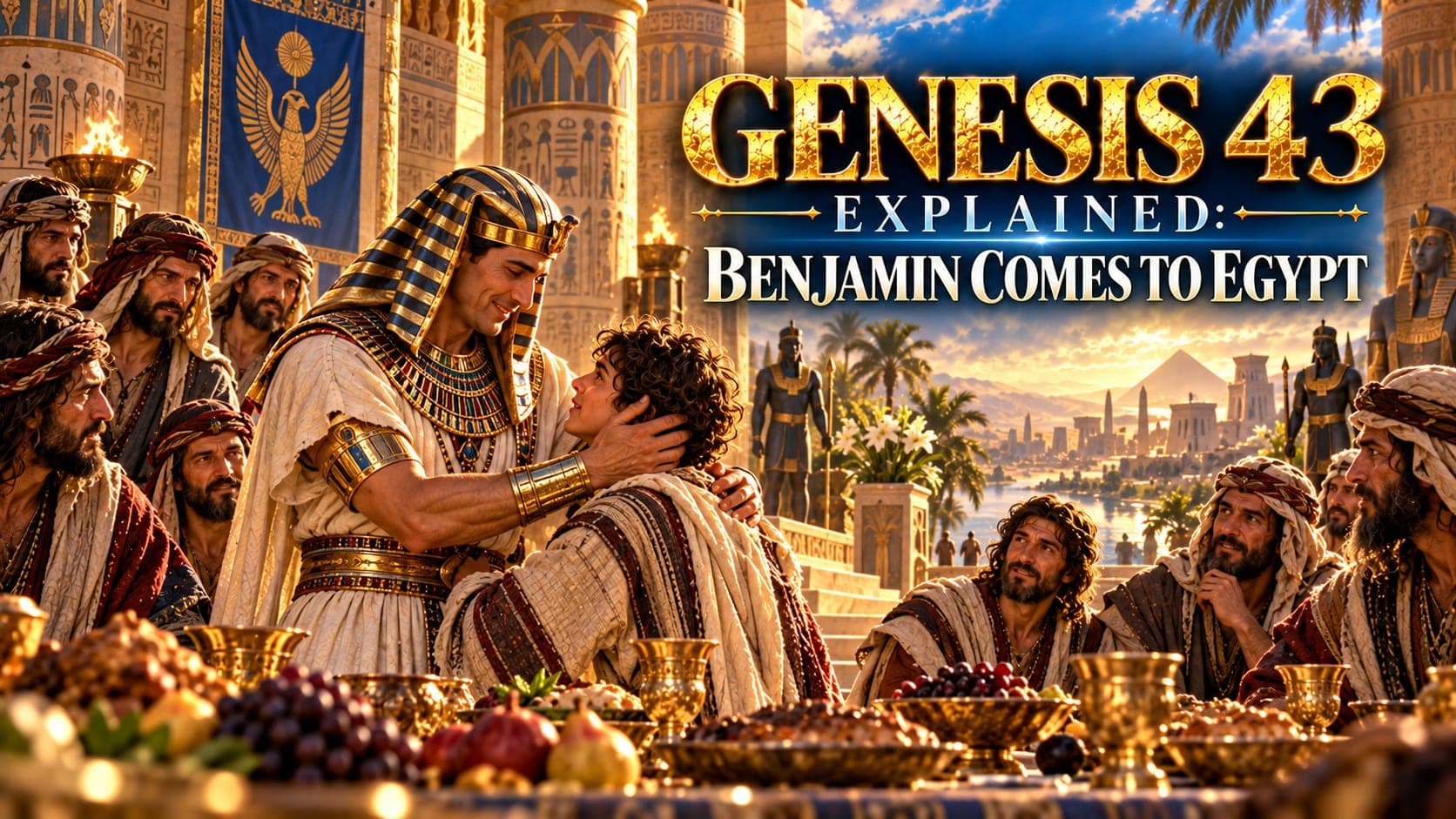
"And he fell upon his brother Benjamin's neck, and wept; and Benjamin wept upon his neck. Moreover he kissed all his brethren, and wept upon them: and after that his brethren talked with him."
📌 Benjamin gets Joseph first, by name, the way he did at the feast in the previous chapter. He is the one full brother Joseph has left, the only other son of Rachel, and the embrace comes before a single word of explanation is given to him.
Then Joseph kisses every brother in the room, including the ones who once sat down to eat a meal while he begged from the bottom of a pit. The last line of verse 15, "after that his brethren talked with him," is easy to read past. Ten men who could not answer him in verse 3 are talking with him by verse 15. Fear has not disappeared instantly, but it has stopped being the only thing in the room.
5. Pharaoh Hears, and Sends Wagons (verses 16 to 24)
The news does not stay inside Joseph's house for long.
"And the fame thereof was heard in Pharaoh's house, saying, Joseph's brethren are come: and it pleased Pharaoh well, and his servants."
Pharaoh is genuinely glad, not merely tolerant, and he backs that gladness with a direct order.
"And Pharaoh said unto Joseph, Say unto thy brethren, This do ye; lade your beasts, and go, get you unto the land of Canaan; And take your father and your households, and come unto me: and I will give you the good of the land of Egypt, and ye shall eat the fat of the land. Now thou art commanded, this do ye; take you wagons out of the land of Egypt for your little ones, and for your wives, and bring your father, and come. Also regard not your stuff; for the good of all the land of Egypt is yours."
📌 Pharaoh tells them to leave their belongings behind without a second thought. The wagons matter here because wagons were an Egyptian technology Canaan did not widely use. A gift of wagons is not a polite gesture. It is physical, undeniable proof riding straight into Jacob's camp.
Joseph adds his own gifts on top of Pharaoh's order, and the numbers are worth slowing down on.
"And the children of Israel did so: and Joseph gave them wagons, according to the commandment of Pharaoh, and gave them provision for the way. To all of them he gave each man changes of raiment; but to Benjamin he gave three hundred pieces of silver, and five changes of raiment. And to his father he sent after this manner; ten asses laden with the good things of Egypt, and ten she asses laden with corn and bread and meat for his father by the way."
💡 Three hundred pieces of silver is fifteen times the twenty pieces the Ishmeelites paid for Joseph himself back in Genesis 37. The traders' price for a brother becomes, in Joseph's own hand, a gift fifteen times larger for the one brother he has left. He is not hiding the favoritism either. The text gives every brother a change of clothing without naming a number, then names Benjamin's exactly: five changes of raiment, on top of the silver. The same shape of preference that once cost Joseph his own coat is repeated here openly, without apology.
Joseph sends them off with one short, pointed warning.
"So he sent his brethren away, and they departed: and he said unto them, See that ye fall not out by the way."
⚠️ Joseph knows exactly what a long road and old guilt can do to men traveling together. Nine brothers now carry the knowledge of what they did, fresh news of Joseph's forgiveness, and a long journey home to blame each other on. He does not assume the reunion has settled everything between them instantly.
6. A Father Who Has to Be Convinced Twice (verses 25 to 28)
The brothers arrive home in Canaan carrying news bigger than any grain they have ever brought back before.
"And they went up out of Egypt, and came into the land of Canaan unto Jacob their father, And told him, saying, Joseph is yet alive, and he is governor over all the land of Egypt. And Jacob's heart fainted, for he believed them not."
📌 Words alone do not move Jacob at all. He has lived twenty two years believing Joseph was torn apart by a wild animal, a story his own sons told him. Hearing that same son is not only alive but ruling Egypt does not read as good news. It reads as something too large to be true, and his heart simply stops taking it in.
"And they told him all the words of Joseph, which he had said unto them: and when he saw the wagons which Joseph had sent to carry him, the spirit of Jacob their father revived: And Israel said, It is enough; Joseph my son is yet alive: I will go and see him before I die."
💡 It is not the retelling that finally reaches Jacob. It is the wagons sitting in front of him, exactly the proof Joseph planned for in verse 19. Seeing does what hearing could not. The chapter that opened with Joseph unable to hold back his own words ends with his father, an old man who had given up grieving quietly, suddenly ready to move.

Hard Questions Genesis 45 Raises
If God sent Joseph to Egypt, were the brothers even guilty of anything? The text itself refuses to pick one side of this. Joseph says plainly, in the same breath, "ye sold me" and "it was not you that sent me hither, but God." Genesis 50:20 states the same pairing even more directly: "ye thought evil against me; but God meant it unto good." Christians have long read this as two truths held together rather than one cancelling the other: the brothers acted with real, blameworthy intent, and God worked through that same choice to bring about good they could not have planned or seen coming. Scripture does not explain the mechanics of how both can be fully true. It simply states both and leaves the reader to hold them together.
"But as for you, ye thought evil against me; but God meant it unto good, to bring to pass, as it is this day, to save much people alive."
Why does Joseph send every Egyptian out of the room before he speaks? Genesis does not explain his reasoning directly, but the moment calls for it on its own terms. What he is about to say, both the confession of his identity and the weeping that follows, is a family matter. A public unmasking in front of Pharaoh's court would turn a private reunion into a political spectacle, and nothing in the text suggests Joseph wants that.
Why does Jacob need to see the wagons before he believes his own sons? Genesis 45:26 says plainly that his heart fainted and he did not believe them at the first report. Twenty two years of believing Joseph was dead, on the word of these same sons, is not undone by one more sentence from them. It takes physical, visible proof, the wagons themselves, to move him from disbelief to action.
Does Joseph's warning not to quarrel on the road mean the brothers were still arguing about what happened? Genesis does not record an actual quarrel breaking out. The warning in verse 24 reads as Joseph anticipating what twenty two years of unspoken blame could still do to men left alone together on a long journey, not as a report that it already had.
Why does Benjamin again receive far more than his brothers? As in Genesis 44, the text states the fact, three hundred pieces of silver and five named changes of clothing for Benjamin, against an unnumbered share for everyone else, without stating Joseph's reasoning. It may simply be the bond of two sons who share a mother neither of the others share, offered now without needing to hide it.
Top 5 Bible Verses From Genesis 45
1. Genesis 45:3
"And Joseph said unto his brethren, I am Joseph; doth my father yet live? And his brethren could not answer him; for they were troubled at his presence."
Three words end twenty two years of not knowing. The brothers have no answer ready for a moment they never expected to live through.
2. Genesis 45:5
"Now therefore be not grieved, nor angry with yourselves, that ye sold me hither: for God did send me before you to preserve life."
Forgiveness that names the actual wound instead of talking around it, then points past it to something bigger than either the crime or the guilt it left behind.
3. Genesis 45:8
"So now it was not you that sent me hither, but God: and he hath made me a father to Pharaoh, and lord of all his house, and a ruler throughout all the land of Egypt."
Joseph traces every title Egypt gave him back to God's hand, not his own rise, even while standing in the full authority of that rise.
4. Genesis 45:14
"And he fell upon his brother Benjamin's neck, and wept; and Benjamin wept upon his neck."
Before a single brother hears an explanation, Joseph reaches for the one sibling who shares his mother, grief meeting grief before any words are needed.
5. Genesis 45:28
"And Israel said, It is enough; Joseph my son is yet alive: I will go and see him before I die."
A father who had resigned himself to dying in grief finds a reason to move again, proof enough carried on wheels he had never needed in Canaan before.

Frequently Asked Questions About Genesis 45
What happens in Genesis 45?
Joseph sends every Egyptian out of the room and tells his brothers who he is. He reassures them, sends them home with a message and gifts for Jacob, and Pharaoh sends wagons to bring the whole family down to Egypt. Jacob does not believe the news until he sees the wagons for himself.
Why did Joseph wait so long to reveal himself?
The chapters before this one show Joseph testing whether his brothers had actually changed, especially whether they would abandon Benjamin the way they once abandoned him. By Genesis 45, Judah's plea in the previous chapter answers that question, and Joseph cannot hold back any longer.
Did Joseph forgive his brothers in Genesis 45?
Yes, though the chapter never uses the word itself. He names what they did plainly, "whom ye sold into Egypt," then tells them not to be grieved or angry with themselves, embraces them, and provides for their entire family. The action carries the weight the word would.
What does "God did send me before you to preserve life" mean?
Joseph is saying that God used the very act of being sold into Egypt to position him to save his family, and many others, from a famine still years away from being predictable by anyone else. It does not erase what his brothers did. It places their choice inside a larger purpose they never intended.
Why does Jacob's heart faint when he hears Joseph is alive?
Genesis 45:26 says he simply did not believe them. Twenty two years of grief, built on a story his own sons told him, is not undone by one more report from the same sons. It takes seeing the wagons Joseph sent for his spirit to revive.
Why did Benjamin get more gifts than the other brothers?
Genesis 45:22 states the fact without stating the reason: five changes of clothing and three hundred pieces of silver for Benjamin, an unnumbered share of clothing for everyone else. Benjamin is Joseph's only full brother, sharing both parents rather than only a father with the rest.
Why did Pharaoh send wagons for Jacob's family?
Wagons were not common in Canaan at the time, so a gift of wagons functioned as visible, undeniable proof of Joseph's new position, something words alone could not provide. Pharaoh also commanded the move himself, glad to welcome Joseph's family into Egypt.
Why did Joseph warn his brothers not to fall out on the road?
Genesis 45:24 records the warning without recording an actual argument that followed. Joseph seems to be anticipating what old blame and fresh emotion could still do to nine men traveling home together, not reporting a conflict that had already broken out.
How does Genesis 45 connect to Genesis 37?
The brothers who sold Joseph for twenty pieces of silver in Genesis 37 now receive grain, wagons, and gifts worth far more from the very brother they sold. Joseph names the sale directly in verse 4 rather than letting the family pretend it never happened.
What happens after Genesis 45?
Genesis 46 opens with Jacob traveling toward Egypt, stopping to offer sacrifices at Beersheba, where God speaks to him directly and promises to go down into Egypt with him and to bring his descendants back out again.
Final Thoughts
Genesis 45 is the chapter the whole Joseph story has been building toward, and it still manages to surprise.
📌 Real forgiveness names the wound instead of avoiding it. Joseph says "whom ye sold into Egypt" before he says anything comforting, and the comfort means more because the truth came first.
📌 God's purpose and human guilt are not opposites in this chapter. They sit in the same sentence. "Ye sold me" and "God did send me" are both true at once, and Joseph never tries to resolve the tension for his brothers. He just states it and moves forward.
📌 Some news is too big for words to carry alone. Jacob needed wagons, not just a report, before grief could finally give way to hope.
You may be carrying something you did, or something done to you, that feels too large to say out loud. Joseph held his for twenty two years before this chapter gave him the moment to finally speak it.
So here is your one next step.
If there is a truth you have been holding back from someone you love, ask God for the moment Joseph got in this chapter, and the courage to actually take it when it comes.