📖 Is Drinking Alcohol a Sin? What the Bible Really Says
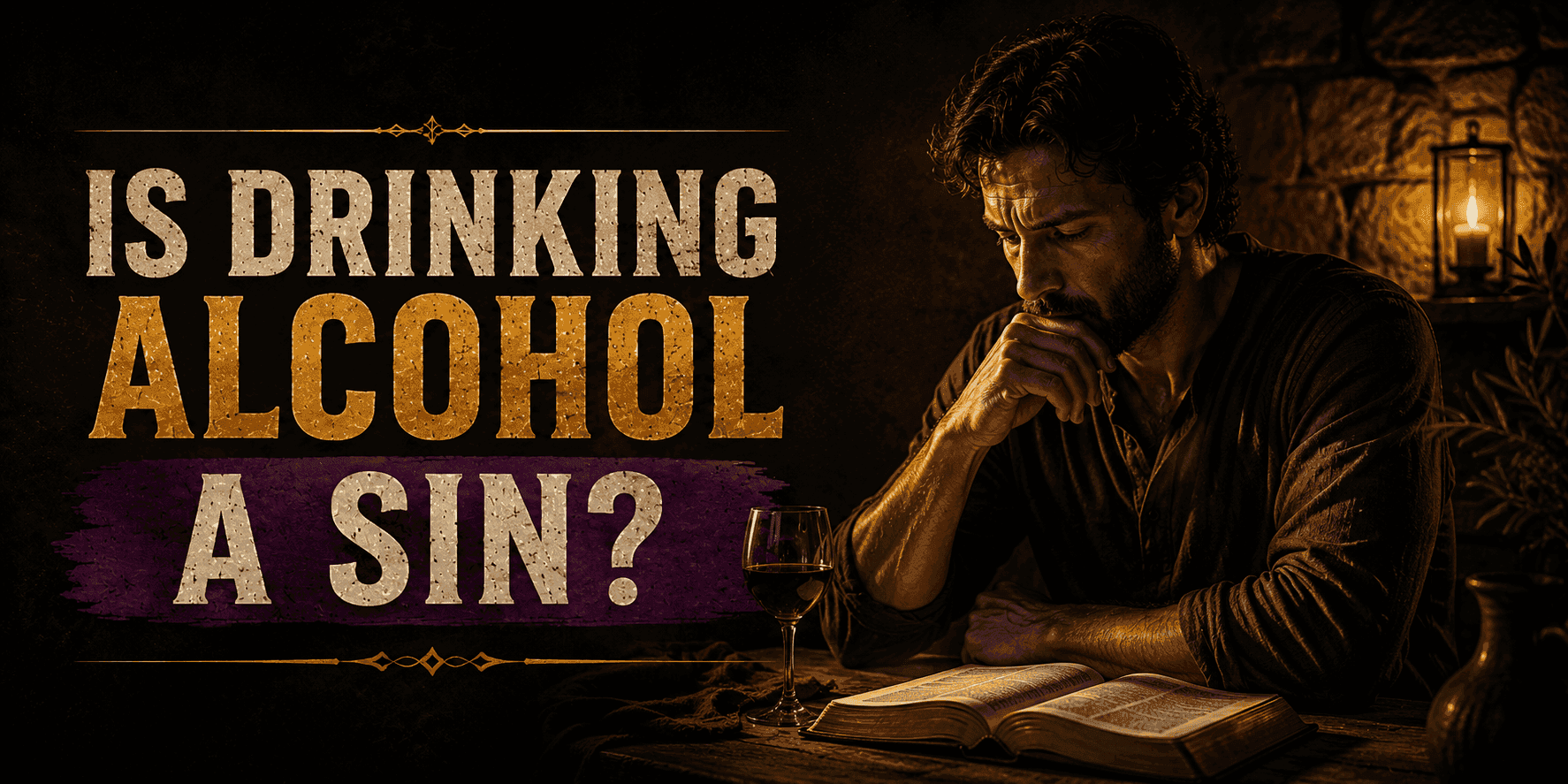
Is drinking alcohol a sin? That question follows you into the beer aisle.
It follows you to the wedding toast when someone hands you a glass and waits to see what you do.
It follows you home from church, if church is where you first heard the answer.
Maybe you grew up being told that any alcohol at all is sin, full stop, and you still feel a flash of guilt reaching for a drink nobody else at the table thinks twice about.
Or maybe nobody ever raised the question for you, and now you are raising it yourself, because something about your own drinking does not sit right anymore.
📌 Here is the honest answer before anything else. The Bible never calls alcohol itself a sin. It calls drunkenness a sin, over and over, without apology.
- 🔲 "Never touch it, ever."
- 🔲 "A drink is fine as long as you are responsible."
- 🔲 "It is nobody's business but your own."
You have probably heard some version of all three, usually stated as settled fact.
Scripture is more specific than any of them, and more useful.
It will not hand you one blanket rule that lets you stop thinking. It will hand you something better: where the real line actually is, why God put it there, and what to do if you already know you crossed it.
That is what this guide walks through. What the Bible actually says about wine and strong drink. Where drunkenness becomes sin and why. What your own conscience and the people around you have to do with your decision. And honest answers to the questions Christians actually ask about this, starting with the one you clicked on.
Get a coffee, or pour whatever is already in your hand. Let's look at what God's Word actually says.
Why This Matters for Your Faith
You could treat this like a question of personal taste, the same weight as coffee or tea.
Scripture will not let you treat it that way, and neither should you.
⚠️ What you do with alcohol touches real spiritual ground: your freedom, your witness, and your body.
Your body is not a shell you get to treat however you feel like. Paul says it is a place where God's own Spirit actually lives, which is part of what it means to understand your body as a temple instead of just property you own.
Your freedom matters too, and so does the person sitting across the table from you.
Scripture spends real space on both: how far your personal liberty goes, and what you owe someone whose conscience is more tender than yours.
The world's answer here is thin. It usually lands on one of two extremes.
- ❓ Either every drop is poison and anyone who drinks is suspect.
- ❓ Or nothing matters as long as you can still drive home.
Neither of those came from the Bible. Both of them skip the actual verses.
📌 What is really at stake is not whether you can enjoy a drink. It is whether something other than Christ ends up ruling you.
That question is worth answering honestly, so let's get into what Scripture actually says.
What God's Word Actually Says About Alcohol
1. Jesus Drank Wine, and the Bible Never Calls Alcohol Itself a Sin
Start with the plainest fact in this whole conversation.
Jesus made wine. On purpose. As His first public miracle.
A wedding in Cana ran out of wine, and Jesus turned water into more of it.
"When the ruler of the feast had tasted the water that was made wine, and knew not whence it was: (but the servants which drew the water knew;) the governor of the feast called the bridegroom, And saith unto him, Every man at the beginning doth set forth good wine; and when men have well drunk, then that which is worse: but thou hast kept the good wine until now."
Read that line again: "when men have well drunk." The governor of the feast is describing people who have already had plenty to drink, at a wedding Jesus Himself supplied.
That is not a loophole someone found. That is the text.
Paul gives the same picture from the other direction, writing to a young pastor named Timothy:
"Drink no longer water, but use a little wine for thy stomach's sake and thine often infirmities."
Paul is not warning Timothy away from wine. He is telling him to use it, for his health, in a letter about godly living.
Proverbs even says wine has a place for the person who is suffering:
"Give strong drink unto him that is ready to perish, and wine unto those that be of heavy hearts. Let him drink, and forget his poverty, and remember his misery no more."
💡 If alcohol itself were sin, none of this makes sense. Jesus would not have made it. Paul would not have prescribed it. Proverbs would not have offered it to the brokenhearted.
So let that settle the first question. The glass in your hand is not the sin.
What comes next matters just as much.
2. But Drunkenness Is Named as Sin Again and Again
The Bible that blesses wine at a wedding is the same Bible that will not soften its language about drunkenness, not even once.
"And be not drunk with wine, wherein is excess; but be filled with the Spirit;"
📌 Notice the contrast Paul draws. Not "drink less wine." Be filled with something else entirely. One fills your head with noise. The other fills your whole life with God.
Paul names drunkenness directly again when he lists what he calls the works of the flesh:
"Now the works of the flesh are manifest, which are these; Adultery, fornication, uncleanness, lasciviousness, Idolatry, witchcraft, hatred, variance, emulations, wrath, strife, seditions, heresies, Envyings, murders, drunkenness, revellings, and such like: of the which I tell you before, as I have also told you in time past, that they which do such things shall not inherit the kingdom of God."
⚠️ Read where drunkenness sits in that list. Beside hatred. Beside murder. Scripture is not treating it as a minor slip.
Proverbs describes exactly what drunkenness does to a person, with no flattering edges:
"Who hath woe? who hath sorrow? who hath contentions? who hath babbling? who hath wounds without cause? who hath redness of eyes? They that tarry long at the wine; they that go to seek mixed wine. Look not thou upon the wine when it is red, when it giveth his colour in the cup, when it moveth itself aright. At the last it biteth like a serpent, and stingeth like an adder."
It bites like a serpent. That is how the oldest wisdom book in your Bible describes the drink you thought was harmless at the bottom of the bottle.
And it names something your own body already knows:
"Wine is a mocker, strong drink is raging: and whosoever is deceived thereby is not wise."
The prophets go after it too, specifically warning against using drink to take advantage of other people:
"Woe unto him that giveth his neighbour drink, that puttest thy bottle to him, and makest him drunken also, that thou mayest look on their nakedness!"
💡 Put the two sides together and the picture is clear. Wine itself gets a yes in Scripture. Drunkenness gets a flat, repeated no. The question was never whether you drank. It is what the drink is doing to you, and what you are doing with it to someone else.
3. The Real Line Isn't the Glass. It Is Who Is in Control
So where exactly is the line, if it is not simply "zero drinks"?
Paul draws it for you in one sentence, and it has nothing to do with counting glasses:
"All things are lawful unto me, but all things are not expedient: all things are lawful for me, but I will not be brought under the power of any."
📌 "Brought under the power of." That is the test. Not how many drinks you had last night. Whether anything other than Christ gets to decide what you do.
Ask it plainly, about yourself, tonight.
- ❓ Can you stop after one, or does one always lead to more?
- ❓ Do you drink to celebrate, or do you drink to not feel something?
- ❓ If you decided never to drink again, could you, without a fight?
That last question is the real one. Freedom means you could walk away and nothing in you would resist.
Being mastered means the thought of walking away makes you anxious before you have even finished reading this sentence.
This is exactly why self control shows up in Scripture as fruit the Holy Spirit grows in you, not a rule you white knuckle on your own. It is worth slowing down to understand what Scripture says about building that fruit in this specific area of your life.
The glass was never the enemy. Whatever ends up holding the leash is.
4. Your Conscience and Your Brother Both Matter
Here is where a lot of church arguments go wrong. People treat this like a single verdict that has to apply the exact same way to every Christian.
Paul does not do that. He addresses a church split over exactly this kind of question:
"Him that is weak in the faith receive ye, but not to doubtful disputations. For one believeth that he may eat all things: another, who is weak, eateth herbs. Let not him that eateth despise him that eateth not; and let not him which eateth not judge him that eateth: for God hath received him."
📌 Both sides get a correction. The one with freedom is told not to look down on the one who abstains. The one who abstains is told not to judge the one who drinks. God has received both of them.
That one sentence settles something readers of this very definition of sin often miss: a disputable question is not the same thing as a plain command. Scripture lets some things stay disputable, on purpose.
Then Paul adds the part that should slow every free conscience down:
"It is good neither to eat flesh, nor to drink wine, nor any thing whereby thy brother stumbleth, or is offended, or is made weak."
Paul says the exact same thing again, almost word for word, in his letter to Corinth:
"But take heed lest by any means this liberty of yours become a stumblingblock to them that are weak."
So here is how to actually hold this. If your conscience is clear and nobody around you is in danger of stumbling, you have real freedom.
If you are sitting with someone in recovery, or a new believer who came out of a drinking life, or a teenager watching how you handle freedom, love moves you to set the glass down.
Not because the rule changed. Because love outranks your personal preference every time.
Sincere, Bible believing Christians land in different places on this. Some abstain entirely out of conviction. Some drink with a completely clear conscience. Both can honor God. What dishonors Him is either side treating the other with contempt.
5. If You Already Know You Have a Problem, This Article Is Not Permission
One more thing needs to be said plainly, because everything above can be misused.
If you already know alcohol has power over you, you do not need another study on Christian liberty.
You are the person 1 Corinthians 6:12 is describing. Not the one with freedom. The one who has already been brought under the power of it.
This article was never written to hand you permission. It was written to hand you the truth.
⚠️ Getting real help for a drinking problem, from a pastor, a counselor, or a group like Celebrate Recovery, is not weak faith. It is exactly the wisdom Scripture tells you to seek.
God is not more impressed by someone who white knuckles their way through alone.
He is honored by someone willing to be honest and get help today instead of tomorrow.
If that is you, let this be the article that finally made you tell someone.

Practical Tips: How to Handle This Honestly
This is not a theory question. It shows up at real dinners, real weddings, real hard nights.
Here are seven ways to carry it well.
- Ask the 1 Corinthians 6:12 question before you drink, not after. "Could I walk away from this right now, without a fight?" Answer it honestly before the first sip, not once the glass is already empty.
- Know your own history. If alcoholism runs in your family, or your own past with it is shaky, that history is relevant information, not something to push past out of pride.
- Never drink to numb a feeling you do not want to deal with. Celebrating a good day and medicating a bad one are two completely different things, even when the glass looks identical.
- Think about who is actually watching. A new believer, a recovering friend, or your own kids may be learning what freedom looks like by watching you use yours.
- Decide your limit before you start, not in the moment. Decisions made one drink in are rarely as wise as the ones made stone sober at the start of the night.
- Remember what Ephesians 5:18 actually offers instead. Being filled with the Spirit is not a punishment for not drinking. It is the better thing the verse is actually pointing you toward.
- If you abstain, let it be about love, not superiority. Romans 14 corrects both sides. A clear conscience that drinks and a clear conscience that abstains can both honor the same Lord.
Top 5 Bible Verses About Alcohol
You could study this for a week and still not run out of verses. If you only have time for five, start here.
1. Ephesians 5:18
"And be not drunk with wine, wherein is excess; but be filled with the Spirit;"
This is the single clearest command in the whole Bible about alcohol, and it is a command about a limit, not the drink itself.
The Greek word behind "excess" means wasteful, out of control living, the opposite of everything the Spirit grows in you.
Memorize the contrast, not just the warning. One empties you. The other fills you.
2. Romans 14:21
"It is good neither to eat flesh, nor to drink wine, nor any thing whereby thy brother stumbleth, or is offended, or is made weak."
This is the verse for the moment your personal freedom meets someone else's real struggle.
It does not say your freedom is wrong. It says your freedom is not the most important thing in the room when someone weaker is sitting across from you.
Love, not liberty, gets the final word.
3. Proverbs 20:1
"Wine is a mocker, strong drink is raging: and whosoever is deceived thereby is not wise."
A mocker promises one thing and delivers another. Alcohol promises relaxation and courage, and it can deliver the opposite just as easily.
Wisdom here is not fear. It is knowing exactly what you are handling.
4. 1 Corinthians 10:31
"Whether therefore ye eat, or drink, or whatsoever ye do, do all to the glory of God."
This verse will not let you keep your drinking in a separate room from your faith.
It is not asking you to feel guilty over a glass of wine. It is asking you to actually run every choice, including this one, through the same question you run everything else through.
Does this glorify God, or am I not even asking?
5. 1 Corinthians 6:12
"All things are lawful unto me, but all things are not expedient: all things are lawful for me, but I will not be brought under the power of any."
This is the verse that defines the actual line, better than any rule you were handed growing up.
Lawful is not the question. Mastery is the question. Read it before your next drink, and let it ask you the hard thing directly.

Frequently Asked Questions About Alcohol and the Bible
Is drinking alcohol a sin?
No, drinking alcohol itself is not called a sin anywhere in Scripture. Jesus made wine at a wedding and Paul told Timothy to use a little of it. What the Bible names as sin, repeatedly and without exception, is drunkenness. The question worth asking is not whether you drink but whether anything controls you besides Christ.
Did Jesus actually drink wine?
Yes. He made it as His first recorded miracle at the wedding in Cana, and He was accused by His critics of being a drinker, which only makes sense if He actually drank. He also drank wine at the Last Supper with His disciples. There is no honest way to read the Gospels and conclude Jesus avoided wine entirely.
Was the wine in Bible times really alcoholic, or was it closer to grape juice?
It was real wine, capable of real drunkenness. Proverbs describes wine that bites like a serpent and Ephesians warns against being drunk with it, language that makes no sense for unfermented grape juice. Ancient wine was often diluted with water, but it was genuine alcohol, not a modern substitute.
What does the Bible say about getting drunk?
It calls drunkenness sin, plainly, in multiple places. Ephesians 5:18 commands believers not to be drunk. Galatians 5 lists drunkenness among the works of the flesh, alongside hatred and strife. There is no verse anywhere that treats getting drunk as a neutral choice.
Is it a sin to get drunk just one time?
Yes. Scripture does not grade drunkenness on a scale of how often it happened. The command in Ephesians 5:18 is not qualified by frequency. One night of losing control is still the thing the Bible names as sin, even if it never happens again.
Should Christians avoid alcohol completely?
Some should, and Scripture respects that choice fully. If you have a history with alcohol, influence over someone vulnerable, or simply a settled conviction, total abstinence is a wise and honorable path. But the Bible does not command every Christian to take it, and it does not let the abstaining believer judge the one who drinks with a clear conscience.
What does Romans 14 mean about not causing your brother to stumble?
It means your freedom is not the only thing that matters in the room. If drinking in front of someone could pull them back into addiction, mock their convictions, or confuse a new believer, love asks you to set your glass down for their sake. It is not about rules. It is about caring more for them than for your own preference.
Can a Christian with a family history of alcoholism still drink?
That history is real wisdom to weigh, not something to ignore for the sake of proving a point. Many believers in that position choose not to drink at all, and that is a wise, Spirit led decision, not a lesser faith. Nobody is required to test a loaded gun to prove they trust God.
Why do some churches forbid alcohol completely?
Many churches adopted total abstinence out of real concern for addiction, witness, and the harm drunkenness has caused in their communities, and that concern is honest and often loving. It is a church conviction added on top of Scripture, not a command Scripture itself gives. A believer can respect that tradition without treating it as the only faithful position.
Final Thoughts
If you remember nothing else from this guide, remember these three things.
📌 Alcohol itself is not the sin. Jesus made it. Paul prescribed it. What Scripture names as sin, every time, is drunkenness.
📌 The real line is not how many drinks. It is who is in control. If anything besides Christ could stop you from walking away, that is the problem Scripture is actually pointing at.
📌 Love settles what rules cannot. Some Christians drink with a clear conscience. Some abstain out of conviction. Both can honor God, as long as neither one looks down on the other.
And if this article found you already knowing alcohol has power over you, hear this last part clearly.
Getting help today is not failure. It is the most faithful thing you could do with what you just read.
Understanding what sin actually is was never about memorizing a list of banned items. It is about who gets to sit on the throne of your life.
So here is your one next step.
If your conscience is clear, hold your freedom loosely and watch who is in the room with you.
If it is not clear, tell someone today. A pastor, a friend, a counselor. Anyone.
He is not waiting to shame you.
He is waiting to meet you exactly where you actually are.