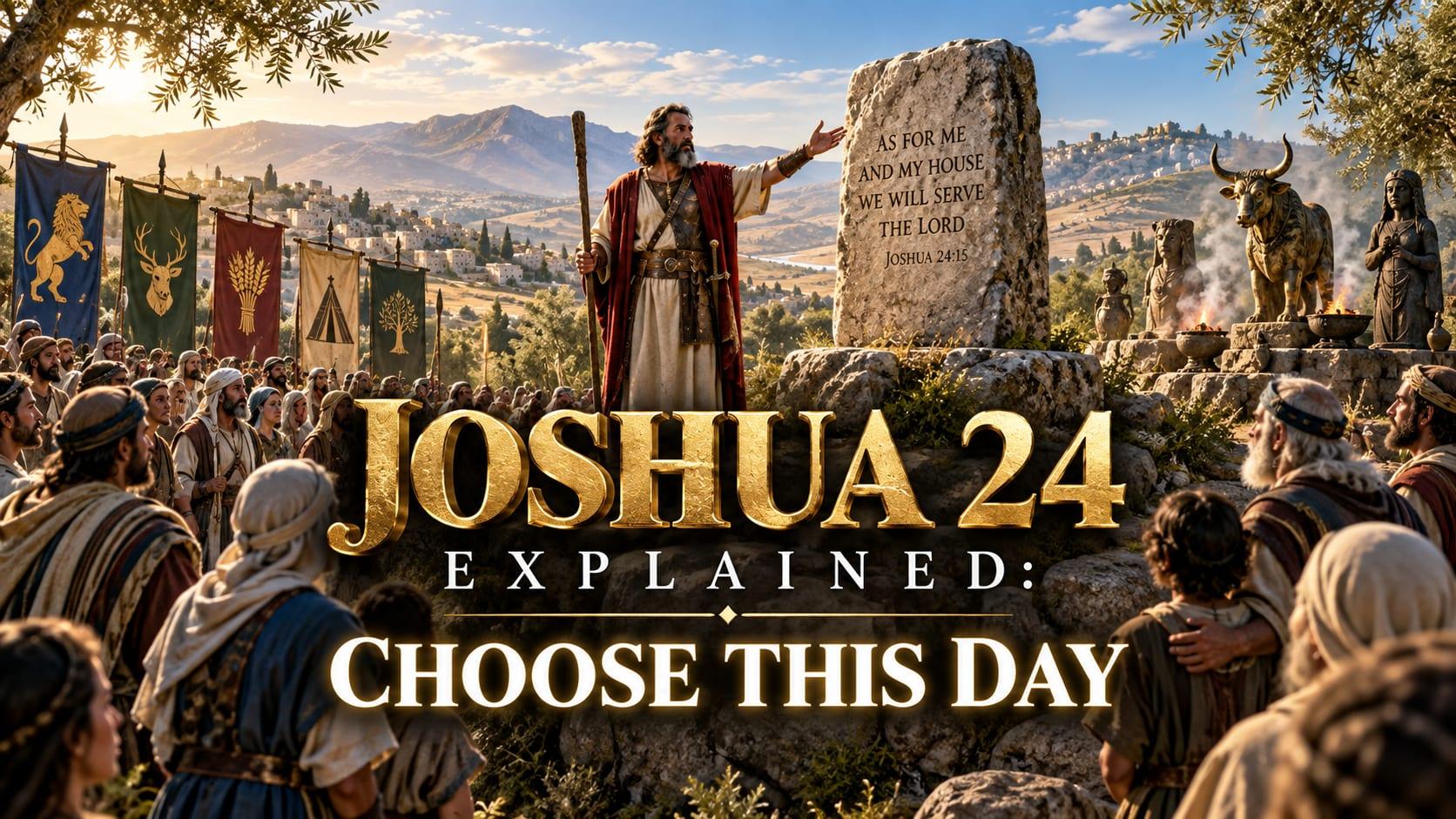
📖 Joshua 24 Explained: Choose You This Day Whom Ye Will Serve
One old man. One last gathering. One line that has outlived every king, every empire, and every generation since.
Joshua 24 explained is the final chapter of the book, and it closes the way a good story should: not with a battle, but with a choice. Joshua calls all Israel together at Shechem, lets God speak first in His own voice, then puts one question to the whole nation that still has to be answered by every person who reads it.
Maybe you have heard "choose you this day whom ye will serve" quoted so often it stopped sounding like a real decision.
- ❓ Why does God speak the whole history lesson Himself, in the first person?
- ❓ Why does Joshua seem to talk the people out of their own answer?
- ❓ Why does the chapter end with three burials instead of one celebration?
- ❓ Is this the same speech as Joshua 23, just said twice?
📌 Joshua does not ask Israel to decide whether God is faithful. He asks them to decide what they will do about a faithfulness nobody in the room can deny.
This walkthrough moves through the whole chapter in order: the wider gathering at Shechem, God retelling Israel's own story back to them, the choice Joshua forces into the open, the people's answer and Joshua's surprising pushback, the covenant sealed with a stone under an oak, and the three deaths the book closes on.
Thirty three verses, one nation's yes, and a question still waiting on every reader after it.
What Happened Just Before This Chapter
Joshua 23 was a smaller, quieter meeting. An aging Joshua called only the elders, heads, judges, and officers together and warned them that intermarriage with the nations still left in the land could undo everything the conquest had won. He told that room plainly that he was "going the way of all the earth," and that God's record of kept promises made His warnings just as certain as His blessings.
Joshua 24 is a different occasion, in a different place, with a much larger guest list. The leaders have already heard the warning. Now Joshua wants every tribe in the room to hear the same history and answer the same question for themselves, in public, where the whole nation can hear what everyone else says.

Joshua 24 Explained Verse by Verse
1. All Israel at Shechem, Not Just the Leaders (verses 1 and 2)
The chapter opens by naming both the place and the much wider crowd Joshua has called.
"And Joshua gathered all the tribes of Israel to Shechem, and called for the elders of Israel, and for their heads, and for their judges, and for their officers; and they presented themselves before God."
💡 Joshua 23:2 named four groups: elders, heads, judges, and officers. This verse names the same four groups, then adds "all the tribes of Israel" in front of them. The leadership briefing is over. This is the full assembly.
Shechem is not a random choice of location either. It is where Abraham first built an altar after arriving in Canaan, where Jacob buried his household's idols under an oak, and where Joseph's bones would end up by the chapter's own final verses. Joshua picks the one city in the land already soaked in covenant history to ask his covenant question.
Then something unusual happens. Joshua steps back, and God speaks first, in His own voice.
"And Joshua said unto all the people, Thus saith the LORD God of Israel, Your fathers dwelt on the other side of the flood in old time, even Terah, the father of Abraham, and the father of Nachor: and they served other gods."
⚠️ "The flood" here is not Noah's flood. It translates a Hebrew word for a river, almost certainly the Euphrates, the region Abraham's family came from before God called him out of it. And the very first fact God states about Israel's own ancestry is not a flattering one: Terah's household served other gods before Abraham ever left.
2. God Tells Israel Its Own Story, In the First Person (verses 3 to 13)
For eleven straight verses, God recounts Israel's entire history from Abraham to the conquest, and He never once hands the credit to Israel itself.
"And I took your father Abraham from the other side of the flood, and led him throughout all the land of Canaan, and multiplied his seed, and gave him Isaac."
"I sent Moses also and Aaron, and I plagued Egypt, according to that which I did among them: and afterward I brought you out."
📌 "I" is the subject of nearly every verb in this speech. I took. I gave. I sent. I plagued. I brought. I destroyed. I delivered. Across verses 3 through 13, the phrase "I" plus a verb appears seventeen separate times, and Israel is almost always the object of the sentence, not the subject.
The speech moves fast through Abraham's call, Isaac and Jacob, the years in Egypt, the exodus, the crossing of the Red Sea, Balaam's failed curse at Balak's hire, the Jordan crossing, and the fall of Jericho's coalition. One detail stands out for how it is told.
"And I sent the hornet before you, which drave them out from before you, even the two kings of the Amorites; but not with thy sword, nor with thy bow."
⚠️ Whatever the hornet pictures, God is careful to name what it was not. Not Israel's sword. Not Israel's bow. Some Bible teachers take it as a literal insect plague terrifying the Canaanites ahead of Israel's arrival; others read it as a figure for the fear and panic God sent before them. The text leaves the mechanism open and nails down only the point that mattered to God: it was not Israel's own weapon that won.
The whole recap lands on a single, pointed summary of what Israel actually has to show for it.
"And I have given you a land for which ye did not labour, and cities which ye built not, and ye dwell in them; of the vineyards and oliveyards which ye planted not do ye eat."
💡 Every blessing listed is something Israel is currently enjoying that it never built, planted, or earned. Before Joshua asks anyone to choose anything, God makes sure the room understands exactly what they would be choosing to walk away from.

3. Choose You This Day (verses 14 and 15)
Only after that full history lesson does Joshua turn the speech into a command, and then into a choice.
"Now therefore fear the LORD, and serve him in sincerity and in truth: and put away the gods which your fathers served on the other side of the flood, and in Egypt; and serve ye the LORD."
"And if it seem evil unto you to serve the LORD, choose you this day whom ye will serve; whether the gods which your fathers served that were on the other side of the flood, or the gods of the Amorites, in whose land ye dwell: but as for me and my house, we will serve the LORD."
📌 The word "serve," in some form, shows up sixteen times across this one chapter, and seven of those are packed into verses 14 and 15 alone. Joshua is not offering a vague spiritual preference. He is naming an action, repeatedly, until no one in the crowd can pretend they did not understand the terms.
💡 Notice that Joshua offers three real options, not two. The gods beyond the river, the gods of Egypt still lingering as a memory, and the gods of the Amorites currently surrounding them in the land. Then he answers for his own household before asking anyone else to answer for theirs.
4. The People Answer, and Joshua Pushes Back (verses 16 to 24)
The people answer fast, and their reasoning sounds exactly like the history God had just recited.
"And the people answered and said, God forbid that we should forsake the LORD, to serve other gods; For the LORD our God, he it is that brought us up and our fathers out of the land of Egypt, from the house of bondage, and which did those great signs in our sight, and preserved us in all the way wherein we went, and among all the people through whom we passed:"
That answer should settle it. Instead, Joshua does something almost no speaker trying to win a crowd would do. He argues against the very answer he asked for.
"And Joshua said unto the people, Ye cannot serve the LORD: for he is an holy God; he is a jealous God; he will not forgive your transgressions nor your sins."
⚠️ This is the hardest line in the chapter, and it is not Joshua doubting God. It is Joshua doubting how lightly the people just said yes. A promise made to a holy and jealous God is not a casual group agreement. Joshua wants them to feel the full weight of what they are about to commit to before he lets the commitment stand.
The people answer again, and Joshua presses a third time, as if testing whether the second answer was any more serious than the first.
"And the people said unto Joshua, Nay; but we will serve the LORD."
"And Joshua said unto the people, Ye are witnesses against yourselves that ye have chosen you the LORD, to serve him. And they said, We are witnesses."
📌 Joshua turns their own repeated yes into legal testimony against them. He is not trying to talk them out of the decision. He is making sure that if they ever break it, they cannot claim they were talked into something they did not understand.
Only once that is locked down does he give the final, practical instruction.
"Now therefore put away, said he, the strange gods which are among you, and incline your heart unto the LORD God of Israel."
5. A Covenant, a Stone, and an Oak (verses 25 to 28)
Joshua does not leave the agreement as spoken words alone. He writes it down and marks the spot.
"So Joshua made a covenant with the people that day, and set them a statute and an ordinance in Shechem. And Joshua wrote these words in the book of the law of God, and took a great stone, and set it up there under an oak, that was by the sanctuary of the LORD."
💡 That oak at Shechem had already held a covenant moment once before. Generations earlier, Jacob told his own household to surrender every foreign god they were carrying, and buried them under that same tree.
"And they gave unto Jacob all the strange gods which were in their hand, and all their earrings which were in their ears; and Jacob hid them under the oak which was by Shechem."
📌 One oak, two generations, the same ground used twice to bury the pull of other gods. Jacob hid idols under it. Joshua sets a witness stone under it. Both scenes happen at the exact place where Israel's family history keeps circling back to the same test.
The stone itself gets one job, stated plainly.
"And Joshua said unto all the people, Behold, this stone shall be a witness unto us; for it hath heard all the words of the LORD which he spake unto us: it shall be therefore a witness unto you, lest ye deny your God."
The word "witness" appears four times across this chapter, between the people calling themselves witnesses against their own future selves and the stone standing as a silent one. With the covenant written, witnessed, and marked, Joshua finally lets everyone go home.
"So Joshua let the people depart, every man unto his inheritance."
6. Joshua Dies, and a Generation Keeps Its Word (verses 29 to 31)
The book that opened with Joshua being told to be strong and of good courage closes with his death.
"And it came to pass after these things, that Joshua the son of Nun, the servant of the LORD, died, being an hundred and ten years old. And they buried him in the border of his inheritance in Timnathserah, which is in mount Ephraim, on the north side of the hill of Gaash."
Moses died at a hundred and twenty. Joshua dies at a hundred and ten, ten years short of the man who trained him. Scripture states both ages without comment, as simple fact, not as a ranking of the two men's standing with God.
The very next verse gives the one sentence that makes this chapter's covenant worth the ink spent on it.
"And Israel served the LORD all the days of Joshua, and all the days of the elders that overlived Joshua, and which had known all the works of the LORD, that he had done for Israel."
📌 The covenant held, but only as far as living memory lasted. As long as someone was still alive who had personally watched the Jordan stop or Jericho fall, Israel kept its word. The book of Judges picks up the same sentence almost word for word, then adds the line that turns it into a warning instead of a happy ending.
"And also all that generation were gathered unto their fathers: and there arose another generation after them, which knew not the LORD, nor yet the works which he had done for Israel."
⚠️ Joshua 24 ends on a faithful generation. Judges 2 opens on the generation right after it, already a stranger to everything the eyewitnesses had taken for granted. The stone under the oak was still standing. The people who remembered why it was there were not.

7. Two More Burials: Joseph's Bones and Eleazar (verses 32 and 33)
The book does not close with Joshua. It closes with two older, unfinished promises finally settled.
"And the bones of Joseph, which the children of Israel brought up out of Egypt, buried they in Shechem, in a parcel of ground which Jacob bought of the sons of Hamor the father of Shechem for an hundred pieces of silver: and it became the inheritance of the children of Joseph."
Joseph had made Israel swear, centuries earlier in Egypt, that his bones would not stay there. Moses carried that oath out of Egypt at the exodus, and it takes until this verse, generations later, for the promise to finally reach the ground Jacob had legally purchased for his family long before any of them needed a grave.
"God will surely visit you, and ye shall carry up my bones from hence."
📌 A promise can outlive Egypt, the wilderness, and the entire conquest, and still arrive exactly where it was supposed to. Joseph died believing a word he never saw kept in his own lifetime. Joshua 24 is the chapter where someone finally finishes carrying it.
The chapter's final verse closes a different, older line of service entirely.
"And Eleazar the son of Aaron died; and they buried him in a hill that pertained to Phinehas his son, which was given him in mount Ephraim."
Eleazar had stood beside Joshua through the entire land division, the same priest who, together with Joshua, received the Levites' request for cities. Phinehas, his son, was the same priest who had carried the accusation east over the altar by the Jordan. The book closes with the political leader, the priestly leader, and a patriarch whose bones had waited four hundred years, all finally laid to rest in the same stretch of hill country.
Hard Questions Joshua 24 Raises
Why does Joshua tell the people "ye cannot serve the LORD" right after calling them to choose to serve Him? What the text says: verse 15 commands them to choose, verses 16 to 18 have them choosing the LORD, and verse 19 then says they cannot serve Him. How this is read: Joshua is not reversing the command. He is warning that serving a holy, jealous God who will not treat sin lightly is a far heavier commitment than the crowd's quick answer suggests. The warning is meant to slow down a group decision, not to cancel it, which is why he still lets the covenant stand once they answer a second and third time.
Is Joshua 24 just a repeat of the farewell speech already given in Joshua 23? What the text says: Joshua 23:2 gathers only the elders, heads, judges, and officers; Joshua 24:1 gathers those same leaders plus "all the tribes of Israel," at a different location, Shechem rather than wherever chapter 23 was spoken. How this fits: the content overlaps because the warning is the same, but the audience and the outcome are different. Chapter 23 ends in a warning to leaders. Chapter 24 ends in a formal, written covenant that the whole nation witnesses and signs onto by their own repeated answer.
What does "the other side of the flood" mean in verses 2, 3, 14, and 15? What the text says: it describes where Terah and Abraham lived before God called Abraham into Canaan. How this is read: this is not Noah's flood. Hebrew usage elsewhere ties this phrase to the region beyond the Euphrates River, Abraham's original home in Mesopotamia, which is also why the gods named there are distinct from "the gods of the Amorites" surrounding Israel in Canaan right now.
What was the hornet God says He sent ahead of Israel in verse 12? What the text says: God sent it before them, and it drove out two Amorite kings without Israel's own sword or bow. How this is read: Bible teachers hold more than one view. Some take it as a literal insect plague terrifying Canaan ahead of Israel's arrival. Others read it as a figure of speech for the fear and confusion God sent into the land. Scripture does not settle which, and the point of the verse does not depend on settling it, only on who gets the credit.
Top Verses From Joshua 24
1. Joshua 24:15
"And if it seem evil unto you to serve the LORD, choose you this day whom ye will serve; whether the gods which your fathers served that were on the other side of the flood, or the gods of the Amorites, in whose land ye dwell: but as for me and my house, we will serve the LORD."
The most quoted line in the book, and the only verse in this chapter that uses the words "this day." Joshua answers for his own household before he ever expects an answer from anyone else's.
2. Joshua 24:13
"And I have given you a land for which ye did not labour, and cities which ye built not, and ye dwell in them; of the vineyards and oliveyards which ye planted not do ye eat."
The summary line of God's whole history lesson: every good thing Israel currently enjoys is something it never earned.
3. Joshua 24:19
"And Joshua said unto the people, Ye cannot serve the LORD: for he is an holy God; he is a jealous God; he will not forgive your transgressions nor your sins."
The verse that sounds like a contradiction until you notice it is a warning about the weight of the promise, not a withdrawal of the invitation.
4. Joshua 24:27
"And Joshua said unto all the people, Behold, this stone shall be a witness unto us; for it hath heard all the words of the LORD which he spake unto us: it shall be therefore a witness unto you, lest ye deny your God."
A physical object given the job of outlasting memory, set under the same oak where Jacob had once buried his household's idols.
5. Joshua 24:31
"And Israel served the LORD all the days of Joshua, and all the days of the elders that overlived Joshua, and which had known all the works of the LORD, that he had done for Israel."
The verse that holds, for exactly one generation, before Judges 2:10 reports the next one never knew the LORD at all.
Frequently Asked Questions About Joshua 24
What happened in Joshua 24?
Joshua gathered all the tribes of Israel at Shechem, let God recount the nation's own history from Abraham to the conquest in the first person, then called the people to choose whom they would serve. They chose the LORD three times under questioning, Joshua wrote the covenant into the book of the law and set up a witness stone, and the chapter closes with Joshua's death, Joseph's bones finally buried at Shechem, and Eleazar the priest's death.
What does "choose you this day whom ye will serve" mean?
It is Joshua's direct challenge in verse 15, naming three real alternatives: the gods Israel's ancestors served beyond the Euphrates, the gods of Egypt, or the gods of the Amorites currently in the land. Joshua answers for his own household first, then leaves the same choice open to everyone listening.
Why does God speak in the first person for so much of this chapter?
Verses 3 through 13 have God, not Joshua, recounting Israel's history, naming Himself as the one who acted again and again. Putting the credit directly in God's own words, rather than Joshua's summary of them, makes the history lesson a direct claim from God Himself before any choice is asked for.
Where is Shechem, and why does this chapter happen there?
Shechem sits in the hill country of Ephraim and already carried deep family history by this point: Abraham's first altar in Canaan, Jacob's purchase of land there, and the place Jacob once buried his household's foreign idols under an oak. Joshua chooses the one site already loaded with covenant memory to ask his covenant question.
Why does Joshua argue against the people after they already said yes?
Verse 19 warns that serving a holy and jealous God who will not treat sin lightly is a far more serious commitment than a quick group answer suggests. Joshua presses them a second and third time not to talk them out of it, but to make sure the commitment is made with full understanding before it is written down.
How old was Joshua when he died, and how does that compare to Moses?
Joshua died at a hundred and ten, stated plainly in verse 29. Moses died at a hundred and twenty. Scripture gives both numbers as simple fact, without ranking either man's standing with God by how long he lived.
Why does Joseph's burial show up at the very end of the book of Joshua?
Joseph had made Israel swear in Genesis 50:25 that his bones would leave Egypt. Moses carried that promise out at the exodus, and it is only in Joshua 24:32, generations later, that the bones finally reach the ground at Shechem Jacob had already purchased. The book closes by showing one of its oldest promises finally kept, not just the most recent one.
Does the book of Joshua end on a happy note?
Verse 31 says Israel served the LORD through Joshua's lifetime and through the elders who had personally seen God's works. That held only as long as living memory lasted. Judges 2:10 reports the very next generation growing up not knowing the LORD at all, which turns this chapter's covenant into both a genuine success and a warning about what outlives a generation and what does not.
What was the point of the great stone Joshua set up?
Verse 27 states its one job directly: to stand as a witness that had "heard all the words of the LORD," so that no one could later deny the covenant was ever made. It was set under the same oak where Jacob had once buried his family's foreign idols, the same ground doing double duty across generations.
How does Joshua 24 connect to the rest of the Bible?
It closes the story that began with Abraham's call out of the land beyond the Euphrates, ties off Joseph's four hundred year old request from Genesis 50 and Exodus 13, and hands off directly into Judges 2, which repeats this chapter's own report of Joshua's death before describing the generation that forgot everything this covenant was meant to secure.
Final Thoughts
Joshua 24 ends the book the same way it began, with a choice standing between a people and the land God already promised them.
📌 God gave the history lesson before He asked for the decision. Every verb in verses 3 through 13 belongs to Him. The choice in verse 15 is never asked of a people guessing at what God has done. It is asked of a people who were just told, in detail, exactly what He did.
📌 A quick yes is not the same as a counted cost. Joshua pressed the people a second and third time, not to shake their answer loose, but to make sure the weight of it had actually landed before he let it stand as covenant.
📌 A covenant outlives the generation that signs it only if the next one is taught to remember it. The stone under the oak stayed exactly where Joshua left it. The people who knew why it was there did not.
You were not at Shechem, but the question Joshua asked that day never closed with that generation.
So here is your one next step.
Answer Joshua 24:15 for yourself today, out loud, the way Israel had to, before you let someone else's old yes stand in for your own.