📖 Judges 1 Explained: Adonibezek, Achsah, and Israel's Unfinished Conquest
Joshua is dead. There is no new Joshua waiting in line.
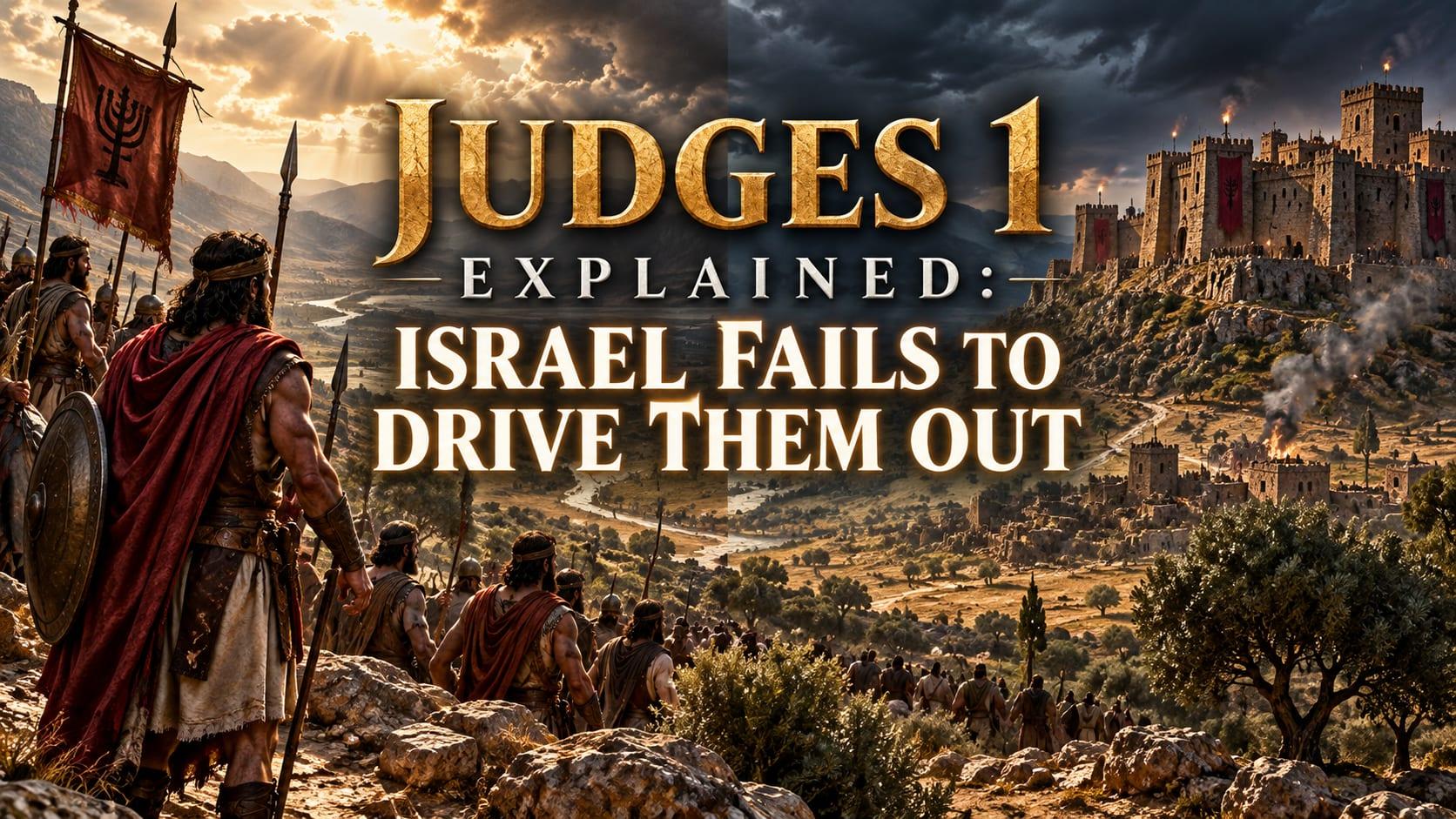
Judges 1 explained is the chapter where Israel steps into the land without a single leader to follow, and the first thing they do is exactly right. They ask the LORD who should go first. What follows is a tribe by tribe report card on the conquest, some fights won outright, one king captured and mutilated the same way he once mutilated others, a bold daughter negotiating with her own father, and a growing list of places the Canaanites never actually left.
Maybe you have started something strong, then watched it quietly stall out tribe by tribe, task by task.
- ❓ Why did Israel ask the LORD a question instead of naming a new leader?
- ❓ Who was Adonibezek, and why does his own punishment match his own crime?
- ❓ Why does a daughter get the final say in her own wedding gift?
- ❓ Why does the chapter end with seven different tribes admitting they could not finish the job?
📌 This chapter opens strong and ends honest. It does not hide how much of the land was still not Israel's to live in freely.
This walkthrough moves through the whole chapter in order: Judah and Simeon teaming up, Adonibezek caught and punished, Jerusalem burned and Hebron and Debir taken, Achsah's request for water, the one enemy even a faithful Judah could not beat, and the long list of tribes who settled for neighbors instead of a cleared land.
Thirty six verses, and the whole rest of the book of Judges is already visible inside them.
What Happened Just Before This Chapter
Joshua 24 closed the previous book with a covenant at Shechem, a witness stone under an oak, and three burials: Joshua himself, Joseph's bones finally laid to rest, and Eleazar the priest. Israel had just answered "choose you this day whom ye will serve" with a loud yes, repeated three times.
That same chapter already named the danger waiting on the other side of the yes. Joshua had warned that marrying into the nations still left in the land could undo everything the conquest had won. Judges 1 opens on the generation that has to actually live out that warning, with the one man who had led every campaign since the Jordan now gone.

Judges 1 Explained Verse by Verse
1. Israel Asks the LORD, and Judah Partners With Simeon (verses 1 to 4)
The book opens on a question, asked the right way, before a single sword is raised.
"Now after the death of Joshua it came to pass, that the children of Israel asked the LORD, saying, Who shall go up for us against the Canaanites first, to fight against them? And the LORD said, Judah shall go up: behold, I have delivered the land into his hand."
📌 No leader stands at the front of this chapter the way Moses and Joshua once did. The whole nation asks God directly, and God answers directly. That pattern, no single king, no permanent judge over everyone, is the shape the rest of this book will take, with God raising up one deliverer at a time rather than one continuous ruler.
Judah does not go alone. The very next verse has one tribe leaning on another.
"And Judah said unto Simeon his brother, Come up with me into my lot, that we may fight against the Canaanites; and I likewise will go with thee into thy lot. So Simeon went with him."
💡 Simeon's own territory sat inside Judah's borders, so this partnership was not charity. It was two tribes whose land overlapped, choosing to fight together instead of separately. The pairing holds, and it pays off fast.
"And Judah went up; and the LORD delivered the Canaanites and the Perizzites into their hand: and they slew of them in Bezek ten thousand men."
2. Adonibezek and the Punishment That Matches the Crime (verses 5 to 7)
The victory at Bezek has a named survivor, and what happens to him is the single most vivid moment in the chapter.
"But Adonibezek fled; and they pursued after him, and caught him, and cut off his thumbs and his great toes. And Adonibezek said, Threescore and ten kings, having their thumbs and their great toes cut off, gathered their meat under my table: as I have done, so God hath requited me. And they brought him to Jerusalem, and there he died."
⚠️ Cutting off a man's thumbs and big toes was not random cruelty. Without thumbs he could never grip a sword or bow again. Without big toes he could never stand firm in battle again. It ended a man as a warrior and a king without ending his life, the same humiliation Adonibezek admits he had already done to seventy kings of his own, keeping them alive just to grovel under his table for scraps.
📌 Notice whose words those are. "So God hath requited me" is Adonibezek talking, not the text announcing God's verdict. Judah's men acted in battle; Scripture reports what the defeated king said about his own fate. The chapter records the irony without pausing to call it a model for how Israel should treat every enemy going forward.
3. Jerusalem Burned, Hebron and Debir Taken, and Achsah's Bold Request (verses 8 to 15)
Judah keeps moving, and the first city named is one that will matter for the rest of the Bible.
"Now the children of Judah had fought against Jerusalem, and had taken it, and smitten it with the edge of the sword, and set the city on fire."
That victory does not stick. Hold that detail. It matters again before this chapter is finished.
Judah presses south into Hebron and Debir, and here the chapter pauses to retell a story that readers of Joshua 15 have already seen once, because Caleb had been promised this exact ground decades earlier for standing alone in faith at Kadeshbarnea.
"And Caleb said, He that smiteth Kirjathsepher, and taketh it, to him will I give Achsah my daughter to wife."
"And Othniel the son of Kenaz, Caleb's younger brother, took it: and he gave him Achsah his daughter to wife."
💡 Judges 1 tells this episode in fewer words than Joshua 15 did, but it adds the one detail every reader remembers. Once Othniel wins Achsah, she does not sit back and accept whatever comes.
"And it came to pass, when she came to him, that she moved him to ask of her father a field: and she lighted from off her ass; and Caleb said unto her, What wilt thou?"
"And she said unto him, Give me a blessing: for thou hast given me a south land; give me also springs of water. And Caleb gave her the upper springs and the nether springs."
📌 Caleb asks her a direct question, "What wilt thou," and Achsah has a direct answer ready. A south land without water is a hard inheritance. She names the exact gap and gets both springs before the conversation ends. She is handed off in marriage by a father's pledge, and she still negotiates her own future the moment she has the chance.

4. Hormah Destroyed, and the One Enemy Judah Could Not Beat (verses 16 to 19)
Before the chapter turns to a long list of setbacks, Judah and Simeon post one more clean win, and the name of the city tells you exactly what happened there.
"And Judah went with Simeon his brother, and they slew the Canaanites that inhabited Zephath, and utterly destroyed it. And the name of the city was called Hormah."
💡 The verse names the action, "utterly destroyed," right next to the new name, Hormah. The city's name became its own record of what happened there, the same way Jacob's wrestling match renamed a place Peniel. Then comes the verse that keeps this chapter honest.
"And the LORD was with Judah; and he drave out the inhabitants of the mountain; but could not drive out the inhabitants of the valley, because they had chariots of iron."
⚠️ This is the strongest tribe in the chapter, with the LORD named as being on their side, and the verse still ends in could not. Judah is not accused of unbelief here the way later chapters of Judges accuse other tribes. The verse simply states the outcome: the valley stayed out of reach, and iron chariots are the stated reason.
5. Jerusalem Revisited, and a Spy's Mercy Deal at Bethel (verses 20 to 26)
Hebron is confirmed as Caleb's, exactly as Moses had promised him. Then the chapter returns to the city it already told you was burned.
"And the children of Benjamin did not drive out the Jebusites that inhabited Jerusalem; but the Jebusites dwell with the children of Benjamin in Jerusalem unto this day."
📌 Verse 8 said Judah took Jerusalem and burned it. Verse 21 says Benjamin never drove the Jebusites out of it. Both can be true at once. Jerusalem sat right on the border between the two tribes, and a city struck hard in one raid is not the same as a city permanently held and resettled. The Jebusites stayed, or came back, and Jerusalem would not be fully Israel's to live in freely until David took it generations later.
The house of Joseph, Ephraim and Manasseh together, has its own moment up north at Bethel, and it plays out almost exactly like a story readers of Joshua 2 already know by heart.
"And the spies saw a man come forth out of the city, and they said unto him, Shew us, we pray thee, the entrance into the city, and we will shew thee mercy."
"And when he shewed them the entrance into the city, they smote the city with the edge of the sword; but they let go the man and all his family."
💡 A city about to fall, a promise of mercy for information, and a family spared while the city itself is struck down. Rahab at least got her name remembered. This man from Bethel never does, only the deal he struck. But the same mercy for information arrangement shows up a second time, which means Jericho was not a one time exception to how Israel treated someone willing to help them.

6. The Long List of What Every Other Tribe Left Undone (verses 27 to 36)
The chapter spends its final ten verses on a single repeated sentence, tribe after tribe, and the repetition is the point.
"Neither did Manasseh drive out the inhabitants of Bethshean and her towns, nor Taanach and her towns, nor the inhabitants of Dor and her towns, nor the inhabitants of Ibleam and her towns, nor the inhabitants of Megiddo and her towns: but the Canaanites would dwell in that land."
Manasseh is only the first name on the list. Count them and the pattern is impossible to miss.
- 👀 Benjamin did not drive out the Jebusites in Jerusalem (verse 21).
- 👀 Manasseh did not drive out five named towns and their people (verse 27).
- 👀 Ephraim did not drive out the Canaanites in Gezer (verse 29).
- 👀 Zebulun did not drive out Kitron or Nahalol (verse 30).
- 👀 Asher did not drive out seven named towns of Canaanites (verse 31).
- 👀 Naphtali did not drive out Bethshemesh or Bethanath (verse 33).
- 👀 Dan could not even come down from the mountain into its own valley (verses 34 and 35).
📌 Seven tribes, named one at a time, each failing to finish the exact job Joshua had already warned them about. Verse 28 explains what actually happened instead of a clean conquest: Israel grew strong enough to tax the Canaanites rather than remove them, trading obedience for convenience.
Dan's entry closes the chapter on its weakest note.
"And the Amorites forced the children of Dan into the mountain: for they would not suffer them to come down to the valley:"
"But the Amorites would dwell in mount Heres in Aijalon, and in Shaalbim: yet the hand of the house of Joseph prevailed, so that they became tributaries."
⚠️ Every other tribe in this list at least holds its ground and makes the Canaanites pay tribute. Dan is the only tribe pushed backward, forced uphill by its enemies rather than the other way around. The chapter ends on that image, a tribe squeezed into the hills, with no victory verse to soften it.
Hard Questions Judges 1 Raises
Why does Israel ask the LORD a question in verse 1 instead of appointing a new leader the way Moses appointed Joshua? What the text says: the children of Israel ask the LORD directly who should fight first, and the LORD answers directly, naming Judah. How this fits the rest of the book: Judges never installs one continuous ruler over the whole nation the way Moses and Joshua once led. Instead it raises up deliverers one at a time, as needed. This opening question is the first sign of that shift, God speaking straight to the nation rather than through one named successor.
Does Adonibezek's line, "so God hath requited me," mean God approved of cutting off his thumbs and toes as proper justice? What the text says: verse 7 records those words coming from Adonibezek himself, after Judah's men had already caught and mutilated him. How this is read: the verse reports what the defeated king said about his own fate, not a divine ruling on the method. The chapter notes the irony, that he did this to seventy kings and now has it done to him, without holding up the act itself as a command for how Israel should treat every future enemy.
Verse 8 says Judah took and burned Jerusalem. Verse 21 says the Jebusites still lived there with Benjamin. Which one is true? What the text says: both, in the same chapter. How this fits: a city struck hard in one raid is not the same as a city permanently garrisoned and resettled. Jerusalem sat on the border claimed by both Judah and Benjamin, and the Jebusites either survived the attack in part or returned afterward. The city did not come under lasting Israelite control until David captured it generations later, which is exactly why this verse can say "unto this day" the Jebusites were still there.
Was it right for Caleb to offer his daughter Achsah as a prize for whoever conquered Kirjathsepher? What the text says: verse 12 has Caleb making the offer before the city falls; verses 14 and 15 then show Achsah herself speaking up and winning springs of water from her own father. How this is read: arranged marriage by a father's pledge was the ordinary custom of the time, not a sign Achsah had no voice. The very next verses give her the loudest voice in the whole episode, asking for exactly what she needs and getting it.

Top Verses From Judges 1
1. Judges 1:1 and 2
"Now after the death of Joshua it came to pass, that the children of Israel asked the LORD, saying, Who shall go up for us against the Canaanites first, to fight against them? And the LORD said, Judah shall go up: behold, I have delivered the land into his hand."
The whole book of Judges opens with a question asked the right way, straight to God, before a single step is taken without Him.
2. Judges 1:7
"And Adonibezek said, Threescore and ten kings, having their thumbs and their great toes cut off, gathered their meat under my table: as I have done, so God hath requited me."
A defeated king naming the exact shape of his own cruelty returning to him, seventy kings for seventy kings, in his own words.
3. Judges 1:19
"And the LORD was with Judah; and he drave out the inhabitants of the mountain; but could not drive out the inhabitants of the valley, because they had chariots of iron."
The most honest verse in the chapter. Even the strongest tribe, with the LORD named as being on their side, still comes up short against the valley.
4. Judges 1:28
"And it came to pass, when Israel was strong, that they put the Canaanites to tribute, and did not utterly drive them out."
The verse that explains the whole second half of the chapter. Strength did not become obedience. It became a comfortable arrangement instead.
5. Judges 1:34
"And the Amorites forced the children of Dan into the mountain: for they would not suffer them to come down to the valley:"
The chapter's lowest point. Every other tribe at least holds ground. Dan is pushed backward by the very people it was supposed to drive out.
Frequently Asked Questions About Judges 1
What happened in Judges 1?
Israel asked the LORD who should fight the Canaanites first after Joshua's death, and He named Judah. Judah and Simeon won several battles together, including the capture of Adonibezek, Jerusalem, Hebron, and Debir. The chapter then turns to a long list of tribes, Benjamin, Manasseh, Ephraim, Zebulun, Asher, Naphtali, and Dan, that each failed to fully drive the Canaanites out of their assigned territory.
Why does the book of Judges open with Israel asking the LORD a question?
Verse 1 shows the nation going directly to God the moment it lost its single leader, Joshua. It sets the tone for the rest of the book, where God raises up individual deliverers rather than one continuous ruler over all Israel.
Who was Adonibezek, and why were his thumbs and toes cut off?
Adonibezek was a Canaanite king captured after the battle at Bezek. Verses 6 and 7 record Judah cutting off his thumbs and great toes, ending his ability to fight or stand firm as a warrior, the same humiliation he admits he had already inflicted on seventy other kings.
Why did Caleb offer his daughter Achsah as a reward for conquering a city?
Verse 12 reflects the marriage customs of the time, where a father arranged a daughter's marriage. Verses 14 and 15 balance that out by showing Achsah herself boldly asking her father for springs of water and receiving them, far from a silent bystander in her own story.
Does Judges 1:19 mean God could not defeat chariots of iron?
The verse states plainly that Judah, with the LORD on their side, still could not drive out the valley because of iron chariots. The text records the outcome honestly rather than explaining it away, leaving the tension exactly where the original writer left it.
How can Judah have burned Jerusalem in verse 8 if the Jebusites were still there in verse 21?
Jerusalem sat on the border of Judah and Benjamin's territory. A single successful raid, which verse 8 describes, is not the same as permanent control. The Jebusites remained or returned, and the city was not fully secured by Israel until David's conquest generations later.
Why does Judges 1 list so many tribes that failed to drive out the Canaanites?
Benjamin, Manasseh, Ephraim, Zebulun, Asher, Naphtali, and Dan each get a verse naming exactly what they left undone. The repetition builds the case for everything the rest of the book of Judges goes on to describe, a nation living alongside the very influences it was warned to remove.
What is the difference between the Achsah story in Joshua 15 and Judges 1?
Both passages record the same event in nearly identical wording, Caleb's offer, Othniel's victory, and Achsah's request. Judges 1 repeats it here because this chapter is retelling the conquest from the perspective of what each tribe accomplished and failed to accomplish once Joshua was gone, not introducing a new event.
Who was the man from Bethel who helped the Israelite spies?
Verses 24 and 25 never name him. He showed the house of Joseph the way into the city in exchange for mercy toward himself and his family, a smaller echo of the deal Rahab struck with Israel's spies at Jericho.
How does Judges 1 set up the rest of the book?
The unfinished conquest described here, Canaanites still living among nearly every tribe, is the exact condition the next chapter traces straight back to a broken covenant, and the exact condition that makes the cycles of the whole book of Judges possible in the first place.
Final Thoughts
Judges 1 starts with a question asked the right way and ends with a list of jobs left undone.
📌 Asking first is not the same as finishing well. Israel went to God before Judah ever marched, and that did not stop seven different tribes from settling for tribute instead of full obedience by the chapter's end.
📌 Even real faith met a real limit. Judah had the LORD with them and still could not take the valley. The chapter does not hide that, and it does not need to explain it away.
📌 What one generation leaves standing, the next one lives next to. Every Canaanite city named here as undriven out becomes a neighbor, and the book of Judges spends the rest of its chapters showing what that neighbor cost.
You probably are not driving Canaanites out of a valley this week. But you likely have your own unfinished list, the thing you started strong and then quietly let stay.
So here is your one next step.
Name one thing on your own list you have been taxing instead of actually removing, and finish it this week.