📖 Joshua 23 Explained: The Warning Joshua Gave Before He Died
The wars are over. The land is divided. And the man who led both just called everyone back together one more time.
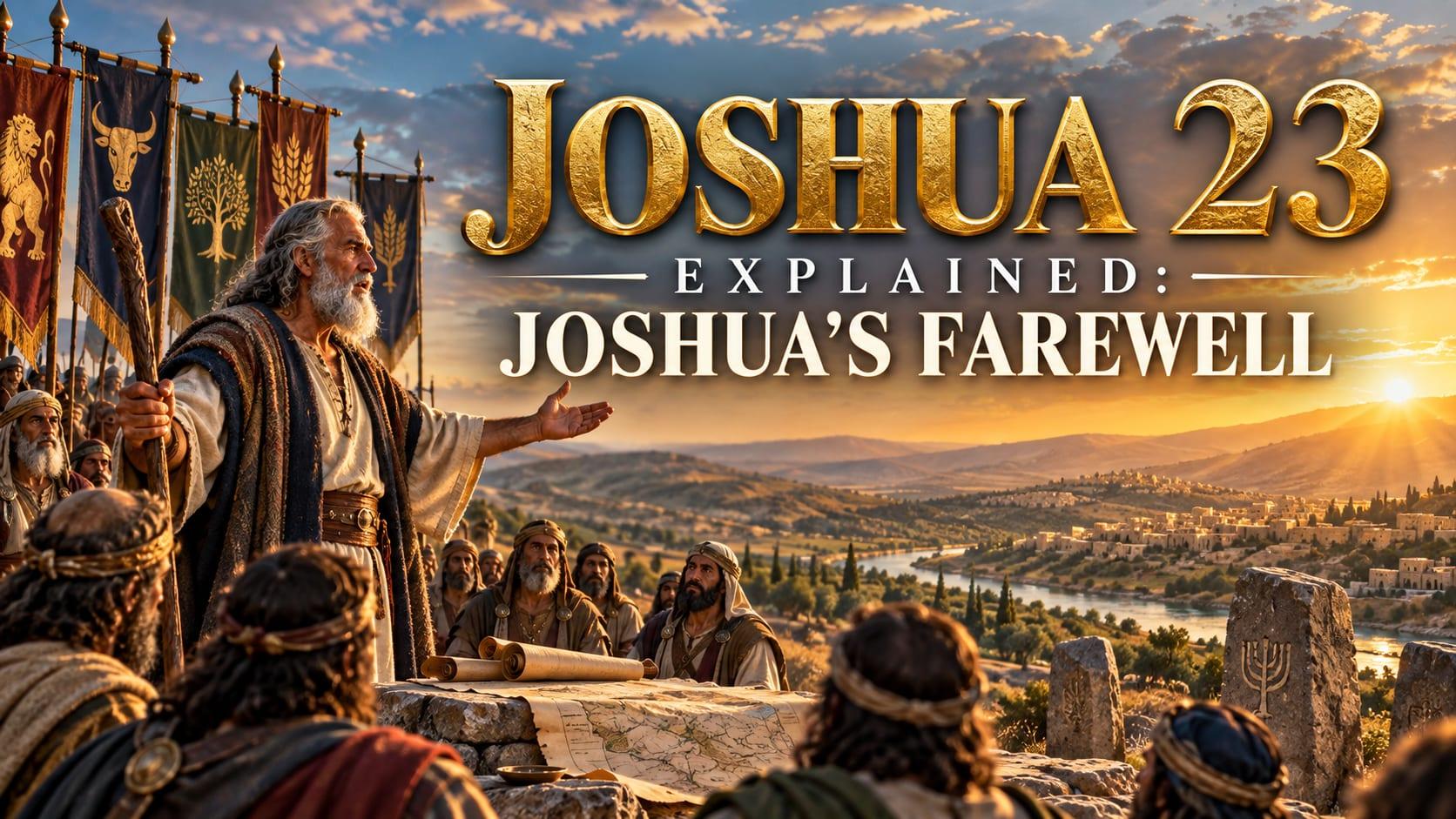
Joshua 23 explained is Joshua's first farewell speech, given to Israel's elders, heads, judges, and officers while he is still alive but "old and stricken in age." He is not handing out any more land here. He is handing out a warning, built entirely on what he has already watched God do with his own eyes.
Maybe you have reached a point in life where you finally have time to say the thing you have been meaning to say for years.
- ❓ Why gather the leaders here, when a second farewell gathers everyone in the next chapter?
- ❓ Why does a single surviving neighbor worry Joshua more than any army ever did?
- ❓ What does "the way of all the earth" actually mean?
- ❓ How can the exact same God who kept every promise also threaten every curse?
📌 Joshua spends his last public words pointing backward at a record nobody in that room could argue with, then uses it to warn about a future none of them had seen yet.
This walkthrough moves through the whole chapter in order: Joshua calling the leaders together, the victories he credits entirely to the LORD, the charge to cleave to the law instead of the nations still living among them, the one specific danger that could undo everything, and the farewell line that ties God's past faithfulness to a warning about the future.
Sixteen verses, one old man's last public word, and a warning still worth hearing.
What Happened Just Before This Chapter
Joshua 22 ended with a near war that never happened. Reuben, Gad, and the half tribe of Manasseh went home east of the Jordan, Israel almost attacked them over a misunderstood altar, and the whole nation stepped back from the edge once Phinehas heard the truth. The land division that had filled chapters 13 through 21 was finished. Every tribe had ground to call its own.
Joshua 23 opens with no new conquest and no new boundary. Time has simply passed. The man who led Israel across the Jordan and through every campaign since is now old, and he knows exactly what that means for how much longer he has left to speak.

Joshua 23 Explained Verse by Verse
1. An Old Man Calls the Leaders Together (verses 1 and 2)
The chapter opens by naming exactly who Joshua gathers, and it is not the whole nation.
"And it came to pass a long time after that the LORD had given rest unto Israel from all their enemies round about, that Joshua waxed old and stricken in age. And Joshua called for all Israel, and for their elders, and for their heads, and for their judges, and for their officers, and said unto them, I am old and stricken in age:"
📌 Joshua names his own age twice in two verses, and he does it before he says anything else. This is not a man hiding how little time he has left. He wants that fact sitting in the room while he talks, because it is the whole reason the room has been called together.
The audience is elders, heads, judges, and officers, the leadership structure of the nation rather than every household in Israel. A second gathering, with a much wider guest list, is still ahead. This one belongs to the men who will have to carry Joshua's words forward once he is gone.
2. What the LORD Has Already Done, in Plain Sight (verses 3 to 5)
Before Joshua asks anything of them, he reminds them of something they do not need to take on faith.
"And ye have seen all that the LORD your God hath done unto all these nations because of you; for the LORD your God is he that hath fought for you."
💡 "Ye have seen" is the whole weight of the sentence. Joshua is not telling them a story from his own memory that they have to trust secondhand. Every person in that room watched walled cities fall and five kings scatter. The evidence is their own eyes, not his word for it.
He then credits the result to the only one who actually deserves it, twice over.
"And the LORD your God, he shall expel them from before you, and drive them from out of your sight; and ye shall possess their land, as the LORD your God hath promised unto you."
📌 Even the land they have not yet fully cleared out, Joshua still says the LORD will finish driving out. He is not describing a closed case. He is describing an ongoing promise that still has ground left to cover, the same unfinished edge God had already told Joshua about at the very start of this book.
3. Be Very Courageous: Cleave to the Law, Not the Nations (verses 6 to 8)
Only after that reminder does Joshua give the first real command of the speech.
"Be ye therefore very courageous to keep and to do all that is written in the book of the law of Moses, that ye turn not aside therefrom to the right hand or to the left;"
💡 Courage here has nothing to do with a battlefield. It is the courage to keep obeying a written law once the fighting is finished and the pressure to compromise quietly sets in instead. This is the same charge Moses already gave Joshua before his own death in Deuteronomy 31, now passed down a generation.
Joshua spells out exactly what staying faithful looks like in practice.
"That ye come not among these nations, these that remain among you; neither make mention of the name of their gods, nor cause to swear by them, neither serve them, nor bow yourselves unto them: But cleave unto the LORD your God, as ye have done unto this day."
⚠️ Four separate verbs describe the slide away from God: come among, mention their gods, swear by them, serve them. Joshua lists it as a sequence, not a single event, because that is how it actually happens. Nobody wakes up bowing to an idol. They drift there one small association at a time.

4. One Man of You Shall Chase a Thousand (verses 9 to 11)
Joshua returns to the evidence one more time, and this time he puts a number on it.
"For the LORD hath driven out from before you great nations and strong: but as for you, no man hath been able to stand before you unto this day. One man of you shall chase a thousand: for the LORD your God, he it is that fighteth for you, as he hath promised you."
📌 One against a thousand is not a boast about Israelite soldiers. It is Joshua's way of saying the math never added up unless the LORD was the one doing the fighting. No army wins at those odds on skill alone. The whole conquest only makes sense as a record of what God did, which is exactly the point Joshua keeps circling back to before he asks for anything.
Only now, after three separate reminders of what they have already seen, does he narrow the command down to one sentence.
"Take good heed therefore unto yourselves, that ye love the LORD your God."
💡 Everything before this verse was evidence. Everything after it is consequence. Verse 11 is the hinge the whole speech turns on, and it reduces obedience to the law, courage in battle, and refusing foreign gods down to a single root: love for the LORD, not a checklist kept for its own sake.
5. The One Door Back Into Danger (verses 12 and 13)
Joshua then names the single specific way all of this could still unravel.
"Else if ye do in any wise go back, and cleave unto the remnant of these nations, even these that remain among you, and shall make marriages with them, and go in unto them, and they to you: Know for a certainty that the LORD your God will no more drive out any of these nations from before you; but they shall be snares and traps unto you, and scourges in your sides, and thorns in your eyes, until ye perish from off this good land which the LORD your God hath given you."
⚠️ Intermarriage with the surviving nations is the single danger Joshua spells out by name. Not another war. Not a famine. A quiet family connection with neighbors who still served other gods, made one household at a time, long after every battle had already been won.
The images he reaches for, snares, traps, scourges, and thorns, describe something small and constant rather than one dramatic disaster. A thorn does not kill in a single moment. It wears a person down, every single day, for as long as it stays in.
6. "I Am Going the Way of All the Earth" (verse 14)
Joshua finally says out loud what the first two verses had already implied.
"And, behold, this day I am going the way of all the earth: and ye know in all your hearts and in all your souls, that not one thing hath failed of all the good things which the LORD your God spake concerning you; all are come to pass unto you, and not one thing hath failed thereof."
💡 "The way of all the earth" is a plain, unafraid way of saying death. Joshua does not dress it up or avoid naming it. He states it in the same breath as the only other claim he wants them to carry away from the whole speech: that God's word to them has never once come up short.
📌 He puts his own coming death right next to God's unbroken record on purpose. Joshua is leaving. The promises he is leaving behind are not.

7. Good Things Kept in Full, Evil Things Just as Sure (verses 15 and 16)
Joshua closes with the argument the whole chapter has been building toward.
"Therefore it shall come to pass, that as all good things are come upon you, which the LORD your God promised you; so shall the LORD bring upon you all evil things, until he have destroyed you from off this good land which the LORD your God hath given you. When ye have transgressed the covenant of the LORD your God, which he commanded you, and have gone and served other gods, and bowed yourselves to them; then shall the anger of the LORD be kindled against you, and ye shall perish quickly from off the good land which he hath given unto you."
📌 Joshua does not treat blessing and judgment as two different kinds of promise. He treats them as the same promise, aimed in two directions. The very reliability that delivered every good thing in verse 14 is the reason the warning in verses 15 and 16 cannot be dismissed as an empty threat. A God who keeps His word does not stop being that God the moment the word is a warning instead of a gift.
Hard Questions Joshua 23 Raises
Why does Joshua treat marrying into the remaining nations as more dangerous than any army Israel fought? What the text says: verse 12 names intermarriage with the surviving nations as the one thing that would undo everything, while verses 9 and 10 describe Israel defeating far greater armies without difficulty. How this is read: a battle is won or lost in a day, in plain view, with everyone aware of the stakes. A marriage brings a different household's gods into daily life quietly, year after year, with no single moment that announces itself as the turning point. The danger Joshua warns about is not strength. It is what gets absorbed without anyone noticing.
Does this warning condemn every marriage between an Israelite and someone from another nation? What the text says: verse 12 specifically targets marriage with "the remnant of these nations, even these that remain among you," the Canaanite peoples still clinging to their own gods in the land Israel had just taken. How this fits the rest of Scripture: later figures like Rahab and Ruth, both foreign born, are welcomed into Israel after turning to the LORD themselves. The concern in Joshua 23 was never ancestry. It was continuing loyalty to other gods, which is exactly what Rahab and Ruth had already left behind before either one became part of the nation's own story.
Why does Joshua anchor a warning about a future nobody has seen yet to a record everybody has already watched? What the text says: verse 14 states that not one good thing God promised had failed, and verses 15 and 16 immediately use that same track record to say the warned evil would be just as certain. How this is read: Joshua is not asking the leaders to trust a new and untested claim. He is asking them to apply the only standard they have direct evidence for, God's consistency, to a promise they have not yet had to test. If the good half of God's word held without exception, the warning half carries the same weight, not a lesser one.
Why gather the leaders here if a wider farewell to the whole nation is still ahead in the next chapter? What the text says: verse 2 names elders, heads, judges, and officers, while the opening of the next chapter explicitly calls together all the tribes of Israel at a different location. How this fits: Joshua 23 reads as a leadership briefing, aimed at the men who will have to keep enforcing this charge long after he is gone, before the fuller public ceremony that follows it. One farewell was not enough for everything an aging leader needed to say before "the way of all the earth" caught up with him.

Top Verses From Joshua 23
1. Joshua 23:14
"And, behold, this day I am going the way of all the earth: and ye know in all your hearts and in all your souls, that not one thing hath failed of all the good things which the LORD your God spake concerning you; all are come to pass unto you, and not one thing hath failed thereof."
Joshua's own death stated plainly, placed deliberately beside the one claim he most wants remembered: God's word to Israel never once came up short.
2. Joshua 23:6
"Be ye therefore very courageous to keep and to do all that is written in the book of the law of Moses, that ye turn not aside therefrom to the right hand or to the left;"
Courage redefined for a generation whose wars are finished. The hardest fight left is staying obedient once no one is watching and nothing is forcing the issue.
3. Joshua 23:10
"One man of you shall chase a thousand: for the LORD your God, he it is that fighteth for you, as he hath promised you."
A ratio no army wins by skill alone, offered as living proof that the conquest was never really about Israel's own strength.
4. Joshua 23:13
"Know for a certainty that the LORD your God will no more drive out any of these nations from before you; but they shall be snares and traps unto you, and scourges in your sides, and thorns in your eyes, until ye perish from off this good land which the LORD your God hath given you."
The cost of compromise described as something slow and constant rather than sudden, the kind of danger easy to underestimate precisely because it never arrives all at once.
Frequently Asked Questions About Joshua 23
What happened in Joshua 23?
An aging Joshua called Israel's elders, heads, judges, and officers together for a farewell speech. He reminded them that the LORD alone had defeated every nation before them, charged them to keep the law and avoid the gods of the nations still remaining in the land, warned that marrying into those nations would undo everything, and tied his own approaching death to God's unbroken record of kept promises.
Who was Joshua speaking to in this chapter?
Verse 2 names the audience specifically: elders, heads, judges, and officers, the leadership of the nation rather than every household in Israel. A broader gathering of all the tribes follows in the next chapter.
What does "the way of all the earth" mean in Joshua 23:14?
It is a plain way of saying death, the one path every person on earth eventually walks. Joshua states it without softening it, then uses the same verse to make his real point about God's faithfulness.
Why was intermarriage with the remaining nations such a serious warning?
Verse 12 ties the danger directly to the nations that still served other gods. A marriage brought a different household's worship into daily Israelite life, a slower and quieter threat than any battlefield, which is exactly why Joshua singles it out by name.
Does Joshua 23 mean God stopped helping Israel take the rest of the land?
No. Verse 5 still describes the LORD expelling the remaining nations as an ongoing promise, not a finished one. The chapter assumes unfinished ground still exists and calls Israel to faithfulness while that process continues.
Is Joshua 23 the same speech as Joshua 24?
No. Joshua 23 addresses the nation's leaders. The chapter that follows opens with Joshua gathering all the tribes at a different location for a wider ceremony. Both are farewell addresses from the same final period of Joshua's life, but they are two separate occasions.
What is the main command in Joshua 23?
Verse 11 states it directly: take good heed to yourselves, that you love the LORD your God. Every other instruction in the chapter, courage, obedience to the law, avoiding foreign gods, flows out of that one command rather than standing beside it as a separate rule.
How does Joshua 23 connect to the rest of the Bible?
It mirrors Moses charging Joshua before his own death in Deuteronomy 31, and it leans on the same warning Moses had already given about the remaining nations becoming a snare in Deuteronomy 7. The blessing and curse pattern in verses 15 and 16 also echoes the choice Moses laid out for the whole nation before they ever crossed the Jordan.
Did Israel listen to Joshua's warning?
Not fully. The book of Judges records exactly the pattern Joshua warned against: intermarriage with the remaining nations, adopting their gods, and the trouble that followed, which makes this farewell speech read less like a formality and more like a warning that history went on to confirm.
Final Thoughts
Joshua 23 is a short chapter, but it carries the full weight of a man who knows this is one of his last chances to be heard.
📌 Evidence came before instruction. Joshua did not ask Israel's leaders to trust him blindly. He pointed at victories they had personally watched before he ever told them what to do next.
📌 The real danger was never the army left standing. It was the neighbor left close. One quiet family connection worried Joshua more than any battle he had already won, because it could undo the victory from the inside, one household at a time.
📌 A God reliable enough to keep every good promise is reliable enough to keep every warning. Joshua refused to let Israel take comfort in half of God's record while ignoring the other half.
You are not standing where Israel's leaders stood, but you likely have your own version of a remaining nation, some small compromise still living quietly inside an otherwise faithful life.
So here is your one next step.
Name whatever that compromise is honestly today, before it has decades to wear you down the way Joshua warned it would.