📖 Leviticus 14 Explained: Cleansing a Healed Leper and a Leprous House
A man has been living outside the camp for weeks, maybe months. Then one morning the mark on his skin is just gone.
Leviticus 14 explained is the chapter that answers the question Leviticus 13 never had to ask. That chapter only diagnosed. This one brings someone back. A healed leper does not simply walk back into camp once the mark fades. He meets the priest outside the gate first, waits eight full days, and is washed with the blood of one bird and the sight of a second one flying free before he is ever called clean again. Then the chapter turns and runs almost the identical process on a house.
Maybe you have skimmed this chapter and only remembered it as more leprosy rules.
- ❓ Why does one bird die while a second one gets set loose alive?
- ❓ Why does a healed leper get blood on his ear, thumb, and toe, the exact spots a priest does?
- ❓ Why would God ever command someone to tear their own house down?
- ❓ And why does this chapter bother making room for a man who is poor?
📌 Leviticus 14 is not a second diagnosis. It is a homecoming, and it costs something every single time.
This walkthrough goes through the whole chapter in order: the priest stepping outside the camp to meet the healed man, the two birds and the seven day wait, the eighth day offering that touches his ear, hand, and foot with blood and then with oil, the exception written in for a man too poor to afford the full offering, and the matching process run all over again when the plague is found growing in the walls of a house.
Read slowly. Restoration here is never cheap, and it is never halfway.
What Happened Just Before This Chapter
Leviticus 13 spent fifty nine verses teaching the priest to tell active, spreading disease from a mark that only looked dangerous. It ended with a leper shut outside the camp, crying "unclean, unclean" as a warning to anyone nearby, for as long as the plague remained on him.
Leviticus 14 picks up at the one moment that chapter never reached: the plague is gone. The mark has healed. But healing alone was never enough to walk back through the gate. Somebody still had to confirm it, and then a process begins that the camp outside never saw coming, one built on sacrifice rather than a simple inspection.

Leviticus 14 Explained Verse by Verse
1. The Priest Goes Out to Him (verses 1 to 7)
The chapter opens with a detail easy to read past. The leper does not come to the priest. The priest goes to him.
"And the LORD spake unto Moses, saying, This shall be the law of the leper in the day of his cleansing: He shall be brought unto the priest: And the priest shall go forth out of the camp; and the priest shall look, and, behold, if the plague of leprosy be healed in the leper;"
📌 The man who was shut outside the camp is still outside the camp. The priest is the one who crosses the line to reach him. Nothing in the chapter waives that boundary until the full process is finished, yet the priest does not make the leper wait for an invitation to come closer. He walks out first.
Once the healing is confirmed, the ritual that follows is unlike anything earlier in Leviticus.
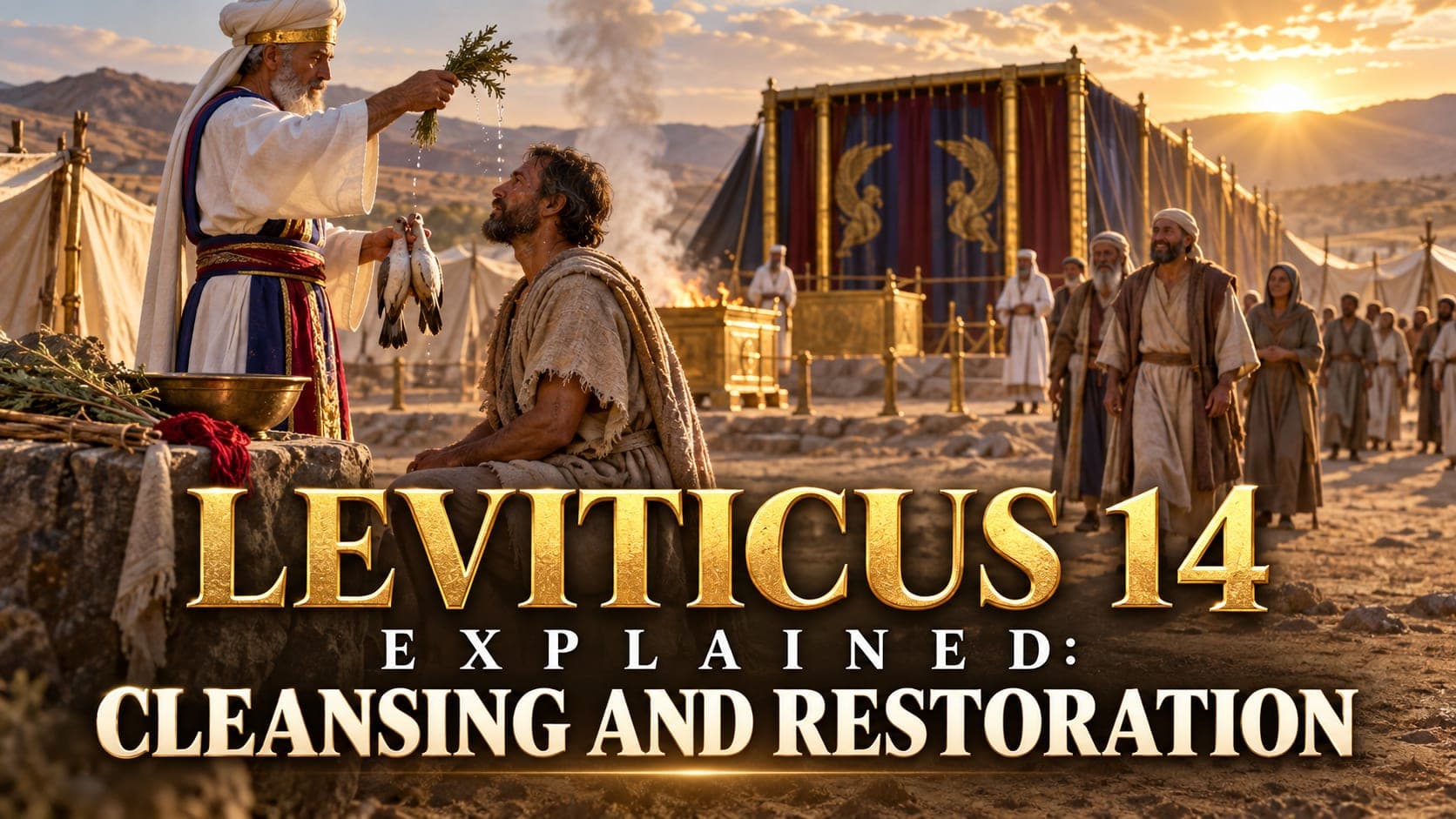
"Then shall the priest command to take for him that is to be cleansed two birds alive and clean, and cedar wood, and scarlet, and hyssop: And the priest shall command that one of the birds be killed in an earthen vessel over running water: As for the living bird, he shall take it, and the cedar wood, and the scarlet, and the hyssop, and shall dip them and the living bird in the blood of the bird that was killed over the running water: And he shall sprinkle upon him that is to be cleansed from the leprosy seven times, and shall pronounce him clean, and shall let the living bird loose into the open field."
Two birds, identical until this moment. One dies over running water. The other is dipped in that same blood and then released, still alive, into the open field.
💡 Hyssop shows up here for the same reason it shows up at the first Passover in Exodus 12: a small, leafy branch used to apply blood to someone who needed to be marked as covered. The plant is ordinary. What it is dipped in is not.
📌 One creature's death pays for the sprinkling. A second creature, still breathing, carries the moment away and does not come back. The chapter never explains the meaning in so many words, but the shape of it, one life given, one life sent away bearing what is finished, is not an isolated idea in Leviticus. It is a pattern this book keeps returning to.
2. Seven More Days, and Every Hair Shaved Off (verses 8 and 9)
Being sprinkled clean does not put the man back in his own tent that same day.
"And he that is to be cleansed shall wash his clothes, and shave off all his hair, and wash himself in water, that he may be clean: and after that he shall come into the camp, and shall tarry abroad out of his tent seven days."
He may now enter the camp, but not his own household, for a full week. Then the instruction repeats itself with one detail added.
"But it shall be on the seventh day, that he shall shave all his hair off his head and his beard and his eyebrows, even all his hair he shall shave off: and he shall wash his clothes, also he shall wash his flesh in water, and he shall be clean."
⚠️ Not a trim. Head, beard, eyebrows, named one at a time so nothing is left out. A week earlier, this same disease could have been living in exactly that hair, turning white inside a mark, the way Leviticus 13 described in case after case. Shaving it all away leaves nothing left that could still be hiding it.
3. The Eighth Day: Blood and Oil on Ear, Thumb, and Toe (verses 10 to 20)
On the eighth day, the man who has been shaved, washed, and waiting finally brings offerings of his own.
"And on the eighth day he shall take two he lambs without blemish, and one ewe lamb of the first year without blemish, and three tenth deals of fine flour for a meat offering, mingled with oil, and one log of oil. And the priest that maketh him clean shall present the man that is to be made clean, and those things, before the LORD, at the door of the tabernacle of the congregation:"
Three animals and a grain offering, the same kind of trespass offering explained in Leviticus 5, now paired with a sin offering and a burnt offering. Then comes the verse that makes this chapter stand apart from every other cleansing in Leviticus.
"And the priest shall take some of the blood of the trespass offering, and the priest shall put it upon the tip of the right ear of him that is to be cleansed, and upon the thumb of his right hand, and upon the great toe of his right foot:"
📌 Right ear, right thumb, right foot. That is not a new gesture invented for a leper. It is the exact same three points where blood was placed on Aaron and his sons when they were ordained in Leviticus 8. The ear that hears, the hand that works, the foot that walks. A man who had been living outside the camp, shut out of the ordinary life of Israel, is marked on exactly the parts of the body that a man entering priestly service was marked on.
Oil follows the blood, in a ritual nowhere else in the book.
"And of the rest of the oil that is in his hand shall the priest put upon the tip of the right ear of him that is to be cleansed, and upon the thumb of his right hand, and upon the great toe of his right foot, upon the blood of the trespass offering: And the remnant of the oil that is in the priest's hand he shall pour upon the head of him that is to be cleansed: and the priest shall make an atonement for him before the LORD."
💡 Oil poured on the head is how a king or a priest was anointed, not an ordinary Israelite returning home. This man receives blood on the same three points a priest did, and then oil poured on his head the way leadership itself was marked. The text does not call him a priest. But the ritual used to welcome him back borrows directly from the one used to set a priest apart in the first place.
The rest of the eighth day finishes what the trespass offering started.
📌 Being clean was never only about the disease leaving. It was about being brought all the way back in, not just tolerated at the edge of the camp again. A verdict of unclean in Leviticus 13 only stopped the spreading harm. The ritual here goes further and restores standing, which is a different kind of problem needing a different kind of fix.
4. Room Made for a Man Who Is Poor (verses 21 to 32)
Two lambs, a ewe lamb, and fine flour was never a small offering for a man who had likely just spent weeks or months unable to work. The chapter accounts for that.
"And if he be poor, and cannot get so much; then he shall take one lamb for a trespass offering to be waved, to make an atonement for him, and one tenth deal of fine flour mingled with oil for a meat offering, and a log of oil; And two turtledoves, or two young pigeons, such as he is able to get; and the one shall be a sin offering, and the other a burnt offering."
One lamb instead of three animals, birds instead of a full flock. The blood, oil, and atonement that follow in verses 24 through 31 are the exact same ritual already described, ear, thumb, toe, head, with a smaller offering standing in for the larger one.
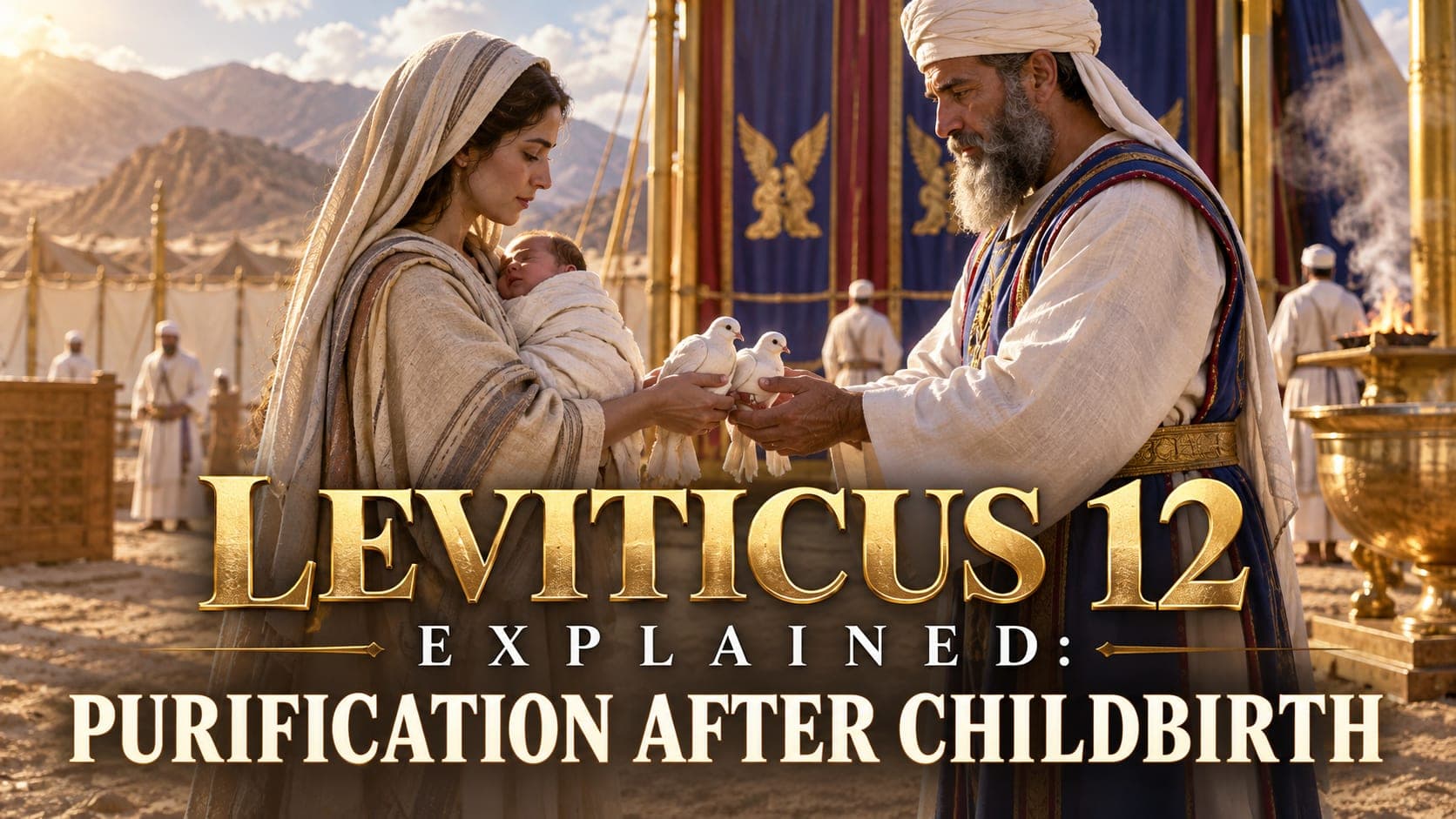
💡 Leviticus 12 built the same kind of door for a poor mother after childbirth, the door Mary herself walked through four hundred years later in Luke 2. This chapter builds it again for a man who has nothing left to bring but two birds.
✅ Nowhere in this chapter does being poor lower the standard of what counts as clean. It only lowers the cost of getting there. The ritual, and the full restoration it brings, is identical either way.
5. When the Plague Lives in a House (verses 33 to 53)
Just as Leviticus 13 moved from skin to a garment, this chapter moves from a person to a building.
"When ye be come into the land of Canaan, which I give to you for a possession, and I put the plague of leprosy in a house of the land of your possession; And he that owneth the house shall come and tell the priest, saying, It seemeth to me there is as it were a plague in the house:"
⚠️ The homeowner reports himself. Nobody has to catch him hiding it. That single detail sets the tone for everything that follows: cooperation with the process, not resistance to it.
Before the priest even looks, one small kindness is written into the law.
"Then the priest shall command that they empty the house, before the priest go into it to see the plague, that all that is in the house be not made unclean: and afterward the priest shall go in to see the house:"
💡 If the house is later pronounced unclean, everything still inside it would share that verdict. Emptying it first protects a family's belongings from a ruling that has not even been made yet.
What follows is the same pattern already familiar from skin, boils, and garments: look at greenish or reddish marks lower than the wall around them, shut the house up seven days, look again, and either let it stand or scrape it down to bare stone and replaster it. But if the mark returns even after that, the chapter reaches its most severe verdict in the whole book so far.
"Then the priest shall come and look, and, behold, if the plague be spread in the house, it is a fretting leprosy in the house: it is unclean. And he shall break down the house, the stones of it, and the timber thereof, and all the morter of the house; and he shall carry them forth out of the city into an unclean place."
📌 A garment that could not be saved was burned in Leviticus 13. A house that cannot be saved is demolished down to its stones here. Nothing in this law treats a diseased structure as a problem to simply live around. Every stone, every beam, every bit of plaster leaves the city for good.
But demolition is the last resort, not the first move, and most houses never reach it.
"And if the priest shall come in, and look upon it, and, behold, the plague hath not spread in the house, after the house was plaistered: then the priest shall pronounce the house clean, because the plague is healed."
A cleared house gets its own small version of the bird ritual from the start of the chapter, blood, running water, cedar wood, scarlet, and hyssop, sprinkled seven times with a bird released alive at the end. A building cannot wait eight days or bring an offering of its own, so the law scales the ceremony down to fit what it actually is.
6. The Chapter's Own Summary (verses 54 to 57)
Leviticus 14 closes by naming everything it has just covered, in one breath.
"This is the law for all manner of plague of leprosy, and scall, And for the leprosy of a garment, and of a house, And for a rising, and for a scab, and for a bright spot: To teach when it is unclean, and when it is clean: this is the law of leprosy."
📌 Skin, a coat, a house. Three completely different kinds of material all judged by the same careful process, and all capable of being pronounced clean again. This chapter never once settles for diagnosis as the finish line. Every path through it, the man, the poor man, the house, ends in the word "clean," not just "not spreading anymore."

Hard Questions Leviticus 14 Raises
Why does one bird die while the other is set free? The chapter never states a meaning for it directly. What can be said plainly is the shape of the act itself: one creature's blood is applied, and a second creature, marked with that same blood, is released alive rather than kept or killed. Leviticus repeats this basic pattern, something given up so something else can go free, in more than one place later in the book. Readers are right to notice it here without needing the text to spell out every layer of what it pictures.
Why mark a healed leper the same way a priest was ordained? Scripture does not explain this choice either, but it is hard to read verses 14 through 18 next to Leviticus 8's ordination of Aaron and his sons and call it a coincidence. Both use blood on the same right ear, right thumb, and right foot. Both finish with oil. Whatever else it means, the law chose to welcome this man back using language usually reserved for someone being set apart for God's service, not merely someone being allowed back in from the edge of the camp.
Was tearing down a house really necessary over mold? The greenish or reddish marks eating into stone and plaster described here are widely read by Bible scholars as a description of toxic mold or fungal growth spreading through the mud brick and stone construction common in the ancient Near East, the kind that can make a home unsafe to live in. The law treats it with the same seriousness it treats a spreading skin condition, because an unseen, spreading danger in the walls someone sleeps inside every night is not a small thing.
Is this "leprosy" the same as the people in the Gospels had? Leviticus 13 already showed that the underlying word covers a broad category of skin, fabric, and now building conditions, not one single disease. The ritual in this chapter being so specifically about restoring a person to community, rather than about medicine, fits that same wider reading rather than narrowing it to Hansen's disease alone.
Why does a poor man get a smaller offering instead of being turned away? Nothing in verses 21 through 32 lowers what counts as clean for him. The animals change. The verdict and the restoration do not. A law that let poverty shut someone out permanently from a process this costly would have punished the poor twice, once with the disease and once with the cure out of reach.
Top Verses From Leviticus 14
1. Leviticus 14:4 to 7
"Then shall the priest command to take for him that is to be cleansed two birds alive and clean, and cedar wood, and scarlet, and hyssop: And the priest shall command that one of the birds be killed in an earthen vessel over running water: As for the living bird, he shall take it, and the cedar wood, and the scarlet, and the hyssop, and shall dip them and the living bird in the blood of the bird that was killed over the running water: And he shall sprinkle upon him that is to be cleansed from the leprosy seven times, and shall pronounce him clean, and shall let the living bird loose into the open field."
One bird's blood pays for the cleansing. A second bird, marked with that same blood, flies off alive, a pattern this book keeps returning to.
2. Leviticus 14:14
"And the priest shall take some of the blood of the trespass offering, and the priest shall put it upon the tip of the right ear of him that is to be cleansed, and upon the thumb of his right hand, and upon the great toe of his right foot:"
The exact same three points marked at a priest's ordination in Leviticus 8, now marked on a man coming back from outside the camp.
3. Leviticus 14:21 and 22
"And if he be poor, and cannot get so much; then he shall take one lamb for a trespass offering to be waved, to make an atonement for him, and one tenth deal of fine flour mingled with oil for a meat offering, and a log of oil; And two turtledoves, or two young pigeons, such as he is able to get; and the one shall be a sin offering, and the other a burnt offering."
The same full restoration, scaled down to what a poor man could actually afford to bring.
4. Leviticus 14:44 and 45
"Then the priest shall come and look, and, behold, if the plague be spread in the house, it is a fretting leprosy in the house: it is unclean. And he shall break down the house, the stones of it, and the timber thereof, and all the morter of the house; and he shall carry them forth out of the city into an unclean place."
The most severe verdict in the chapter, a home torn to its stones once the danger in its walls cannot be stopped any other way.
5. Leviticus 14:54 to 57
"This is the law for all manner of plague of leprosy, and scall, And for the leprosy of a garment, and of a house, And for a rising, and for a scab, and for a bright spot: To teach when it is unclean, and when it is clean: this is the law of leprosy."
The chapter's own closing summary, covering skin, cloth, and stone under one single law.

Frequently Asked Questions About Leviticus 14
What is Leviticus 14 about?
Leviticus 14 gives the full process for restoring a healed leper to the camp, two birds, an eight day wait, and an offering that marks his ear, thumb, toe, and head, then applies a smaller version of the same process to a house found to have the plague of leprosy in its walls.
Why did the priest release a live bird in Leviticus 14?
One bird was killed and its blood used for sprinkling. The second bird was dipped in that same blood and let go alive into the open field, a pattern of one life given and another sent away that Leviticus repeats elsewhere in the book.
What is the trespass offering in Leviticus 14?
It is the same kind of guilt offering described in Leviticus 5, here brought by the cleansed leper alongside a sin offering and a burnt offering as part of his eighth day restoration.
Why was blood put on the ear, thumb, and toe in Leviticus 14?
Those are the exact same three points, right ear, right thumb, right foot, marked with blood when Aaron and his sons were ordained as priests in Leviticus 8. The healed leper is welcomed back using the same ritual language used to set a priest apart.
What does Leviticus 14 teach about leprosy in a house?
It describes greenish or reddish marks spreading in the walls of a house, widely read as a description of toxic mold, and gives the priest the same cycle of watching, scraping, and replastering used for skin and garments in Leviticus 13.
Why would God have someone destroy their own house?
Only after the mark returns a second time, even after the stones were scraped and replastered, does Leviticus 14:44 and 45 call for the house to be torn down completely. Demolition is the last step in the process, not the first.
How does Leviticus 14 provide for the poor?
Verses 21 and 22 allow a poor man to bring one lamb and two birds instead of three animals and a larger grain offering. The ritual and the verdict stay exactly the same; only the cost of getting there changes.
Does Leviticus 14 connect to Jesus healing lepers?
The Gospels describe Jesus healing lepers and sending them to a priest, the same examination and cleansing process laid out here. What this chapter spends eight days and several offerings to complete, Jesus accomplished with a touch and a word.
Why does the cleansing take eight full days?
The leper is sprinkled clean on day one, shaves all his hair on day seven, and only brings his offering on day eight. The waiting period matches the pattern already used for careful diagnosis in Leviticus 13, now applied to confirming restoration instead of disease.
What does "to teach when it is unclean, and when it is clean" mean?
It is the chapter's own closing summary in verse 57, naming skin, garments, and houses together as one law. Whatever the material, the same careful process decides the verdict, and the same door back to clean stays open.
Is the leprosy in a house the same thing as leprosy in a person?
No. Leviticus 14 uses the same underlying word and the same basic method of watching and re-examining, but a house cannot wait eight days or bring an offering. Its cleansing is a smaller version of the bird ritual alone, scaled to what a building actually is.
Final Thoughts
Leviticus 14 is the chapter where being clean finally stops meaning only "not dangerous anymore."
📌 Restoration costs something every time, and the law never pretends otherwise. Two birds, a lamb, flour, oil, eight days of waiting. Nothing about coming back in was made casual.
📌 The man who was shut farthest out is welcomed back using the language of priesthood. Blood on ear, thumb, and toe, oil on the head, the exact marks given to Aaron's own sons. Being cleansed here was never a bare minimum.
📌 Poverty never lowered the verdict, only the cost of reaching it. A man with nothing but two birds received the same word, clean, as a man who could afford three animals.
You will likely never stand outside a camp waiting on a priest to cross the line toward you. But this chapter still shows what it costs God to call someone, or something, fully clean again, not just safe to be near.
So here is your one next step.
Read how a leper in the Gospels falls at Jesus's feet already clean, and notice that the long process this chapter required, Jesus simply spoke into being.