📖 Leviticus 8 Explained: The Ordination of Aaron and His Sons
Everyone in the camp is called to one door, to watch one man get washed.
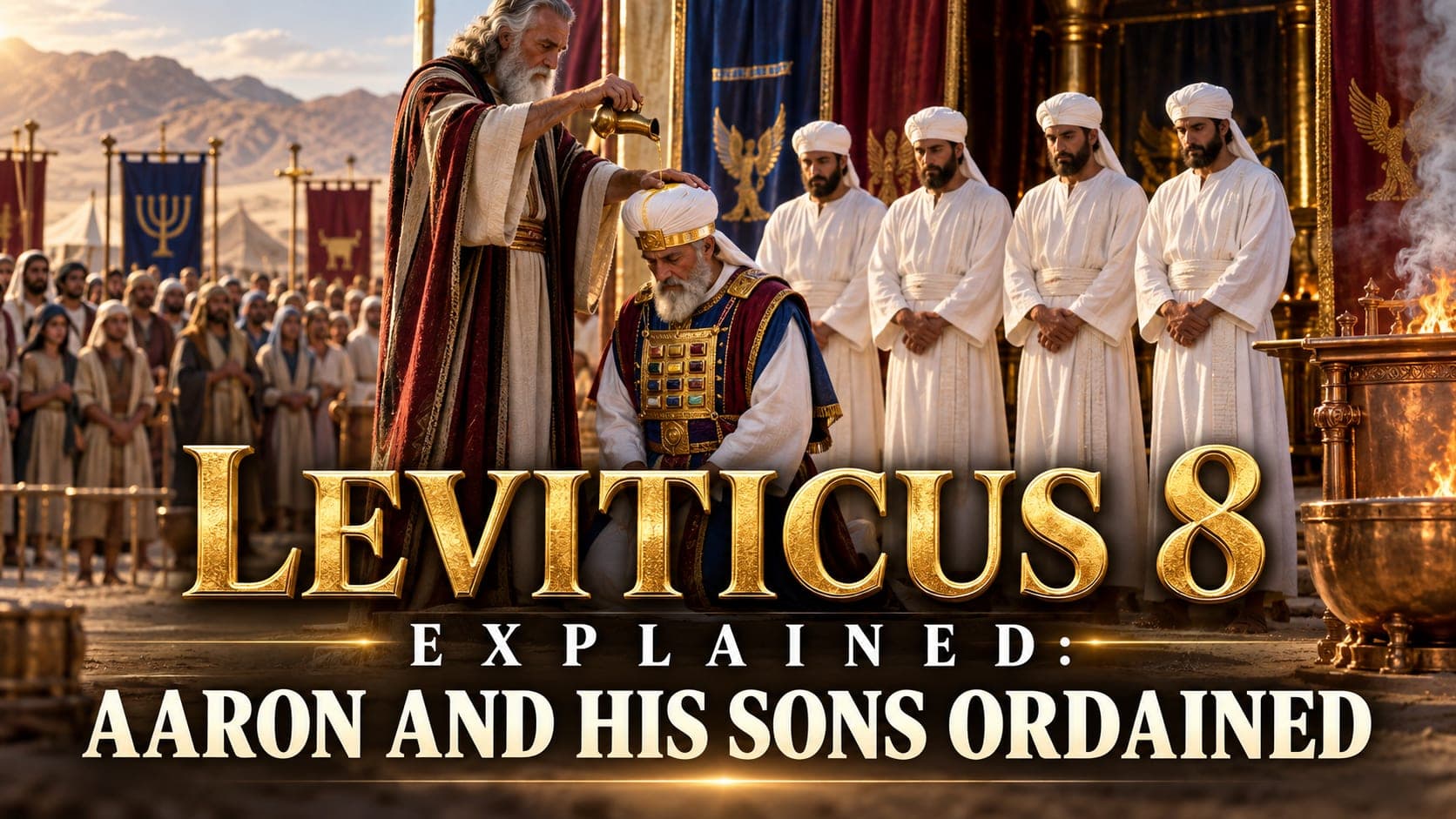
Leviticus 8 explained is the chapter where seven chapters of written law finally turn into an actual event. Moses does not hand Aaron a scroll and send him off to figure out the priesthood on his own. He washes him himself, dresses him piece by piece, pours oil on his head in front of the whole assembly, and then kills three separate animals before Aaron ever touches anything holy.
Maybe you have skimmed this chapter as a repeat of commands you already read in Exodus.
- ❓ Why does the whole congregation need to watch a man get dressed?
- ❓ Why is blood mixed with anointing oil here, when Aaron was anointed with plain oil just verses earlier?
- ❓ Why does Moses, who is not a priest, keep part of the sacrifice for himself?
- ❓ And why can none of them leave that doorway for seven straight days?
📌 Leviticus 8 is the one chapter in this book that is not a law. It is a record of a law being obeyed, in public, to the letter, the very first time.
This walkthrough goes through the whole chapter in order: the public gathering at the tabernacle door, the washing and robing of Aaron, the anointing of the tabernacle and the man, the sin offering and the two rams, the blood placed on ear and thumb and toe, the one time the wave offering broke its own rule, and the seven days that had to pass before any of it was finished.
Read slowly. This chapter is where instructions stop being paper and start being a priesthood.
What Happened Just Before This Chapter
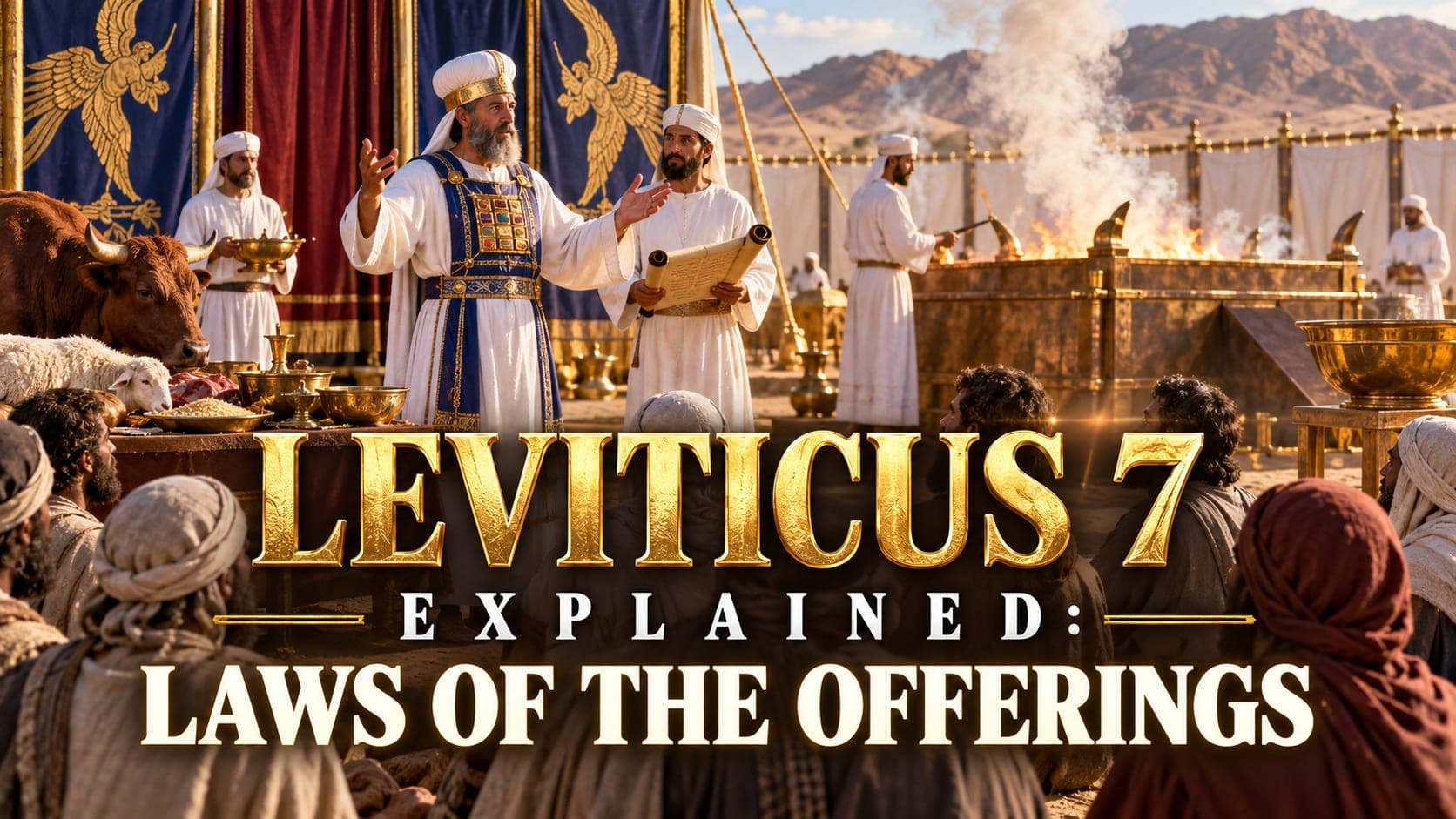
Leviticus 7 closed the entire offering code with one sentence naming every sacrifice covered so far and the mountain it came from. That sentence settled what Israel was supposed to bring and why. It never said anyone had actually done it yet.
Leviticus 8 answers that gap. Long before this book was written, God had already told Moses exactly how to ordain Aaron and his sons, in Exodus 29, down to which ear gets the blood and which part of the ram goes to whom. Leviticus 8 is Moses carrying out that exact script, almost line for line, with real animals, real oil, and a real crowd watching.

Leviticus 8 Explained Verse by Verse
1. The Whole Congregation Is Called to Watch (verses 1 to 5)
The chapter opens with a guest list nobody expected this large.
"Take Aaron and his sons with him, and the garments, and the anointing oil, and a bullock for the sin offering, and two rams, and a basket of unleavened bread;"
"And gather thou all the congregation together unto the door of the tabernacle of the congregation."
📌 Not a few elders. Not just the priests in training. The whole congregation. Every sacrifice described in the previous seven chapters was handled quietly between a worshipper and a priest at the altar. This one happens with the entire camp standing at the door, which means every single detail that follows was witnessed, not just performed.
Moses tells them plainly why they were called.
"And Moses said unto the congregation, This is the thing which the LORD commanded to be done."
💡 Not Moses' idea, not a tradition he was improvising. A command, stated out loud, so that no one watching could later claim the priesthood started as a human invention rather than something God Himself set up.
2. Washing and Robing Aaron, Piece by Piece (verses 6 to 9)
Before a single sacrifice is killed, Aaron is washed like a man starting over.
"And Moses brought Aaron and his sons, and washed them with water."
Then comes the dressing, garment by garment, in an order that is never rushed.
"And he put upon him the coat, and girded him with the girdle, and clothed him with the robe, and put the ephod upon him, and he girded him with the curious girdle of the ephod, and bound it unto him therewith."
"And he put the breastplate upon him: also he put in the breastplate the Urim and the Thummim."
💡 The Urim and the Thummim are never described here or anywhere else in Scripture. What is clear from how they are used later in Israel's history is that they were objects carried inside the breastplate and consulted for decisions that needed an answer from God directly. What they actually looked like, and exactly how they gave that answer, the text never says, and no honest reading of Leviticus 8 can fill that gap in.
The last piece goes on Aaron's head, and it carries words, not just metal.
"And he put the mitre upon his head; also upon the mitre, even upon his forefront, did he put the golden plate, the holy crown; as the LORD commanded Moses."
📌 This is the first of five times in this chapter alone that the text stops to say "as the LORD commanded Moses." Exodus 28 already described that golden plate and the words engraved on it. Leviticus 8 never repeats what it says. It simply confirms the plate went on Aaron's head exactly where and how God had specified, years before this day arrived.
3. Anointing the Tabernacle, the Altar, and Then the Man (verses 10 to 13)
The oil comes out before Aaron does, and it touches the building before it touches him.
"And Moses took the anointing oil, and anointed the tabernacle and all that was therein, and sanctified them."
"And he sprinkled thereof upon the altar seven times, and anointed the altar and all his vessels, both the laver and his foot, to sanctify them."
💡 Seven sprinklings on the altar, not one. The number is never explained in the verse itself, but it matches a pattern already familiar from this book: completeness, not a quick dab. Every vessel in that tent, down to the laver Aaron would wash his hands in, is made holy before a single person is.
Only then does the oil reach Aaron's own head.
"And he poured of the anointing oil upon Aaron's head, and anointed him, to sanctify him."
📌 A psalm written centuries later still remembers this exact moment, and names Aaron by name.
"It is like the precious ointment upon the head, that ran down upon the beard, even Aaron's beard: that went down to the skirts of his garments;"
Psalm 133 is not describing a different anointing. It is remembering this one, oil poured so generously it ran down a beard and reached the hem of a robe, used as a picture of what real unity among God's people actually looks like.
Aaron's sons get dressed too, though nothing is poured on them yet.
"And Moses brought Aaron's sons, and put coats upon them, and girded them with girdles, and put bonnets upon them; as the LORD commanded Moses."
4. The Bullock for Sin, Burned Where No One Can Eat It (verses 14 to 17)
With the men dressed, the actual sacrifices begin, and the first one is for sin.
"And he brought the bullock for the sin offering: and Aaron and his sons laid their hands upon the head of the bullock for the sin offering."
"And he slew it; and Moses took the blood, and put it upon the horns of the altar round about with his finger, and purified the altar, and poured the blood at the bottom of the altar, and sanctified it, to make reconciliation upon it."
💡 Notice who does the slaughtering and the blood work here. Not Aaron. Moses. The man being ordained has not yet been given the authority to perform the very acts he is about to spend his life performing. Every detail of his own ordination is still done to him and for him, not by him.
What happens to the body afterward matches a rule readers have already met before.
"But the bullock, and his hide, his flesh, and his dung, he burnt with fire without the camp; as the LORD commanded Moses."
📌 This is exactly how Leviticus 4 treated the anointed priest's own sin offering, a whole bullock carried entirely outside the camp and burned. Aaron is not yet functioning as a priest when this bullock dies, but the animal is already being handled exactly the way a priest's own guilt offering is handled. The pattern was fixed before Aaron ever stood at that altar.
5. The First Ram, Burned Whole for a Sweet Savour (verses 18 to 21)
A second animal follows, and this one is not about guilt at all.
"And he brought the ram for the burnt offering: and Aaron and his sons laid their hands upon the head of the ram."
"And he killed it; and Moses sprinkled the blood upon the altar round about."
💡 Sprinkled round about, not poured at the base. A sin offering's blood goes to the bottom of the altar. A burnt offering's blood circles it. The chapter never explains the difference in words, it simply repeats the motion each offering already called for back in the laws that named them.
"And he washed the inwards and the legs in water; and Moses burnt the whole ram upon the altar: it was a burnt sacrifice for a sweet savour, and an offering made by fire unto the LORD; as the LORD commanded Moses."
Nothing of this ram is kept back for anyone, priest or worshipper. The whole animal goes up in smoke, a complete gift with no portion held out for a meal, before the second ram even enters the picture.
6. The Ram of Consecration: Blood on Ear, Thumb, and Toe (verses 22 to 24)
The second ram carries a name the chapter has not used yet, and a far stranger ritual.
"And he brought the other ram, the ram of consecration: and Aaron and his sons laid their hands upon the head of the ram."
"And he slew it; and Moses took of the blood of it, and put it upon the tip of Aaron's right ear, and upon the thumb of his right hand, and upon the great toe of his right foot."
📌 Ear, thumb, and toe are not random spots. They are the parts of a man most directly involved in doing the job. The ear that will hear God's instruction, the hand that will do the work of the altar, the foot that will walk into the holy place. Blood touches the body at the exact points where a priest's actual service will happen.
His sons receive the same mark.
"And he brought Aaron's sons, and Moses put of the blood upon the tip of their right ear, and upon the thumbs of their right hands, and upon the great toes of their right feet: and Moses sprinkled the blood upon the altar round about."
7. The Wave Offering That Breaks Its Own Rule (verses 25 to 29)
What happens next to this second ram is where the chapter does something Leviticus 7 never allowed.
"And he took the fat, and the rump, and all the fat that was upon the inwards, and the caul above the liver, and the two kidneys, and their fat, and the right shoulder:"
"And out of the basket of unleavened bread, that was before the LORD, he took one unleavened cake, and a cake of oiled bread, and one wafer, and put them on the fat, and upon the right shoulder:"
"And he put all upon Aaron's hands, and upon his sons' hands, and waved them for a wave offering before the LORD."
💡 The fat, the bread, and the right shoulder, all piled into Aaron's own hands and waved, the same motion Leviticus 7 attached to the breast of a peace offering. Here it happens to the shoulder and the fat instead, and all of it still ends up burned.
"And Moses took them from off their hands, and burnt them on the altar upon the burnt offering: they were consecrations for a sweet savour: it is an offering made by fire unto the LORD."
Then the breast itself gets waved, and goes somewhere no breast had gone before.
"And Moses took the breast, and waved it for a wave offering before the LORD: for of the ram of consecration it was Moses' part; as the LORD commanded Moses."
📌 In every other peace offering, the wave breast belongs to Aaron and his sons, the whole priesthood together. In this one case, it belongs to Moses. The reason is right there in the chapter itself: Aaron has not finished being ordained yet. There is no functioning priesthood on the day this animal dies, so the one man acting as priest for this single ceremony, Moses, receives the portion a priest would normally receive. The rule did not change. The man standing in the priest's role for one day did.
8. Oil and Blood Together, Then Seven Days at the Door (verses 30 to 36)
One more anointing closes out the ceremony, and this one is unlike the first.
"And Moses took of the anointing oil, and of the blood which was upon the altar, and sprinkled it upon Aaron, and upon his garments, and upon his sons, and upon his sons' garments with him; and sanctified Aaron, and his garments, and his sons, and his sons' garments with him."
💡 Verse 12 anointed Aaron with oil alone, poured on his head before any animal had died. Verse 30 sprinkles oil mixed with blood taken straight off the altar, onto his garments and his sons' garments as well as onto the men themselves. The first anointing set a man apart. This second one binds that same man to everything the altar had just done, oil and sacrifice applied together rather than oil by itself.
Then comes an instruction about the meal that has to happen next.
"And Moses said unto Aaron and to his sons, Boil the flesh at the door of the tabernacle of the congregation: and there eat it with the bread that is in the basket of consecrations, as I commanded, saying, Aaron and his sons shall eat it."
"And that which remaineth of the flesh and of the bread shall ye burn with fire."
Nothing is left over past this one meal. What is not eaten is burned, the same no-leftovers principle Leviticus 7 already attached to a peace offering eaten in thanksgiving.
And then comes the instruction that stretches this one day into an entire week.
"And ye shall not go out of the door of the tabernacle of the congregation in seven days, until the days of your consecration be at an end: for seven days shall he consecrate you."
"Therefore shall ye abide at the door of the tabernacle of the congregation day and night seven days, and keep the charge of the LORD, that ye die not: for so I am commanded."
⚠️ "That ye die not" is not a gentle warning. Leaving that doorway before the seven days ended was not framed as a minor lapse in protocol. The consequence named for it is death. Whatever happened at that door during those seven days, Aaron and his sons were not free to treat it as optional or interrupt it early.
The chapter's last verse closes with the only verdict that actually matters.
"So Aaron and his sons did all things which the LORD commanded by the hand of Moses."
A quick recount of this chapter's own refrain confirms how often it matters. "As the LORD commanded Moses" appears five separate times in Leviticus 8, in verses 9, 13, 17, 21, and 29, and some form of the word "commanded" shows up four more times after that, in verses 31, 34, 35, and 36 alone. Obedience, stated and restated, is the real subject of this chapter, not just the ceremony itself.

Hard Questions Leviticus 8 Raises
Why does Moses, who was never ordained a priest himself, perform every sacrifice in this chapter? Leviticus 8 never explains this directly, but the text is consistent about it. Moses slays the bullock, sprinkles the blood, and even keeps the wave breast for himself in verse 29. Aaron is the one being made a priest in this chapter; he cannot yet act as one. Someone already standing in God's authority had to perform the ordination, and that was Moses, acting under direct command rather than his own office.
Why are the Urim and the Thummim never described, here or anywhere else in the law? Leviticus 8:8 places them in the breastplate without a word about their size, shape, or material. Later history shows they were consulted for decisions that needed a direct word from God, but Bible teachers genuinely differ on exactly how they worked. What the text supports is only that they existed and sat inside the breastplate; anything more specific than that goes beyond what Scripture says.
Why mix blood with anointing oil in verse 30, when verse 12 already anointed Aaron with oil by itself? The chapter states both acts without connecting them explicitly. What is observable is the order. Oil alone, in verse 12, happens before any animal has died, setting Aaron apart for the role. Oil mixed with altar blood, in verse 30, happens only after the sin offering, the burnt offering, and the ram of consecration are already finished, joining that same man to what the sacrifices had just accomplished.
Why seven days at the tabernacle door, with death named as the cost of leaving early? Leviticus 8:33 and 35 state the requirement and the stakes without giving a reason for the specific number. What the text does make unmistakable is that this was not a symbolic grace period. The next chapter opens "on the eighth day," which means this ordination was only ever considered finished once the full seven had actually passed, not sooner.
Top Verses From Leviticus 8
1. Leviticus 8:12
"And he poured of the anointing oil upon Aaron's head, and anointed him, to sanctify him."
The moment Psalm 133 still remembers centuries later, oil poured so generously it ran down Aaron's beard to the hem of his robe.
2. Leviticus 8:23
"And he slew it; and Moses took of the blood of it, and put it upon the tip of Aaron's right ear, and upon the thumb of his right hand, and upon the great toe of his right foot."
Blood applied to the exact parts of the body a priest's service would use: the ear that hears, the hand that works, the foot that walks into the holy place.
3. Leviticus 8:29
"And Moses took the breast, and waved it for a wave offering before the LORD: for of the ram of consecration it was Moses' part; as the LORD commanded Moses."
The one time in the entire sacrificial code the wave breast belongs to someone outside the priesthood, because on this day there was no priesthood yet to receive it.
4. Leviticus 8:33
"And ye shall not go out of the door of the tabernacle of the congregation in seven days, until the days of your consecration be at an end: for seven days shall he consecrate you."
A consecration measured in days, not hours, that could not be shortened or stepped away from early.
5. Leviticus 8:36
"So Aaron and his sons did all things which the LORD commanded by the hand of Moses."
The chapter's actual verdict. Not that the ceremony looked impressive, but that every part of it was obeyed exactly as commanded.

Frequently Asked Questions About Leviticus 8
What is Leviticus 8 about?
Leviticus 8 records the actual ordination of Aaron and his sons as priests, carried out by Moses in front of the whole congregation of Israel. It includes the washing and robing of Aaron, the anointing of the tabernacle and the man himself, a sin offering, a burnt offering, a ram of consecration, and seven days the new priests had to spend without leaving the tabernacle door.
Why did Moses perform the sacrifices instead of Aaron?
Aaron was the one being ordained in this chapter, so he could not yet function in the role he had not finished receiving. Moses, already acting under God's direct command, performed every sacrifice on Aaron's behalf, including killing the animals and even keeping the wave breast for himself in Leviticus 8:29, a portion that normally belonged to the priesthood.
What were the Urim and the Thummim?
Leviticus 8:8 places them inside Aaron's breastplate without describing what they were made of or exactly how they worked. Later Scripture shows they were used to seek a direct answer from God on certain decisions, but their precise form is genuinely disputed among Bible teachers, and the text itself never settles the question.
Why did Moses put blood on Aaron's ear, thumb, and toe?
Leviticus 8:23 and 24 apply the blood of the ram of consecration to the ear, thumb, and toe of Aaron and his sons. These are the parts of the body most directly tied to a priest's actual service, hearing instruction, doing the work of the altar with the hands, and walking into the holy place, consecrated specifically for that use.
What is the difference between the anointing in verse 12 and verse 30?
Leviticus 8:12 anoints Aaron with oil alone, before any sacrifice has happened, setting him apart for the role. Leviticus 8:30 anoints him again with oil mixed with blood taken from the altar, after the sin offering, burnt offering, and ram of consecration are finished, joining him to what those sacrifices had already accomplished.
Why did Aaron and his sons have to stay at the tabernacle door for seven days?
Leviticus 8:33 and 35 state the requirement and warn that leaving early carried the penalty of death, without explaining the exact reason for seven days specifically. What is clear is that the ordination was not considered complete until the full week had passed, since Leviticus 9:1 opens on the eighth day as the first time Aaron ministers as a finished priest.
Why was the bullock burned outside the camp instead of eaten?
Leviticus 8:17 burns the entire sin offering bullock outside the camp, matching the treatment Leviticus 4 already gave to an anointed priest's own sin offering. Even though Aaron was not yet functioning as a priest, the animal tied to his ordination was handled the same way a priest's personal guilt offering always was.
Why does the chapter keep repeating "as the LORD commanded Moses"?
That exact phrase appears five times in Leviticus 8, in verses 9, 13, 17, 21, and 29. The repetition underlines that nothing in this ceremony was improvised by Moses. Every garment, every motion, every portion of every animal followed instructions God had already given, mainly in Exodus 29, years before this day arrived.
How does Leviticus 8 connect to Jesus?
Hebrews draws a direct line from this chapter to Christ's own priesthood.
"And no man taketh this honour unto himself, but he that is called of God, as was Aaron."
Aaron never anointed himself. He was washed, dressed, and anointed by someone else, under God's own command. Hebrews uses that exact pattern to describe Christ, who also did not appoint Himself to the priesthood He holds, but was called and glorified into it by the Father.
Final Thoughts
Leviticus 8 is the chapter where seven chapters of written law stop being theory.
📌 Nothing about Aaron's priesthood was self-appointed. He was washed by someone else's hands, dressed by someone else's hands, and anointed by someone else's hands, long before he ever performed a single act of the office himself.
📌 Obedience, not spectacle, was the actual point of the ceremony. "As the LORD commanded Moses" repeats five times across one chapter, and the final verse states plainly that Aaron and his sons did all of it exactly as commanded.
📌 Consecration took time it could not be rushed through. Seven full days at one doorway, with death named as the cost of leaving early, before the eighth day could even begin.
You will never be washed at a tabernacle door or have blood placed on your ear and thumb and toe. But this chapter still asks whether you treat your own calling as something you built yourself, or something you were given.
So here is your one next step.
Name one part of your life you have quietly started treating as self-appointed, and hand it back to the One who actually called you to it, the way Aaron never had the chance to pretend otherwise.