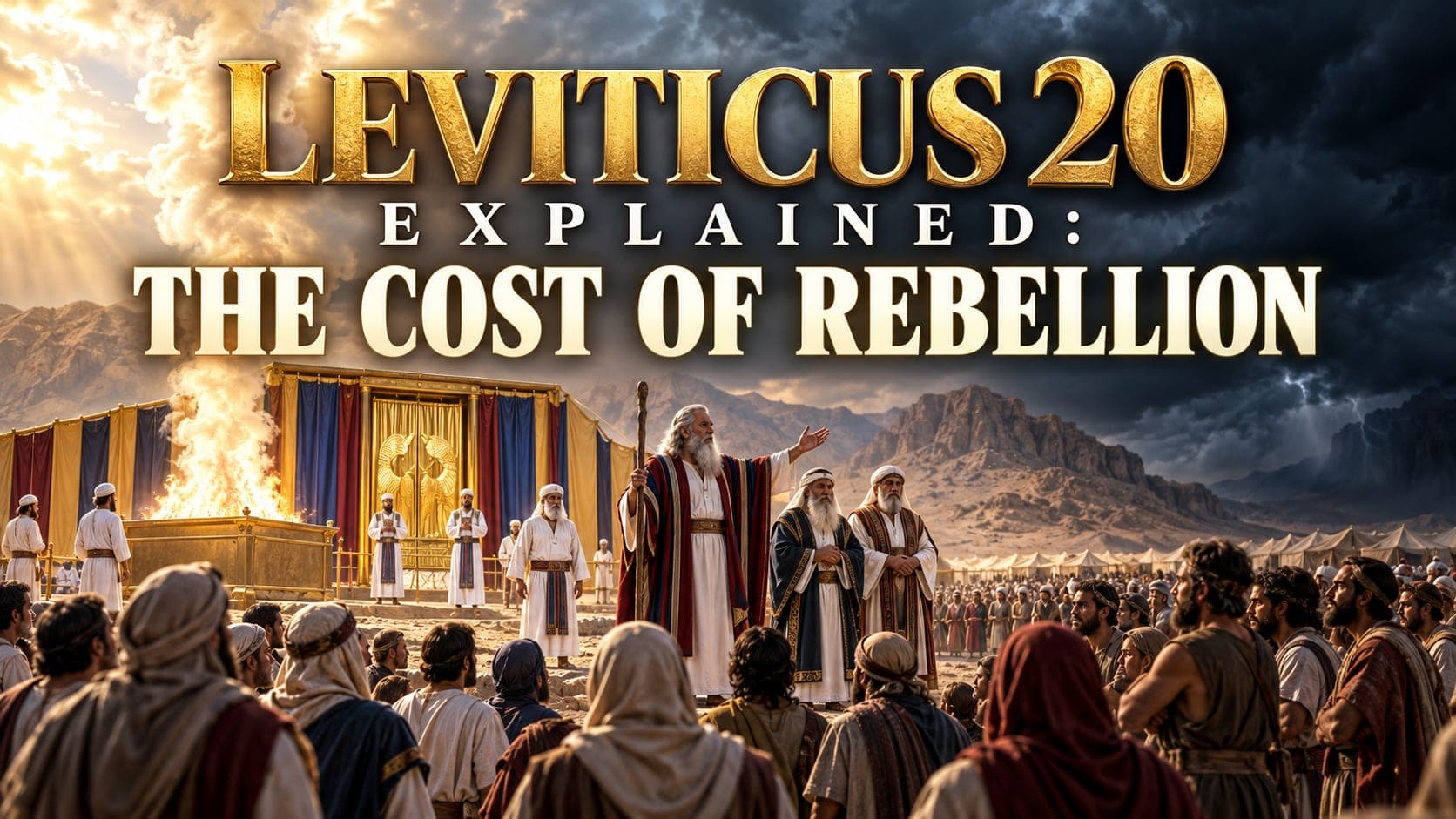
📖 Leviticus 20 Explained: The Death Penalty Chapter of the Law
Twenty seven verses. Ten different death sentences, and not one of them delivered the same way.
Leviticus 20 explained is the chapter that finally answers a question Leviticus 18 left hanging. That chapter named which relationships were forbidden. This one names what happens to someone who breaks the law anyway, and the answer is not one single penalty handed out evenly. Some sins here end in stoning. One ends in fire. Others end only in a childless old age, with no human court sentence attached at all.
Maybe you have assumed every sin on this list carried the exact same weight.
- ❓ Why does cursing your own parent carry a death sentence in the middle of a chapter about sex?
- ❓ What does it mean that God says He will personally cut off a man and his whole family?
- ❓ Why do some incest cases in this chapter end in death, and others only in bearing guilt?
- ❓ And why does a chapter about forbidden relationships end with a rule about clean and unclean animals?
📌 Leviticus 20 is not a flat list of death sentences. It is a careful, uneven scale, and the unevenness is the whole point.
This walkthrough goes through the whole chapter in order: the death sentence for Molech worship and the family it reaches beyond the guilty man himself, the call to holiness repeated a third time, the parent curse law tucked into the middle of it, the sexual sins Leviticus 18 already named now given a penalty, the cases that get a lighter sentence than you might expect, and the closing lines tying the whole chapter back to the land itself.
Read slowly. The differences between these verses matter as much as what they have in common.
What Happened Just Before This Chapter
Leviticus 19 widened the lens from the family out to the field, the courtroom, and the marketplace, closing with honest scales and love for the stranger. Before that, Leviticus 18 drew the actual lines around who could be touched inside a family and who could not, and closed with a warning that the land itself had already paid a price for the nations that ignored those lines.
Leviticus 20 goes back to finish what Leviticus 18 started. That chapter spent thirty verses naming forbidden relationships and almost never said what should happen to someone who crossed one of those lines anyway. This chapter closes that gap, relationship by relationship, and adds a few penalties Leviticus 18 never mentioned at all, cursing a parent, consulting a familiar spirit, and worshiping Molech.
Leviticus 20 Explained Verse by Verse
1. Molech Worship, and the Family It Reaches Beyond the Guilty Man (verses 1 to 5)
The chapter opens with the one sin it treats as heaviest of all.
"Again, thou shalt say to the children of Israel, Whosoever he be of the children of Israel, or of the strangers that sojourn in Israel, that giveth any of his seed unto Molech; he shall surely be put to death: the people of the land shall stone him with stones."
Molech was worshiped by giving a child to be burned, the same practice Leviticus 18:21 already forbade without naming a penalty. Here the penalty is named plainly, death by stoning, and it applies equally to a native Israelite or a foreigner living among them.
📌 God does not stop at punishing the man who does it. He adds a second layer no other sin in this chapter gets.
"And I will set my face against that man, and will cut him off from among his people; because he hath given of his seed unto Molech, to defile my sanctuary, and to profane my holy name."
"And if the people of the land do any ways hide their eyes from the man, when he giveth of his seed unto Molech, and kill him not: Then I will set my face against that man, and against his family, and will cut him off, and all that go a whoring after him, to commit whoredom with Molech, from among their people."
⚠️ Verse 2 names a human court's job, stoning by the people of the land. Verses 3 and 4 name something the court cannot do at all, God Himself acting directly, in His own words, "I will set my face against that man." If the community looks away and refuses to carry out the sentence, God says He will reach past the guilty man to his whole family. Looking away was never a safe third option.
2. Familiar Spirits, and Holiness Stated a Third Time (verses 6 to 8)
From Molech, the chapter turns to a different kind of counterfeit worship.
"And the soul that turneth after such as have familiar spirits, and after wizards, to go a whoring after them, I will even set my face against that soul, and will cut him off from among his people."
A familiar spirit describes a spirit people believed could be reached for guidance through a human medium, often understood as contact with the dead. King Saul later breaks this exact law, seeking out a medium at Endor the night before his final battle. Leviticus 19 already forbade seeking one out. This verse attaches God's own direct judgment to it, "I will even set my face against that soul," the same phrase just used for Molech.
"Sanctify yourselves therefore, and be ye holy: for I am the LORD your God. And ye shall keep my statutes, and do them: I am the LORD which sanctify you."
💡 "Be ye holy, for I am the LORD your God" already opened Leviticus 19. Here it functions almost like a hinge, closing the first half of this chapter and bracing the reader for the list that is about to follow. Holiness is not simply the subject of a chapter. It is the reason every verse after this one carries the weight it does.
3. Cursing a Parent, in the Middle of a List About Sex (verse 9)
Before the chapter turns to its long list of sexual sins, one verse interrupts with something that, at first glance, looks out of place.
"For every one that curseth his father or his mother shall be surely put to death: he hath cursed his father or his mother; his blood shall be upon him."
📌 This is the same offense named in Exodus 21:17, and it sits here next to the same command Leviticus 19:3 already gave, fearing your father and mother. The chapter treats contempt for a parent as belonging to the same category as the sexual boundaries surrounding it, both are about who has authority over your life and your body, and whether you will honor the limits that authority sets.
"His blood shall be upon him" places the responsibility for the sentence on the guilty person himself, not on the one who carries it out.
4. Leviticus 18's Sins, Now Given a Penalty (verses 10 to 16)
The chapter now works back through relationships Leviticus 18 already forbade, this time naming exactly what happens when someone breaks the law anyway.
"And the man that committeth adultery with another man’s wife, even he that committeth adultery with his neighbour’s wife, the adulterer and the adulteress shall surely be put to death."
"And the man that lieth with his father’s wife hath uncovered his father’s nakedness: both of them shall surely be put to death; their blood shall be upon them."
⚠️ Notice that both parties share the sentence equally in these two verses, the man and the woman alike. "Their blood shall be upon them" repeats the same principle verse 9 just used for cursing a parent, responsibility for the sentence rests on the guilty, not on whoever enforces it.
"And if a man lie with his daughter in law, both of them shall surely be put to death: they have wrought confusion; their blood shall be upon them."
"If a man also lie with mankind, as he lieth with a woman, both of them have committed an abomination: they shall surely be put to death; their blood shall be upon them."
Verse 13 states the same prohibition Leviticus 18:22 already named, and attaches the same word, "abomination." What Leviticus 18 only forbade, this verse sentences, the heaviest penalty this chapter has, applied equally to both men involved.
Verse 14 then describes a penalty found nowhere else in this chapter.
"And if a man take a wife and her mother, it is wickedness: they shall be burnt with fire, both he and they; that there be no wickedness among you."
⚠️ Every other sentence in this chapter is death by stoning or simply "put to death" without a method named. This is the one case in the whole chapter where the method itself is fire, and it is the only sin here involving three people at once rather than two.
"And if a man lie with a beast, he shall surely be put to death: and ye shall slay the beast. And if a woman approach unto any beast, and lie down thereto, thou shalt kill the woman, and the beast: they shall surely be put to death; their blood shall be upon them."
💡 The law names this offense for a man and for a woman separately, in nearly identical language, rather than assuming it only needed stating once. Both the person and the animal are put to death in either case, a detail the text states without further comment.
5. Not Every Sin on This List Gets the Same Sentence (verses 17 to 21)
The chapter now shifts to a set of relationships that, on the surface, look just as serious as the ones already listed, but the sentence attached to them changes.
"And if a man shall take his sister, his father’s daughter, or his mother’s daughter, and see her nakedness, and she see his nakedness; it is a wicked thing; and they shall be cut off in the sight of their people: he hath uncovered his sister’s nakedness; he shall bear his iniquity."
📌 Compare this to verse 11. A man with his father's wife is put to death. A man with his sister is cut off and bears his iniquity, a real and serious consequence, but not the death sentence named just a few verses earlier. The chapter does not explain why the two relationships are weighed differently. It simply states a different sentence for each one.
"And if a man shall lie with a woman having her sickness, and shall uncover her nakedness; he hath discovered her fountain, and she hath uncovered the fountain of her blood: and both of them shall be cut off from among their people."
"And thou shalt not uncover the nakedness of thy mother’s sister, nor of thy father’s sister: for he uncovereth his near kin: they shall bear their iniquity."
"And if a man shall lie with his uncle’s wife, he hath uncovered his uncle’s nakedness: they shall bear their sin; they shall die childless. And if a man shall take his brother’s wife, it is an unclean thing: he hath uncovered his brother’s nakedness; they shall be childless."
⚠️ "Die childless" appears nowhere else in this chapter. For an aunt by marriage and a brother's wife, the stated consequence is not stoning and not being cut off from the community outright. It is living without the one thing an Israelite family depended on most, an heir to carry the family name forward.

The Land, Clean and Unclean, and Belonging to the LORD (verses 22 to 27)
The chapter closes by widening out from individual cases to the whole nation, the same way Leviticus 18 did.
"Ye shall therefore keep all my statutes, and all my judgments, and do them: that the land, whither I bring you to dwell therein, spue you not out. And ye shall not walk in the manners of the nation, which I cast out before you: for they committed all these things, and therefore I abhorred them."
"Spue you not out" repeats the same picture of the land vomiting out its inhabitants that Leviticus 18:25 already used for Canaan's previous residents. Israel is warned that the same fate waits for them if they copy what those nations did.
Then, unexpectedly, the chapter brings in a subject it has not touched once until now.
"Ye shall therefore put difference between clean beasts and unclean, and between unclean fowls and clean: and ye shall not make your souls abominable by beast, or by fowl, or by any manner of living thing that creepeth on the ground, which I have separated from you as unclean."
💡 Leviticus 11 already laid out the clean and unclean food laws in full detail. This verse does not repeat those details. It uses the category itself, the practice of telling clean apart from unclean, as one more picture of the same thing this entire chapter has been doing with relationships, drawing a line and keeping it.
"And ye shall be holy unto me: for I the LORD am holy, and have severed you from other people, that ye should be mine."
📌 "Severed you from other people, that ye should be mine" is the real reason behind every penalty in this chapter. Israel was not being punished for its own sake. It was being kept distinct, on purpose, for a relationship with God that required that distinction to survive.
The chapter's final verse circles back to exactly where the second section started.
"A man also or woman that hath a familiar spirit, or that is a wizard, shall surely be put to death: they shall stone them with stones: their blood shall be upon them."
Verse 6 named familiar spirits as deserving God's own direct judgment. Verse 27 closes the loop, naming the human penalty, stoning, that verse 6 never specified. The chapter opens and closes on the same two counterfeit forms of worship, Molech and the familiar spirit, framing everything about family and sex that sits between them.
Hard Questions Leviticus 20 Raises
Why does this chapter repeat relationships Leviticus 18 already forbade? Leviticus 18 states the boundary. Leviticus 20 answers the question that chapter left open, what happens when the boundary is crossed. Reading them side by side shows law and penalty were given in two separate stages rather than all at once.
Does Leviticus 20:13 really call for the death penalty, and how does the New Testament treat the same subject? The verse is direct, forbidding sexual relations between men and naming a death sentence for it under Israel's civil law. The New Testament addresses the same subject again, in passages like Romans 1:26 and 27 and 1 Corinthians 6:9 and 10, without repeating the civil penalty attached to it here. Most Christian traditions separate Israel's civil penalties, tied to its own national law, from its moral teaching, which carries forward.
Why do verses 19 to 21 give a lighter sentence than verse 11 for what look like similar offenses? The text states the different sentences plainly, death for a father's wife, being cut off or dying childless for an aunt or a brother's wife, without explaining the reasoning behind the difference. What can be said honestly is that the chapter itself draws this line, and any claim beyond what the text states goes further than Leviticus 20 does.
What does "cut off from among his people" actually mean? In some verses it sits beside a named human penalty, stoning in verses 2 and 27. In others, like verse 3's "I will set my face against that man," it is God speaking in the first person about His own action, separate from anything a human court could carry out. The phrase does not always describe the same kind of judgment.
Was the death penalty for Molech worship or cursing a parent actually carried out in Israel's history? Scripture records Israelites worshiping Molech anyway, generations later, including under king Manasseh, which suggests this law was not consistently enforced even though it remained on the books. The text commands the penalty. It does not claim every generation of Israel kept it.
Top Verses From Leviticus 20
1. Leviticus 20:26
"And ye shall be holy unto me: for I the LORD am holy, and have severed you from other people, that ye should be mine."
The closest thing this chapter has to a thesis statement, naming the real reason behind every penalty just listed, belonging, not punishment for its own sake.
2. Leviticus 20:9
"For every one that curseth his father or his mother shall be surely put to death: he hath cursed his father or his mother; his blood shall be upon him."
The verse that breaks the pattern, interrupting a chapter about sexual sin to name contempt for a parent as carrying the exact same weight.
3. Leviticus 20:4 and 5
"And if the people of the land do any ways hide their eyes from the man, when he giveth of his seed unto Molech, and kill him not: Then I will set my face against that man, and against his family, and will cut him off, and all that go a whoring after him, to commit whoredom with Molech, from among their people."
The verse that removes looking away as a safe option, naming God's own direct action against a man and his family if the community refuses to act.
4. Leviticus 20:20 and 21
"And if a man shall lie with his uncle’s wife, he hath uncovered his uncle’s nakedness: they shall bear their sin; they shall die childless. And if a man shall take his brother’s wife, it is an unclean thing: he hath uncovered his brother’s nakedness; they shall be childless."
Proof that this chapter is not a flat list. The same book that commands stoning a few verses earlier names childlessness as the consequence here instead.
5. Leviticus 20:7 and 8
"Sanctify yourselves therefore, and be ye holy: for I am the LORD your God. And ye shall keep my statutes, and do them: I am the LORD which sanctify you."
The hinge in the middle of the chapter, repeating Leviticus 19's opening command and bracing the reader for the long list of penalties that follows.

Frequently Asked Questions About Leviticus 20
What is Leviticus 20 about?
Leviticus 20 attaches penalties to the relationships Leviticus 18 forbade, adds a few new offenses of its own, Molech worship, cursing a parent, and consulting a familiar spirit, and closes by tying the whole chapter back to Israel's holiness and its hold on the land.
Why does Leviticus 20 repeat laws from Leviticus 18?
Leviticus 18 names forbidden relationships without stating what should happen to someone who breaks them. Leviticus 20 goes back through the same list and attaches a specific penalty to each one, which is why the two chapters read like companions rather than duplicates.
Does the Bible really say to put someone to death for cursing their parents?
Yes, in Leviticus 20:9, the same offense named in Exodus 21:17. It is placed inside a list about sexual sin because both are treated as offenses against the authority God placed over a person's life.
What does "cut off from among his people" mean in Leviticus 20?
It is not used the same way every time. Some verses pair it with a named human penalty like stoning. Others, like verse 3, use it as God's own first person statement, "I will cut him off," separate from anything a human court could carry out.
Why do some sins in Leviticus 20 get the death penalty and others do not?
Verses 17 through 21 state lighter sentences, being cut off or dying childless, for relationships that look similar to ones punished by death earlier in the chapter. The text states the difference plainly without explaining the reasoning behind it.
What does Leviticus 20:13 say, and how does the New Testament treat it?
It forbids sexual relations between men and names a death sentence under Israel's civil law. The New Testament addresses the same subject again in Romans 1 and 1 Corinthians 6 without repeating the civil penalty, which most Christian traditions read as reaffirming the moral teaching while setting aside the national law tied to it.
Why does Leviticus 20 end with a rule about clean and unclean animals?
Verse 25 does not repeat the detailed food laws from Leviticus 11. It uses the same practice of telling clean apart from unclean as one more example of the line drawing this entire chapter has been doing with relationships.
Was the Molech death penalty actually enforced in Israel's history?
Not consistently. Later Scripture records kings of Israel and Judah, including Manasseh, tolerating or even practicing Molech worship generations after this law was given, which shows the command existed without always being carried out.
What does "die childless" mean as a punishment in Leviticus 20?
It names a consequence without a human court sentence attached, the loss of an heir to carry the family name forward, used specifically for a man who takes his uncle's wife or his brother's wife.
Do Christians today still have to follow the penalties in Leviticus 20?
Most Christian traditions separate Israel's civil penalties, tied to its own law and government, from its moral teaching. The moral boundaries named in this chapter are reaffirmed elsewhere in the New Testament; the specific civil sentences are not treated as binding on Christians today.
Why does God say He will punish a man's whole family for Molech worship?
Verses 4 and 5 attach that consequence specifically to a community that hides its eyes and refuses to act, not to the guilty man alone. The text frames looking away as its own kind of participation in the sin.
Final Thoughts
Leviticus 20 is uncomfortable to read quickly, and the discomfort is doing real work.
📌 This chapter refuses to treat every sin the same way. A father's wife brings death. An uncle's wife brings a childless life instead. The text itself draws that line, even where it does not explain it.
📌 Looking away was never neutral. A community that refused to act against Molech worship did not escape judgment. It shared in it.
📌 Every penalty in this chapter answers back to one verse near its middle, "severed you from other people, that ye should be mine." The point was never punishment alone. It was belonging to God, kept distinct on purpose.
You will likely never face a court applying these exact sentences. But the question underneath them has not gone anywhere, whether you treat the boundaries God sets as His to set, even the ones you cannot fully explain.
So here is your one next step.
Read back through Leviticus 20:26 today, and ask what it would look like for your own life to be visibly set apart, not identical to everyone around you.