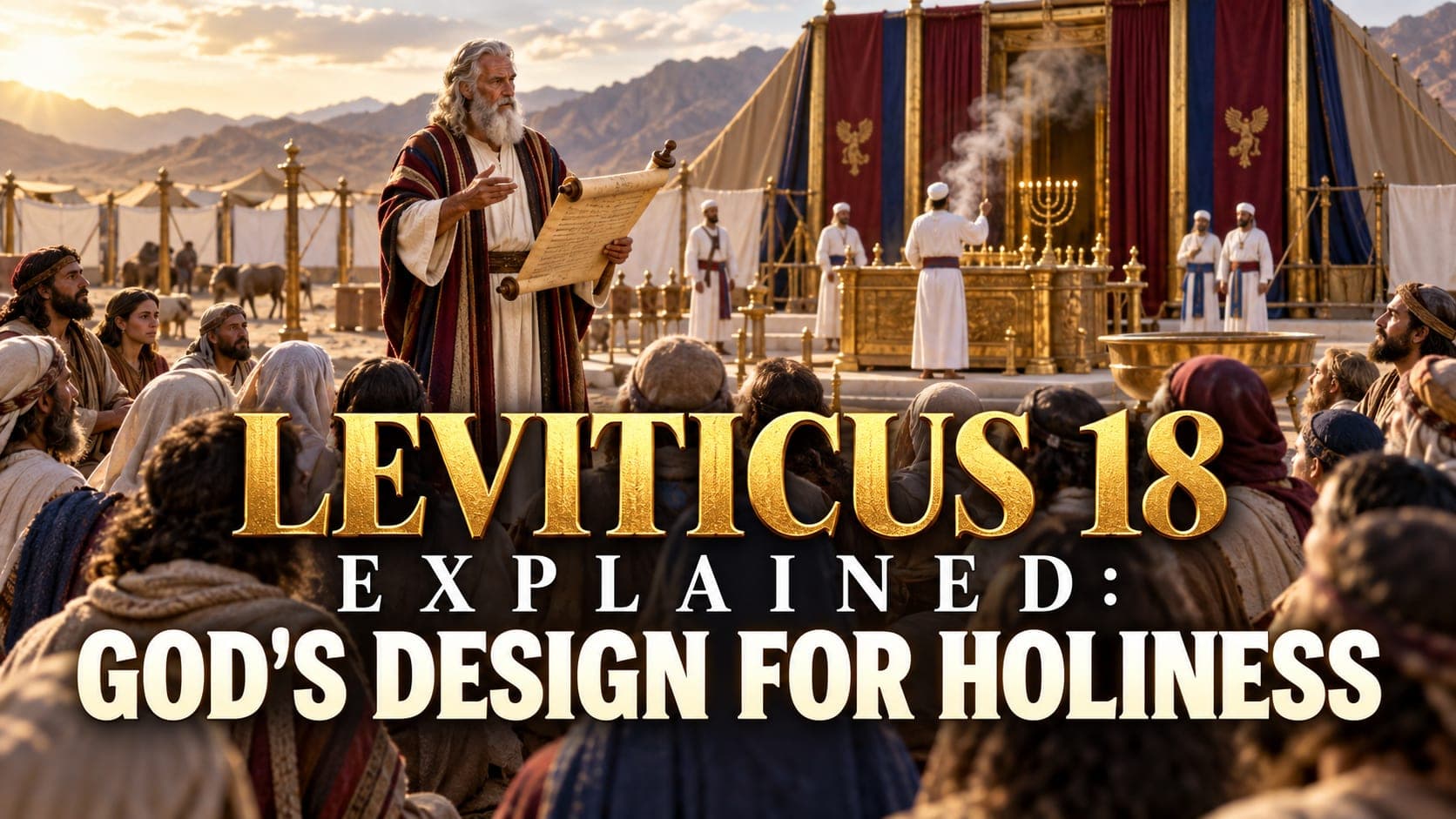
📖 Leviticus 18 Explained: The Laws Against Sexual Immorality
No altar in this chapter. No priest, no bird, no bullock.
Leviticus 18 explained is the chapter where the law stops talking about what happens at the tabernacle door and starts talking about what happens behind a closed tent flap. Thirty verses, one word repeated over and over, "nakedness," and a single command underneath all of it: some doors in a family stay shut, for good.
Maybe this is a chapter you have skipped past, assuming it has nothing to teach you today.
- ❓ Why does "uncover nakedness" get repeated so many times in one chapter?
- ❓ Did Jacob break this law when he married both Leah and Rachel?
- ❓ Why does a command about child sacrifice sit in the middle of a list about sex?
- ❓ And why does the chapter end by warning that the land itself can vomit people out?
📌 Leviticus 18 is not a random list of taboos. It is Israel's God drawing one line around the most private room in human life and saying, Egypt and Canaan do not get to decide what happens in here. I do.
This walkthrough goes through the whole chapter in order: the warning that opens it, the boundaries inside the immediate family, the boundaries just outside it, the handful of lines named directly with no family connection at all, and the warning about the land itself that closes the chapter.
Read slowly. This chapter still names exactly what it means, with no euphemism softening it.
What Happened Just Before This Chapter
Leviticus 17 closed by telling Israel that blood belongs to the LORD alone, not to anyone's private table. That chapter drew one line around what could be eaten. This chapter draws another line around who could be touched.
The connection is not an accident. Leviticus 17 had already named "the doings of Egypt" once, the open field sacrifices Israel had been offering to idols instead of the LORD. Leviticus 18 opens by naming Egypt and Canaan again, this time for a completely different kind of practice Israel is about to walk straight into. A nation that had just left one culture behind, and was about to enter the land of another, is told plainly that neither culture gets to set the terms for what happens inside an Israelite family.

Leviticus 18 Explained Verse by Verse
1. "I Am the LORD Your God" (verses 1 to 5)
Before a single prohibition is named, the chapter spends five verses on something else entirely: who is speaking, and why that matters.
"After the doings of the land of Egypt, wherein ye dwelt, shall ye not do: and after the doings of the land of Canaan, whither I bring you, shall ye not do: neither shall ye walk in their ordinances."
📌 Israel is standing between two cultures named directly, the one they just left and the one they are about to enter, and told not to copy either one. Egypt was behind them. Canaan was ahead of them. Both had their own sexual customs. Neither one gets a vote in what Israel does.
The reason is stated as plainly as the law itself.
"Ye shall do my judgments, and keep mine ordinances, to walk therein: I am the LORD your God."
💡 Count how often this short phrase appears in just thirty verses. "I am the LORD" or "I am the LORD your God" shows up six separate times across this chapter, once in this opening and five more times before the list ends. Every single prohibition that follows rests on that one claim of authority, not on taste, not on culture, not on whatever Egypt or Canaan happened to be doing that generation.
✅ Verse 5 adds something easy to miss in a chapter mostly remembered for its prohibitions: "which if a man do, he shall live in them." These are framed as boundaries that lead to life, not a list designed only to restrict.
2. Inside the Immediate Family (verses 6 to 11)
The list proper opens with a single summary line that every verse after it will unpack one relationship at a time.
"None of you shall approach to any that is near of kin to him, to uncover their nakedness: I am the LORD."
📌 "Uncover nakedness" is this chapter's own idiom for sexual relations, not a euphemism added by later translators. The word "nakedness" alone appears twenty four times in thirty verses. "Near of kin" is the category. Every verse that follows names exactly who falls inside it.
"The nakedness of thy father, or the nakedness of thy mother, shalt thou not uncover: she is thy mother; thou shalt not uncover her nakedness."
"The nakedness of thy father’s wife shalt thou not uncover: it is thy father’s nakedness."
⚠️ Verse 8 covers a father's wife even where she is not the son's own mother, a real situation in a culture where men sometimes had more than one wife. Reuben would later be condemned for exactly this, lying with his father's concubine in Genesis 35, decades before this law was ever spoken at Sinai.
The list keeps moving outward, one relationship at a time, never slowing down.
"The nakedness of thy sister, the daughter of thy father, or daughter of thy mother, whether she be born at home, or born abroad, even their nakedness thou shalt not uncover."
"The nakedness of thy son’s daughter, or of thy daughter’s daughter, even their nakedness thou shalt not uncover: for theirs is thine own nakedness."
"The nakedness of thy father’s wife’s daughter, begotten of thy father, she is thy sister, thou shalt not uncover her nakedness."
💡 Verse 9 closes a loophole before anyone could even think to use it. A half sister, sharing only a father or only a mother, "born at home" or "born abroad," counts exactly the same as a full sister. The law does not grade kinship by degree of shared blood. It grades it by the relationship itself.
3. Beyond the Immediate Family: Aunts, In-Laws, and the Sister Clause (verses 12 to 18)
The list widens again, past parents and siblings into the wider household.
"Thou shalt not uncover the nakedness of thy father’s sister: she is thy father’s near kinswoman."
"Thou shalt not uncover the nakedness of thy mother’s sister: for she is thy mother’s near kinswoman."
"Thou shalt not uncover the nakedness of thy father’s brother, thou shalt not approach to his wife: she is thine aunt."
Both an aunt by blood and an aunt by marriage fall under the same word, "near kinswoman." The law treats marriage itself as creating real kinship, not just a legal arrangement that leaves the old boundaries untouched.
The same principle covers a daughter in law and a brother's wife.
"Thou shalt not uncover the nakedness of thy daughter in law: she is thy son’s wife; thou shalt not uncover her nakedness."
"Thou shalt not uncover the nakedness of thy brother’s wife: it is thy brother’s nakedness."
⚠️ This is the general rule for a brother's wife, stated with no exception written into it here. Genesis 38 shows a very different custom already practiced before this law, a childless widow married to her late husband's brother to continue his family line. That custom, levirate marriage, gets its own separate instruction later in Deuteronomy 25, specifically for a brother who died leaving no son. Leviticus 18:16 is not written with that narrow exception in view. It is the ordinary rule for every other case.
Two more verses close out this stretch of the list.
"Thou shalt not uncover the nakedness of a woman and her daughter, neither shalt thou take her son’s daughter, or her daughter’s daughter, to uncover her nakedness; for they are her near kinswomen: it is wickedness."
"Neither shalt thou take a wife to her sister, to vex her, to uncover her nakedness, beside the other in her life time."
📌 Verse 18 is the one verse in this section with real history already behind it when it was spoken. Genesis 29 records Jacob married to both Leah and Rachel, two sisters, at the same time, generations before Moses ever brought this law down from Sinai. Leviticus 18 does not go back and condemn Jacob. The law did not exist yet when he married them. What verse 18 does is close that exact door going forward, naming "beside the other in her life time" as the specific situation it forbids: marrying a wife's sister while the first wife is still living.
4. Two Everyday Boundaries (verses 19 and 20)
The chapter steps outside the family tree for a moment, into two situations any married Israelite could face.
"Also thou shalt not approach unto a woman to uncover her nakedness, as long as she is put apart for her uncleanness."
💡 This is the same monthly separation Leviticus 15 already laid out in detail. That chapter explained the uncleanness itself. This one simply adds it to the list of boundaries a husband does not cross.
"Moreover thou shalt not lie carnally with thy neighbour’s wife, to defile thyself with her."
⚠️ This is the one line in the whole chapter that has nothing to do with family at all. Adultery gets its own command here, and again later as one of the ten words Moses brought down from Sinai. Leviticus 18 treats it as part of the same larger category as everything around it, a boundary around whose body belongs to whom.
5. Three Lines the Text Will Not Soften (verses 21 to 23)
The list turns to three practices that stood out even among the nations Israel was about to displace, named with no family relationship attached to any of them.
"And thou shalt not let any of thy seed pass through the fire to Molech, neither shalt thou profane the name of thy God: I am the LORD."
📌 Child sacrifice to Molech sits in the middle of a list about sex because both belong to the same category in this chapter: what a person's own body and children exist for, and who actually gets to decide that. "Thy seed" is the same word used for offspring throughout Genesis. A practice tied to Canaanite worship, giving a child to be burned, is named as the clearest possible way a person could profane the LORD's name with what belonged to Him.
The next two verses turn back to sexual boundaries, and state them without qualification.
"Thou shalt not lie with mankind, as with womankind: it is abomination."
"Neither shalt thou lie with any beast to defile thyself therewith: neither shall any woman stand before a beast to lie down thereto: it is confusion."
⚠️ Both verses use strong, specific words. "Abomination" in verse 22 is the same word the chapter repeats three more times, as "abominations," once it sums up the whole list in the verses that close the chapter. "Confusion" in verse 23 names a disorder, a violation of the created order rather than an ordinary offense. Neither verse softens its own language, and this chapter does not ask the reader to.
6. The Land Itself Keeps Score (verses 24 to 30)
The chapter closes by widening the lens from individual Israelites to the nations Israel is about to replace.
"Defile not ye yourselves in any of these things: for in all these the nations are defiled which I cast out before you: And the land is defiled: therefore I do visit the iniquity thereof upon it, and the land itself vomiteth out her inhabitants."
📌 The land itself is pictured as sick, defiled by what was done on it, and finally vomiting out the people who defiled it. Canaan is not being emptied out so Israel can simply move in. The text says the practices just listed are the reason the previous inhabitants are being removed at all. Genesis 19 already showed one city in that same region judged for exactly this kind of corruption, generations before Israel ever left Egypt.
"Ye shall therefore keep my statutes and my judgments, and shall not commit any of these abominations; neither any of your own nation, nor any stranger that sojourneth among you:"
💡 Just like the blood law in Leviticus 17, this rule reaches past native born Israel to cover any foreigner living among them too. Nobody living inside Israel's camp gets a different standard.
The warning closes with the same severity it opened with.
"For whosoever shall commit any of these abominations, even the souls that commit them shall be cut off from among their people."
Israel is not told these boundaries are unique to them, a strange religious custom nobody else has to answer for. They are told the land they are about to inherit has already paid a price for ignoring them.

Hard Questions Leviticus 18 Raises
Did Jacob sin by marrying both Leah and Rachel, since verse 18 forbids marrying two sisters? The text of Leviticus 18 was spoken at Sinai, generations after Genesis 29 records Jacob's marriages. Scripture does not go back and apply this law to events that happened before it existed. What verse 18 does is close that door for Israel going forward, named specifically as marrying a wife's sister while the first wife is still alive.
Does verse 16's ban on a brother's wife contradict the levirate marriage custom in Genesis 38 and Deuteronomy 25? Leviticus 18:16 states the ordinary rule with no exception written into this chapter. Deuteronomy 25:5 and 6 later carve out one specific, narrow case: a man who died leaving his widow with no son. Genesis 38 shows that custom already practiced, and shows Onan condemned specifically for refusing to carry it out honestly. The general prohibition and the narrow exception sit in two different texts, each addressing a different situation.
Why is child sacrifice to Molech placed in the middle of a list about sexual boundaries? The text does not explain its own ordering, only the command. What can be said plainly is that verse 21 sits inside a chapter about what a person's body, children, and household exist for, and who gets to decide that. Canaanite worship of Molech and the sexual practices named around it were not separate categories to the nations Israel was displacing.
What does "it is abomination" in verse 22 actually mean, and how does the New Testament address it? The Hebrew text here is not disputed among scholars: it forbids sexual relations between men, using the same strong word the chapter later repeats, as "abominations," for the whole list it closes with. The New Testament returns to the same subject directly rather than leaving it only to this one verse, in passages like 1 Corinthians 6:9 and 10 and Romans 1:26 and 27. Most Christian traditions read Leviticus 18's moral commands, as distinct from its tabernacle-era ceremonial ones, as still reflecting God's standard, reaffirmed rather than reversed in the New Testament.
Do Christians today still have to keep the specific boundaries listed in this chapter? Most Christian traditions separate Israel's ceremonial law, tied to the tabernacle and its priesthood and fulfilled in Christ, from its moral law, understood as a lasting reflection of God's character. Leviticus 18's prohibitions on incest, adultery, and the practices named in verses 21 through 23 fall into that second category in how the New Testament treats them, named again rather than dropped.
Top Verses From Leviticus 18
1. Leviticus 18:4 and 5
"Ye shall do my judgments, and keep mine ordinances, to walk therein: I am the LORD your God. Ye shall therefore keep my statutes, and my judgments: which if a man do, he shall live in them: I am the LORD."
The verse that frames the entire chapter before a single prohibition is named: these boundaries are tied to the LORD's own authority, and framed as leading to life, not only restriction.
2. Leviticus 18:6
"None of you shall approach to any that is near of kin to him, to uncover their nakedness: I am the LORD."
The summary line every verse after it unpacks one relationship at a time, naming the category the entire chapter is built around.
3. Leviticus 18:21
"And thou shalt not let any of thy seed pass through the fire to Molech, neither shalt thou profane the name of thy God: I am the LORD."
The one command in the chapter with nothing to do with sexual boundaries directly, naming what a child belonged to, and who had no right to claim one.
4. Leviticus 18:24 and 25
"Defile not ye yourselves in any of these things: for in all these the nations are defiled which I cast out before you: And the land is defiled: therefore I do visit the iniquity thereof upon it, and the land itself vomiteth out her inhabitants."
The verse that reframes everything before it: Canaan was not emptied out at random. The text names exactly why its previous inhabitants lost the land.
5. Leviticus 18:30
"Therefore shall ye keep mine ordinance, that ye commit not any one of these abominable customs, which were committed before you, and that ye defile not yourselves therein: I am the LORD your God."
The chapter's closing line, tying everything back to the same claim it opened with: not culture, not custom, but the LORD's own ordinance.

Frequently Asked Questions About Leviticus 18
What is Leviticus 18 about?
Leviticus 18 lists the sexual boundaries Israel had to keep instead of copying the practices of Egypt and Canaan, covering relationships inside the family, adultery, child sacrifice to Molech, and several practices named directly with no family connection attached.
What does "uncover nakedness" mean in Leviticus 18?
It is this chapter's own repeated idiom for sexual relations. The word "nakedness" alone appears twenty four times across thirty verses, and each verse names exactly which relationship the idiom applies to.
Did Jacob break Leviticus 18:18 by marrying Leah and Rachel?
No. Genesis 29 records those marriages generations before Moses brought this law down from Sinai. Leviticus 18:18 closes that specific door going forward, naming marrying a wife's sister while she is still living as the case it forbids.
Why does Leviticus 18 forbid marrying a brother's wife when Deuteronomy allows it in one case?
Leviticus 18:16 states the ordinary rule. Deuteronomy 25:5 and 6 later give one narrow exception, for a brother who died leaving his widow with no son, so his family line would not end. Genesis 38 shows that custom already in practice before either law was written down.
Why does Leviticus 18 mention Molech in a list about sexual sins?
Verse 21 bans giving a child to be sacrificed to Molech, a Canaanite practice. The text does not explain its own placement, but it sits inside a chapter about what a person's body and children exist for, and who has no right to claim either one.
What does Leviticus 18:22 say, and how does the New Testament address it?
The verse forbids sexual relations between men, calling it abomination, the same word used for the other practices named around it. The New Testament returns to the subject directly in passages like 1 Corinthians 6:9 and 10 and Romans 1:26 and 27, which most Christian traditions read as reaffirming this standard rather than setting it aside.
Why does the chapter say the land itself was defiled?
Leviticus 18:24 and 25 say the nations already living in Canaan were removed because of the very practices just listed. The land is pictured as sick from what was done on it, not simply emptied out to make room for Israel.
Did these laws apply to foreigners living among Israel too?
Yes. Leviticus 18:26 names "any stranger that sojourneth among you" alongside native born Israel, the same pattern already used for the blood law in Leviticus 17. Nobody living inside the camp was held to a different standard.
What happened to someone who broke these laws?
Leviticus 18:29 says whoever committed these things would be "cut off from among their people," the same severe language used for the most serious offenses elsewhere in Leviticus.
Do Christians still have to follow Leviticus 18 today?
Most Christian traditions separate Israel's ceremonial law, fulfilled in Christ, from its moral law. Leviticus 18's sexual boundaries fall under the moral category, named again rather than dropped in New Testament passages addressing the same subjects.
Final Thoughts
Leviticus 18 is a hard chapter to read quickly, and it was never meant to be read quickly.
📌 Every boundary in this chapter answers the same question: who decides what a body is for. Egypt did not get a vote. Canaan did not get a vote. "I am the LORD" answers it six times in thirty verses.
📌 These were never framed only as restriction. Verse 5 calls them boundaries a person could do and live in, not simply a wall to avoid.
📌 The land itself is pictured as paying a price for ignoring them. Israel was warned before they ever crossed into Canaan, using that same land as proof.
You will likely never need to apply most of this chapter's specific cases to your own life. But the question underneath all of them has not gone away.
So here is your one next step.
Ask honestly whose terms you are letting set the boundaries in your own most private life, culture's, or the LORD's.