📖 Leviticus 23 Explained: Israel's Seven Feasts of the LORD
Open a calendar and you will find holidays scattered across the year with no obvious pattern.
Leviticus 23 explained is Israel's calendar, and it is nothing like that. Every date in this chapter is set by God Himself, every one of them is called holy, and every one of them teaches something a Sabbath, a Sunday, or a national holiday never could on its own.
Maybe you have only ever heard of Passover from this list.
- ❓ Why does a weekly rest day open a chapter about yearly festivals?
- ❓ Why are the loaves at one feast baked with leaven, when leaven is almost always forbidden in Leviticus?
- ❓ Why does a law about leaving food for the poor interrupt a list of holy days?
- ❓ And why does God command Israel to live in homemade huts for a week every year?
📌 Leviticus 23 is not a random list of holidays. It is a single year, drawn out in advance, with every major turn of Israel's story built into its dates.
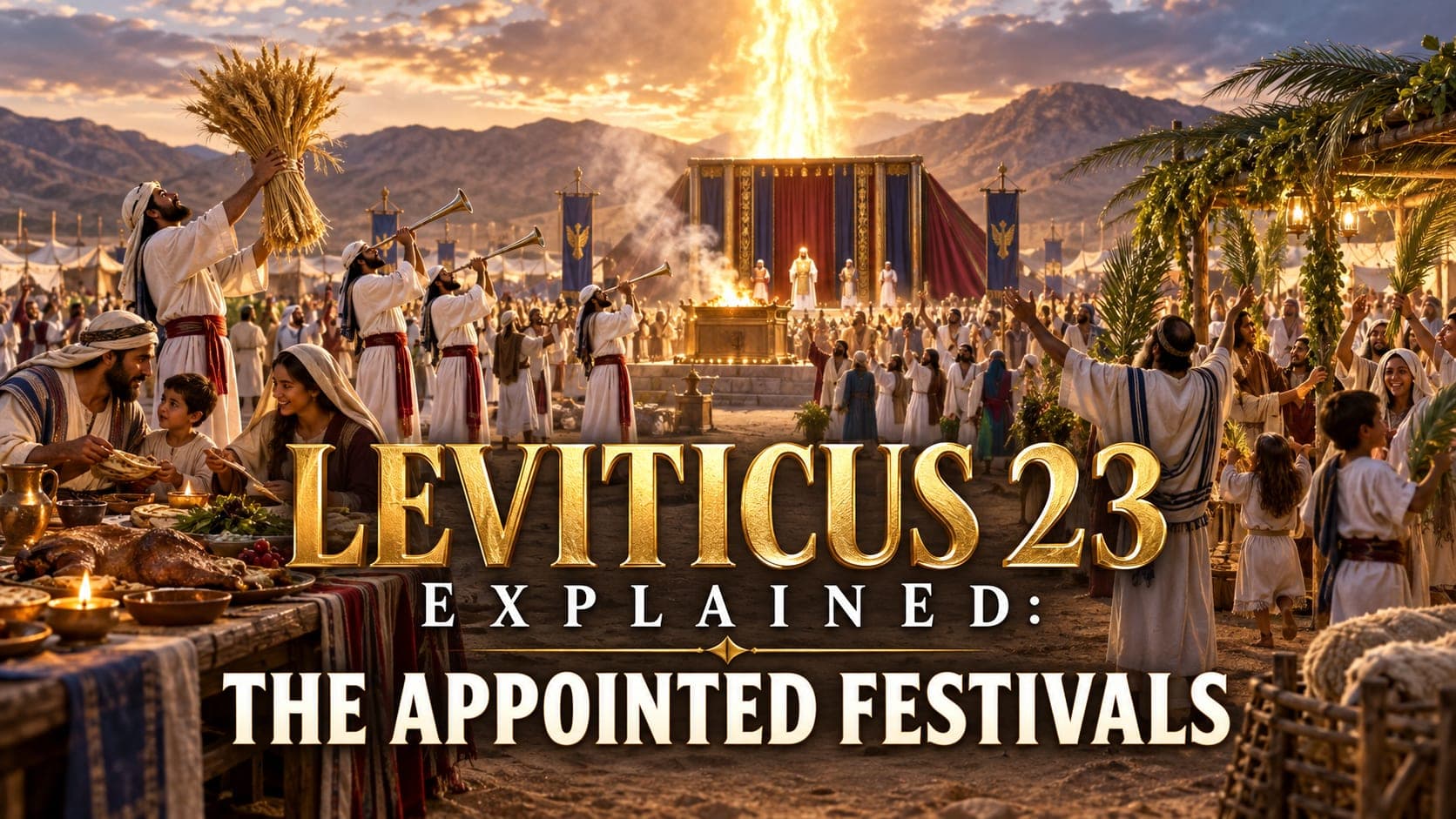
This walkthrough goes through the whole chapter in order: the weekly Sabbath that opens it, Passover and the days of unleavened bread, the wave sheaf of firstfruits, the feast fifty days later, the trumpets that announce the seventh month, the Day of Atonement, and the seven days spent living in booths.
Read slowly. This one chapter maps out an entire year of worship.
What Happened Just Before This Chapter
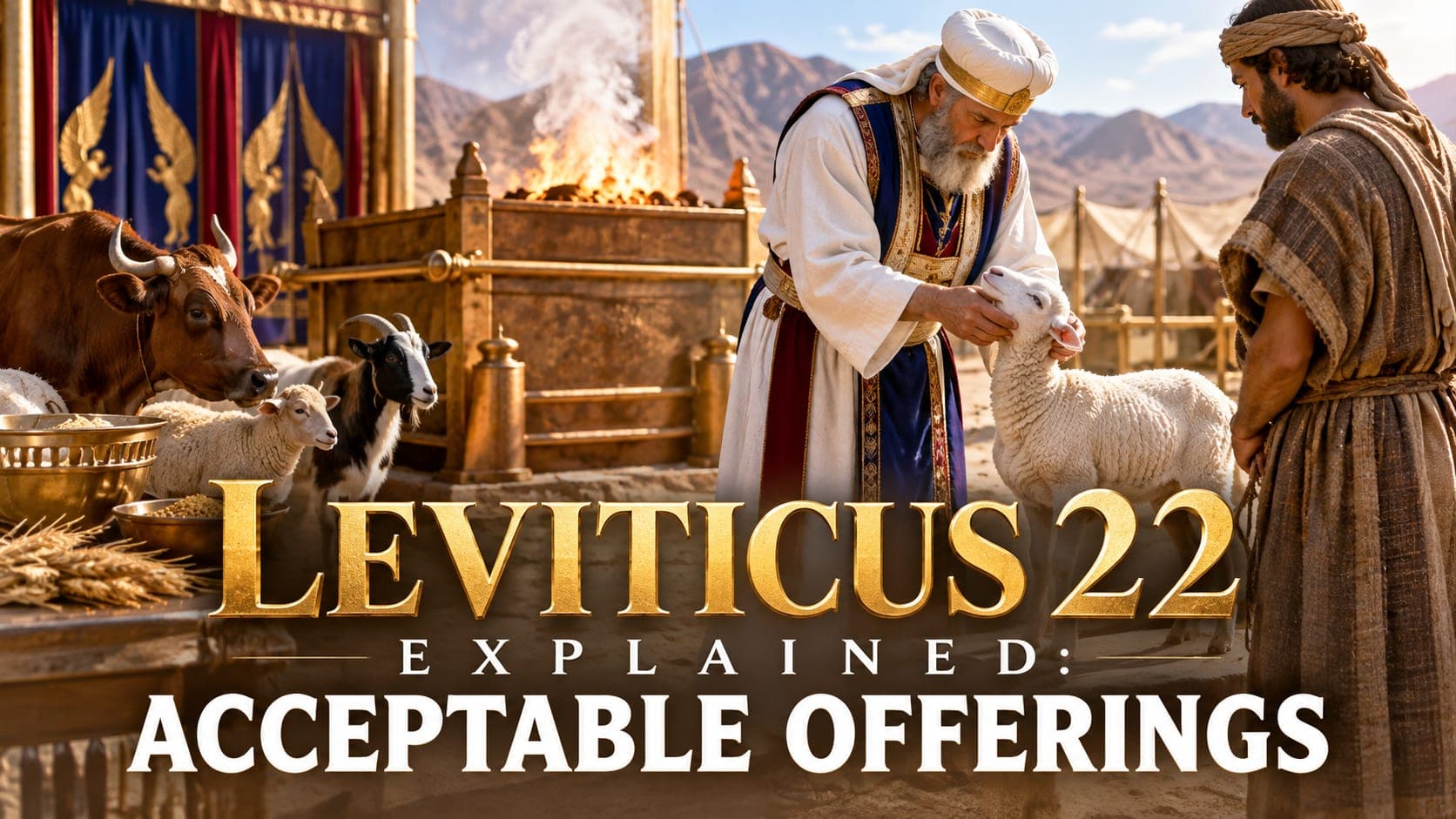
Leviticus 22 closed by asking whether the man eating the holy food, and the animal brought to the altar, were both clean enough and whole enough to come near the LORD. That chapter measured a single meal and a single offering.
Leviticus 23 widens the lens from one meal to an entire year. Instead of asking what makes one offering acceptable, it lays out every date on which Israel was required to stop, gather, and remember something God had done. The holiness that governed a single animal in the last chapter now governs the whole calendar in this one.

Leviticus 23 Explained Verse by Verse
1. The Sabbath Opens the List (verses 1 to 3)
Before naming a single yearly festival, the chapter names the oldest rhythm Israel already kept.
"Speak unto the children of Israel, and say unto them, Concerning the feasts of the LORD, which ye shall proclaim to be holy convocations, even these are my feasts."
"Six days shall work be done: but the seventh day is the sabbath of rest, an holy convocation; ye shall do no work therein: it is the sabbath of the LORD in all your dwellings."
📌 God calls the weekly Sabbath a holy convocation in the same breath He uses for the yearly festivals that follow. Every single week already carried a small version of what the big feasts would do once a year: stop working, gather, and remember who provides.
💡 Verses 2 through 44 use the word "feasts" or "holy convocation" so often that the chapter reads less like a law code and more like a calendar handed down from God Himself, with every date already filled in.
2. Passover and the Days of Unleavened Bread (verses 4 to 8)
The yearly calendar opens with the night Israel never stopped telling their children about.
"In the fourteenth day of the first month at even is the LORD's passover."
"And on the fifteenth day of the same month is the feast of unleavened bread unto the LORD: seven days ye must eat unleavened bread."
Exodus 12 already told the story behind this date: the lamb's blood on the doorposts, the angel of death passing over, the hurried meal eaten standing up. Leviticus 23 does not retell that story. It simply fixes the date on the calendar forever, the fourteenth day of the first month, so no generation after the exodus would ever forget which night it was.
📌 Passover happens on one evening. Unleavened Bread stretches across the week right after it. The first and seventh days of that week are holy convocations with no work done, bracketing five ordinary days in between where the only requirement was what Israel did not eat.
3. The Wave Sheaf of Firstfruits (verses 9 to 14)
In the middle of that same week, a second observance begins, tied not to Egypt but to the harvest ahead.
"Speak unto the children of Israel, and say unto them, When ye be come into the land which I give unto you, and shall reap the harvest thereof, then ye shall bring a sheaf of the firstfruits of your harvest unto the priest: And he shall wave the sheaf before the LORD, to be accepted for you: on the morrow after the sabbath the priest shall wave it."
💡 Before Israel could eat a single loaf of bread from the new harvest, the very first cut sheaf had to be brought to the priest and waved before God. No one touched the rest of the crop until the first portion had already been handed over.
⚠️ Verse 14 makes the order strict: no bread, no roasted grain, no fresh ears from the new harvest until this offering was made. The first and best came before anyone's own table did.
"And ye shall eat neither bread, nor parched corn, nor green ears, until the selfsame day that ye have brought an offering unto your God: it shall be a statute for ever throughout your generations in all your dwellings."
4. Fifty Days Later: The Feast of Weeks (verses 15 to 22)
From the day the first sheaf was waved, Israel started counting.
"And ye shall count unto you from the morrow after the sabbath, from the day that ye brought the sheaf of the wave offering; seven sabbaths shall be complete: Even unto the morrow after the seventh sabbath shall ye number fifty days; and ye shall offer a new meat offering unto the LORD."
Seven full weeks, then one more day, fifty days in all. This is the feast Greek speaking Jews later called Pentecost, simply the word for fiftieth. Where the firstfruits offering was a single sheaf of raw grain, this one asks for finished bread.
"Ye shall bring out of your habitations two wave loaves of two tenth deals: they shall be of fine flour; they shall be baken with leaven; they are the firstfruits unto the LORD."
⚠️ Leaven disqualified almost every other grain offering in this book, yet these two loaves require it. The text does not explain the difference. What it does say plainly is that these loaves were called firstfruits in their own right, the first baked bread from a harvest that began with a single waved sheaf fifty days earlier.
Right in the middle of this festival's offering list, the chapter drops a rule that has nothing to do with grain or leaven at all.
"And when ye reap the harvest of your land, thou shalt not make clean riddance of the corners of thy field when thou reapest, neither shalt thou gather any gleaning of thy harvest: thou shalt leave them unto the poor, and to the stranger: I am the LORD your God."
📌 A harvest festival built entirely around giving God the first and the best still makes room, in its own closing line, for the poor and the stranger to eat. Leviticus 19 already gave this exact gleaning command once before. Here it returns, placed where every farmer in Israel would hear it again at the very moment the harvest was on his mind.
5. The Memorial of Trumpets (verses 23 to 25)
After the spring festivals, the chapter jumps forward to the seventh month, and opens it with a sound rather than a meal.
"Speak unto the children of Israel, saying, In the seventh month, in the first day of the month, shall ye have a sabbath, a memorial of blowing of trumpets, an holy convocation."
💡 No harvest, no bread, no sheaf. Just rest from work and the sound of trumpets, announcing that the most solemn stretch of Israel's whole year had just begun. Everything from here to the end of the chapter happens inside this same seventh month.
6. The Day of Atonement (verses 26 to 32)
Ten days after the trumpets sound, the calendar reaches the one day with the heaviest weight of the whole year.
"Also on the tenth day of this seventh month there shall be a day of atonement: it shall be an holy convocation unto you; and ye shall afflict your souls, and offer an offering made by fire unto the LORD."
Leviticus 16 already laid out the actual ceremony for this day, the two goats, the blood brought into the most holy place, the scapegoat sent away carrying Israel's sin into the wilderness. Leviticus 23 does not repeat any of that. It only fixes the date and states what every Israelite, not just the high priest, had to do that day.
"For whatsoever soul it be that shall not be afflicted in that same day, he shall be cut off from among his people."
⚠️ "Afflict your souls" is never spelled out in this chapter, but Jewish tradition has consistently understood it to include fasting. This was the one day on Israel's calendar built entirely around going without, while the high priest worked on everyone else's behalf.
7. Seven Days in Booths: The Feast of Tabernacles (verses 33 to 44)
Five days after the fasting of atonement, the year's calendar turns to its longest and most joyful feast.
"Speak unto the children of Israel, saying, The fifteenth day of this seventh month shall be the feast of tabernacles for seven days unto the LORD."
"And ye shall take you on the first day the boughs of goodly trees, branches of palm trees, and the boughs of thick trees, and willows of the brook; and ye shall rejoice before the LORD your God seven days."
Branches, palms, and willows built into shelters were not a backdrop for a festival. They were the point of it.
"Ye shall dwell in booths seven days; all that are Israelites born shall dwell in booths: That your generations may know that I made the children of Israel to dwell in booths, when I brought them out of the land of Egypt: I am the LORD your God."
📌 For one week every year, long after Israel had houses, fields, and a land of their own, every family had to leave the house and sleep under branches again. The feast that closes the calendar is also the one that most deliberately makes a settled people remember what it felt like to have nothing but a tent and God's provision.
Hard Questions Leviticus 23 Raises
Why does the weekly Sabbath open a chapter otherwise about yearly festivals? Verse 3 calls it a holy convocation using the exact same term used for Passover, Trumpets, and every feast after it. The text treats the weekly rhythm and the yearly one as the same kind of appointment with God, just spaced differently.
Why are the two loaves at the Feast of Weeks baked with leaven, when leaven is forbidden almost everywhere else in Leviticus? Verse 17 states the instruction plainly without explaining the exception. What can be said honestly is that these loaves were ordinary baked bread, called firstfruits of the grain harvest rather than an offering burned on the altar, and the altar offerings elsewhere in this book are the ones that exclude leaven.
Why does a gleaning law for the poor and the stranger show up in the middle of a festival calendar? Verse 22 gives no reason beyond repeating a command already given in Leviticus 19. Placed where it is, right after the instructions for the harvest festival, it lands at the exact moment a farmer would be thinking hardest about his own crop.
Do these feasts point forward to anything beyond Israel's own calendar? Later New Testament writers draw direct lines from several of them to events in Jesus's life. Paul calls Christ "our passover," and Christians have long read the timing of His resurrection against the wave sheaf of firstfruits.
"But now is Christ risen from the dead, and become the firstfruits of them that slept."
"And when the day of Pentecost was fully come, they were all with one accord in one place."
📌 The Holy Spirit came on the exact feast fifty days after firstfruits names in this chapter. Christians have long read that timing as more than a coincidence, though Leviticus 23 itself never states that connection; it only sets the dates that the events in Acts would later land on.
Top Verses From Leviticus 23
1. Leviticus 23:2
"Speak unto the children of Israel, and say unto them, Concerning the feasts of the LORD, which ye shall proclaim to be holy convocations, even these are my feasts."
The verse that names the whole chapter's subject in one line. Every date that follows belongs to God first, not to Israel's own tradition.
2. Leviticus 23:11
"And he shall wave the sheaf before the LORD, to be accepted for you: on the morrow after the sabbath the priest shall wave it."
The single waved sheaf that opened Israel's harvest to God before anyone ate from it, and the verse Christians most often connect to the timing of the resurrection.
3. Leviticus 23:22
"And when ye reap the harvest of your land, thou shalt not make clean riddance of the corners of thy field when thou reapest, neither shalt thou gather any gleaning of thy harvest: thou shalt leave them unto the poor, and to the stranger: I am the LORD your God."
A single line of mercy for the poor, dropped in the middle of a chapter otherwise focused entirely on what Israel owed God.
4. Leviticus 23:27
"Also on the tenth day of this seventh month there shall be a day of atonement: it shall be an holy convocation unto you; and ye shall afflict your souls, and offer an offering made by fire unto the LORD."
The heaviest day on Israel's calendar, named here only by its date and its demand, with the full ceremony left to Leviticus 16.
5. Leviticus 23:43
"That your generations may know that I made the children of Israel to dwell in booths, when I brought them out of the land of Egypt: I am the LORD your God."
The reason stated plainly for the whole feast of booths, so no generation settled in the land would forget where it had come from.
Frequently Asked Questions About Leviticus 23
What is Leviticus 23 about?
Leviticus 23 lists every holy day on Israel's calendar for the year: the weekly Sabbath, Passover and Unleavened Bread, the wave sheaf of firstfruits, the Feast of Weeks, the memorial of Trumpets, the Day of Atonement, and the Feast of Tabernacles.
Why does the Sabbath appear in a chapter about yearly feasts?
Verse 3 calls the weekly Sabbath a holy convocation using the same language used for every feast listed after it. The chapter treats the weekly rest and the yearly festivals as the same kind of appointed time with God.
What is the difference between Passover and the Feast of Unleavened Bread?
Verses 5 and 6 set Passover as a single evening, the fourteenth day of the first month, and the Feast of Unleavened Bread as the seven days right after it, during which no leavened bread could be eaten.
What was the wave sheaf offering?
Verses 10 and 11 describe a single sheaf cut from the new harvest and waved before the LORD by the priest, offered before anyone was allowed to eat bread, roasted grain, or fresh ears from that same harvest.
Why were the Feast of Weeks loaves baked with leaven?
Verse 17 simply states that the two wave loaves were baked with leaven, unlike most other offerings in Leviticus. The text does not explain the exception, only that these loaves were ordinary baked bread offered as firstfruits, not a burnt offering on the altar.
What does "afflict your souls" mean on the Day of Atonement?
The chapter does not define the phrase, but Jewish tradition has long understood it to include fasting. Verse 29 attaches a serious consequence to ignoring it, being cut off from the people.
Why did Israel have to live in booths for the Feast of Tabernacles?
Verse 43 states the reason directly: so every later generation would remember living in booths when God brought their ancestors out of Egypt, even after they had houses and land of their own.
Do Christians today still have to keep these feasts?
Colossians 2:16 and 17 tells believers not to be judged over holy days, calling them a shadow of what was still to come in Christ. Most Christian traditions read Israel's festival calendar as fulfilled rather than required, while still valuing what each feast taught.
"Let no man therefore judge you in meat, or in drink, or in respect of an holyday, or of the new moon, or of the sabbath days: Which are a shadow of things to come; but the body is of Christ."
How does Leviticus 23 connect to Jesus?
1 Corinthians 5:7 calls Christ "our passover," and 1 Corinthians 15:20 calls His resurrection the firstfruits of the dead, language drawn straight from this chapter's calendar. Christians have long read the timing of Pentecost in Acts 2 the same way, landing on the exact feast Leviticus 23 places fifty days after firstfruits.
Final Thoughts
Leviticus 23 can read like a list of dates, until you notice what each one was built to do.
📌 Every feast on this calendar remembers something God already did, before it asks anything of the people keeping it. Passover remembers a rescue. Firstfruits remembers a provided harvest. Tabernacles remembers a wilderness survived.
📌 Rest and remembering were never optional extras. From the weekly Sabbath to the week spent sleeping under branches, God kept pulling His people away from their normal routine so they would not forget who was actually providing for them.
📌 Even a calendar this carefully set made room for someone else's harvest. Right in the middle of a festival about the firstfruits Israel owed God, the poor and the stranger were still named and given a share.
You keep no feast exactly like these today. But the question behind the whole chapter still reaches you: whether your own calendar has any days set aside to stop and remember what God has already done for you.
So here is your one next step.
Pick one thing God has done for you this year, and set one day this month to stop and actually remember it, the way this entire chapter asked Israel to do.