📖 Leviticus 16 Explained: The Day of Atonement and the Scapegoat
One day a year. One man. Every sin the whole nation carried, loaded onto an animal and marched out of camp for good.
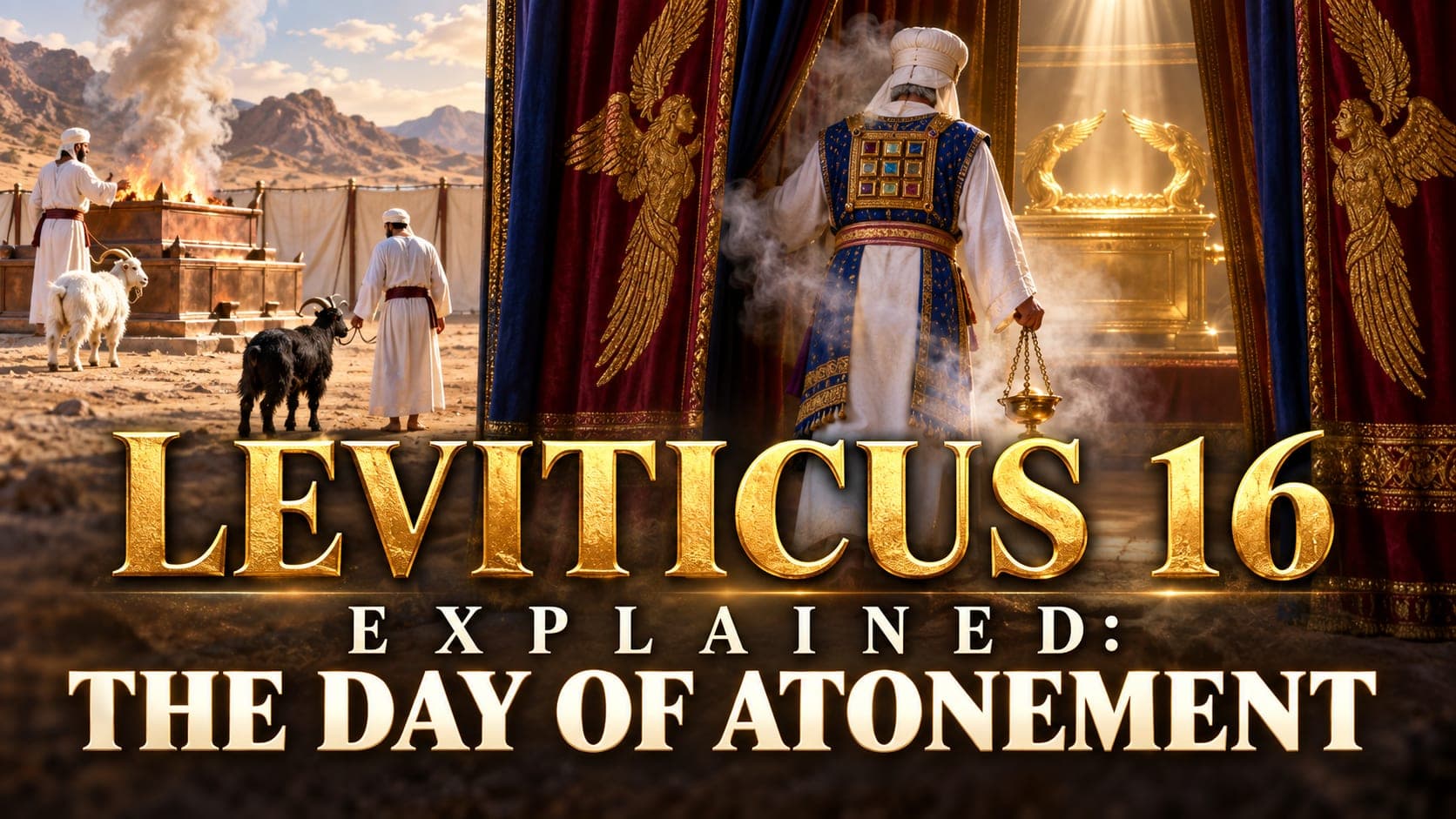
Leviticus 16 explained is the Day of Atonement, the single most solemn day in Israel's calendar. Aaron strips down to plain linen, kills a bullock for his own sin before he can touch anyone else's, carries blood and incense behind a veil most people will never see past, and then does something no other chapter in Leviticus asks for: he lays both hands on a live goat, speaks every sin of Israel over its head, and sends it away into land no one will ever walk into again.
Maybe you have only ever heard this chapter summed up as "the scapegoat one."
- ❓ Why does Aaron need his own sin offering before he can offer anything for anyone else?
- ❓ Why two goats instead of one, and why does only one of them actually die?
- ❓ Why would entering the wrong room on the wrong day kill the high priest himself?
- ❓ And why does one chapter cover both "your own country" and "a stranger" in the very same sentence?
📌 Leviticus 16 never covers one sin or one kind of person. It covers all of it, for everyone, once a year, on purpose.
This walkthrough goes through the whole chapter in order: why Aaron cannot simply walk behind the veil, the sin offering he brings for himself before anything else, the two goats and the lot cast between them, the blood carried into the holiest room in the camp, the goat that carries the nation's sin into the wilderness, and the statute that made this one day different from every other day of the year.
Read slowly. This chapter is the hinge the book of Hebrews keeps swinging back to.
What Happened Just Before This Chapter
Leviticus 15 closed with a single sentence that explained why thirty three verses on ordinary bodily discharge had ever mattered: "that they die not in their uncleanness, when they defile my tabernacle that is among them." A holy God was living in the middle of an ordinary camp, and uncleanness of every kind, little and large, could reach the place He met His people.
Leviticus 16 opens by naming the chapter that proved exactly how serious that was. "After the death of the two sons of Aaron" points straight back to Leviticus 10, where Nadab and Abihu offered strange fire before the LORD and died for it. Everything that follows in this chapter, every garment, every washing, every warning, is written in the shadow of two priests who treated something holy carelessly and did not survive it.

Leviticus 16 Explained Verse by Verse
1. Why Aaron Cannot Simply Walk Behind the Veil (verses 1 to 5)
The chapter opens with a warning that names the danger before it names the day.
"And the LORD said unto Moses, Speak unto Aaron thy brother, that he come not at all times into the holy place within the vail before the mercy seat, which is upon the ark; that he die not: for I will appear in the cloud upon the mercy seat."
📌 "Not at all times" is the whole chapter in four words. The space behind the veil was not forbidden outright. It was restricted to one man, on one day, under one very specific set of conditions. Stepping past that veil on any other terms is exactly what killed Nadab and Abihu.
Before Aaron goes anywhere, he changes clothes.
"He shall put on the holy linen coat, and he shall have the linen breeches upon his flesh, and shall be girded with a linen girdle, and with the linen mitre shall he be attired: these are holy garments; therefore shall he wash his flesh in water, and so put them on."
💡 This is not the gold, blue, and scarlet ephod and breastplate Aaron wore at his own ordination. It is plain white linen, the same fabric an ordinary priest wore. On the one day Aaron represents the whole nation before God, he dresses down, not up.
Then two separate sets of animals arrive, one for Aaron, one for the people.
"And he shall take of the congregation of the children of Israel two kids of the goats for a sin offering, and one ram for a burnt offering."
⚠️ Aaron already brought his own bullock and ram in verse 3. The congregation's two goats are a separate provision entirely. From the very first verse, this chapter keeps the high priest's own sin and the nation's sin as two distinct problems, never one standing in for the other.
2. A Sin Offering for Himself Before Anything Else (verse 6, verses 11 to 14)
Before Aaron can represent anyone else, the law makes him deal with his own account first.
"And Aaron shall offer his bullock of the sin offering, which is for himself, and make an atonement for himself, and for his house."
📌 Not even the high priest skips this line. The man who will carry Israel's sin into the holiest room in the camp cannot do it until his own sin and his household's sin are covered first.
Only after that does Aaron carry anything behind the veil, and he does not go in empty handed.
"And he shall take a censer full of burning coals of fire from off the altar before the LORD, and his hands full of sweet incense beaten small, and bring it within the vail: And he shall put the incense upon the fire before the LORD, that the cloud of the incense may cover the mercy seat that is upon the testimony, that he die not:"
💡 The cloud of incense is not decoration. The text says plainly why it is there: "that he die not." Whatever it meant to stand that close to the mercy seat, Aaron does not approach it in the open.
"And he shall take of the blood of the bullock, and sprinkle it with his finger upon the mercy seat eastward; and before the mercy seat shall he sprinkle of the blood with his finger seven times."
Seven sprinklings, the same number used at a healed leper's cleansing. This chapter did not invent a new pattern for its most important moment. It reused the number already stamped across the rest of the book.
3. Two Goats, and a Lot Cast Between Them (verses 7 to 10)
The congregation's two goats from verse 5 now come forward together, and their paths split by a decision Aaron does not make himself.
"And he shall take the two goats, and present them before the LORD at the door of the tabernacle of the congregation. And Aaron shall cast lots upon the two goats; one lot for the LORD, and the other lot for the scapegoat."
⚠️ Nothing about the goats themselves marks one for death and one for the wilderness. Aaron casts lots, which means the outcome is not his to choose. Which goat dies and which goat lives is settled before he ever lays a hand on either one.
"And Aaron shall bring the goat upon which the LORD's lot fell, and offer him for a sin offering. But the goat, on which the lot fell to be the scapegoat, shall be presented alive before the LORD, to make an atonement with him, and to let him go for a scapegoat into the wilderness."
💡 The Hebrew word behind "scapegoat" is genuinely debated among scholars. Some read it as a description, roughly "the goat that departs." Others read it as a proper name tied to the wilderness place the goat was sent to. Leviticus 16 itself never settles which reading is right. What the text does settle plainly is what happens to the goat either way: it stays alive, and it does not come back.
4. The Goat for the People, and the Holy Place Itself Cleansed (verses 15 to 19)
The goat chosen by the LORD's lot is killed, and its blood is carried behind the veil the exact same way the bullock's blood was.
"Then shall he kill the goat of the sin offering, that is for the people, and bring his blood within the vail, and do with that blood as he did with the blood of the bullock, and sprinkle it upon the mercy seat, and before the mercy seat:"
📌 The people's sin gets the identical treatment Aaron's own sin just got. No lesser blood, no shorter process, no second class ritual. What follows answers the exact sentence Leviticus 15 ended on.
"And he shall make an atonement for the holy place, because of the uncleanness of the children of Israel, and because of their transgressions in all their sins: and so shall he do for the tabernacle of the congregation, that remaineth among them in the midst of their uncleanness."
That is almost word for word the problem Leviticus 15:31 named: a tabernacle sitting in the middle of an unclean people's uncleanness. This is the day that answer finally arrives.
While it happens, no one else is even allowed to be present.
"And there shall be no man in the tabernacle of the congregation when he goeth in to make an atonement in the holy place, until he come out, and have made an atonement for himself, and for his household, and for all the congregation of Israel."
⚠️ Not even an assistant. Every other offering in this book involves other priests carrying, holding, catching blood in basins. This one is Aaron, alone, for the whole nation. Then the atonement reaches outward, one piece of furniture at a time.
"And he shall go out unto the altar that is before the LORD, and make an atonement for it; and shall take of the blood of the bullock, and of the blood of the goat, and put it upon the horns of the altar round about. And he shall sprinkle of the blood upon it with his finger seven times, and cleanse it, and hallow it from the uncleanness of the children of Israel."
Mercy seat, then holy place, then tabernacle, then the altar outside it. Nothing the nation's sin could have reached is skipped.
5. The Scapegoat Carries the Sin Away (verses 20 to 22)
With the sanctuary itself cleansed, Aaron turns to the second goat, still standing alive where it was presented in verse 10.
"And when he hath made an end of reconciling the holy place, and the tabernacle of the congregation, and the altar, he shall bring the live goat: And Aaron shall lay both his hands upon the head of the live goat, and confess over him all the iniquities of the children of Israel, and all their transgressions in all their sins, putting them upon the head of the goat, and shall send him away by the hand of a fit man into the wilderness:"
📌 This is the only moment in the whole book of Leviticus where sin is spoken out loud over an animal by name. Every other sin offering is silent. Here, Aaron confesses, specifically and audibly, with both hands pressed on the goat's head, before it is ever sent anywhere.
"And the goat shall bear upon him all their iniquities unto a land not inhabited: and he shall let go the goat in the wilderness."
⚠️ "A land not inhabited" is not a minor detail. The goat is not released near the camp where it might wander back. It is sent somewhere no person lives, carrying something that is never meant to return.
6. Coming Back Out: Washing, Garments, and What Gets Burned (verses 23 to 28)
The holiest part of the day is finished, but the chapter is not ready to call anyone clean yet.
"And Aaron shall come into the tabernacle of the congregation, and shall put off the linen garments, which he put on when he went into the holy place, and shall leave them there: And he shall wash his flesh with water in the holy place, and put on his garments, and come forth, and offer his burnt offering, and the burnt offering of the people, and make an atonement for himself, and for the people."
💡 The plain linen he wore behind the veil is left behind entirely, not folded away for next year. Only after washing does Aaron put on his regular garments again and come out to finish the burnt offerings in front of everyone.
Two other men carry out their own parts of the day, and neither one walks back into camp without washing first.
"And he that let go the goat for the scapegoat shall wash his clothes, and bathe his flesh in water, and afterward come into the camp."
"And the bullock for the sin offering, and the goat for the sin offering, whose blood was brought in to make atonement in the holy place, shall one carry forth without the camp; and they shall burn in the fire their skins, and their flesh, and their dung. And he that burneth them shall wash his clothes, and bathe his flesh in water, and afterward he shall come into the camp."
📌 Every single person who had contact with what carried the nation's sin, even just leading a goat away or lighting a fire outside the camp, had to wash before coming back. Atonement did not make the process itself untouchable. It made touching it something that still needed washing afterward, the same ordinary pattern already run on contact with uncleanness one chapter earlier.
7. A Statute Forever: One Day, All Your Sins (verses 29 to 34)
The chapter closes by fixing this day permanently on Israel's calendar.
"And this shall be a statute for ever unto you: that in the seventh month, on the tenth day of the month, ye shall afflict your souls, and do no work at all, whether it be one of your own country, or a stranger that sojourneth among you: For on that day shall the priest make an atonement for you, to cleanse you, that ye may be clean from all your sins before the LORD."
📌 "Clean from all your sins" is language this book rarely uses. Most offerings in Leviticus answer one specific wrong. This day answers everything, for every Israelite and every foreigner living among them, in the same sentence.
"And this shall be an everlasting statute unto you, to make an atonement for the children of Israel for all their sins once a year. And he did as the LORD commanded Moses."
The chapter that opened with two priests who did not do as the LORD commanded closes with Aaron, this time, doing exactly as he was told.

Hard Questions Leviticus 16 Raises
What does the Hebrew word behind "scapegoat" actually mean? Scholars genuinely disagree. One widely held view reads it as a description of the goat's function, "the goat that departs" or is sent away. Another reads it as a proper name attached to the wilderness location itself. Leviticus 16 does not settle the question, and any confident claim beyond those two readings goes further than the text does.
Did the goat really carry sin away, in some physical sense? The chapter never explains a mechanism. What it records plainly is an act: confession spoken aloud with both hands on the animal's head, then the animal sent somewhere it cannot return from. Whatever is happening, the text presents it as something enacted and witnessed, not as a magic transfer it tries to describe scientifically.
Why could only the high priest enter, and only once a year? Hebrews draws the connection directly. "The Holy Ghost this signifying, that the way into the holiest of all was not yet made manifest, while as the first tabernacle was yet standing," from Hebrews 9:8, reads the limited access itself as a message, a door that was real but not yet fully open. Nadab and Abihu's deaths in Leviticus 10 show what happened to anyone who tried that door on other terms.
How does the New Testament say this day was fulfilled? Hebrews 9 draws the comparison as plainly as any chapter in the New Testament does.
"Neither by the blood of goats and calves, but by his own blood he entered in once into the holy place, having obtained eternal redemption for us."
"Nor yet that he should offer himself often, as the high priest entereth into the holy place every year with blood of others; For then must he often have suffered since the foundation of the world: but now once in the end of the world hath he appeared to put away sin by the sacrifice of himself."
📌 What Leviticus 16 required once a year, every year, without end, Hebrews says happened once, and did not need to happen again. Many Christian readers also notice that Leviticus 16's two goats, one killed and one sent away alive, together picture two things the New Testament says Christ did at once: paying the penalty, and carrying guilt completely out of reach. That is a Christian reading drawn from the pattern, not a meaning Leviticus 16 states for itself.
Is Yom Kippur today the same ritual as Leviticus 16? Not in its form. Jewish communities still observe Yom Kippur as the most solemn day of the year, marked by fasting and repentance, but without animal sacrifice, since no standing temple or tabernacle has existed since the year 70. The day survives. The ritual this chapter describes required a tabernacle that no longer stands.
Top Verses From Leviticus 16
1. Leviticus 16:2
"Speak unto Aaron thy brother, that he come not at all times into the holy place within the vail before the mercy seat, which is upon the ark; that he die not: for I will appear in the cloud upon the mercy seat."
The restriction that frames the entire chapter: not forbidden outright, but limited to one man, one day, under conditions that cost Nadab and Abihu their lives to ignore.
2. Leviticus 16:10
"But the goat, on which the lot fell to be the scapegoat, shall be presented alive before the LORD, to make an atonement with him, and to let him go for a scapegoat into the wilderness."
Decided by lot, not by Aaron's own choice, one goat's entire fate is to stay alive and carry something away for good.
3. Leviticus 16:21 and 22
"And Aaron shall lay both his hands upon the head of the live goat, and confess over him all the iniquities of the children of Israel, and all their transgressions in all their sins, putting them upon the head of the goat, and shall send him away by the hand of a fit man into the wilderness: And the goat shall bear upon him all their iniquities unto a land not inhabited."
The only place in Leviticus where sin is spoken aloud, by name, over an animal before it is sent somewhere it can never come back from.
4. Leviticus 16:30
"For on that day shall the priest make an atonement for you, to cleanse you, that ye may be clean from all your sins before the LORD."
Not one sin, named and answered, the way most of Leviticus works. All of them, on one day, for everyone standing in the camp.
5. Leviticus 16:34
"And this shall be an everlasting statute unto you, to make an atonement for the children of Israel for all their sins once a year. And he did as the LORD commanded Moses."
The chapter's own closing line, obedience answering the disobedience that opened it back in Leviticus 10.

Frequently Asked Questions About Leviticus 16
What is Leviticus 16 about?
Leviticus 16 lays out the Day of Atonement, the one day a year the high priest enters the Most Holy Place, offers a sin offering for himself and his house, cleanses the sanctuary with blood, and sends a second goat into the wilderness carrying the confessed sins of the whole nation.
What is the Day of Atonement in the Bible?
It is the yearly observance Leviticus 16:29 and 30 sets on the tenth day of the seventh month, when the priest makes atonement so the people are clean from all their sins before the LORD. It later becomes the holiday known as Yom Kippur.
What were the two goats in Leviticus 16 for?
Lots were cast over them in verses 7 and 8. One goat, chosen by the LORD's lot, was killed as a sin offering and its blood carried into the Most Holy Place. The other was kept alive, had Israel's sins confessed over it, and was sent into the wilderness.
What does "scapegoat" mean in the Bible?
The underlying Hebrew word is debated among scholars, read either as a description of a goat that departs or as a name tied to the wilderness place it was sent to. What the text makes clear either way is the goat's fate: kept alive, then released where it would never return.
Why could only the high priest enter the Most Holy Place, and only once a year?
Leviticus 16:2 ties the restriction directly to Aaron's own safety, "that he die not," written in the shadow of Leviticus 10, where his sons died for treating a holy space carelessly. Hebrews 9:8 later reads that same limited access as a deliberate sign that full access had not yet been opened.
What is the mercy seat?
It is the covering of the ark inside the Most Holy Place, named in Leviticus 16:2 and 14 as the exact spot where Aaron sprinkles blood seven times and where the LORD says He will appear in the cloud.
Why did Aaron wear plain linen instead of his usual priestly garments?
Leviticus 16:4 puts him in a plain linen coat, breeches, girdle, and mitre, not the gold and jewelled garments described at his ordination in Leviticus 8. On the one day he represents the whole nation before God, the high priest dresses in the simplest clothing, not the most elaborate.
How does Leviticus 16 connect to Jesus and Hebrews?
Hebrews 9:12 and 25 and 26 contrast the high priest entering yearly with the blood of animals to Christ entering once with His own blood, "once in the end of the world, hath he appeared to put away sin." What this chapter required every year, Hebrews says was answered once, without needing to be repeated.
Is Yom Kippur today the same as the Day of Atonement in Leviticus 16?
The date and the spirit of repentance carry forward, but the ritual does not. Leviticus 16 requires a functioning tabernacle and an animal sacrifice; Yom Kippur has been observed through prayer and fasting rather than sacrifice since the Jerusalem temple was destroyed in the year 70.
Why did people who touched the sin offering have to wash before returning to camp?
Leviticus 16:26 to 28 require anyone who led the scapegoat away or burned the remains of the sin offering outside the camp to wash their clothes and bathe first. Even carrying out what cleansed the nation left a person needing to be washed before coming back in.
Final Thoughts
Leviticus 16 is the one day the whole sacrificial system has been building toward since Leviticus 1.
📌 Not one sin. All of it. "Clean from all your sins" in verse 30 is language this book almost never reaches for, reserved for one day a year.
📌 Two goats, two different endings. One dies so the sanctuary itself can be cleansed. One lives, carrying confessed sin into a land no one will ever walk into again.
📌 Even atonement left a mark on everyone who touched it. Aaron washed. The man who led the goat away washed. The man who burned the remains washed. Nobody walked through this day untouched by what it cost.
You will never cast lots over two goats or wait outside a veil for a priest to come back out. But this chapter still asks the same question it asked Israel once a year: what happens to everything you have done wrong, not just the parts you remember.
So here is your one next step.
Read Hebrews 9:11 through 26 today, and notice how directly it answers back to this exact chapter, once, instead of once a year.