📖 Proverbs 6 Explained: The Sluggard, the Ant, and Six Things God Hates
No single subject holds this chapter together. Six different subjects do.
Proverbs 6 explained covers more ground than any chapter before it in this book. A warning about cosigning a debt. A command to watch an ant. A description of a troublemaker's body language. A list of seven things the LORD hates. A charge to keep a father's words close. And then, taking up nearly a third of the chapter, a return to the warning Proverbs 5 already gave, this time from a different angle entirely.
Maybe you have only ever heard this chapter quoted for the ant.
- ❓ What does it actually mean to be "surety" for someone?
- ❓ Why does Solomon send his son to watch an insect?
- ❓ What are the six, or seven, things God hates?
- ❓ Why come back to the warning about adultery after chapter 5 already gave it?
📌 Six short lessons, one after another, all aimed at the same target: a young man who has not yet learned to count the cost before he acts.
This walkthrough takes each section in order, on its own terms, before showing how they connect to each other and to the two chapters on either side of them.
Read it as six short sermons stitched into one chapter, not one long sermon.
What Happened Just Before This Chapter
Proverbs 5 ended on a man caught in cords of his own making, holden by his own sins, dying without instruction. That closing picture, a man trapped by choices he made himself, is exactly the shape of the first lesson in Proverbs 6. Only this time the trap is not an affair. It is a handshake.
Proverbs 5 also spent its final verses insisting that nothing a person does is hidden from God. Proverbs 6 opens on a much smaller stage, a promise made between two neighbors, but it carries the same weight. A careless word can bind you just as surely as a bad choice can.
📌 Chapter 5 ended with a warning about hidden consequences. Chapter 6 opens with one about consequences that are not hidden at all, just ignored.
Proverbs 6 Explained Verse by Verse
1. Trapped by Your Own Words: The Warning About Surety (verses 1 to 5)
The chapter opens mid conversation, describing a promise already made.
"My son, if thou be surety for thy friend, if thou hast stricken thy hand with a stranger, Thou art snared with the words of thy mouth, thou art taken with the words of thy mouth."
Surety means guaranteeing someone else's debt. If the friend cannot pay, the one who struck hands on his behalf now owes it instead. Struck thy hand was how a deal was sealed in that culture, the same function a signature serves today. Notice that the trap Solomon describes is not the friend failing to pay. The trap is the son's own mouth, the promise he already spoke.
📌 He is not warned to avoid a bad friend. He is warned to avoid a bad promise, even to a good one.
"Do this now, my son, and deliver thyself, when thou art come into the hand of thy friend; go, humble thyself, and make sure thy friend. Give not sleep to thine eyes, nor slumber to thine eyelids. Deliver thyself as a roe from the hand of the hunter, and as a bird from the hand of the fowler."
The urgency here is almost startling next to the calm tone of the surrounding chapters. Go now. Humble yourself. Do not sleep. A roe and a bird caught by a hunter do not wait until morning to struggle free. Solomon wants the same urgency applied to getting out from under a bad financial promise before it tightens.
💡 The son is told to go back and make sure thy friend, meaning press for release from the obligation, not simply feel bad about it. Regret without action changes nothing here.
2. Go to the Ant: A Lesson for the Sluggard (verses 6 to 11)
From urgency about a debt, Solomon turns to the opposite problem: no urgency at all.
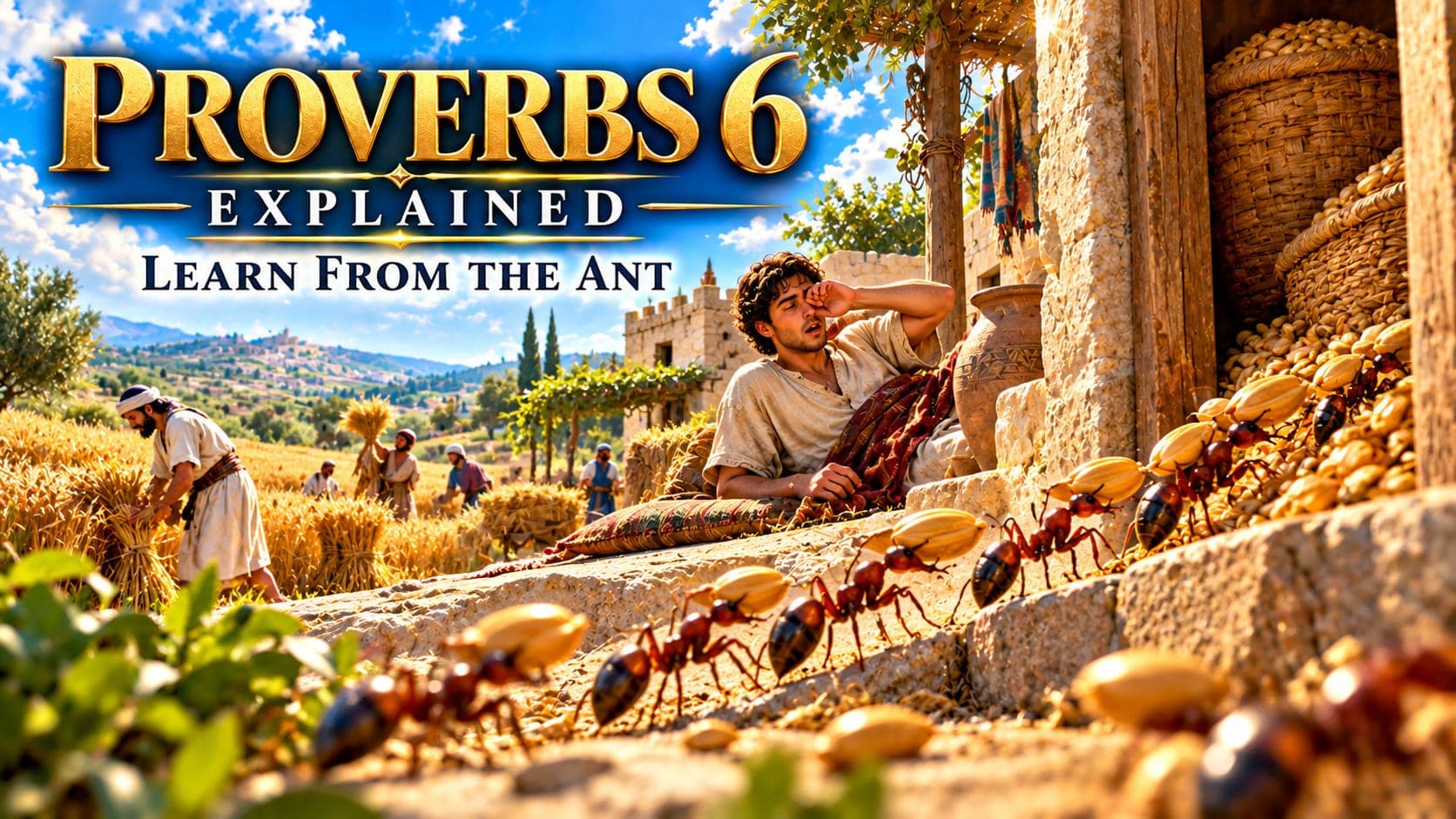
"Go to the ant, thou sluggard; consider her ways, and be wise: Which having no guide, overseer, or ruler, Provideth her meat in the summer, and gathereth her food in the harvest."
Sluggard is Proverbs' word for a lazy person, and it appears often enough in this book to be one of its favorite targets. What makes the ant worth studying is not only her work but the fact that nobody makes her do it. No guide, overseer, or ruler stands over her. She works because the season demands it, not because someone is watching.
📌 Solomon does not send his son to a teacher for this lesson. He sends him outside to watch an insect nobody supervises. Wisdom, in this verse, is simply paying attention to what is right in front of you.
"How long wilt thou sleep, O sluggard? when wilt thou arise out of thy sleep? Yet a little sleep, a little slumber, a little folding of the hands to sleep: So shall thy poverty come as one that travelleth, and thy want as an armed man."
The sluggard never plans to stay in bed all day. He only ever asks for a little more. Solomon lets the request repeat three times, a little sleep, a little slumber, a little folding of the hands, to show how small each individual delay feels and how large the total becomes.
⚠️ Poverty does not politely knock in this picture. It arrives like a traveller who was already on the road, and then like an armed man who does not ask permission. The first comparison suggests it was coming anyway. The second suggests it takes what it wants.
3. The Body Language of a Troublemaker (verses 12 to 15)
Solomon moves from a lazy man to a dangerous one, and describes him almost entirely through gesture.
"A naughty person, a wicked man, walketh with a froward mouth. He winketh with his eyes, he speaketh with his feet, he teacheth with his fingers; Frowardness is in his heart, he deviseth mischief continually; he soweth discord."
Froward means twisted or contrary, someone who habitually turns things the wrong way. What stands out is how much of this description has nothing to do with words. A wink, a shuffle of the feet, a gesture of the fingers, small signals used to communicate deception without ever saying anything false out loud.
📌 Frowardness is in his heart comes before any of his actions are named. The gestures are symptoms. The real problem sits underneath them, already planning mischief before a single signal is given.
"Therefore shall his calamity come suddenly; suddenly shall he be broken without remedy."
The word suddenly appears twice in one verse. A person who plots quietly and patiently often assumes he has time. Solomon says the collapse, when it comes, will not match the pace of the scheming that led to it.
4. Six Things the LORD Hates, Seven That Are an Abomination (verses 16 to 19)
Solomon now names the traits behind that troublemaker directly, in a numbered list.
"These six things doth the LORD hate: yea, seven are an abomination unto him: A proud look, a lying tongue, and hands that shed innocent blood, An heart that deviseth wicked imaginations, feet that be swift in running to mischief, A false witness that speaketh lies, and he that soweth discord among brethren."
The pattern "six things, yea seven" is a numbering style used elsewhere in Proverbs and in books like Amos, where a fixed number is stated and then one more is added. It is not a miscount. The point of the form is that the list could keep growing, and naming one more than expected makes that plain.
📌 Notice that every item on this list is an action, not a feeling. A proud look, a lying tongue, hands, feet, a false witness, someone who sows discord. Pride and scheming start in the heart, but this list names what they look like once they move.
The list also ends where it began. A proud look opens it, and sowing discord among brethren closes it. Pride toward God and division among people are placed as opposite ends of the same short chain.
5. Bind Them Continually Upon Your Heart (verses 20 to 23)
Solomon returns to the same appeal that opens chapters 1 through 4, but adds his son's mother to it directly this time.
"My son, keep thy father's commandment, and forsake not the law of thy mother: Bind them continually upon thine heart, and tie them about thy neck."
This same language, binding words to the heart and tying them about the neck, appears earlier in Deuteronomy 6, where later Judaism eventually developed the practice of wearing small boxes of Scripture on the body as a literal fulfillment of it. Whether Solomon has that kind of physical object in mind here or is speaking only in picture language, the point lands the same way: something worn close enough that it cannot be forgotten by accident.
"When thou goest, it shall lead thee; when thou sleepest, it shall keep thee; and when thou awakest, it shall talk with thee. For the commandment is a lamp; and the law is light; and reproofs of instruction are the way of life:"
📌 Three times of day, walking, sleeping, waking, and instruction is present in all three. Solomon is not describing a habit reserved for a quiet morning devotional. He is describing something that stays present through the whole day and the whole night.
A lamp does not light up an entire road at once. It lights the next step. That is the kind of guidance Solomon promises here, enough light for what comes immediately next, which turns out to matter a great deal in the section that follows.
6. Fire in Your Bosom: The Real Cost of Adultery (verses 24 to 35)
The lamp of instruction, Solomon now says, exists specifically to keep his son off one particular road.
"To keep thee from the evil woman, from the flattery of the tongue of a strange woman. Lust not after her beauty in thine heart; neither let her take thee with her eyelids."
Solomon already gave a full chapter to this warning in Proverbs 5. Here he adds something new before repeating it: a comparison to a different kind of wrongdoing entirely.
"For by means of a whorish woman a man is brought to a piece of bread: and the adulteress will hunt for the precious life. Can a man take fire in his bosom, and his clothes not be burned?"
"Can one go upon hot coals, and his feet not be burned? So he that goeth in to his neighbour's wife; whosoever toucheth her shall not be innocent."
📌 Fire in the bosom and hot coals under bare feet are not questions Solomon expects an answer to. They only have one possible answer. That is the point. He is not arguing that adultery might be risky. He is saying it works exactly the way fire works, every single time, with no version of the outcome that leaves a person unmarked.
"Men do not despise a thief, if he steal to satisfy his soul when he is hungry; But if he be found, he shall restore sevenfold; he shall give all the substance of his house. But whoso committeth adultery with a woman lacketh understanding: he that doeth it destroyeth his own soul."
💡 Solomon is not excusing theft here. He is making a comparison. A starving thief has a reason people can at least understand, and the law still requires him to pay it back sevenfold. An adulterer has no comparable excuse. Hunger did not drive him to it. What he damages, his own soul, cannot simply be repaid the way stolen property can.
"A wound and dishonour shall he get; and his reproach shall not be wiped away. For jealousy is the rage of a man: therefore he will not spare in the day of vengeance. He will not regard any ransom; neither will he rest content, though thou givest many gifts."
📌 The thief could pay his way out. The wronged husband here cannot be bought off at any price. Solomon closes the chapter on a consequence that money cannot undo, the exact opposite of every earlier warning in this book about what wealth can and cannot fix.

Hard Questions Proverbs 6 Raises
Does Proverbs 6 forbid ever helping someone financially? The text warns against striking hands as surety, a specific act of guaranteeing someone else's debt with your own resources, not against generosity in general. Solomon elsewhere in this book commends giving to the poor. The warning is about the particular risk of a promise that can trap the one who makes it.
Does "six things, yea seven" mean Solomon lost count? No. This is a known numbering pattern in Hebrew wisdom writing, also used in Proverbs 30 and in Amos, where stating a number and then adding one more emphasizes that the list could keep growing rather than claiming to be exhaustive.
Does verse 30 mean it is not really wrong to steal when you are hungry? The text still calls the hungry man a thief who must restore sevenfold if caught. It says people do not despise him the way they despise other wrongdoers, which describes human sympathy, not divine approval of the theft itself.
Is Proverbs 6 repeating chapter 5 by accident? The two chapters approach the same danger from different angles. Chapter 5 focuses on where the path leads and what it costs over time. Chapter 6 focuses on the moment of contact itself, comparing it to fire, and adds the specific anger of a wronged husband that chapter 5 never mentioned.
What exactly binding the commandment "about thy neck" refers to is not fully certain from this verse alone. It may be figurative language for constant attention, or it may echo the same wording in Deuteronomy 6 that later Judaism took up as a literal practice. Scripture does not settle which, and either reading supports the same point Solomon is making.
Practical Tips From Proverbs 6
Six short lessons, seven things worth actually doing differently this week.
- Think before you guarantee someone else's debt. Verses 1 and 2 warn that a promise like this can snare the one who makes it, not just the one who fails to pay. Money decisions carry weight Scripture takes seriously, this one included.
- If you are already stuck in a bad promise, move now. Verse 3 does not say wait for a better time. It says go, humble yourself, and get free.
- Watch something that works without being watched. The ant in verse 6 has no supervisor. Let unsupervised diligence, not deadlines, be what actually drives your effort.
- Name the small delays before they add up. Verse 10 lists a little sleep, a little slumber, a little folding of the hands. Poverty in verse 11 is the sum of many small choices, not one big one.
- Watch your own gestures, not just your words. Verses 12 to 14 describe deception carried in a wink and a step. Honesty has to reach further than your sentences.
- Keep instruction close enough that it meets you at every hour. Verse 22 pictures guidance present when you walk, sleep, and wake. A once a week habit will not do what this verse describes.
- Treat the warning about fire literally. Verses 27 and 28 are not exaggerating. Deciding your boundaries before the moment arrives is what actually keeps you off the coals, not willpower once you are already standing on them.
Top 5 Bible Verses From Proverbs 6
1. Proverbs 6:6 to 8
"Go to the ant, thou sluggard; consider her ways, and be wise: Which having no guide, overseer, or ruler, Provideth her meat in the summer, and gathereth her food in the harvest."
The most quoted verse in the chapter, and one of the most practical pictures of unsupervised diligence anywhere in Scripture.
2. Proverbs 6:16 to 19
"These six things doth the LORD hate: yea, seven are an abomination unto him: A proud look, a lying tongue, and hands that shed innocent blood, An heart that deviseth wicked imaginations, feet that be swift in running to mischief, A false witness that speaketh lies, and he that soweth discord among brethren."
A rare direct list of what God hates, opening on pride and closing on division among believers.
3. Proverbs 6:23
"For the commandment is a lamp; and the law is light; and reproofs of instruction are the way of life:"
Instruction pictured as light enough for the next step, not a floodlight over the whole road at once.
4. Proverbs 6:27 and 28
"Can a man take fire in his bosom, and his clothes not be burned? Can one go upon hot coals, and his feet not be burned?"
Two questions with only one possible answer, used to show that adultery damages every single time, without exception.
5. Proverbs 6:32
"But whoso committeth adultery with a woman lacketh understanding: he that doeth it destroyeth his own soul."
The chapter's sharpest verse. Not merely a bad decision, but self destruction, in Solomon's own words.
Frequently Asked Questions About Proverbs 6
What is Proverbs 6 about?
It covers five separate warnings: cosigning a debt, laziness, a troublemaker's deceitful body language, seven things God hates, and a return to the warning against adultery first given in Proverbs 5.
What does "go to the ant" mean?
It is an instruction to observe how an ant works hard without anyone supervising her, and to let that same unsupervised diligence, not outside pressure, be what drives your own effort.
What are the six or seven things God hates in Proverbs 6?
A proud look, a lying tongue, hands that shed innocent blood, a heart that plans evil, feet quick to do wrong, a false witness who lies, and someone who stirs up conflict among believers.
What does it mean to be "surety" for someone?
It means guaranteeing another person's debt with your own resources, so that if they cannot pay, you legally owe it instead. Proverbs 6 warns that this promise can trap the one who makes it just as surely as the one who owes the original debt.
Why does Proverbs 6 warn against adultery again after chapter 5?
Chapter 5 focused on where the path leads and what it costs over years. Chapter 6 focuses on the moment itself, comparing it to fire that burns every time, and adds the wronged husband's anger, a detail chapter 5 does not include.
Does Proverbs 6:30 and 31 mean stealing is acceptable if you are hungry?
No. The thief in these verses still owes sevenfold restitution if caught. The point is a comparison, not a pardon: even a crime with an understandable motive still carries real cost, and adultery carries a cost that cannot be repaid the same way.
Is being a "sluggard" considered a sin in Proverbs?
Proverbs treats laziness as a serious moral failure with real consequences, not a minor personality trait. The sluggard is warned about repeatedly across the book, and Proverbs 6 pictures the result as poverty arriving like an armed man.
What does "the commandment is a lamp" mean?
It pictures God's instruction as light enough to show the very next step, rather than a full view of the whole road ahead. It matches Psalm 119's later description of God's word as a lamp for the feet.
How does Proverbs 6 connect to the rest of the Bible?
Its numbered list of things God hates matches a pattern used again in Proverbs 30 and in Amos. Its picture of instruction as a lamp reappears almost word for word in Psalm 119:105, and its warning against adultery continues directly into Proverbs 7.
Final Thoughts
Proverbs 6 covers five different failures, but every one of them shares the same root.
📌 Small choices, left unexamined, become large consequences. A hasty promise, a little more sleep, a wink meant to deceive. None of them look dangerous the moment they happen.
📌 God names what He hates in plain language. Pride, lying, violence, scheming, false witness, and division are not left for guesswork in verses 16 to 19.
📌 Some things really do burn every single time. Verses 27 and 28 leave no room for the idea that this time might be different.
So here is your one next step.
Look back over this week for one small choice you let slide because it seemed too minor to matter, and deal with it today instead of letting it compound.