📖 Proverbs 5 Explained: The Warning Against the Strange Woman
Her words taste like honey. That is exactly the problem.
Proverbs 5 explained is the chapter where Solomon stops mentioning this danger in passing and gives it his full attention. Chapter 2 named her in four verses and moved on. This chapter does not move on. Solomon spends all twenty three verses on one temptation, because he has watched what it does to a man from the inside out.
Maybe you have never heard this chapter preached in full.
- ❓ Why does an entire chapter go to one warning?
- ❓ What does drinking from your own cistern actually mean?
- ❓ Why does a King James word like "ravished" show up in a chapter about adultery?
- ❓ Does verse 22 mean God traps people in their own sin on purpose?
📌 Proverbs 5 does not only say no. Before it is finished, it hands you something worth saying yes to instead.
This walkthrough goes through the whole chapter in order: the honey that turns bitter, the real cost this path carries, the marriage Solomon tells his son to actually enjoy, and the closing reminder that nothing here happens where God cannot see it.
Read it as it was written, one long, specific warning, not a scattered list of rules.
What Happened Just Before This Chapter
Proverbs 4 closed on your feet: ponder the path of them, keep them steady, turn neither right nor left, remove them from evil. Proverbs 5 opens by naming exactly whose feet that warning had in mind. Verse 5 says her feet go down to death, the same footstep language chapter 4 had just spent four verses on.
Proverbs 2 had already named this woman once, in four short verses near the end of a much longer sentence about two dangers. This chapter is Solomon coming back to only one of those two dangers and giving it the space he did not give it the first time.
📌 Proverbs 2 mentioned her. Proverbs 5 sits you down and makes you look at her, all the way to the end of where she leads.
Proverbs 5 Explained Verse by Verse
1. Honey Lips, Bitter End (verses 1 to 6)
Solomon opens the same way he opened chapters 2 through 4, asking for attention before he asks for anything else.
"My son, attend unto my wisdom, and bow thine ear to my understanding: That thou mayest regard discretion, and that thy lips may keep knowledge."
Discretion here means the ability to tell a good choice from a dangerous one before it is too late to matter. Solomon wants his son's own lips guarded by knowledge, which is a strange thing to ask for right before he describes a pair of lips that are not guarded at all.
"For the lips of a strange woman drop as an honeycomb, and her mouth is smoother than oil: But her end is bitter as wormwood, sharp as a two-edged sword."
📌 Notice what Solomon does not say. He never claims she tastes bad or sounds unconvincing. Honeycomb and oil are both genuinely pleasant. The danger was never that this path looks obviously ugly from the entrance. Wormwood is a plant known through Scripture for its bitter taste, used again and again as a picture of sorrow and ruin. A two edged sword cuts going in and coming out. Both images describe the same thing: whatever felt sweet at the start does damage on both ends.
"Her feet go down to death; her steps take hold on hell. Lest thou shouldest ponder the path of life, her ways are moveable, that thou canst not know them."
💡 Moveable means unstable, shifting, impossible to pin down. Every other path in Proverbs can be studied and learned. This one cannot, because it never holds still long enough to be mapped. That is part of what makes it dangerous. A son cannot ponder a path he can never quite get a fixed reading on.
2. What This Path Actually Costs You (verses 7 to 14)
Solomon does not tell his son to resist bravely once he is standing in front of the door. He tells him to never get near the door at all.
"Hear me now therefore, O ye children, and depart not from the words of my mouth. Remove thy way far from her, and come not nigh the door of her house:"
Remove thy way far is not a suggestion to stay cautious nearby. It is an instruction to put real distance between yourself and the situation entirely. When Joseph fled Potiphar's house rather than stay one more second in the room, he was living out exactly this verse centuries before Solomon wrote it down.
Solomon then spells out what staying near that door actually costs, and it is not only guilt.
"Lest thou give thine honour unto others, and thy years unto the cruel: Lest strangers be filled with thy wealth; and thy labours be in the house of a stranger;"
📌 Reputation, years of your life, and everything you worked to build, all named as things this path can drain away. Solomon's own household knew this cost was not hypothetical. His father David's affair with Bathsheba, the woman who would become Solomon's own mother, cost a marriage, a child's life, and years of consequences David never fully outran. Solomon is not warning his son about a stranger's mistake.
"And thou mourn at the last, when thy flesh and thy body are consumed, And say, How have I hated instruction, and my heart despised reproof; And have not obeyed the voice of my teachers, nor inclined mine ear to them that instructed me! I was almost in all evil in the midst of the congregation and assembly."
Solomon writes his son's own future regret as a speech, before it ever happens. "Almost in all evil in the midst of the congregation and assembly" pictures a man one step from total public disgrace in front of the whole community he belongs to, not a private failure kept quietly between two people.
3. Drink From Your Own Well (verses 15 to 19)
Solomon now turns from warning to something he almost never does in this book: he tells his son exactly what to enjoy.
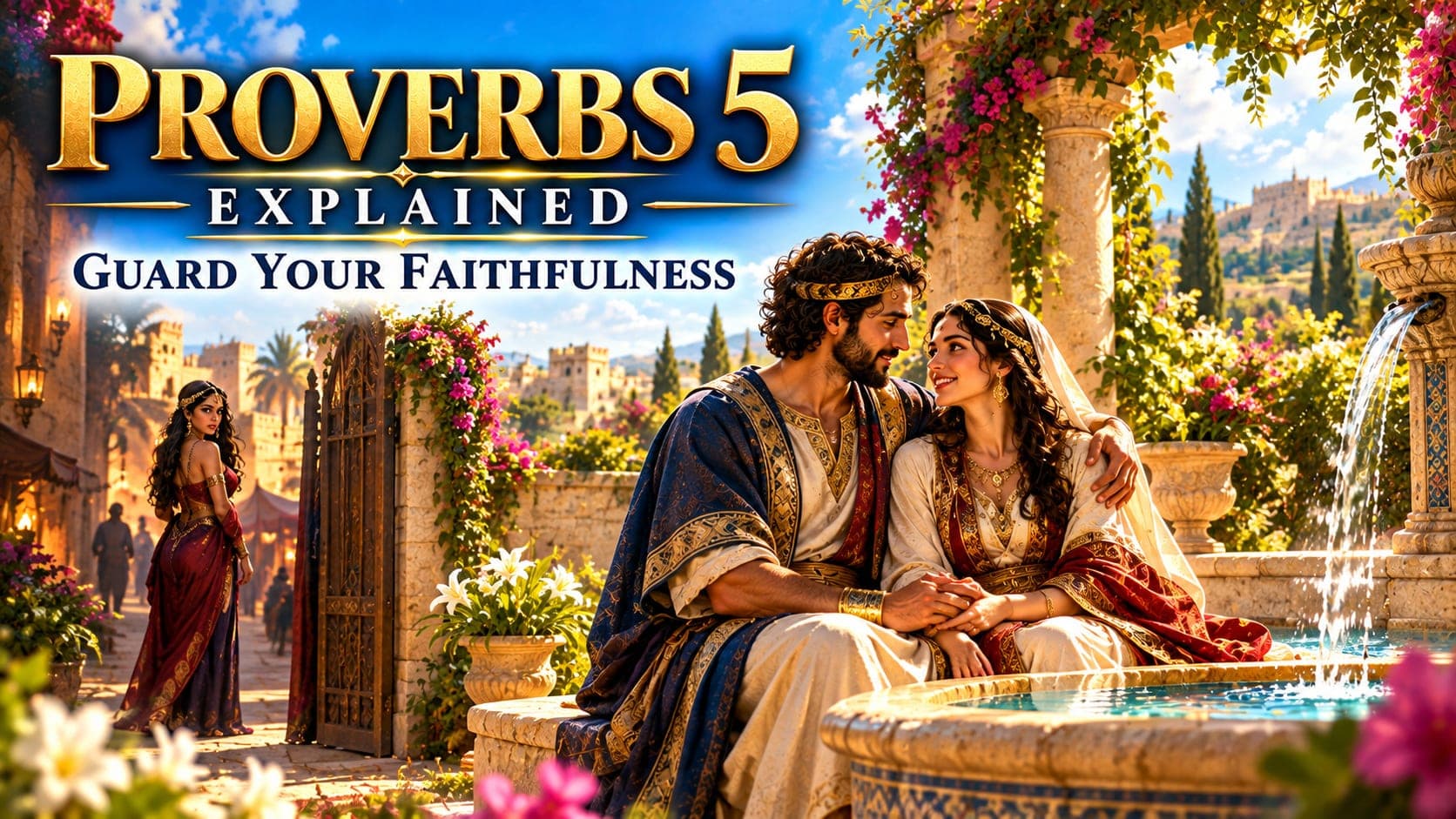
"Drink waters out of thine own cistern, and running waters out of thine own well."
A private cistern was one of the most valuable things a household could own. Water was not something you could count on finding elsewhere. Solomon pictures marriage the same way, a source that already belongs to you and does not need to be searched for somewhere else.
"Let thy fountains be dispersed abroad, and rivers of waters in the streets. Let them be only thine own, and not strangers’ with thee."
⚠️ Some read verse 16 as a question, should your water really run out into the open street for anyone to share, before verse 17 answers it directly. Either way the two verses land in the same place: whatever this water pictures belongs inside the marriage, not scattered outside it.
"Let thy fountain be blessed: and rejoice with the wife of thy youth. Let her be as the loving hind and pleasant roe; let her breasts satisfy thee at all times; and be thou ravished always with her love."
📌 "The wife of thy youth" means the one he already married, not a replacement waiting somewhere else. Hind and roe are both female deer, graceful and admired, the same kind of picture language Song of Solomon uses elsewhere for the same subject. And ravished, a word that sounds alarming to modern ears, meant captivated or intoxicated with delight in the English this chapter was translated into. Solomon commands his son to be swept away with joy over his own wife, in the same breath he has spent warning him away from everyone else's.
4. Nothing Is Hidden From God (verses 20 to 23)
Having just described a wife worth being captivated by, Solomon asks his son a pointed question.
"And why wilt thou, my son, be ravished with a strange woman, and embrace the bosom of a stranger?"
The same word, ravished, used two verses earlier for a wife now describes the exact wrong direction to aim it. Solomon is not asking because he does not know the answer. He wants his son to feel how little sense that choice makes next to what he was just told he already has.
"For the ways of man are before the eyes of the LORD, and he pondereth all his goings."
"His own iniquities shall take the wicked himself, and he shall be holden with the cords of his sins. He shall die without instruction; and in the greatness of his folly he shall go astray."
📌 Notice who does the catching in verse 22. Solomon does not say God reaches down and traps the wicked man from outside. His own iniquities take him. His own sins become the cords holding him. The chapter that opened describing a path you cannot map closes describing a rope you tied yourself, one choice at a time.

Hard Questions Proverbs 5 Raises
Is the "strange woman" in this chapter a real person or only a symbol? The details argue for a real, specific danger. Wealth handed to strangers, years given to the cruel, public disgrace before the whole assembly, these are the consequences of an actual affair, not an abstract idea. Proverbs 9 later personifies Folly herself as a woman calling from a doorway, but that is a different literary picture built later in the book, not what chapter 5 is doing.
Do verses 16 and 17 treat a wife as her husband's property? The picture is exclusivity, not ownership in the sense of a possession. The water language describes something the couple shares only with each other, a boundary around the marriage rather than a claim over a person. The rest of Scripture, including Paul's later teaching that a husband's body belongs to his wife just as much as hers belongs to him, fills out that this exclusivity was never meant to run in one direction only.
Does verse 22 mean God sets people up to fail so He can punish them? Read carefully, the verse says the opposite. It is the wicked man's own iniquities that catch him, not God springing a trap. Solomon is describing how sin works, not claiming God manufactures the snare. The warning exists precisely so the son can avoid becoming his own trap.
Is "ravished" in verse 19 a bad translation? Not a bad one, an old one. In the English of this translation it meant captivated or overcome with delight, the same root word used for being carried away by joy. Modern English has narrowed the word to something violent, which is exactly why this verse needs the explanation rather than being read the way it sounds today.
Does this chapter only apply to men, since it is addressed to a son? Proverbs is written as a father instructing a son, the household form its original audience used, but the warning itself is not really about gender. The standard this chapter asks for, faithfulness to the marriage you already have instead of chasing one you do not, is the same standard the rest of Scripture applies to husbands and wives alike.
Practical Tips From Proverbs 5
This chapter is not only a warning. It is a plan for where to actually put your attention instead.
- Do not measure danger by how something sounds at first. Verse 3 describes honey and oil, not something obviously bitter. Judge a path by where verses 4 and 5 say it ends, not by how pleasant it feels at the door.
- Put real distance between yourself and the situation, not just willpower. Verse 8 says remove thy way far from her. Deciding ahead of time, before you are standing in the room is what makes verse 8 possible to obey.
- Name the real costs out loud. Verses 9 and 10 list honour, years, wealth, and labour. A temptation loses some of its pull the moment you count what it actually takes.
- Treat your own marriage as the well worth drinking from. Verse 15 pictures a private source already yours. Neglect is often what sends someone looking elsewhere before an affair ever does.
- Let joy stay inside the marriage on purpose. Verse 19 commands delight, not just faithfulness. Solomon does not only forbid the wrong well. He tells his son to actually enjoy the right one.
- Remember nothing here is hidden from God. Verse 21 says every step is already before His eyes. That truth is meant to steady you, not just frighten you.
- If this warning names a struggle you already carry, there is a real way back from it. Solomon is warning his son before the fact here, not writing off anyone already caught in the cords verse 22 describes.
Top 5 Bible Verses From Proverbs 5
1. Proverbs 5:3 and 4
"For the lips of a strange woman drop as an honeycomb, and her mouth is smoother than oil: But her end is bitter as wormwood, sharp as a two-edged sword."
The whole chapter in two verses. Something can taste like honey at the start and cut like a blade by the end.
2. Proverbs 5:15
"Drink waters out of thine own cistern, and running waters out of thine own well."
The positive command hiding inside a chapter mostly remembered for its warnings. What you already have is pictured as valuable, not as second best.
3. Proverbs 5:18 and 19
"Let thy fountain be blessed: and rejoice with the wife of thy youth. Let her be as the loving hind and pleasant roe; let her breasts satisfy thee at all times; and be thou ravished always with her love."
A direct command to enjoy your own marriage, not just avoid someone else's. Faithfulness in this chapter is never only about restraint.
4. Proverbs 5:21
"For the ways of man are before the eyes of the LORD, and he pondereth all his goings."
Nothing in this chapter's warning happens in secret from God, whatever it may look like to the people around you.
5. Proverbs 5:22
"His own iniquities shall take the wicked himself, and he shall be holden with the cords of his sins."
The chapter's closing picture of consequence. Not a trap set by God from outside, but a rope a man ties with his own choices.

Frequently Asked Questions About Proverbs 5
What is Proverbs 5 about?
It is Solomon's extended warning to his son against the strange woman, an affair outside marriage, covering how appealing it looks at first, what it actually costs, and the marriage Solomon tells his son to enjoy instead.
Who is the strange woman in Proverbs 5?
She is a woman outside the son's own marriage covenant, first named briefly in Proverbs 2:16 to 19 and developed at full length here. The consequences described, lost wealth, lost years, public shame, describe a real, specific danger rather than only a symbol.
What does "drink waters out of thine own cistern" mean?
It pictures marriage as a private, valuable source that already belongs to you, the same way a household's own water source did not need to be searched for elsewhere in a dry climate.
What does "ravished" mean in Proverbs 5:19?
In this translation's English it meant captivated or overcome with delight, not the violent meaning the word carries in modern usage. Solomon uses it to command joyful delight in marriage.
What does "her feet go down to death" mean?
It pictures the path this woman walks as one that leads to real ruin, continuing the same footstep and path language Proverbs 4 had just used to describe walking wisely.
Does Proverbs 5:22 mean God traps people in their sin?
No. The verse says a wicked man's own iniquities take him, describing how sin works rather than claiming God sets the trap. The warning exists so the reader avoids becoming his own snare.
What does "sharp as a two-edged sword" mean in Proverbs 5:4?
A two edged sword cuts on both the way in and the way out. Solomon pictures this path as damaging at every point, not only at some final, obvious ending.
Does Proverbs 5 say marriage is only about physical intimacy?
The chapter focuses on that one aspect because it is answering that one temptation directly. It is not offering a complete picture of marriage, only insisting that this particular gift stays inside the covenant it was given for.
How does Proverbs 5 connect to the rest of the Bible?
It expands the brief warning first given in Proverbs 2 and is followed by two more chapters, 6 and 7, on the same danger. Hebrews later calls the marriage bed undefiled, defending exactly the exclusive intimacy this chapter already assumes.
Final Thoughts
Proverbs 5 is not only a warning chapter. It is a chapter about where to aim your delight.
📌 What tastes sweetest at the start is not proof it is safe. Honey and oil open this chapter. Wormwood and a two edged sword close the picture.
📌 Avoidance beats willpower. Solomon does not tell his son to stand firm at the door. He tells him to remove his way far from it.
📌 The answer to this temptation is not only no. Verses 15 through 19 hand the son a well already his own, worth actually enjoying.
So here is your one next step.
Name one thing you already have that this chapter would call you to actually delight in, instead of quietly looking past it.