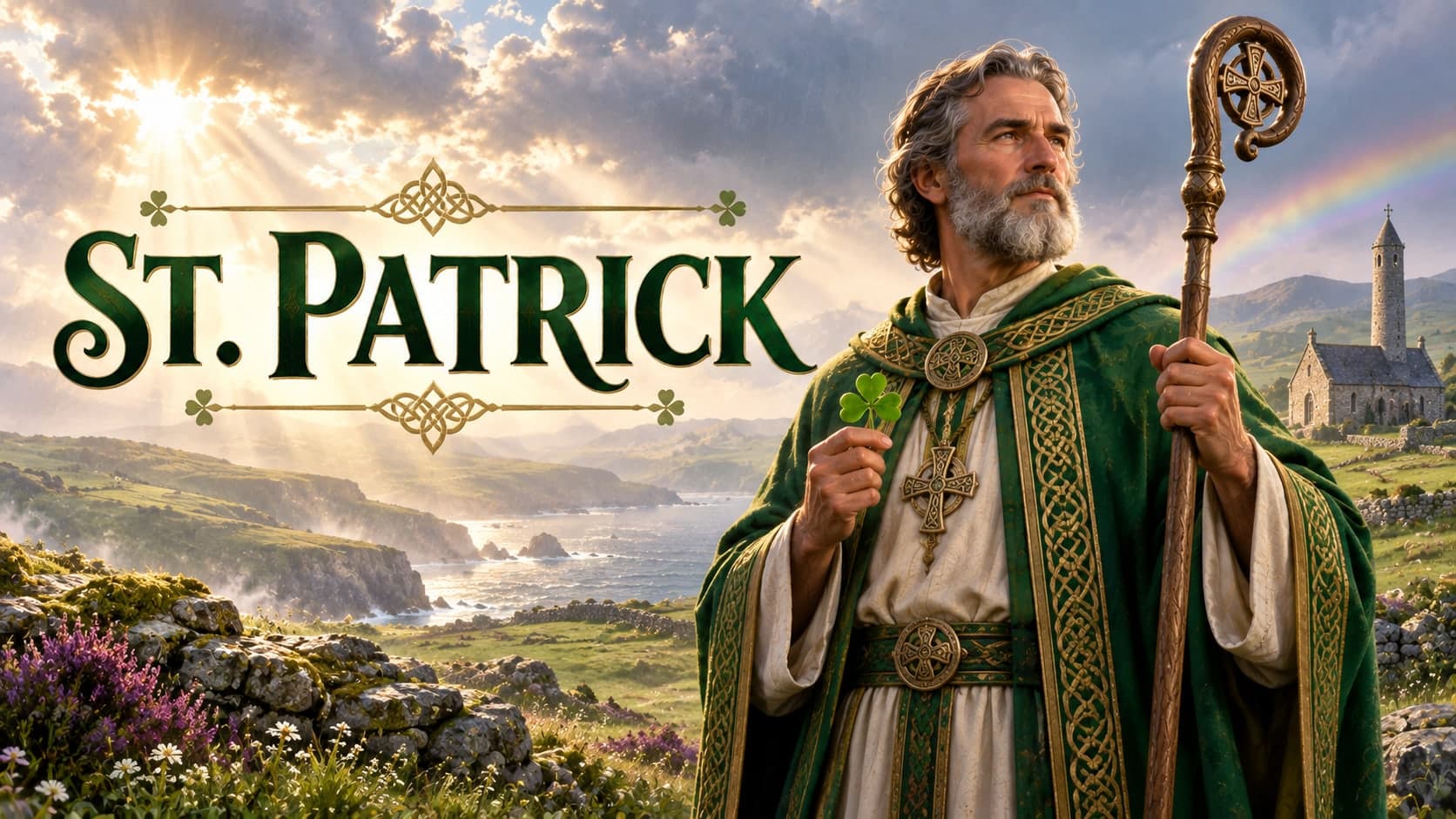
📖 Who Was St. Patrick? The Slave Who Went Back to Ireland
For most people today, St. Patrick's Day means one thing.
- 🍀 Wear green
- 🍺 Celebrate loudly
- 🎉 Call it Irish culture
But the day was never meant to begin as a party.
It began as a story about slavery, faith, and forgiveness.
📌 Ask yourself something before you read this. Is there a person or a place you would never go back to?
Somebody who took something from you that you are still paying for.
A season you got out of and swore you would never revisit.
Everybody has one.
Patrick went back to his.
He was kidnapped at sixteen and enslaved for six years.
He escaped. He got home. He was free.
And then he chose to return to the people who had taken his life from him.
This is the real story of St. Patrick, what the history actually says, which famous parts are legend, and what his life still asks of you.
Who Patrick Was
Here is the first surprise.
⚠️ Patrick was not Irish.
He was born in Roman Britain in the late 300s AD.
His birth name was likely Maewyn Succat.
Patricius was the Latin name he took later, which became Patrick.
His father was a deacon and his grandfather a priest.
So he grew up around church without it meaning anything to him.
He admitted that himself, in his own writing, as an old man.
📌 Unlike most figures this old, we have two documents Patrick actually wrote: his Confessio and a Letter to the Soldiers of Coroticus.
💡 That matters. Almost everything popular about Patrick is legend, but the core of his story comes from his own hand.
The Life of St. Patrick
1. Kidnapped at Sixteen
When Patrick was about sixteen, Irish raiders attacked his village.
He was captured. Taken across the sea. Sold.
For six years he worked as a shepherd in Ireland.
- 🌧️ Alone in brutal weather
- 🌙 Guarding animals through the night
- ⛓️ No freedom, no family, no way home
This was not a rough patch. This was his entire youth.
Sixteen to twenty two, gone.
And in those years, something in him changed.
He later wrote that he began praying constantly.
Sometimes, he says, close to a hundred prayers in a day.
Not because a preacher told him to.
Because he had nothing else.
💡 Hardship stripped away his comfort. Isolation stripped away his distraction. And the faith he had ignored his whole life became real.
⚠️ Notice God did not rescue him out of it right away. He met him inside it. If you are praying in a hard place right now, what the Bible says about anxiety walks through that same ground.
2. The Escape
After six years, Patrick says he heard a voice in a dream telling him to go.
His ship was ready.
So he ran.
He traveled roughly two hundred miles on foot to reach the coast.
A slave, alone, crossing hostile country with no map and no protection.
He found a ship. He talked his way onto it.
And eventually he made it home to Britain.
His family was overjoyed. They begged him never to leave again.
📌 That should have been the end of the story. Boy taken, boy escapes, boy comes home.
It was not the end. It was the preparation.
3. Decades of Getting Ready
Patrick did not turn around and sail back the next year.
He spent years studying.
- 🧠 Learning theology
- 📖 Studying Scripture, which he had ignored as a boy
- ⛪ Training under church leaders
Training for the priesthood in the fifth century followed a strict order.
A man served first as a reader, then a deacon, then a priest.
Only after years in each role could he be raised to bishop.
Every step meant more time under an older bishop, memorizing the Latin Psalms, learning church law, and learning the rites of baptism and teaching.
💡 There was no shortcut. The Church did not hand authority to strangers, even one this determined.
Later tradition says he studied for years at a place called Auxerre in Gaul, under a bishop named Germanus.
⚠️ Be honest about where that detail comes from. It is from a biography written centuries after Patrick died, not from Patrick himself.
His own Confessio never names the place or the man who trained him.
He only says, more than once, that his education was poor and that he is ashamed of his rough Latin.
Eventually he was ordained as a bishop.
⏳ Nearly forty years passed between his capture as a teenager and his return to Ireland as a missionary.
Forty years.
His mission was not an emotional impulse.
It was a prepared decision made by a grown man who knew exactly what he was walking into.
💡 That is the same pattern you see in Moses and his forty years in the desert. God is rarely in a hurry with the people He plans to use.
4. He Went Back
Here is the sentence that defines his whole life.
He chose to go back.
Back to Ireland. Back to the land where he was a slave.
Back to the same people who had stolen six years of his life.
Not with soldiers. Not with revenge. Not with a lawsuit.
With the gospel.
📌 Patrick returned to preach Christ to the very people who had enslaved him.
He said in his Confessio that he was compelled by the Spirit to go.
He described a vision that helped push him toward that decision.
A man named Victoricus came to him in a dream, carrying more letters than he could count, all from Ireland.
He read one, and as he read it he heard the voices of people from the very woods near where he had been a slave, calling out together as one voice:
"We beg you, holy boy, to come and walk again among us."
It touched him so deeply that he could not keep reading. Then he woke up.
📌 The same country that stole his freedom was the one calling him back, in a dream, years later.
Read that and then think about the person you are still angry at.
❓ Would you go back for them?
That is not a rhetorical question. It is the entire point of his life.
5. Ireland Before Christianity
Understand what he was walking into.
Fifth century Ireland was not part of the Roman Empire.
It was tribal and pagan.
Ireland had no single king and no central government.
It was split into dozens of small kingdoms called tuatha, each ruled by its own king.
Tradition placed a high king over them all, seated at the hill of Tara, though real power stayed scattered among the local rulers.
Druid priests held the spiritual authority.
They served the kings as priests, judges, and advisors, and they guarded that role closely.
They kept the old stories, read omens, and set the terms of worship at sacred wells, trees, and hilltops.
A new religion with a different priesthood was not just unfamiliar. It threatened the whole system of power.
Worship centered on nature, many gods, and ritual.
Christianity was almost unknown there.
He had no Roman law to protect him and no local status.
He was, on paper, an escaped slave returning to the scene of his captivity.
He wrote that he was in danger constantly and expected to be killed.
He preached anyway.
- ✝️ Christ crucified and risen
- 🙏 Repentance
- 🕊️ New life through the Holy Spirit
And over years, whole communities turned to Christ.
He baptized thousands. He ordained local leaders.
He worked with the tribal system rather than against it.
He preached to them in the language he had first learned as a slave, herding sheep on their hills.
He went to chieftains first, and when a chief believed, his people listened.
He gave gifts to local kings for safe passage rather than demanding protection.
💡 He was not naive. He was strategic, and he paid his own way through danger for decades.
One story about that danger comes from a biography written centuries after Patrick died, not from his own hand.
It says the high king at Tara had ordered that no fire be lit anywhere nearby until his own ceremonial fire was lit first.
Patrick is said to have lit an Easter fire on a nearby hill anyway, in plain defiance of the order.
⚠️ Treat that one as tradition, not confirmed history. It comes from a Life of Patrick written by a monk named Muirchú roughly two hundred years after Patrick lived.
💡 True in every detail or not, it captures something real about him. His whole mission was a quiet refusal to bow to the old order.
Compare that to what happened when Christianity later gained political power under Constantine. Patrick had no empire behind him. Just a message and a willingness to be killed for it.
💡 He did not build a mission that depended on him. He built one that could keep going without him.
6. The Man Who Called Out a King
One story rarely gets told on March 17.
A warlord named Coroticus raided a group of Patrick's new converts.
They were killed or sold into slavery, some the day after their baptism.
Coroticus called himself a Christian.
Patrick wrote him a letter, and it is still in our hands.
He publicly condemned him and demanded the captives be released.
📌 A former slave used his position to fight slavery. He is one of the earliest voices in recorded history to do it.
He had every reason to protect his standing and stay quiet.
He spent it on people who could do nothing for him.
7. What Is True and What Is Legend
Let's be honest about the famous parts.
🐍 The snakes. Legend says Patrick drove the snakes out of Ireland. There is no evidence snakes ever lived in Ireland after the Ice Age. Most historians read the story as symbolic, with snakes standing for paganism.
☘️ The shamrock. Tradition says he used a three leaf clover to explain the Trinity: one God, three persons. It is a beautiful picture and it may well be true, but it does not appear in his own writings and shows up centuries later.
🍀 The green. Patrick was originally associated with blue. Green came later, tied to Irish identity rather than to him.
⚠️ He was also never formally canonized by a pope. He was declared a saint by popular acclaim in an earlier era of the Church.
💡 None of that weakens his story. It sharpens it.
📌 The real Patrick is better than the legend. You do not need snakes when the true story is a slave who forgave a nation.
8. What He Said About Himself
The Confessio is not a victory lap.
It is a defense written by an old man who was being criticized.
He calls himself a sinner, unlearned, and the least of all believers.
He put it in his own words, and they are worth reading exactly as he wrote them:
"My name is Patrick. I am a sinner, a simple country person, and the least of all believers. I am looked down upon by many."
That is not false humility written for effect. He meant it.
He apologizes for his poor Latin, because slavery cost him his education.
He also described, in his own words, the prayer life that grew in him as a slave:
"I prayed frequently during the day. More and more the love of God increased, and my sense of awe before God. In one day I would pray up to one hundred times, and at night perhaps the same. I would rise to pray before dawn in snow and ice and rain."
📌 That is not poetic exaggeration. That is a description of an actual daily life, written by the man who lived it.
He gives God credit for everything and takes almost none of it.
He also wrote about the fear he lived with.
He expected to be murdered or enslaved again, and said so plainly.
He mentions being held captive at least once more during his mission.
⚠️ Nothing about his return was safe. He simply decided the risk was worth it and kept going for roughly thirty years.
💡 The most successful missionary of his century thought of himself as an uneducated ex slave who God used anyway.
That is the voice of a man who never forgot where he came from.

Lessons From Patrick's Life
1. God can meet you in the worst season of your life
Patrick did not find God in church. He grew up in church and ignored it.
He found God on a freezing hillside as somebody's property.
📌 The place you would never choose may be the place you finally hear Him.
2. Forgiveness is not a feeling. It is a direction you walk.
Patrick did not just stop hating the Irish.
He got on a boat and spent the rest of his life serving them.
💡 Real forgiveness eventually shows up in your feet, not just your words.
3. Preparation is not procrastination
Forty years passed between his capture and his return.
He studied. He trained. He waited.
⚠️ Rushing into a calling half ready has ruined more ministries than waiting ever did.
4. Your pain can become your assignment
Patrick knew the Irish language because he was enslaved by Irish speakers.
He knew the culture because he had lived inside it against his will.
📌 The six years stolen from him became the exact training the mission required. God wastes nothing.
5. Use whatever standing you get for people who have none
When Patrick finally had influence, he spent it confronting a warlord over slaves.
He risked his own reputation for people who could not repay him.
❓ What is your influence actually for?
Key Verses That Fit Patrick's Story
1. Genesis 50:20
"But as for you, ye thought evil against me; but God meant it unto good, to bring to pass, as it is this day, to save much people alive."
Joseph said this to the brothers who sold him into slavery.
It is the closest thing in Scripture to Patrick's whole life.
Notice he does not pretend the evil was good. He says God meant it for good.
💡 Those are two very different sentences.
2. Matthew 5:44
"Love your enemies, bless them that curse you, do good to them that hate you, and pray for them which despitefully use you."
Most of us read this verse and think about someone who annoyed us.
Patrick applied it to the men who kidnapped him.
Despitefully use you is not a small phrase. It means abuse.
📌 He did not water the verse down to fit his comfort. He obeyed it at full strength.
3. Romans 8:28
"And we know that all things work together for good to them that love God, to them who are the called according to his purpose."
This verse does not say everything that happens is good.
It says God works things together toward good.
Six stolen years became a nation reached.
💡 Patrick could not have seen that at nineteen, freezing on a hill.
4. Isaiah 6:8
"Also I heard the voice of the Lord, saying, Whom shall I send, and who will go for us? Then said I, Here am I; send me."
Easy to say when the destination is somewhere you want to go.
Patrick said it about the country that enslaved him.
❓ Is there a place you have quietly told God you will go anywhere except there?
5. 1 Corinthians 1:27
"But God hath chosen the foolish things of the world to confound the wise; and God hath chosen the weak things of the world to confound the things which are mighty."
Patrick called himself unlearned and least.
He was not being modest. Slavery genuinely cost him his education.
📌 God reached an entire island through a man who apologized for his grammar.

Frequently Asked Questions About St. Patrick
Was St. Patrick Irish?
No. He was born in Roman Britain, most likely in the late 300s AD. He first came to Ireland as a kidnapped slave, escaped home, and then returned decades later as a missionary by choice. The patron saint of Ireland was a foreigner who was once held there against his will.
Did St. Patrick really drive the snakes out of Ireland?
No, and the honest answer is more interesting than the legend. There is no evidence snakes lived in Ireland after the Ice Age, so there were none to drive out. Most historians read the story as a symbol for Christianity displacing pagan worship. The legend appears centuries after Patrick died.
Did St. Patrick use the shamrock to explain the Trinity?
Possibly, but we cannot confirm it. The story does not appear in his own writings and shows up much later. It is a genuinely helpful picture of one God in three persons, and it became a lasting symbol of Irish Christianity either way.
Was St. Patrick a real person?
Yes, and unusually for someone from that era, we have documents he wrote himself. His Confessio and his Letter to the Soldiers of Coroticus are widely accepted as authentic. They give us his own account of his capture, his faith, and his mission.
Why do we celebrate St. Patrick's Day on March 17?
March 17 is traditionally held as the date of his death, around AD 461. It began as a religious feast day in Ireland. The parades and heavy drinking came much later, largely developing among Irish communities in America.
Was St. Patrick Catholic or Protestant?
Neither label fits cleanly. He lived roughly a thousand years before the Reformation, in an undivided Western Church. Both Catholic and Protestant Christians claim him, and both can read his own writings, which are focused on Christ, Scripture, and the Trinity.
How long was St. Patrick a slave?
Six years. He was captured around age sixteen and escaped around age twenty two, working that entire time as a shepherd. He describes those years as when his faith became real, praying many times a day out in the weather.
Why is green associated with St. Patrick?
Originally he was associated with blue, sometimes called St. Patrick's blue. Green came later through Irish nationalism, the shamrock, and Ireland's landscape. It is about Irish identity more than about Patrick himself.
Was St. Patrick ever officially made a saint?
Not by a formal papal canonization, because that process did not exist in his time. He was recognized as a saint by popular acclaim and long standing tradition, which is how many early saints were declared.
What can Christians learn from St. Patrick?
That God can meet you in the worst season of your life. That forgiveness eventually shows up in what you do, not just what you say. That preparation is worth decades. And that the hardest thing you survived may turn out to be the training for what God asks of you next.
Final Thoughts
Strip away the parades, the green beer, and the snakes.
What is left is one of the hardest stories in Church history.
📌 A boy was stolen. A man came back on purpose.
He did not go back with a lawsuit or an army.
He went back with the only thing that had helped him out on that hillside.
So here is your one next step.
Think of the person or place you have written off.
You do not have to move there. You do not have to pretend it did not hurt.
Just pray for them once tonight, by name.
That is where Patrick's story started too. Not with a mission. With a prayer on a cold hill.