📖 Who Was St. Valentine? The Real Story Behind the Holiday
Every February, the same aisle shows up at the store.
- ❤️ Cards
- 🍫 Chocolate
- 🌹 Flowers you will forget you bought by March
And somewhere under all of it, a lot of people feel a little empty.
📌 Ask yourself something honest. Do you actually believe love that costs something still exists, or does it feel like everything gets reduced to a greeting card?
You are not wrong to feel that.
Culture has turned love into a purchase you make once a year.
But the name on the holiday did not start that way.
Valentine was a real name attached to real Christians who were executed for their faith.
Not for romance. For refusing to deny Christ.
💡 Here is the twist. Almost everything you have heard about him, the secret weddings, the letter, the note signed "from your Valentine," is legend, not history.
This is the honest story of who Valentine actually was, what can be verified, what cannot, and what his life still says about love that is willing to pay a price.
Who Valentine Was
Start with the first honest thing to say about Valentine.
⚠️ He is not in the Bible.
Unlike Esther or Leah, Valentine's story is not Scripture. It comes from early Church history, from the centuries when Rome hunted Christians for their faith.
📌 The record places him in the Roman Empire in the mid to late 200s AD, during the reign of the emperor Claudius II.
That much is generally agreed on.
Almost everything else about him is disputed.
Early Church records actually list at least two, possibly three, different martyrs named Valentine, all commemorated on the same day, February 14.
- ✝️ A priest in Rome
- ⛪ A bishop of Terni, a town in central Italy
- ❓ A third Valentine martyred in North Africa, mentioned in some ancient sources
Over centuries, their stories likely blended into one.
This is a common problem with early Church martyrs. Records from the third century are scarce, and a name, a date, and a rough location were often all that survived. Later writers, wanting to honor the martyr with a fuller story, filled in the gaps.
💡 That does not mean nothing about him is true. It means the biography got built up slowly, over generations, by people who had less information than they wanted.
📌 That is not a modern doubt. It is old enough that the Catholic Church itself eventually acted on it.
In 1969, the Church removed St. Valentine's feast day from its General Roman Calendar, the official worldwide list of celebrated saints' days, because so little about him could be historically confirmed.
📌 He was not erased. He was simply admitted to be uncertain.
Keep that honesty in mind. It is the same standard St. Patrick's story gets held to, separating what a person actually did from what later tradition added on top.
The Story Behind Valentine's Day
1. Rome in the Third Century
To understand Valentine, you have to understand the world he lived in.
The 200s AD were a brutal stretch for the Roman Empire.
Historians call it the Crisis of the Third Century.
- 👑 Emperors rose and were assassinated in rapid succession
- ⚔️ Civil wars broke out across the empire
- 🛡️ Foreign armies pressed in on every border
Rome needed soldiers, and it needed them badly.
It also needed someone to blame for its instability, and Christians, who refused to worship the emperor as a god, were an easy target.
⚠️ Christianity was not a protected religion in the Roman Empire. It was, at times, a capital crime. Being a Christian leader in this period meant living under a constant threat of arrest.
The decades right before Valentine were especially dangerous. In AD 250, the emperor Decius ordered every citizen across the empire to offer sacrifice to the Roman gods and get a certificate proving it. Christians who refused were arrested, tortured, or killed. A few years later, the emperor Valerian issued edicts specifically targeting Christian clergy, bishops, and priests.
📌 Valentine, if he was a priest or bishop, belonged to exactly the group Rome had already spent a generation trying to eliminate.
This is the world Valentine ministered in.
2. Claudius II and the Marriage Ban Legend
The most famous piece of the Valentine story is a legend, and it deserves to be treated as one.
Later Christian tradition says Claudius II believed unmarried men made better soldiers.
📌 The theory goes that single men had no wife or children pulling their hearts home, so they fought harder and died more willingly.
Tradition claims Claudius responded by outlawing marriage for young men.
⚠️ Be honest about this detail. Historians cannot confirm this ban actually happened.
There is no surviving Roman law, decree, or contemporary record of Claudius II banning marriage. The claim shows up only in Christian tradition, written well after his reign.
💡 Whether the ban was real, exaggerated, or invented later to explain Valentine's arrest, the point of the story stayed the same: a Christian leader was said to have defied an emperor to protect something sacred.
3. Why Marriage Mattered That Much
Whatever the exact law was or was not, the reason the legend endured is worth understanding.
For early Christians, marriage was never just a social arrangement.
- 📖 Rooted in God's design at creation
- ✝️ Pictured as a reflection of Christ and the Church
- 🙏 Treated as a covenant made before God, not just before the state
To early believers, a covenant like that was not something the empire had the right to forbid.
📌 That is the real reason the legend gave Valentine a marriage ban to defy. It made him a defender of something Christians already believed was worth defending.
Notice what the legend is not doing. It is not inventing a reason for Christians to care about marriage. It is attaching an existing conviction to a specific man, which is exactly how legends about real people tend to grow.
4. The Secret Weddings
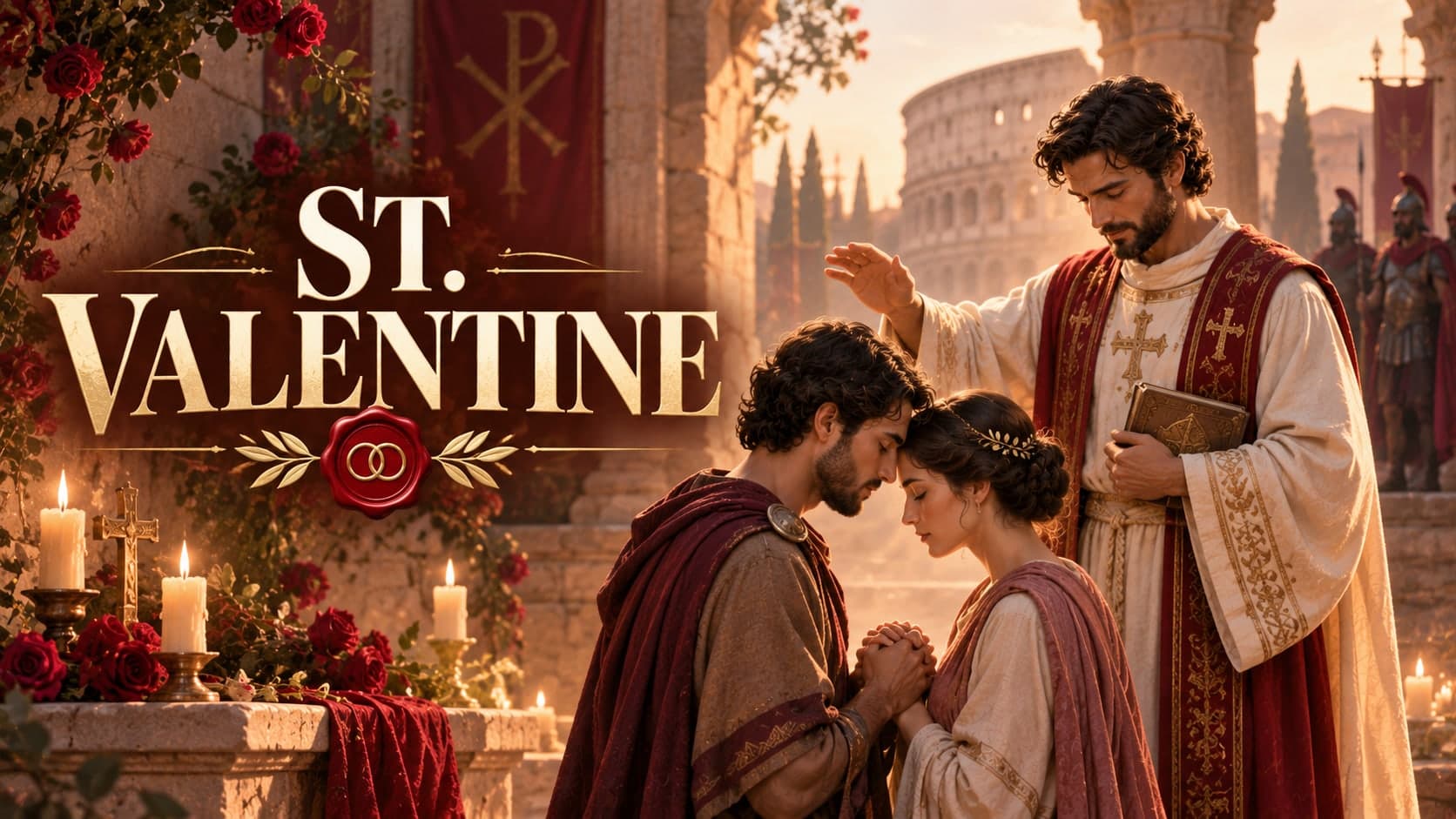
According to tradition, Valentine kept performing Christian marriages anyway.
- 🏠 In private homes
- 🕯️ In hidden gatherings
- ✝️ In the name of Christ, regardless of the risk
⚠️ There is no surviving account from Valentine's own century describing this. It comes from Christian tradition written long after his death.
That does not necessarily make it false. It makes it unverified.
💡 What is not in doubt is the cost of being a Christian leader in this era. Christian leaders had already been executed under Roman persecution before Valentine, and more would be after him, right up until Christianity was finally legalized decades later under Constantine, a story told here.
Pope Fabian was executed under Decius in AD 250. The bishop Cyprian of Carthage was beheaded under Valerian in AD 258, just over a decade before Valentine's own death. These were not obscure figures. They were leaders of the Church, killed in public, specifically because of their position.
Persecution was not a rumor. It was the reality every Christian leader lived inside.
5. The Prison Letter and "From Your Valentine"
This is the detail everyone knows, and the one with the least historical footing.
Later legend says that while imprisoned, Valentine befriended his jailer's daughter.
Some versions say he restored her sight. Some say he simply comforted her.
Before his execution, the story goes, he wrote her a note and signed it, "from your Valentine."
⚠️ This detail does not appear in any account from the third century. It shows up centuries later, in much later medieval retellings of his life.
💡 There is no way to confirm the daughter existed, the healing happened, or the note was ever written.
📌 It is a beautiful story. It is not a historical one, and the honest thing to do is say so plainly rather than repeat it as fact.
6. Arrest and Martyrdom
What tradition agrees on more consistently is how his story ended.
Valentine was arrested and brought before Roman authorities.
Ordered to renounce Christ. Ordered to worship Roman gods instead.
He refused.
📌 Tradition holds that he was beaten and executed, likely by beheading, along the Flaminian Way outside Rome, around AD 269.
He died not for romance, not for a wedding, and not for a note. He died for refusing to deny Christ.
💡 That is the part of the story the holiday quietly buried. A man's execution for his faith became, over time, a day for chocolate hearts.
The Church honored his death with a feast day on February 14, the same pattern that gave St. Patrick March 17. Both dates started as remembrance of a death, not a celebration of a legend.
7. From a Martyr's Feast to a Romantic Holiday
For centuries after his death, February 14 stayed a solemn church feast day.
Reflection. Church remembrance. Nothing close to romance.
⚠️ The romantic connection came over a thousand years later, and it did not come from Valentine at all.
Most historians point to the English poet Geoffrey Chaucer, writing in the 1300s. In a poem called Parliament of Fowls, Chaucer linked February 14 to the day birds supposedly chose their mates for the season.
📌 That single poetic idea is largely credited with starting the link between the date and romantic love.
Medieval royal courts picked it up next, exchanging poems and love notes on the day.
By the 1800s, mass printed cards made it a holiday for everyone, not just poets and nobles, especially once cheap printing and the postal system made sending one easy. American companies began mass producing Valentine's cards in the early 1900s, and the holiday only grew more commercial from there.
💡 Notice the timeline. Nearly 1,100 years passed between Valentine's death and the first poem connecting his feast day to romance.
The name survived. The meaning changed completely.

Lessons From Valentine's Life
1. Real love costs something
Strip away every legend, and one fact remains. A Christian was executed rather than deny his faith.
Whatever the exact details, that is not a small act.
📌 Love that never costs you anything is not the love the Bible describes.
2. The world's love and the Bible's love are not the same thing
Culture's version of Valentine is roses, chocolate, and a card once a year.
The Bible's version of love is covenant, sacrifice, and faithfulness under real pressure.
💡 One is a purchase. The other is a decision you keep making, especially when it is hard.
One is measured in dollars spent on a single day. The other is measured in whether you are still faithful on the ordinary Tuesday nobody is watching.
❓ Which version of love are you actually practicing on the people closest to you?
3. Conviction can outlast an empire
Rome persecuted the Church for close to three centuries and never won.
Emperors who executed Christians are gone. Their names live on mostly in history books.
Decius, Valerian, and Claudius II all thought they could kill their way out of a movement built on the resurrection. None of them are worshipped anywhere today.
📌 The empire that killed Valentine no longer exists. The faith he died for is still being lived out right now, by you, reading this.
4. You can love the story and still tell the truth about it
Nothing about admitting the legends are legends makes Valentine less worth remembering.
It actually makes the real parts count for more.
💡 Learning how to defend the Bible starts with this same habit: knowing the difference between what is confirmed and what is tradition, and never confusing the two.
Key Verses From Valentine's Story
1. Genesis 2:24
"Therefore shall a man leave his father and his mother, and shall cleave unto his wife: and they shall be one flesh."
This is the verse behind why marriage mattered so much to the early Church.
It was never framed as a private arrangement between two people.
It was God's own design, spoken at creation, before any emperor existed to ban it.
📌 That is why tradition remembers Valentine as someone who would not let a covenant this old be legislated away. Read Leah's story for another look at how seriously Scripture treats the covenant of marriage, even when it is messy.
2. 1 Corinthians 13:4-7
"Charity suffereth long, and is kind; charity envieth not; charity vaunteth not itself, is not puffed up, doth not behave itself unseemly, seeketh not her own, is not easily provoked, thinketh no evil; rejoiceth not in iniquity, but rejoiceth in the truth; beareth all things, believeth all things, hopeth all things, endureth all things."
Nobody sends this passage on a greeting card.
Charity here means love, and every verb in it is active, not decorative.
Suffereth long. Endureth all things. This is love built for pressure, not for a holiday display.
💡 It describes a love that is still standing after the flowers are gone.
3. John 15:13
"Greater love hath no man than this, that a man lay down his life for his friends."
Jesus said this the night before He was arrested.
It is the highest definition of love in the entire Bible, and it is not romantic at all.
It is sacrificial.
📌 Whatever the exact facts of Valentine's life, this is the verse his death actually points to, far more than any card ever could.
4. Revelation 2:10
"Fear none of those things which thou shalt suffer: behold, the devil shall cast some of you into prison, that ye may be tried; and ye shall have tribulation ten days: be thou faithful unto death, and I will give thee a crown of life."
This verse was written to Christians facing exactly what Valentine faced.
Prison. Threat. The real possibility of death for refusing to give up their faith.
Be thou faithful unto death is not a metaphor in that context. It is a literal instruction.
💡 Whatever Valentine's exact story was, this is the verse the early Church martyrs actually lived by, the same courage Esther showed when she risked her own life for her people.

Frequently Asked Questions About St. Valentine
Was St. Valentine a real person?
Almost certainly, yes, though the details are thin. Early Church records name at least two, possibly three, different martyrs called Valentine, all commemorated on February 14. Historians believe their stories likely blended into the single figure known today.
Why is Valentine's Day on February 14th?
February 14 was already the traditional feast day of St. Valentine in the early Church, set aside to remember his martyrdom. The romantic meaning was added over a thousand years later. The date is older than the holiday it is now known for.
Is Valentine's Day pagan?
Some popular claims connect it to Lupercalia, an ancient Roman pagan festival held in mid February involving fertility rites. Most modern historians consider that link weak and largely speculative, since there is no solid evidence the Church timed Valentine's feast to replace it, and the two observances existed side by side for centuries without being connected. The honest answer is that the connection is a popular theory, not confirmed fact, and the romantic holiday itself did not exist until Chaucer's time, over a thousand years after Lupercalia had already faded out.
Did St. Valentine really perform secret weddings?
There is no surviving record from his own century confirming this. The story comes from Christian tradition written long after his death. It may reflect something real about his ministry, or it may have grown up later to explain why he was arrested. It cannot be verified either way.
Who did St. Valentine write "from your Valentine" to?
Legend says he wrote it to his jailer's daughter before his execution. This detail first appears in medieval retellings of his life, centuries after he died, not in any third century source. It is one of the least historically supported parts of the whole story.
How did St. Valentine die?
Tradition holds that he was beaten and executed, likely by beheading, outside Rome along the Flaminian Way around AD 269, after refusing to renounce his Christian faith. This is the most consistently attested part of his story, even though the exact date and circumstances cannot be confirmed with certainty.
Is St. Valentine still a recognized saint?
He is still honored in Catholic tradition, but in 1969 the Catholic Church removed his feast day from its General Roman Calendar, the official universal calendar of celebrated saints, because so little about him could be historically verified. Local churches and traditions can still observe his feast day.
Why did the Catholic Church remove St. Valentine from its calendar?
Not because his existence was denied, but because the historical record was judged too thin and too tangled with legend to confirm the specific details of his life. Several other early saints with uncertain records were reviewed in the same 1969 calendar revision.
Is Valentine's Day mentioned in the Bible?
No. Valentine himself is never mentioned in Scripture, and the holiday did not exist until centuries after the Bible was written. What the Bible does describe in detail is the kind of love, sacrificial, covenantal, and tested under pressure, that Valentine's story is remembered for pointing toward.
What can Christians learn from St. Valentine today?
That real love costs something, and a holiday can survive even after its true meaning gets buried under marketing. That conviction under pressure outlasts the empire that tries to crush it. That telling the honest history, legend included, makes the real story more compelling, not less. And that the love worth celebrating every February 14 is the kind described in 1 Corinthians 13, not the kind sold in the card aisle.
Final Thoughts
Strip away the cards, the chocolate, and the legend of the letter.
What is left is a Christian who was executed for refusing to deny Christ.
📌 Whatever the exact facts, that is the real story behind the name on your calendar every February.
You do not have to throw out the holiday to see it clearly.
You just have to remember what it is actually named after.
The parts you cannot verify, the letter, the healed daughter, the secret weddings, can stay legend without shame. The part you can verify is enough on its own. A man was asked to trade his faith for his safety, and he would not.
This year, do not let February 14 stop at a card.
Read 1 Corinthians 13:4-7 out loud to the people you love, slowly, and ask yourself if your love actually looks like that when it costs you something.
That is closer to Valentine's real story than any greeting card will ever get.