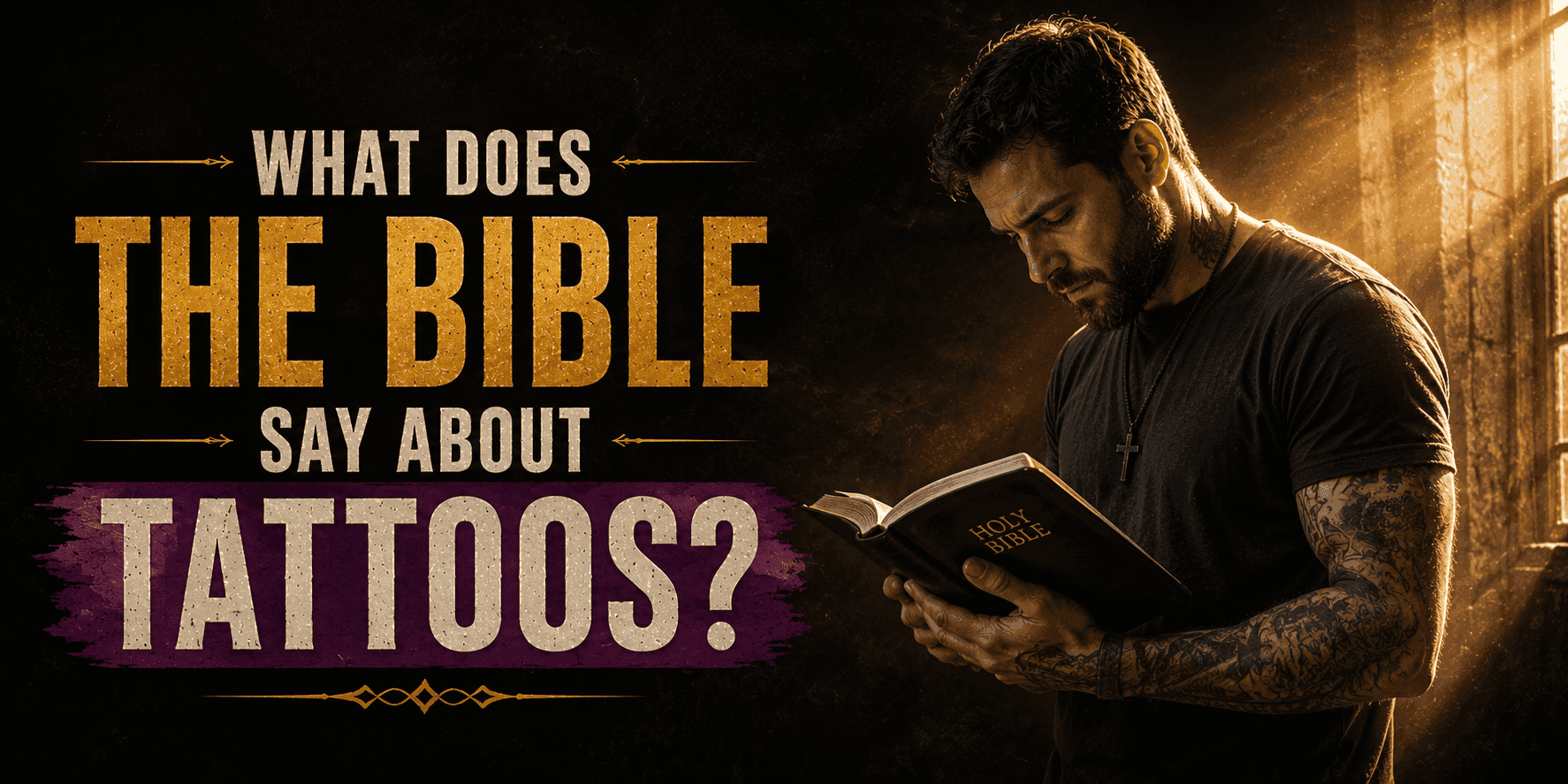
📖 What Does the Bible Say About Tattoos?
You googled it before you booked the appointment.
Or you googled it after, and now you are just hoping for the best.
Either way, somebody in your life quoted a Bible verse at you.
📌 Probably Leviticus 19:28. Probably with a tone that made you feel small.
So you are here, phone in hand, trying to find out if God is actually angry about this.
Here is the short version, before anything else.
- ✅ That one verse is real, and we are not going to hide it from you.
- ✅ It is also talking about something very specific, not every tattoo everywhere.
- ✅ The real question the Bible wants you asking is bigger than one verse.
What does the Bible say about tattoos? It gives one direct command, written into a specific moment in Israel's history, surrounded by other laws nobody keeps today. And it gives a much bigger principle that outlasts that one verse: what you do with your body, and why you do it, matters to God.
Most answers you will find online do one of two things.
- 🔲 Wave Leviticus 19:28 at you like a verdict and walk away.
- 🔲 Ignore it completely because it is inconvenient.
Neither one actually teaches you anything.
So this guide is going to do something different.
We are going to read Leviticus 19:28 in its actual context. We are going to look at the verses sitting right next to it that nobody applies today, and ask why. We are going to walk through how a Christian is even supposed to read Old Testament law in the first place. And then we are going to land on what the New Testament actually says about your body, your conscience, and the motive behind a decision like this one.
No shame. No verdict handed down before you finish reading.
Just an honest look at what Scripture says, so you can think it through with a clear conscience.
Why This Matters for Your Faith
You could treat this like a trivia question. It is not one.
How you handle a question like this says something about how you read the whole Bible.
⚠️ Get this wrong one way, and you turn Scripture into a list of ancient rules you quote at people without understanding them.
Get it wrong the other way, and you decide the Old Testament has nothing to say to you at all, which is its own kind of trouble.
This is also personal for a lot of readers.
Maybe you already have tattoos and someone made you feel unwelcome at church because of it.
Maybe you are thinking about getting one to remember a person or a season you cannot forget.
Maybe you just want to know if this is a line you are allowed to cross with a clear conscience.
📌 The stakes are not really about ink. They are about whether you can read God's law honestly, and whether you believe your body belongs to Him either way.
That is worth getting right.

What the Bible Actually Says About Tattoos
1. What Leviticus 19:28 Actually Says
Start with the verse itself, word for word.
"Ye shall not make any cuttings in your flesh for the dead, nor print any marks upon you: I am the LORD."
Read it slowly. It is not a general ban on body art.
It is one sentence with two halves, and both halves are pointed at the exact same thing: what the surrounding nations did when someone died.
"Cuttings in your flesh for the dead" is mourning behavior. Cutting yourself, gashing your skin, as part of grieving a death.
"Print any marks upon you" sits right beside it, in the same breath, about the same occasion.
❓ So who was doing this, and why would God need to say it out loud to Israel?
2. The Pagan Mourning Rites Behind This Law
Israel did not live in a vacuum. They camped and later settled surrounded by nations with their own gods.
Canaanite mourning customs regularly included self cutting and permanent marking of the skin, done to honor the dead or to appeal to gods associated with the underworld and fertility. A grieving family would gash their arms and faces. A mark would be cut or branded into the skin, sometimes carrying the name or symbol of a god, as a way of binding the living to the dead or to the deity they served.
This was not abstract to Moses' original readers. They had just come out of Egypt.
💡 Egyptian and Canaanite grief rituals were not symbolic decoration. They were acts of worship aimed at gods who were not the LORD.
That is why the verse ends the way it does, with a short signature: "I am the LORD."
That same short phrase shows up again and again through Leviticus 19, almost like a signature at the bottom of each law. It is God reminding Israel who they actually belong to.
Grieving as if you belong to a dead idol, rather than to the living God, was the real target. Not the needle. The worship behind it.
3. The Same Chapter Has Laws Nobody Follows Today
Here is the part that gets skipped when someone quotes Leviticus 19:28 at you and nothing else.
Keep reading one verse earlier, in the very same chapter.
"Ye shall not round the corners of your heads, neither shalt thou mar the corners of thy beard."
If you have ever trimmed your hair around your ears or shaped your beard, you just broke that one.
Go a few verses earlier in the same chapter and it gets more obvious.
- 🔲 No mixing two kinds of seed in one field.
- 🔲 No wearing a garment woven from two different fabrics.
- 🔲 No eating meat still containing blood.
Almost nobody keeps those, including the person who messaged you Leviticus 19:28 this week wearing a cotton poly blend shirt.
⚠️ That is not a contradiction in the Bible. It is a clue about how this whole chapter works.
These laws were not a universal code for every human for all time. They were specific instructions keeping Israel visibly distinct from the pagan nations around them, especially in how they worshiped and mourned. Which means reading one line out of that list and applying it directly to a modern tattoo shop, while skipping the rest of the list, is not reading the Bible honestly.
4. Why Old Testament Law Is Not One Flat Checklist
So how are you supposed to read it, if not as one long list you either keep or break?
Bible teachers have long noticed that the law given to Israel carries different kinds of weight.
- 🟢 Some of it is moral law. Do not murder. Do not steal. Honor your parents.
- 🟢 Some of it is civil law, for running a nation that no longer exists in that form.
- 🟢 Some of it is ceremonial law, marking Israel as set apart from the nations around them.
The moral law still stands, which is why the Ten Commandments given at Sinai are not optional for a Christian today. Those laws reflect God's unchanging character.
The mourning and marking laws in Leviticus 19:28 sit in a different category entirely.
The New Testament actually tells us what happened to that category.
"Let no man therefore judge you in meat, or in drink, or in respect of an holyday, or of the new moon, or of the sabbath days: Which are a shadow of things to come; but the body is of Christ."
Those ceremonial markers were a shadow, pointing forward. Christ is the substance they pointed to. When the early church had to settle whether Gentile believers had to keep every ceremonial law of Moses, the apostles in Acts 15 said no. They were never meant to carry that weight forever.
💡 A verse written to keep Israel visibly separate from pagan worship is not automatically a command written to you, sitting in a tattoo shop in the twenty first century.
That does not make the verse meaningless. It means we have to ask what it is actually protecting.
5. What the New Testament Says About Your Body
Here is where the real answer lives, and it is not a loophole. It is a higher standard.
The New Testament never once mentions tattoos by name. But it says something much bigger about your body.
"What? know ye not that your body is the temple of the Holy Ghost which is in you, which ye have of God, and ye are not your own? For ye are bought with a price: therefore glorify God in your body, and in your spirit, which are God's."
Paul is not talking about tattoos there. He is talking about sexual sin. But the principle underneath it reaches further than that one issue, as Your Body Is a Temple explains in full.
You are not your own. Whatever you do with your body, including what you put on it permanently, is done as someone who belongs to God, bought at a price.
Paul gives the test that actually matters, and he gives it in the context of a genuinely gray area.
"Whether therefore ye eat, or drink, or whatsoever ye do, do all to the glory of God."
"Whatsoever ye do" is a wide net. Wide enough to catch a decision like this one.
And remember how you got a body in the first place. Genesis does not treat the body as an afterthought or a shell.
"So God created man in his own image, in the image of God created he him; male and female created he them."
Your body already carries an image. The question the New Testament actually asks is not "does ink ruin that image," because it does not. The question is whether what you do with your body, and why you do it, glorifies the God whose image it carries.
6. Motive Is the Real Question
This is the part most arguments about tattoos skip completely.
They ask "is this allowed," as if faith were a permission slip.
Scripture keeps pointing you to a better question: "why am I actually doing this?"
- ❓ Is this tied to an idol, an occult symbol, or a belief system that is not Christ?
- ❓ Am I marking my body to say something true, or to chase an identity I am insecure about?
- ❓ Would I regret this in five years, or does it carry meaning that outlasts a season?
- ❓ Could I explain this choice to Jesus without flinching?
📌 Leviticus 19:28 was never really about a mark on skin. It was about who, or what, that mark was made in honor of.
A tattoo that memorializes a grandmother, carries a verse, or marks a milestone of faith is not doing what that ancient mourning rite did. A tattoo that calls on another god, or that you got to numb grief instead of bringing it to God, is worth examining a lot more closely.
Same needle. Completely different heart behind it.
7. Where Your Conscience Comes In
This lands tattoos in a category Scripture actually names: a matter of conscience, not a flat command. Is Drinking Alcohol a Sin? walks through this exact kind of question, and the same chapter applies here.
"One man esteemeth one day above another: another esteemeth every day alike. Let every man be fully persuaded in his own mind."
Paul is talking about holy days and food in that chapter, but the pattern is exactly this kind of issue.
Two sincere Christians can land in different places and both honor God.
But Paul also gives a warning that cuts both ways.
"And he that doubteth is damned if he eat, because he eateth not of faith: for whatsoever is not of faith is sin."
If your own conscience is not settled, that is worth listening to. Do not silence it just because someone online told you it is fine. And do not let someone else's conscience become a law they hand you either.
You were called to liberty, not to a new list of rules replacing the old one.
"Stand fast therefore in the liberty wherewith Christ hath made us free, and be not entangled again with the yoke of bondage."
And one more piece, because freedom was never meant to be about you alone. Would this choice put a stumbling block in front of someone whose faith is newer or more fragile than yours.
💡 The goal was never a new rule to replace the old rule. The goal is a settled conscience before God, and love that considers the people watching you.

Practical Tips: Thinking This Through With a Clear Conscience
If you are actually weighing this decision right now, here is how to walk through it well.
- Ask what story it tells. Picture explaining the meaning behind it to a brand new believer. If the honest answer makes you wince, pay attention to that.
- Rule out anything tied to idolatry or the occult. A symbol borrowed from another god or belief system is the one thing Leviticus 19:28 is actually warning you away from. When in doubt, leave it out.
- Give it time before you act. A permanent decision deserves patience. Do not decide in the middle of grief, anger, or a breakup. Wait until the feeling settles and the reasoning still holds.
- Bring it to prayer, not just a group chat. Ask God directly whether this honors Him, and actually wait for peace before you book the appointment.
- Consider who is watching. Romans 14:13 asks you to think about whether your freedom could trip up someone newer in their faith than you are.
- Guard against impulse. Building Self Control matters here just as much as it does anywhere else a quick decision can outlast the feeling that drove it.
- If you already have one, release the shame. A past decision does not define your standing with God. He is not keeping score of your skin.
- Do not weaponize this against another believer. Someone else's tattoos are not your invitation to play judge. That job already has an owner, and it is not you.
Top 5 Bible Verses About Tattoos
There is no long list of tattoo verses in Scripture, because this was never a major theme of the Bible.
But these five frame everything you actually need.
1. Leviticus 19:28
"Ye shall not make any cuttings in your flesh for the dead, nor print any marks upon you: I am the LORD."
The verse everyone quotes, aimed at pagan mourning rites and marks made for dead gods, not body art in general. The signature at the end, "I am the LORD," is the real point. Your grief and your body belong to Him.
2. 1 Corinthians 6:19 and 20
"What? know ye not that your body is the temple of the Holy Ghost which is in you, which ye have of God, and ye are not your own? For ye are bought with a price: therefore glorify God in your body, and in your spirit, which are God's."
This is the verse that actually governs the decision today. Not a ban on ink, but a reminder that your body is not fully your own to use however you please, without a thought for who it belongs to.
3. 1 Corinthians 10:31
"Whether therefore ye eat, or drink, or whatsoever ye do, do all to the glory of God."
The simplest test you will find anywhere in Scripture for a gray area. Not "is it technically allowed," but "does this bring God glory." Run the tattoo question through that filter honestly.
4. Romans 14:5
"One man esteemeth one day above another: another esteemeth every day alike. Let every man be fully persuaded in his own mind."
Scripture's own category for an issue like this one. Two Christians can land in different places and both be walking in faith, as long as each is fully persuaded before God rather than guessing.
5. Galatians 5:1
"Stand fast therefore in the liberty wherewith Christ hath made us free, and be not entangled again with the yoke of bondage."
A warning against two different traps. Do not let a new legalism bind you to rules Christ did not give. And do not use that freedom carelessly either. Liberty was never the same thing as license.

Frequently Asked Questions About Tattoos and the Bible
Is getting a tattoo a sin?
Not automatically. The New Testament never names tattoos as sinful, and the one Old Testament verse about marking your skin was aimed at pagan mourning rites, not ink in general. What matters more is the reason behind it, whether it ties to idolatry, and whether you can do it with a clear conscience before God.
Does Leviticus 19:28 forbid all tattoos?
Read in context, no. The verse sits beside laws about trimming hair, mixing fabrics, and mixing seeds that almost no Christian applies literally today. All of them were about keeping Israel visibly separate from the pagan worship and mourning customs around them, not a timeless rule against body art.
Will I go to hell for having tattoos?
No single verse teaches that. Salvation rests on faith in Christ, not on the state of your skin. If you already have tattoos, carrying guilt about them is not the same thing as conviction from God. Bring the question to Him honestly and let Him settle it, rather than letting shame settle it for you.
What does the New Testament say about tattoos?
Nothing by name. What it does say is that your body is the temple of the Holy Ghost, bought at a price, and that whatever you do should be done to the glory of God. Those principles apply to a tattoo the same way they apply to any other decision about your body.
Can a Christian get a tattoo of a Bible verse or a cross?
Many Christians do, and nothing in Scripture singles that out as wrong. The same test still applies. Make sure the motive is genuine, not a trend, and that you would still stand behind that verse or symbol on your skin years from now.
Is it a sin to get a tattoo after already becoming a Christian?
Not inherently. Pray it through first, check your own conscience, and consider whether it is tied to anything other than Christ. Romans 14 puts this kind of choice in the category each believer has to settle for themselves, in faith, rather than by borrowing someone else's rule.
Why did God give Israel this law in the first place?
To keep His people visibly distinct from the nations around them, especially in how they grieved and worshiped. Cutting the flesh and marking the skin for the dead were tied to pagan religion. God was protecting Israel from blending His worship with theirs, not issuing a universal ban on skin art.
Should I get my tattoos removed after becoming a Christian?
Only you and God can answer that. If a tattoo genuinely ties to idolatry, the occult, or something you now want nothing to do with, removing or covering it can be a meaningful step. If it does not, there is no verse commanding removal, and guilt alone is not a good enough reason to spend money you do not have to.
Can pastors or Christian leaders have tattoos?
Scripture never excludes tattooed believers from ministry. 1 Timothy 3 lists character qualities for leaders, and skin is not one of them. A local church is free to set its own standards for its own leaders, but that is a church policy decision, not a biblical command binding every congregation.
Is it wrong to get a tattoo to remember someone who died?
Remembering someone you loved is not the same thing as the pagan mourning rites Leviticus 19:28 addresses. Those rites were acts of worship toward other gods. A memorial tattoo, chosen in faith and not despair, sits in a very different place. Examine your own heart, and let that answer guide you.
Final Thoughts
If you remember nothing else from this guide, remember these three things.
📌 Leviticus 19:28 is real, and it is not a general ban on tattoos. It was written against the pagan mourning rites of a specific moment in history, sitting in a chapter full of other laws nobody keeps the same way today.
📌 The New Testament raises the bar instead of lowering it. Your body is the temple of the Holy Ghost, bought at a price, meant to glorify God in whatever you do with it.
📌 Motive and conscience are where the real answer lives. Not a loophole to exploit, and not a rule to weaponize against someone else. A question to bring honestly to God.
Whatever you decide, decide it in prayer, not in fear and not in defiance.
What sin actually is was never about a checklist of externals. It is about the condition of your heart before God, and that is exactly where this question belongs too.
So here is your one next step.
Whether the needle has already touched your skin or not, take the real question to God tonight.
Not "am I allowed," but "does this glorify You."
He already knows the answer. He is just waiting for you to ask.
Keep Growing With Bible Buddy
Questions like this one are exactly why Bible Buddy exists. Not to hand you a verdict, but to help you actually read Scripture for yourself, in context, so you can answer hard questions with confidence instead of guessing.
Inside the app you will find daily devotionals built around real teaching, a community of other believers working through the same kinds of questions, and a reading streak that keeps you in the Word day after day instead of just when something comes up.
Whatever you are wrestling with this week, you do not have to wrestle with it alone.
There is room for you.
Start studying by clicking the button below. 👇