📖 What Is Boxing Day? St. Stephen's Day and Its Christian Roots
December 26 shows up on your calendar with a strange name attached to it.
Boxing Day. No gloves. No ring. Half the world gets the day off and still could not tell you why it is called that.
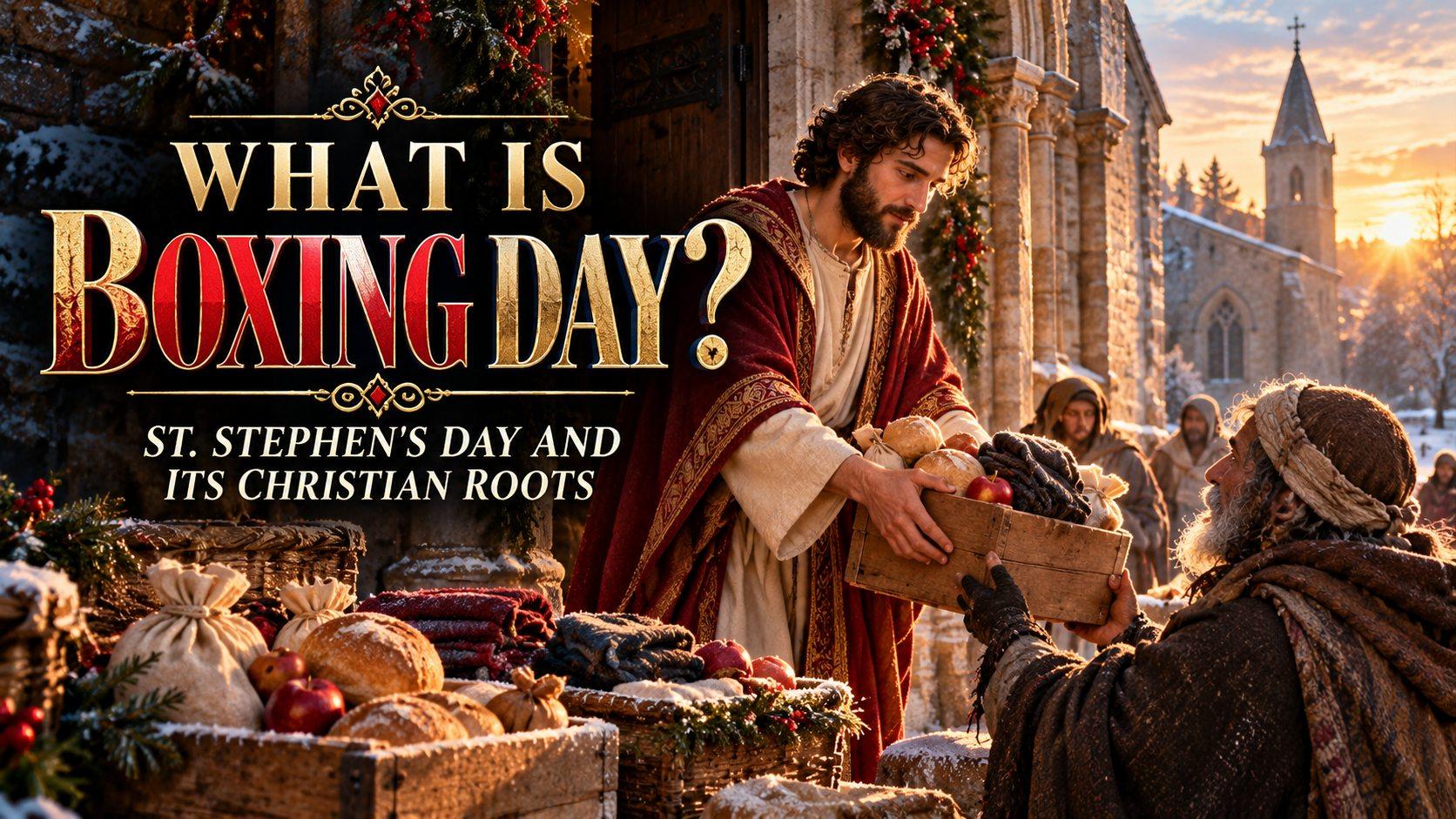
📌 Here is the plain answer. Boxing Day began as a day for giving, not fighting. Servants, tradesmen, and the poor received boxes of money or gifts on this day, and the custom grew up alongside an older, quieter observance: the feast of Saint Stephen, the first Christian ever killed for his faith.
Two different stories share one date. One is about British household custom. The other is about a deacon who forgave the men stoning him. This guide walks through both, where the name actually comes from, and why some Christians still mark the day as a feast while the rest of the world treats it as a shopping holiday.
Every historical claim below links back to a named source you can check yourself.
Why This Matters for Your Faith
It would be easy to let December 26 pass as nothing more than leftover turkey and doorbuster sales.
"He that hath pity upon the poor lendeth unto the LORD; and that which he hath given will he pay him again."
⚠️ But the oldest layer of this day is about exactly that verse. Long before anyone called it Boxing Day, churches were opening alms boxes and handing the contents to the poor on this exact date, right beside remembering a man who gave his whole life away in service.
💡 A holiday built around generosity, sitting next to a feast for a martyr who died serving widows, is not a coincidence worth skipping past. It is the church putting the manger and the cross closer together than a calendar usually allows.

Where Boxing Day Actually Comes From
1. What Boxing Day Actually Is Today
Strip away the name for a moment. Boxing Day is simply the day right after Christmas, December 26, kept as a public holiday across Britain and much of the Commonwealth.
📌 Wikipedia's own account of the holiday lists it as a statutory or general holiday in Australia, Canada, New Zealand, Hong Kong, Nigeria, Trinidad and Tobago, and South Africa, where it was renamed the Day of Goodwill in 1994. In most of Ireland the same date is called Saint Stephen's Day instead, while Ulster tends to call it Boxing Day like the rest of the United Kingdom.
The United States never adopted the holiday nationally. One small exception stands out. Massachusetts Governor William F. Weld declared December 26 Boxing Day there in 1996, though it never became an employee holiday.
💡 For most people today the name just means a second day of rest, or the day the sales start. The history underneath it is older and, honestly, kinder than that.
2. The Servant Who Had to Work on Christmas Day
One widely told explanation starts in the kitchens and stables of wealthy British households, not in a church.
Servants worked straight through Christmas Day, cooking and serving a feast they could not sit down to eat with their own families. The day after, employers sent them home with a box: a bonus, a bit of food from the feast, sometimes a small gift, as thanks for a year of service they rarely got thanked for out loud.
📌 History.com's account of the custom calls these Christmas boxes, in essence, an early version of the holiday bonus. Tradesmen who had served a household all year, the milkman, the butcher, the chimney sweep, collected a similar box or tip on the first working day after Christmas as thanks for twelve months of reliable work.
Wikipedia's account adds a real diary entry to the custom. The English diarist Samuel Pepys mentions giving a Christmas box to a tradesman in his own journal, dated 19 December 1663, which is one of the earliest personal records of the practice in writing.
3. The Church's Own Alms Box, Opened on a Saint's Day
A second, older explanation does not start with wealthy households at all. It starts inside the church building itself.
📌 Parish churches kept alms boxes near the entrance all through Advent, collecting money for the poor. Wikipedia's account of the custom traces the practice back to late Roman and early Christian almsgiving, and says those boxes were traditionally opened and distributed on the feast of Saint Stephen, December 26.
History.com states the same connection plainly: clergy gave the contents of those boxes to the poor on "the feast of St. Stephen, the first Christian martyr" and a figure the early church already associated with charity, since Stephen himself was chosen to make sure widows got fed.
⚠️ Neither story cancels the other out. A servant's tip box and a church's alms box grew up on the same date for the same basic reason. December 26 had already become the day this culture gave something away.

4. A Carol Written for This Exact Day
If you have ever sung Good King Wenceslas, you have already celebrated the Christian layer of this day without noticing it.
📌 Wikipedia's account of the carol says the English clergyman John Mason Neale wrote its lyrics in 1853, setting them on "the Feast of Stephen," and fitting them to a much older thirteenth century spring melody called Tempus Adest Floridum. The carol first appeared that year in a collection called Carols for Christmas Tide.
The king in the song is Wenceslas, a tenth century duke of Bohemia who was never crowned king in his own lifetime. Wikipedia notes that the Holy Roman Emperor Otto the First gave him the royal title after his death, which is the only reason the carol calls him a king at all.
💡 Neale did not pick December 26 by accident. He set a story about a ruler going out in brutal cold to give food to a poor man on the exact day church tradition had already marked for generosity. The carol is a sermon on Proverbs 19:17 wearing a snow scene.
5. How a Tip Box Turned Into a Bank Holiday
A household custom does not automatically become a day off work. That took an act of law, nearly two centuries after the habit of giving boxes was already common.
📌 Wikipedia's account of the holiday says the Bank Holidays Act 1871 formally established December 26 as a bank holiday in England, Wales, and Ireland, and the Oxford English Dictionary records the earliest British attestation of the actual name "Boxing Day" from 1743.
Scotland came later. The same account notes Boxing Day only became an additional bank holiday there in 1974, by royal proclamation under a 1971 update to the original law.
💡 The name is older than the law, and the custom is older than the name. A tip handed to a servant in the 1600s eventually became a date parliament had to formally protect.
6. One Date, Kept Two Very Different Ways
Here is the honest picture. December 26 is not one holiday wearing two names. It is two different things that happen to land on the same square of the calendar.
📌 In the Catholic Church, December 26 is kept as the Feast of Saint Stephen, First Martyr, the second day inside the Christmas octave. The Church of England's own Book of Common Prayer still assigns the day its own readings, and many Lutheran churches keep it too.
Eastern Orthodox churches honor Stephen a day later, December 27, or January 9 on the Julian calendar still followed in some Orthodox communities. Many low church Protestant traditions mark neither the feast nor a fixed saints' calendar at all, since they do not organize the year around a list of saints' days the way Catholic and Anglican calendars do.
Meanwhile Boxing Day itself, the bank holiday and the sales, runs almost entirely separate from any of that. Most shoppers lining up for a discount on December 26 have never heard of Stephen and are not trying to insult him. They are keeping the civic half of a date that has carried two different meanings for centuries.
💡 You do not have to choose only one. You can take the day off, and still spend five minutes remembering the man the alms box was originally opened for.

Practical Tips for Keeping Boxing Day Well
You do not need a Victorian household or a parish alms box to let this history actually shape your own December 26.
- Give something away before you buy anything. Even a small gift to someone who served you this year, a tip, a note, a meal, keeps the oldest version of this custom alive.
- Read Acts 6 and 7 on December 26. It takes ten minutes and puts the actual man behind the feast day back into a day most people spend shopping.
- Play Good King Wenceslas and actually listen to the words. It was written for this exact day, about a ruler who went out in the cold rather than stay warm while someone else was hungry.
- Learn what your own country calls this day. Boxing Day, Saint Stephen's Day, the Day of Goodwill, or no holiday at all. The name tells you which half of the history your culture kept.
- Do not assume Boxing Day sales are a Christian tradition. They are not. The feast and the bank holiday share a date, not a purpose.
- If your church keeps the feast, show up. A Mass or service for the first martyr the day after Christmas is a short walk from the manger to the cost of actually following Christ.
- Ask who in your life serves you quietly all year. The original box was for exactly that person. Most of us can still name one.
Top Bible Verses Behind Boxing Day
Boxing Day has no Bible verse of its own. These five passages carry the two ideas, giving and sacrifice, that the day actually grew out of.
1. Proverbs 19:17
"He that hath pity upon the poor lendeth unto the LORD; and that which he hath given will he pay him again."
This is the verse every alms box and every Christmas box was quietly obeying, long before anyone wrote a name for the custom down.
2. Deuteronomy 15:10 and 11
"Thou shalt surely give him, and thine heart shall not be grieved when thou givest unto him: because that for this thing the LORD thy God shall bless thee in all thy works, and in all that thou puttest thine hand unto. For the poor shall never cease out of the land: therefore I command thee, saying, Thou shalt open thine hand wide unto thy brother, to thy poor, and to thy needy, in thy land."
Moses commands an open hand centuries before any English household started handing servants a box. Boxing Day did not invent generosity. It just gave an old command a date.
3. Acts 6:1 to 3
"And in those days, when the number of the disciples was multiplied, there arose a murmuring of the Grecians against the Hebrews, because their widows were neglected in the daily ministration. Then the twelve called the multitude of the disciples unto them, and said, It is not reason that we should leave the word of God, and serve tables. Wherefore, brethren, look ye out among you seven men of honest report, full of the Holy Ghost and wisdom, whom we may appoint over this business."
Stephen was appointed because people were going hungry. The man the church remembers on December 26 got his start solving the exact problem the day's alms boxes existed to fix.

4. Matthew 5:44 and 45
"But I say unto you, Love your enemies, bless them that curse you, do good to them that hate you, and pray for them which despitefully use you, and persecute you; That ye may be the children of your Father which is in heaven: for he maketh his sun to rise on the evil and on the good, and sendeth rain on the just and on the unjust."
Stephen kept this exact command while he was being stoned, praying for the men killing him rather than against them. The feast on December 26 remembers a man who put Jesus' hardest teaching into practice at the worst possible moment.
5. Acts 8:2
"And devout men carried Stephen to his burial, and made great lamentation over him."
Even the men who buried Stephen are only described by their devotion, not their names. The first Christian martyr was mourned by people history never bothered to identify, which is its own quiet lesson about whose grief actually matters to God.
Frequently Asked Questions About Boxing Day
What is Boxing Day?
Boxing Day is December 26, the day after Christmas, kept as a public holiday in the United Kingdom and much of the Commonwealth. It has nothing to do with the sport of boxing. The name comes from a tradition of giving boxes of money, gifts, or alms on this date.
Why is it called Boxing Day?
Historians give two main explanations, and both may be true at once. Wealthy households gave servants and tradesmen a Christmas box of money or gifts on the first weekday after Christmas, and churches opened their own alms boxes on the same date and gave the contents to the poor.
Is Boxing Day a religious holiday?
The civic holiday, the bank holiday and the sales, is not religious on its own. It shares its date with a genuinely religious observance, the Feast of Saint Stephen, which several Christian traditions still keep as a feast day.
What is the difference between Boxing Day and Saint Stephen's Day?
They fall on the same date, December 26, but they are not the same thing. Saint Stephen's Day is the church's feast for the first Christian martyr. Boxing Day is a separate British civic custom that grew up alongside it on the same date. In most of Ireland the day is actually called Saint Stephen's Day rather than Boxing Day.
Is Boxing Day celebrated in the United States?
Not nationally. It is not a federal or state holiday for most of the country. Massachusetts is the one notable exception, after Governor William F. Weld declared December 26 Boxing Day there in 1996, though it was never made an employee holiday.
Which countries celebrate Boxing Day?
It is a public or statutory holiday in the United Kingdom, Australia, Canada, New Zealand, Hong Kong, and Nigeria, among others. South Africa renamed it the Day of Goodwill in 1994, and Trinidad and Tobago also keeps it as a public holiday.
Why does the carol Good King Wenceslas mention the Feast of Stephen?
Because its English lyricist, John Mason Neale, set the story deliberately on December 26 in 1853, matching a tale about a generous ruler to the day the church already associated with giving to the poor.
Do Protestants celebrate Boxing Day or Saint Stephen's Day?
Many do, through the civic Boxing Day holiday itself, which is not tied to any one church. Anglicans and many Lutherans also keep the religious Feast of Saint Stephen on the same date. Other Protestant traditions follow no fixed saints' calendar and may not mark the feast at all, which how different church calendars actually work explains in more depth.
Why do stores have such big Boxing Day sales?
The sales grew out of the civic holiday, not the church feast. Once December 26 became a guaranteed day off work across the Commonwealth, retailers used the free time and the post Christmas returns rush to launch major sales, a modern habit with no connection to the alms boxes the day is actually named for.
What happens after Boxing Day in the church calendar?
The Christmas octave keeps moving. December 27 remembers the apostle John, December 28 remembers the Holy Innocents, and the full twelve days of Christmas run until Epiphany on January 6.
Final Thoughts
Strip away the sales and the strange name, and two true things remain about this day.
📌 Boxing Day began as a day for giving something away, not getting a discount. A servant's tip, a tradesman's thanks, a church's alms box emptied for the poor. Whatever shopping it has grown into since, that is where the name actually started.
📌 The same date remembers a man who gave everything, not just a box of coins. Stephen served tables, preached without fear, and prayed for the people killing him while they were still doing it. The church placed his feast right after Christmas on purpose, so the joy of the manger would sit next to the real cost of following Christ.
You do not have to pick a side between the bank holiday and the feast day. Keep the rest if your country gives it to you. Just do not let the whole day pass without giving something away, the way the very first Boxing Day custom asked you to.
❓ Who served you this year without much thanks, and what will you actually give them?
📌 That question is the oldest part of this whole holiday.
📚 Sources
Every claim in this article traces back to one of these. All links checked 9 November 2026.
- Boxing Day
Wikipedia
The source for the Oxford English Dictionary's 1743 earliest attestation of the name, the Bank Holidays Act 1871 and the 1974 Scottish proclamation, Samuel Pepys's 1663 diary reference to a Christmas box, the alms box tradition tied to the Feast of Saint Stephen, and the list of countries that observe the holiday, including South Africa's 1994 renaming to the Day of Goodwill and Massachusetts Governor William F. Weld's 1996 declaration.
- Saint Stephen's Day
Wikipedia
The source for the Western December 26 and Eastern December 27 or January 9 observance dates, and the day's standing as the second day of Christmastide.
- Good King Wenceslas
Wikipedia
The source for John Mason Neale writing the carol's lyrics in 1853 and setting them on the Feast of Stephen, its first publication in Carols for Christmas Tide, the Tempus Adest Floridum melody, and Wenceslas of Bohemia receiving the royal title only after his death.
- Why Is the Day After Christmas Called Boxing Day?
History.com, by Christopher Klein
The source for the Christmas box as an early form of a holiday bonus for servants and tradesmen, and for the feast of Saint Stephen being described as the first Christian martyr and a figure associated with charity.
- December 26 — Feast of Saint Stephen, First Martyr
United States Conference of Catholic Bishops, Daily Readings
The source for the Catholic Church's current title for the day and its assigned Mass readings from Acts 6 and 7.