📖 What Is Christmastide? The Twelve Days of Christmas Explained
The tree comes down on December 26. The last candy cane gets eaten. Everyone goes back to work, and Christmas is officially over.
Except, according to most of Christian history, it just started.
Maybe you have heard the song about twelve days of Christmas and assumed it was just a strange list of birds and jewelry with no real meaning behind it.
📌 Here is the plain answer. Christmastide is the actual Christian season that begins on Christmas Day and runs for twelve days, through January 5, with the wider Catholic calendar stretching the celebration even further into January. December 25 was never meant to be the whole party. It was meant to be day one.
That one sentence raises more questions than it answers. Twelve days of what, exactly? Why does the song count gifts instead of church feasts? And why do Orthodox Christians, Catholics, and Protestants all seem to draw the lines in slightly different places?
This guide walks through where Christmastide actually comes from, what the Catholic Church's own law says about its exact dates, the specific feast days hidden inside those twelve days, how Orthodox Christians keep the same season on their own calendar, and why most Protestant Christians treat the whole thing very differently.
Every historical and liturgical claim below links back to a named source, so you can go check it yourself.
Why This Matters for Your Faith
It is easy to treat December 25 like a finish line. The gifts are opened, the big meal is eaten, and the next thought is already about New Year's or getting back to normal.
⚠️ That instinct to rush past the manger is older than Black Friday. It is just human nature to want to move on quickly from something you cannot fully take in.
Scripture describes the incarnation as something far too large for one day to hold.
"And the Word was made flesh, and dwelt among us, (and we beheld his glory, the glory as of the only begotten of the Father,) full of grace and truth."
📌 God did not visit the world for an afternoon. He moved in. The Word becoming flesh is not a single transaction you can wrap up in twenty four hours. It keeps unfolding: a baby born, a name given, a light revealed to strangers from the east, a Savior eventually baptized as a grown man.
💡 Christmastide exists because the Church, centuries ago, decided the Incarnation deserved more than a single day of attention before everyone moved on to ordinary life again.
The stakes here are not really about calendars or decorations. The stakes are whether you let the birth of Christ actually sink in, or whether you let it get crowded out by the next thing on the list before you have even finished sitting with it.

What Christmastide Actually Is
1. The Plain Definition: Twelve Days, Starting on Christmas Day
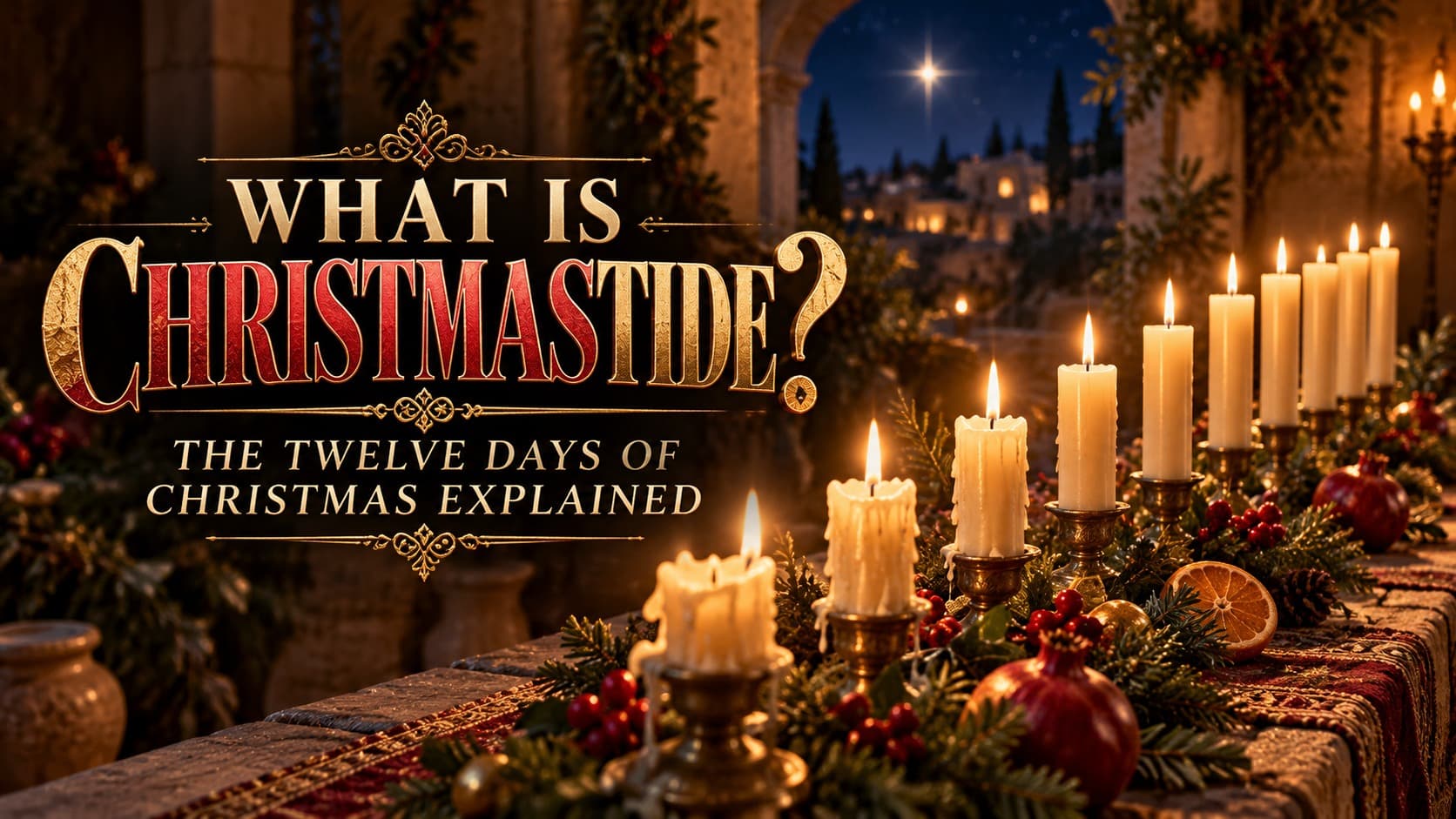
Start with the simplest version. Christmastide, also called Twelvetide, is the twelve day stretch that begins on December 25 and runs through January 5, the night traditionally called Twelfth Night.
📌 Count it out and the math works cleanly. December 25, 26, 27, 28, 29, 30, 31, then January 1 through 5. Twelve days, start to finish, closing the evening before Epiphany on January 6.
This is the season behind the familiar carol. The gifts in the song are not the point of this guide. The twelve actual days behind the counting are. The night before all of this begins carries its own separate history, built around waiting rather than celebrating.
2. Where Rome Draws the Line: Christmas Time in Catholic Law
Here is where most explanations of Christmastide stop short, and this guide will not. The twelve folk days are not actually the full length of the Catholic Church's own Christmas season.
The Church's own General Norms for the Liturgical Year and the Calendar, the official document governing the Catholic calendar, states it plainly in its own numbered rule: "Christmas Time runs from First Vespers (Evening Prayer I) of the Nativity of the Lord up to and including the Sunday after Epiphany or after 6 January."
📌 That is longer than twelve days, on purpose. The same document states a second rule right after it: "The Sunday falling after 6 January is the Feast of the Baptism of the Lord." That Sunday, not January 5 or January 6, is the day the Catholic Church's own Christmas season actually closes.
So there are really two separate measuring sticks running at once. The twelve days most people know from the song are the older, shorter folk tradition. Christmas Time, the Church's own liturgical season, quietly runs a week or two beyond it, all the way to the Baptism of the Lord. Where this season sits inside the Church's whole yearly calendar is worth understanding on its own.
3. The Octave: Eight Days Counted as One Single Feast
The first eight days of Christmastide are not just any eight days. The same official Catholic norms give the Nativity its own Octave, meaning the Church treats the first eight days of Christmas as one extended, continuous feast rather than eight separate ordinary days.
The document lays the Octave out day by day:
- 🟢 December 25, the Nativity of the Lord itself
- 🟢 December 26, the Feast of Saint Stephen, the first Christian martyr
- 🟢 December 27, the Feast of Saint John, Apostle and Evangelist
- 🟢 December 28, the Feast of the Holy Innocents
- 🟢 December 29 through 31, ordinary days within the Octave
- 🟢 January 1, the Octave Day, kept as the Solemnity of Mary, the Holy Mother of God
💡 Notice who gets remembered in those first few days. A martyr, an apostle who died of old age, and a group of murdered children. Christmastide does not wait long before reminding you that the Incarnation walked straight into a world of real suffering.
The Sunday that falls within the Octave, or December 30 in a year with no such Sunday, also carries the Feast of the Holy Family. And whichever Sunday lands between January 2 and January 5 is marked as the Second Sunday after the Nativity, the last Sunday of the season before Epiphany itself.
4. Twelfth Night and Where the Carol Actually Comes From
January 5, the last of the twelve folk days, is Twelfth Night, the eve of Epiphany. Christian History Institute, a magazine devoted to church history, traces the season's formal start to a church council meeting at Tours in the year 567, which named the days between Christmas and Epiphany a special, sacred season of feasting rather than ordinary time.
📌 That council meeting is where "the twelve days of Christmas" comes from, long before it was ever a song. In medieval Western Europe, Twelfth Night itself became a night of real festivity, plays, and reversal of the usual order, which is also where William Shakespeare borrowed the name for his own comedy about mistaken identity.
⚠️ What this guide will not do is dress the carol's gift list up as a secret code for church teaching. That claim circulates widely online, but it is a separate, disputed question with real evidence problems on both sides, and it deserves its own honest treatment rather than a confident paragraph here. What is well established is simpler and sturdier: the twelve days themselves are a real, old feature of the Christian calendar, regardless of what any song's verses do or do not symbolize.
5. How the Orthodox Church Keeps the Same Twelve Days
Eastern Orthodox Christians keep a version of this same season, built around the same idea: the Nativity and the feast of Theophany, the Orthodox name for the Lord's baptism and manifestation, are treated as two connected Great Feasts with twelve festive days linking them together.
The Orthodox Church in America's own published guide to the feast states it directly: "December 25 through January 4 are fast free," following an afterfeast period of six days after the Nativity itself on December 25. Theophany, completing the twelve day arc, falls on January 6, with a strict fast kept the day before on January 5, the eve of the feast.
Churches still using the older Julian calendar for their church year, including the Russian, Serbian, and Jerusalem Orthodox Churches, keep this exact same twelve day structure, just running on dates that currently sit thirteen days behind the Gregorian calendar most of the world uses. The full explanation for why their Christmas lands on January 7 instead of December 25 is its own guide, but the underlying twelve day season is the same one described here, simply read off an older calendar.
6. Why Most Protestants Keep One Day, Not a Season
💡 Be fair to both sides here, because Bible Buddy has Catholic and Protestant readers. Liturgical Protestant traditions, including Anglican and Lutheran churches, generally keep a version of the same twelve day Christmas season, often followed by their own Epiphany season afterward.
Most other Protestant traditions, particularly Baptist, nondenominational, and many evangelical churches, do not observe a formal liturgical Christmas season at all. Christmas Day itself gets celebrated, and then ordinary church life simply resumes.
Paul gave the theological reasoning many of these traditions still point back to.
"Let no man therefore judge you in meat, or in drink, or in respect of an holyday, or of the new moon, or of the sabbath days: Which are a shadow of things to come; but the body is of Christ."
⚠️ Never present one side of this as simply the Christian answer. A Catholic or Orthodox believer reads a structured Christmastide as the Church, with real authority Christ gave it, drawing out the full weight of the Incarnation over time. A Protestant reading Colossians 2 often concludes that no specific calendar of extra feast days is owed to God, even a good one, and that keeping or not keeping it is a matter of conscience rather than command.
Both readers can love the same Christmas Day without agreeing on whether the twelve days that follow it are binding, optional, or simply unnecessary. That disagreement is honest, and it does not need to be settled here for either side to be taken seriously.
Practical Tips for Actually Keeping Christmastide
Whether or not your own church marks these twelve days, here is how to let the season shape you a little, even quietly, on your own.
- Leave the tree and lights up past December 26. You are not behind on taking down decorations. In most of Christian history, the season was only getting started.
- Read one Gospel passage a day for the twelve days. Spread the Christmas story out instead of reading it once on the 25th and moving on. Let it settle in slowly.
- Remember Saint Stephen and the Holy Innocents on their actual days. A quiet prayer for persecuted Christians on December 26, and for grieving parents on December 28, keeps the season honest about the cost the Incarnation walked into.
- Mark January 1 as more than a countdown to resolutions. Many churches keep it as the day Mary is honored as the Mother of God and the day the name Jesus was formally given. Let that outrank your diet plan for five minutes.
- Plan something for Twelfth Night, January 5. A simple family meal or a short time of prayer gives the ending of the season its own shape, instead of letting it dissolve without notice.
- If your tradition does not mark these days, that is not a lesser faith. You can still choose to let the Incarnation occupy more than one day of your own personal attention, with or without a church calendar telling you to.
- Carry the season all the way to Epiphany. What the Church remembers on January 6 is really the finish line this whole season has been walking toward the entire time.
Top 5 Bible Verses for the Twelve Days of Christmas
Christmastide was built around real events in the Gospels, not a greeting card season. These five verses mark out the days themselves.
1. Luke 2:21
"And when eight days were accomplished for the circumcising of the child, his name was called JESUS, which was so named of the angel before he was conceived in the womb."
Count eight days from Christmas and you land on January 1, the Octave Day the Catholic calendar keeps as the Solemnity of Mary and the giving of the Holy Name. This verse is the actual Gospel event behind that date, not a tradition invented later.
2. Matthew 2:1 and 2
"Now when Jesus was born in Bethlehem of Judaea in the days of Herod the king, behold, there came wise men from the east to Jerusalem, Saying, Where is he that is born King of the Jews? for we have seen his star in the east, and are come to worship him."
The wise men were already traveling while the twelve days were unfolding. Their arrival at the very end of the season is why the whole Christmastide arc has always pointed toward one destination: a star over a house, and strangers finally kneeling down.
3. Matthew 2:9 and 10
"When they had heard the king, they departed; and, lo, the star, which they saw in the east, went before them, till it came and stood over where the young child was. When they saw the star, they rejoiced with exceeding great joy."
Twelve days of waiting end in exceeding great joy, not a shrug. Whatever your own Christmastide looks like this year, that is the emotion the season is actually built to arrive at.
4. Matthew 2:16 to 18
"Then Herod, when he saw that he was mocked of the wise men, was exceeding wroth, and sent forth, and slew all the children that were in Bethlehem, and in all the coasts thereof, from two years old and under, according to the time which he had diligently enquired of the wise men. Then was fulfilled that which was spoken by Jeremy the prophet, saying, In Rama was there a voice heard, lamentation, and weeping, and great mourning, Rachel weeping for her children, and would not be comforted, because they are not."
This is the hard verse behind December 28's Feast of the Holy Innocents. Christmastide does not skip past it. A season built around real history has to make room for real grief, even grief this old and this heavy.
5. Galatians 4:4 and 5
"But when the fulness of the time was come, God sent forth his Son, made of a woman, made under the law, To redeem them that were under the law, that we might receive the adoption of sons."
Fulness of time is not a fast idea. It is a slow, deliberate one. Christmastide gives that phrase twelve actual days to breathe instead of twenty four rushed hours.

Frequently Asked Questions About Christmastide
What is Christmastide?
Christmastide, also called Twelvetide or the Twelve Days of Christmas, is the Christian season that begins on December 25 and runs twelve days through January 5, the eve of Epiphany. The Catholic Church's own liturgical Christmas season actually extends past those twelve days, all the way to the Feast of the Baptism of the Lord in January.
What are the twelve days of Christmas, exactly?
December 25 through January 5. The Nativity itself has its own eight day Octave running December 25 to January 1, and the remaining four days lead up to Twelfth Night on January 5, the evening before Epiphany on January 6.
Is the song about a secret religious code?
That claim is widely repeated online, but it is a genuinely disputed theory, not a settled historical fact, and the evidence for it is weaker than the story suggests. The twelve days themselves are real and well documented; what a specific popular song's verses may or may not symbolize is a separate, far less certain question.
When does Christmastide actually end?
It depends which measuring stick you use. The folk tradition of twelve days ends January 5, Twelfth Night. The Catholic Church's own official Christmas season runs further, closing on the Feast of the Baptism of the Lord, the Sunday after January 6.
What feast days fall inside Christmastide?
Saint Stephen on December 26, Saint John the Evangelist on December 27, the Holy Innocents on December 28, the Holy Family on the Sunday within the Octave, and the Solemnity of Mary, the Holy Mother of God, on January 1, the Octave Day of Christmas itself.
Do Orthodox Christians celebrate Christmastide too?
Yes. Orthodox Christians keep a fast free twelve day period linking the Nativity on December 25 to the feast of Theophany on January 6, the Orthodox celebration of Christ's baptism. Churches on the older Julian calendar keep the same structure on dates that currently fall thirteen days later on the Gregorian calendar.
Do Protestants celebrate the twelve days of Christmas?
Anglican and Lutheran churches generally do, following a version of the same liturgical calendar. Most Baptist, nondenominational, and many other evangelical churches do not observe a formal season, treating Christmas Day itself as the full observance and leaving the following days as a matter of personal choice.
What is Twelfth Night?
Twelfth Night is January 5, the final evening of the twelve days and the eve of Epiphany. In medieval Western Europe it became a night of feasting and festivity, and it is also where William Shakespeare borrowed the title for his own comedy.
Is it wrong to take Christmas decorations down right after December 25?
No single verse requires anyone to keep decorations up for twelve days. It is simply a much older pattern than the modern habit of packing everything away on December 26, and many Christians find real meaning in letting the season run its full course on purpose.
Final Thoughts
Christmastide is not a quirky detail hiding behind a children's song. It is one of the oldest instincts in the Christian calendar: the conviction that God becoming flesh is too large an event to process in a single day.
📌 Twelve real days, a saint and a group of murdered children remembered honestly along the way, and a Catholic calendar that keeps the celebration going even longer than that. None of it was ever about a song's gift list. All of it was about giving the Incarnation room to actually sink in.
Whatever your own tradition does or does not observe on the calendar, you still get to decide how long you let the news of Christmas actually occupy your attention this year. What that one birth in Bethlehem actually means does not stop mattering the moment the wrapping paper gets thrown away.
So here is one way to carry it forward.
Pick one day between now and January 5 that you would otherwise have treated as ordinary.
Read the Christmas story again that day. Slowly, out loud if you can.
Let the twelfth day of a two thousand year old season still have something to say to you.
📚 Sources
Every claim in this article traces back to one of these. All links checked 30 October 2026.
- General Norms for the Liturgical Year and the Calendar
Catholic Bishops' Conference of England and Wales, Liturgy Office
The source for the official text of nos. 32 to 38, defining Christmas Time as running from First Vespers of the Nativity to the Sunday after Epiphany, the structure of the Octave day by day, the Feast of the Holy Family, the Second Sunday after the Nativity, and the Feast of the Baptism of the Lord.
- Twelve days of Christmas
Christian History Institute
The source for the Council of Tours in 567 naming the twelve days a season of feasting, the Western Octave feasts of Saint Stephen, Saint John, and the Holy Innocents, and Twelfth Night as the origin of Shakespeare's play title.
- The Nativity of Our Lord Jesus Christ
Orthodox Church in America (OCA), Department of Christian Education
The source for the Nativity's six day afterfeast and the exact wording that December 25 through January 4 are fast free in Orthodox practice.
- Icons of the Twelve Great Feasts
Orthodox Church in America (OCA)
The source for the Nativity of Christ (December 25) and Theophany (January 6) as two of Orthodoxy's Twelve Great Feasts.
- Why Orthodox Christians celebrate Christmas in January
National Geographic · 2022
The source for the Julian calendar churches, including Russia, Serbia, and Jerusalem, sitting thirteen days behind the Gregorian calendar.