📖 What Is the Liturgical Calendar? A Beginner's Guide to the Christian Year
You show up at a friend's church in December and someone hands you a candle for something called Advent.
A coworker gives up chocolate for forty days every spring and calls it Lent, and you nod like you understand why.
Your own pastor mentions "the Third Sunday of Ordinary Time" from the pulpit, like everyone in the room already knows what season that is.
📌 The liturgical calendar is the name for all of it. It is the yearly cycle of seasons, colors, and holy days that churches use to walk through the story of Jesus one season at a time, every single year, instead of preaching whatever comes to mind.
It is not a secret handshake, and it is not only a Catholic thing.
Orthodox churches keep one. Many Lutheran, Anglican, and Methodist churches keep one. Some Baptist and nondenominational churches have never heard the phrase.
And almost every Christian, whether their church uses the word or not, already lives by a small piece of it every December and every spring.
This guide walks through what the liturgical calendar actually is, where the idea of marking sacred time comes from in Scripture, how the Christian year grew into its present shape, and why Catholics, Orthodox Christians, and Protestants do not all keep it the same way.
Why This Matters for Your Faith
It is easy to treat a church calendar as trivia. A fact to know, not a reason to care.
⚠️ But how a church spends its year is a statement about what it thinks is worth remembering.
A congregation that walks through Advent, Christmas, Lent, and Easter every year is rehearsing the same claim on repeat. God became human. He died. He rose. He is coming back.
Nobody has to invent a new sermon series to keep that story central. The calendar does it for you, year after year, whether the preaching that week is strong or weak.
That is the real stake here. Not whether you personally observe Lent, but whether the shape of your year keeps bringing you back to the night Jesus was born and the resurrection that followed it, or whether those truths only show up when you happen to remember them.
💡 A calendar cannot save anyone. But a calendar built around the gospel keeps putting the gospel back in front of you, on schedule, whether you feel like hearing it that week or not.

How the Christian Year Actually Works
1. What the Liturgical Calendar Actually Is
Strip away the Latin and the stained glass, and the idea is simple. The liturgical calendar is a yearly cycle of seasons and set days that a church uses to structure its worship around the life of Christ, instead of around the plain January through December calendar everyone else uses.
Catholic churches describe the year in two layers. The United States Conference of Catholic Bishops calls them the Proper of Time, the seasonal celebrations tied to Christmas and Easter, and the Proper of Saints, the feast days scattered across the year that honor specific saints and events like All Saints' Day.
Both layers get published together in the liturgical calendar every church receives for the year, and individual dioceses and countries can add their own local observances on top.
📌 None of this replaces Sunday worship. It shapes what Sunday worship is about each week.
2. The Two Big Arcs of the Year
Underneath all the individual feast days, the Christian year runs on two main arcs.
- 🟢 The Christmas arc. Advent, four weeks of waiting, leads into Christmas, which opens into Epiphany.
- 🟢 The Easter arc. Lent, forty days of repentance, leads into Holy Week, Easter, and then the fifty days to Pentecost.
Between those two arcs sits what the Catholic calendar simply calls Ordinary Time. Not ordinary in the sense of unimportant, but ordinary in the older sense of counted, numbered Sundays, the weeks that are not part of either high season.
The USCCB's own liturgical year page explains that Ordinary Time actually comes in two separate stretches, a shorter block of four to eight weeks after Christmas Time ends, and a longer block of roughly six months after Easter Time ends, running until Advent begins again.
📌 So the year is not one long season. It is two climbs and two plateaus, repeating every year of a Christian's life.
3. Where the Idea Comes From in Scripture
Marking sacred time is not a medieval invention. God built it into Israel's calendar from the start.
"Speak unto the children of Israel, and say unto them, Concerning the feasts of the LORD, which ye shall proclaim to be holy convocations, even these are my feasts... These are the feasts of the LORD, even holy convocations, which ye shall proclaim in their seasons."
Leviticus 23 goes on to lay out Passover, the Feast of Weeks, and several other appointed days, each tied to a fixed point in the year. These were not suggestions. They were commanded, proclaimed, and repeated on schedule.
Jesus kept that rhythm. Luke says it was simply what He did every week.
"And he came to Nazareth, where he had been brought up: and, as his custom was, he went into the synagogue on the sabbath day, and stood up for to read."
"As his custom was" is the key phrase. Jesus lived inside a calendar of appointed days His whole life, and the early church inherited that same instinct. Acts dates the giving of the Holy Spirit by one of those appointed feasts, not by a date on a civil calendar.
"And when the day of Pentecost was fully come, they were all with one accord in one place."
But the New Testament also hands the church real freedom here, and it would be dishonest to skip it. Paul tells the Colossians not to let anyone bind their conscience to the old calendar of holy days.
"Let no man therefore judge you in meat, or in drink, or in respect of an holyday, or of the new moon, or of the sabbath days: Which are a shadow of things to come; but the body is of Christ."
Paul's point is not that marking time is wrong. It is that the old festival calendar was always pointing at Christ, and now that He has come, the shadow does not get to rule over the One it was pointing to. Paul says almost the same thing to the Galatians, worried that going back to the old calendar as a requirement would undo the freedom they had found in Christ.
"Ye observe days, and months, and times, and years."
And to the Romans, Paul settles the whole question of conscience in a single verse.
"One man esteemeth one day above another: another esteemeth every day alike. Let every man be fully persuaded in his own mind."
📌 That single sentence is the reason Christians have always had room to disagree about this, in good conscience, without either side being unfaithful.
4. How the Calendar Grew After the New Testament
The New Testament gives the church the Lord's Day and the pattern of appointed time. It does not hand down a finished church calendar. That took centuries to settle, and the fight over one date shows exactly how hard it was.
Some early Christians, remembered as the Quartodecimans, kept Easter on the fourteenth of Nisan, tying it to the Jewish Passover date no matter what day of the week it fell on. Others insisted Easter always had to land on a Sunday, the day of the resurrection itself. The Catholic Encyclopedia's entry on Easter says this dispute is actually how historians first learn much of what they know about how early Christians kept the feast at all.
The First Council of Nicaea in the year 325 tried to settle it, decreeing that the practice already used at Rome, Easter on the Sunday after the first full moon following the spring equinox, should be observed everywhere. It did not fully work. The same source notes that even at Rome itself, the date used for calculating Easter "was changed repeatedly" in the years after Nicaea, and different regions kept disagreeing over the exact calculation for centuries more.
⚠️ Worth saying plainly: Nicaea settled a method, not a single uniform date overnight. The disagreement between Eastern and Western dates for Easter that still shows up on calendars today traces back to that same unfinished argument.
Once Easter had a settled rhythm, the rest of the year slowly filled in around it. Saints' feast days, Lent as a season of preparation, and eventually Advent as its mirror before Christmas, all developed over the following centuries as the church kept building a fuller way to walk through the gospel story every year.
5. What the Catholic Church Officially Teaches Today
The calendar Catholic parishes follow now is called the General Roman Calendar. Pope Paul VI promulgated it in 1969, after the Second Vatican Council, and the Holy See has revised it since, most recently in a major way in 2002.
The governing document behind it, the church's Universal Norms on the Liturgical Year and the Calendar, opens by saying the church celebrates Christ's saving work on set days throughout the year, which is as close to an official definition of the whole idea as exists. A later paragraph in the same norms, numbered 49 by the USCCB's summary, describes the General Roman Calendar as combining the seasonal Proper of Time with the feasts of saints who matter to the whole church, alongside others who show the continuity of holiness through God's people across history.
The liturgical year itself begins on the First Sunday of Advent, which actually falls in what the ordinary calendar still calls the previous year. Catholics start a new church year in late November or early December, weeks before anyone else starts theirs in January.
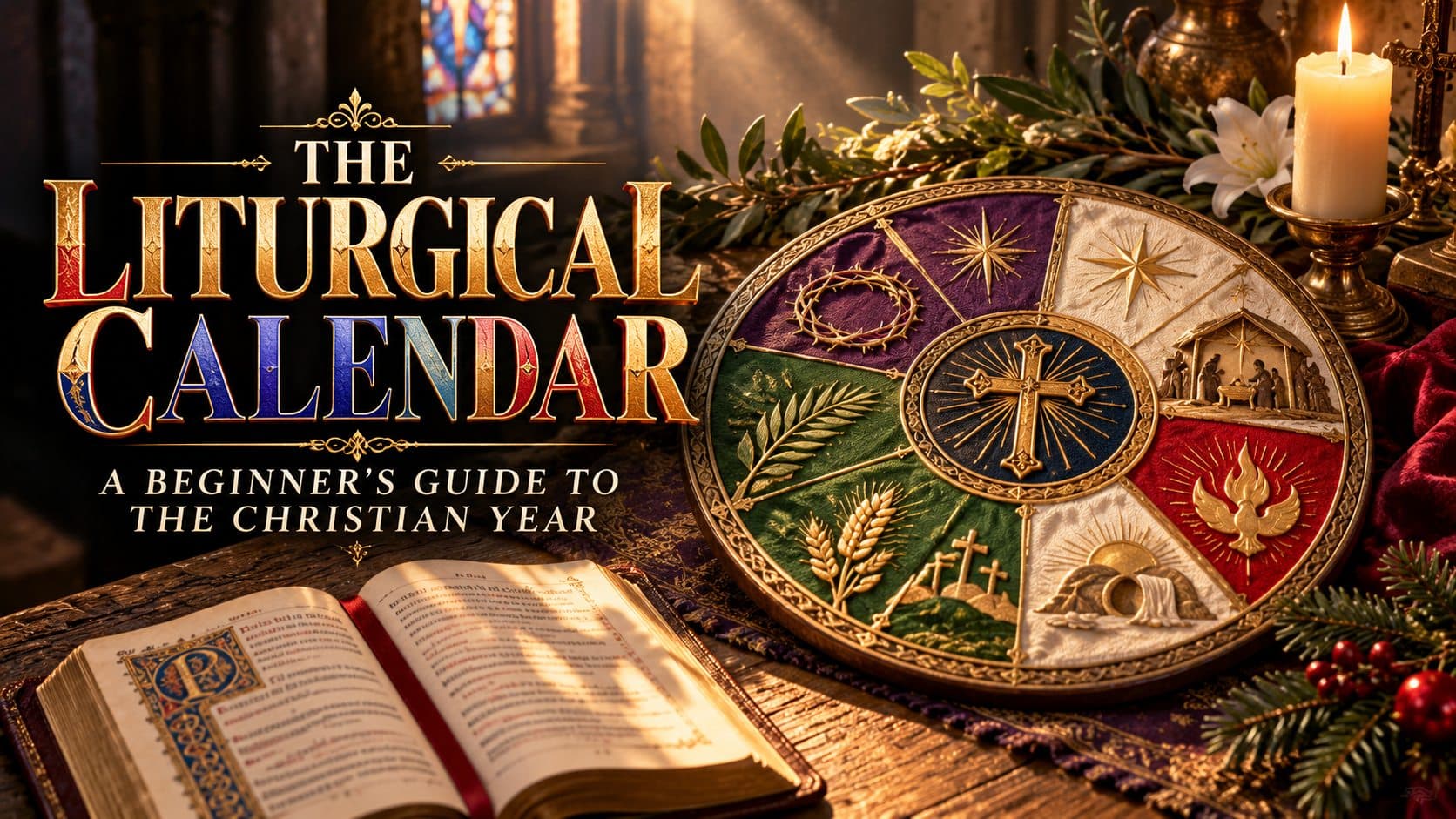
Even the color a priest wears is set by this calendar, not by personal taste. The USCCB explains that white marks Christmas and Easter seasons along with feasts of the Lord, Mary, angels, and non martyred saints. Red marks Palm Sunday, Good Friday, Pentecost, and the feasts of martyrs. Green covers the long stretches of Ordinary Time, and violet marks the penitential seasons of Advent and Lent.
📌 Walk into a Catholic parish on any Sunday of the year and the color at the altar alone tells you what season the church believes it is in.
6. How Orthodox and Protestant Christians Differ
Orthodox Christians keep a liturgical year too, built around the same two centers as the Catholic calendar, just organized a little differently. The Orthodox Church in America lays its own church year out as a cycle that runs from Pre-Lent through Great Lent, Holy Week, Pascha, the weeks that follow, Ascension, and Pentecost, with a separate set of fixed feasts like the Nativity of Christ, Epiphany, and the Transfiguration layered on top.
Most Orthodox churches still calculate their calendar using the older Julian reckoning, which is the reason, covered in full in what Christmas actually celebrates, that many Orthodox Christians mark the Nativity nearly two weeks after Western churches do, even though by their own calendar it falls on the same date it always has.
Protestants split much further apart on this question than Catholics and Orthodox Christians do from each other. Lutheran, Anglican, and Methodist churches generally kept the shape of the Christian year at the Reformation, trimming some of the saints' days but holding on to Advent, Christmas, Lent, and Easter.
Reformed and Puritan churches went a different direction entirely, on principle rather than by accident. The Westminster Confession of Faith, written by English and Scottish Reformed theologians in the 1640s, devotes a whole chapter to worship and states that acceptable worship is "instituted by himself, and so limited to his own revealed will," a rule historians call the regulative principle. Read the chapter closely and it names one single day God appointed for worship across the year, "one day in seven for a Sabbath," now kept as the Lord's Day. It never mentions Christmas, Easter, or any other feast at all.
That silence was the point. If Scripture never commands a yearly cycle of feast days beyond the weekly Lord's Day, Reformed churches in this tradition concluded a church calendar was a human addition no congregation was bound to keep, whatever history the wider Reformation shares with that conviction is its own story, covered in what Reformation Day actually commemorates.
Many Baptist and nondenominational churches today sit somewhere in the middle. They never adopted a formal liturgical calendar, but most still preach through Christmas and Easter every year, keeping the two biggest arcs of the Christian story without the rest of the structure around them.
7. Why the Calendar Still Shapes Worship Today
Whichever tradition you come from, the calendar question eventually comes down to the same two verses from earlier: Colossians 2:16 and 17, and Romans 14:5.
The old festival calendar was a shadow pointing at Christ. Once He arrived, the shadow lost its power to bind anyone's conscience. That frees a Lutheran to keep Advent, a Baptist to skip it, and a Presbyterian in the Reformed tradition to keep only the Lord's Day, all without one of them sinning against the others.
What none of them can skip is the thing the calendar was always built to protect. Somewhere, on some rhythm, the church has to keep returning to the birth, the death, and the resurrection of Jesus, or the story quietly drifts to the edge of ordinary life.
💡 The liturgical calendar is not the gospel. It is one of the sturdiest tools the church has ever built to make sure the gospel keeps getting told.

Practical Tips for Learning the Christian Year
You do not need a seminary degree to start paying attention to the church year. Start with these.
- Learn the two big arcs before the small feast days. Get comfortable with Advent to Epiphany and Lent to Pentecost first. Everything else is detail layered on top of those two shapes.
- Pick one season to observe on purpose this year. Advent or Lent are the easiest starting points, since both come with a clear, short practice built in.
- Find out what your own church actually does, and why. Ask your pastor directly whether your congregation follows a calendar, part of one, or none at all.
- Read Colossians 2:16 and 17 before you judge another tradition's practice. Whatever your own church does, Scripture itself tells you not to make this a test of someone else's faith.
- Visit a different tradition's service during a high season at least once. A Catholic Midnight Mass or an Orthodox Pascha service will show you the calendar doing exactly what it was built to do.
- Remember the calendar never replaces gathering with other believers. Whether or not your church marks Advent, showing up on the Lord's Day is the one rhythm every tradition in this article agrees is not optional.
- Let the color of the season remind you of the story, not just decorate it. Purple for waiting, white for celebration, green for ordinary faithfulness. The color is a memory aid, not a rulebook.
Top 4 Bible Verses About Sacred Time
If you want the biblical backbone behind all of this, start with these four.
1. Ecclesiastes 3:1
"To every thing there is a season, and a time to every purpose under the heaven:"
Before there was an Advent wreath or a Lenten fast, Scripture already assumed that time comes in seasons, each with its own purpose. The liturgical calendar did not invent that idea. It simply applied it to the story of Christ.
2. Leviticus 23:2 and 4
"Speak unto the children of Israel, and say unto them, Concerning the feasts of the LORD, which ye shall proclaim to be holy convocations, even these are my feasts... These are the feasts of the LORD, even holy convocations, which ye shall proclaim in their seasons."
God Himself handed Israel a calendar of appointed days. Marking sacred time by season is not a later add on to biblical faith. It is in the text from early on.
3. Colossians 2:16 and 17
"Let no man therefore judge you in meat, or in drink, or in respect of an holyday, or of the new moon, or of the sabbath days: Which are a shadow of things to come; but the body is of Christ."
This is the freedom verse. Whatever calendar your church keeps or does not keep, nobody gets to make it a test of someone else's standing with God.
4. Psalm 118:24
"This is the day which the LORD hath made; we will rejoice and be glad in it."
Catholic and Orthodox Easter liturgies have sung some form of this verse for centuries. It is the one line that explains why any of this matters at all. The point of marking the day was always joy, not obligation.

Frequently Asked Questions About the Liturgical Calendar
What is the liturgical calendar in simple terms?
It is the yearly cycle of seasons and holy days many churches use to organize worship around the life of Christ, instead of using only the plain January through December calendar. It includes Advent, Christmas, Lent, Easter, Pentecost, and Ordinary Time, plus feast days for saints and specific events.
Is the liturgical calendar in the Bible?
The specific Christian calendar used today is not laid out in Scripture. What is biblical is the underlying idea, since Leviticus 23 commands Israel to keep appointed feasts, and Jesus Himself kept the sabbath as His custom. The church built its own calendar on that foundation over the centuries that followed the New Testament.
Do Protestants follow the liturgical calendar?
It depends on the church. Lutheran, Anglican, and Methodist congregations generally kept the shape of the Christian year at the Reformation. Reformed and Puritan churches rejected any calendar beyond the weekly Lord's Day, on the conviction that Scripture never commands one. Many Baptist and nondenominational churches informally mark Christmas and Easter without following a full calendar.
What are the two main seasons of the Christian year?
The Christmas arc, running from Advent through Christmas into Epiphany, and the Easter arc, running from Lent through Holy Week, Easter, and Pentecost. Ordinary Time fills the weeks between and after those two arcs.
What is Ordinary Time?
Ordinary Time is the Catholic calendar's name for the counted, numbered Sundays that fall outside the Christmas and Easter seasons. It comes in two blocks each year, a short stretch after Christmas Time and a longer stretch of roughly six months after Easter Time, and it takes its name from being numbered, not from being unimportant.
Why do Orthodox and Western churches celebrate Easter on different dates?
The First Council of Nicaea in 325 tried to set one method for dating Easter, but the exact calculation kept being adjusted for centuries afterward, and Eastern and Western churches ended up applying it differently. Most Orthodox churches also still use the older Julian calendar for their religious dates, which widens the gap further most years.
Is it a sin to not follow a church calendar?
No. Romans 14:5 explicitly leaves this to each believer's own conscience, and Colossians 2:16 and 17 says nobody should be judged over holy days. A church can faithfully follow a full liturgical calendar, part of one, or none at all.
What do the liturgical colors mean?
In the Catholic calendar, white marks Christmas and Easter seasons and feasts of the Lord, Mary, and non martyred saints. Red marks Pentecost, the Passion, and the feasts of martyrs. Green covers Ordinary Time, and violet marks the penitential seasons of Advent and Lent. The color worn at the altar follows whatever that specific day is actually celebrating.
What is the difference between the Proper of Time and the Proper of Saints?
The Proper of Time is the seasonal cycle tied to Christmas and Easter. The Proper of Saints is the separate set of fixed feast days honoring individual saints and events scattered across the year. The General Roman Calendar publishes both together every year.
Did Jesus follow a religious calendar?
Yes. Luke 4:16 says going to the synagogue on the sabbath was simply His custom, and the Gospels show Him keeping Passover and other appointed feasts throughout His life. The Christian calendar grew out of that same instinct, even though its specific shape developed after the New Testament was written.
Final Thoughts
Strip away the Latin names and three things remain.
📌 The liturgical calendar is a tool, not a gospel. It exists to keep the story of Christ in front of a church every year, not to earn anyone anything on its own.
📌 Christians have genuinely differed over it, in good conscience, for centuries. Catholics built a detailed calendar with its own colors and seasons. Orthodox churches kept a parallel one on an older calendar. Reformed Christians rejected any calendar beyond the weekly Lord's Day, and meant it as an act of faithfulness, not laziness.
📌 The verse that should settle how you treat someone else's practice is Romans 14:5. Let every man be fully persuaded in his own mind.
So here is one way to start. Whatever your own church does or does not keep, pick one season this year, Advent or Lent are the easiest doors in, and walk through it on purpose for the first time.
Not because the calendar saves you.
Because the story it keeps retelling already has.
📚 Sources
Every claim in this article traces back to one of these. All links checked 26 October 2026.
- Liturgical Year & Calendar
United States Conference of Catholic Bishops (USCCB)
On the Proper of Time and Proper of Saints, the start of the liturgical year on the First Sunday of Advent, Ordinary Time's two blocks, and the General Roman Calendar's 1969 promulgation and 2002 revision.
- Understanding the Liturgical Colors
United States Conference of Catholic Bishops (USCCB)
On which color is worn for which season and celebration.
- The Church Year
Orthodox Church in America (OCA), The Orthodox Faith, Volume II: Worship
On the structure of the Orthodox liturgical year, from Pre-Lent through Pascha, Pentecost, and the fixed feasts.
- Easter
The Catholic Encyclopedia, New Advent · 1909
On the Quartodeciman controversy, the First Council of Nicaea's 325 decree, and the continued adjustment of the Easter date afterward.
- Westminster Confession of Faith, Chapter 21: Of Religious Worship and the Sabbath Day
A Puritan's Mind · 1646
On the regulative principle of worship and the Confession naming only the weekly Lord's Day as divinely appointed, with no mention of an annual feast calendar.