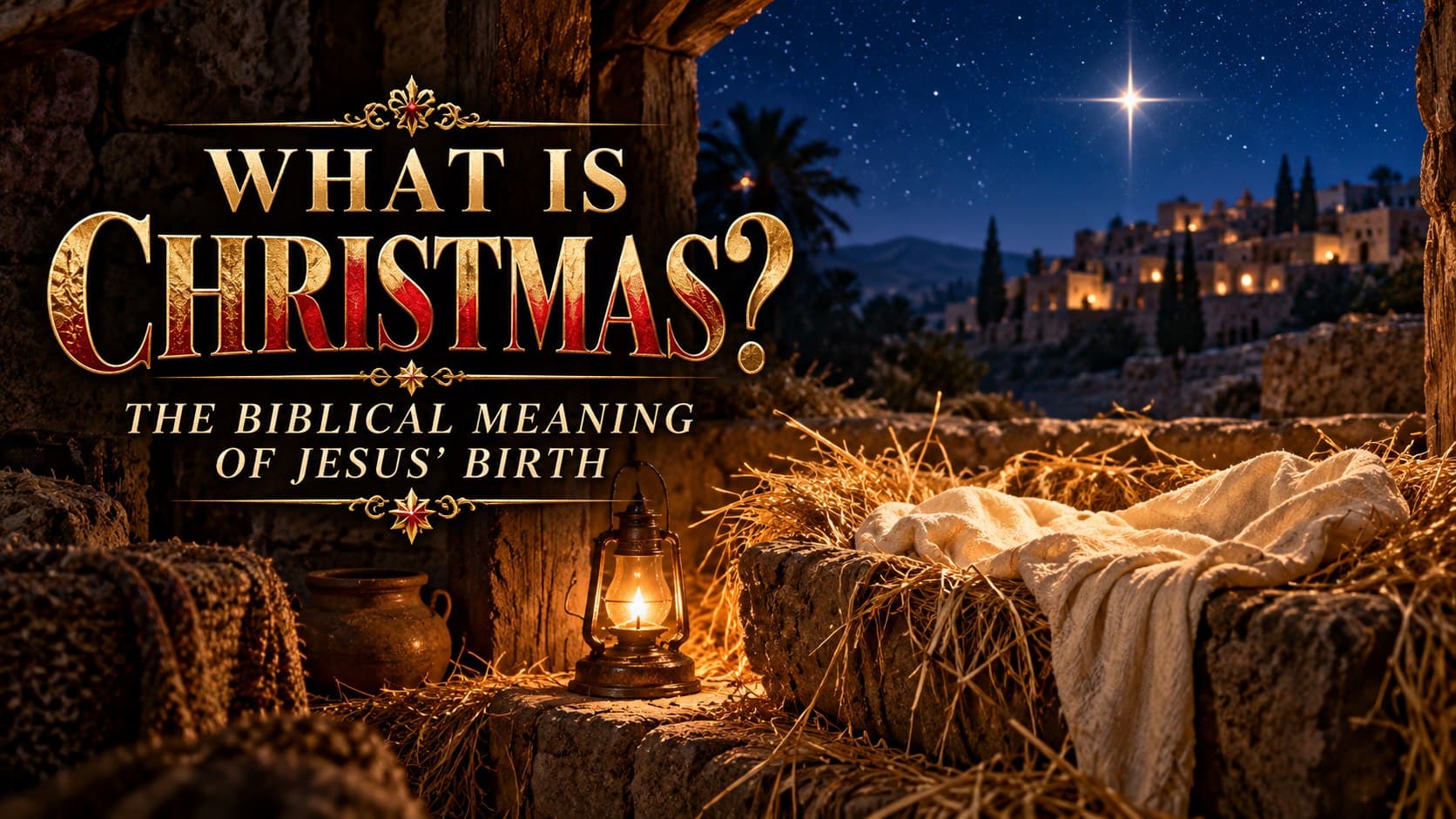
📖 What Is Christmas? The Biblical Meaning of Jesus' Birth
You have celebrated Christmas your whole life.
Lights, a tree, maybe a service, maybe a ham.
But ask most people, even people who go to church every year on December 25, what the day is actually about, and the answer gets vague fast.
📌 Christmas is the day Christians set aside to remember one claim: that God became a human being, on purpose, to rescue the people He made.
That is a bigger sentence than it sounds. It means Christmas is not a birthday party with extra decorations. It is a claim about who Jesus actually is, and it is worth knowing where that claim comes from, how the Church settled on a date for it, and why Catholics, Orthodox Christians, and Protestants have not always marked it the same way.
This guide walks through what Christmas means biblically, where the word and the date came from, what different churches actually teach and practice, and the Bible verses that explain why any of this matters for you.
Why This Matters for Your Faith
It is easy to let Christmas become background noise. A season that happens to you rather than a truth you actually engage.
⚠️ But what Christmas claims, if it is true, changes what kind of God you are dealing with.
A God who stays distant and simply issues instructions is one kind of God. A God who puts on a body, feels cold, gets tired, and grows up inside the mess of a real family in a real town is a very different one.
Christmas is the hinge of that difference. It is the claim that Jesus is not one teacher among many but God Himself, arriving on foot.
If that is true, it means God was never content to watch from a distance. He moved in. And that changes what you can expect from Him now.

What Christmas Actually Celebrates
1. The Word Became a Human Being
Christmas exists because of one event theologians call the incarnation, from a Latin word that simply means "becoming flesh." John's Gospel opens with it, long before it gets to a manger.
"In the beginning was the Word, and the Word was with God, and the Word was God. The same was in the beginning with God. All things were made by him; and without him was not any thing made that was made."
John calls Jesus "the Word" to make a specific point. A word is how a person makes themselves known. John is saying that Jesus is how God makes Himself known, not a messenger sent from God but God's own self, showing up.
Paul puts a date on it. The birth did not happen at a random moment in history.
"But when the fulness of the time was come, God sent forth his Son, made of a woman, made under the law, To redeem them that were under the law, that we might receive the adoption of sons."
📌 "The fulness of the time" means it happened on schedule, not by accident. Christmas is the day that schedule reached its moment.
2. The Child Had a Name and a Future Before He Had a Birthday
Long before Mary gave birth, an angel told her exactly who the child would be.
"And, behold, thou shalt conceive in thy womb, and bring forth a son, and shalt call his name JESUS. He shall be great, and shall be called the Son of the Highest: and the Lord God shall give unto him the throne of his father David: And he shall reign over the house of Jacob for ever; and of his kingdom there shall be no end."
That is not vague comfort. It is a throne, a kingdom, and a reign with no end, handed to a baby who had not been born yet.
Centuries earlier, the prophet Isaiah had already pointed to a sign nobody in his own generation lived to see fulfilled.
"Therefore the Lord himself shall give you a sign; Behold, a virgin shall conceive, and bear a son, and shall call his name Immanuel."
Immanuel means "God with us." Christmas is the day that name stopped being a prophecy and became an address.
We walk through the actual night this pointed toward, manger and all, in what the first Christmas actually looked like. This article is about the day itself, not the night it remembers.
3. Where the Word "Christmas" Comes From
The word is older English than it looks. It comes from "Cristes maesse," meaning "the Mass of Christ," a phrase that shows up in writing as early as 1038. Over the centuries the spelling wore down into the single word we use now.
Other languages kept the same idea in different clothes. German calls it "Weihnachtsfest," the holy night festival. Dutch has "Kerstmis." Latin simply calls it "Dies Natalis," the birthday.
📌 Every one of those names points at the same thing: a church service, built around a birth.
4. How the Church Settled on December 25
Here is something worth knowing honestly: the Gospels never give a date for the birth. The date was worked out later, and the earliest clear evidence for it comes from a Roman document called the Chronography of 354, which lists, among its civil and religious dates, "Christ was born in Bethlehem of Judea" under December 25.
By the 380s, the preacher John Chrysostom told his congregation in Antioch that part of the church there had already been keeping December 25 for at least ten years, and he pushed for the rest of the city to adopt it too. It worked. Within a few decades the date had spread across most of the Christian world.
⚠️ Historians do not fully agree on why December 25 was chosen in the first place. One explanation says early Christians worked backward from a belief about the date of the crucifixion, March 25, reasoning that a life this significant would begin and end on the same calendar date. Count forward nine months from a conception on March 25 and you land on December 25. Another explanation points out that December 25 was already the date of a Roman festival honoring the sun at the winter solstice, and argues the church placed its own feast there on purpose or by overlap. Both explanations have real defenders among historians, and no single piece of evidence settles which one is right.
One popular idea is worth correcting on its own. People often assume the date borrowed from Saturnalia, Rome's raucous midwinter festival. Saturnalia ran December 17 to 23, finishing two days before Christmas even starts, which is a weak foundation for that theory on its own. Historians looking closely tend to connect December 25 to the separate Roman festival for the sun, held on the solstice date itself, rather than to Saturnalia at all.
What is not in question is that by the end of the fourth century, December 25 was established, widespread, and treated as a day of real importance across the Church.
5. What the Catholic Church Officially Teaches About the Day
For Catholics, Christmas is not optional in the way a nice tradition is optional. The Church's own Code of Canon Law names the Nativity of the Lord directly in its list of holy days of obligation, the days Catholics are required to attend Mass the same way they are on a Sunday.
Christmas sits at the end of Advent, the four weeks of preparation and waiting that lead up to it, and opens a season of its own called Christmastide, which the Catholic calendar carries through to the Baptism of the Lord in January. Midnight Mass on Christmas Eve is one of the most attended services of the entire Catholic year, in parishes that otherwise see much smaller crowds.
None of that treats Christmas as a cultural extra. The Church built an entire season around it, on the conviction that the incarnation is worth that much structure.
The Western liturgy even developed a custom of three separate Christmas Masses, said at midnight, at dawn, and during the day, each tied to a different way of reading the same birth: Christ born eternally from the Father, born in time in Bethlehem, and born spiritually in the believer. Old sacramentaries from the early medieval Church already assign three Masses to the feast, and a Spanish bishop named Ildefonsus refers to the custom directly in the year 845. It is old enough that nobody alive remembers it starting.
The twelve days from Christmas to Epiphany were declared sacred in their own right by a Church council meeting at Tours in the 560s, which is where "the twelve days of Christmas" comes from before it was ever a song.
6. Why Not Every Christian Keeps It the Same Way
Walk into a church on December 25 and you might be the only person there that day, depending which church it is. Christmas has not always been kept the same way everywhere, or even kept at all.
Most Eastern Orthodox churches still follow the older Julian calendar rather than the Gregorian calendar most of the world uses. The two calendars have drifted thirteen days apart, so churches in Russia, Serbia, Ethiopia, and elsewhere mark the Nativity on what falls as January 7 on the modern calendar, even though by their own calendar it is still December 25. Orthodox Christians in Greece, Cyprus, and Romania moved to the Gregorian date decades ago, so even within Orthodoxy the day is not uniform.
Most Orthodox churches also lead up to the day with the Nativity Fast, forty days of simplified eating and extra prayer beginning on November 15, serving a purpose close to Western Advent even though the two seasons are not the same length. One Orthodox priest summed up the point of any fast this way: it is kept so a Christian can learn, for a season, to live depending on God's word rather than on what is on the table.
Protestants have an even stranger history with the holiday. In 1647, England's Puritan-led Parliament banned Christmas outright, along with Easter, fining anyone who kept it. Massachusetts Bay Colony followed in 1659, making public Christmas celebration a crime punishable by a five-shilling fine. The Puritans argued the Bible never commands a birthday celebration for Jesus and never gives a date, and they associated the day with drunken, disorderly behavior they wanted no part of. Both bans were eventually repealed under political pressure from the English crown, but Christmas did not become an official public holiday in Massachusetts until 1856.
Most Protestant churches today keep Christmas warmly, with carol services and Christmas Eve worship. That long Puritan history is part of why debates about how much the holiday should be observed still surface in some Protestant circles, even now. The split between Catholics and Protestants that opened the door to disagreements like this one is its own story, which we cover in what Reformation Day actually commemorates.
7. What the Incarnation Actually Means for You
All of that history answers when and how. It does not answer why it matters to you personally. Paul answers that question with a hymn about what it cost.
"Who, being in the form of God, thought it not robbery to be equal with God: But made himself of no reputation, and took upon him the form of a servant, and was made in the likeness of men: And being found in fashion as a man, he humbled himself, and became obedient unto death, even the death of the cross."
Notice the direction of every verb. Not grasped at. Emptied. Took on. Humbled. Christmas only makes sense once you see it as the start of that whole downward motion, not the end of it. The manger leads to the cross. They are one story, not two.
💡 Christmas is the day God started keeping a promise that would cost Him everything, on purpose, because He loved the people He was coming for.
That is not a sentiment for a card. It is the reason every saint the Church has ever celebrated has anything to celebrate at all. The whole list starts here, in a birth nobody important was watching.
It also means the distance between you and God was never the problem on His side. He closed it Himself, in a body, at a real address, on a real night. Whatever this Christmas looks like for you, loud house or empty chair, that part of the story does not depend on how the day goes.
Practical Tips for Keeping Christmas Christian
You do not need a theology degree to keep Christmas with your eyes open. Start with these.
- Read the incarnation passages before the busy season swallows them. John 1, Luke 1, and Philippians 2 take fifteen minutes together and will do more for your December than another errand.
- Say what you actually believe happened, out loud, once. "God became a man" is a strange enough sentence that saying it plainly, even to yourself, keeps it from going flat.
- Learn one thing your own tradition does differently from another. Whether you are Catholic, Orthodox, or Protestant, knowing why your church keeps the day the way it does is better than assuming everyone else is simply wrong.
- Let the manger and the cross sit in the same thought. Christmas without Good Friday is only half the story, and Philippians 2 was written to keep both halves together.
- Give to someone with nothing political or performative behind it. The incarnation was God coming toward people with nothing to offer back. A gift with no strings attached echoes that, however small.
- Go to a service that is not your normal one, at least once. A Catholic Midnight Mass or an Orthodox Nativity service will show you how differently the same event gets honored.
- Carry one line of this into the day itself. We wrote a short devotional for exactly that moment in Christmas Day: one thing to carry.
Top 4 Bible Verses That Explain Christmas
If you only remember four verses from this whole guide, make it these.
1. Isaiah 7:14
"Therefore the Lord himself shall give you a sign; Behold, a virgin shall conceive, and bear a son, and shall call his name Immanuel."
Written roughly seven centuries before the birth it describes. This is the promise end of Christmas, the sign given long before anyone alive at the time would see it kept.
2. Galatians 4:4 and 5
"But when the fulness of the time was come, God sent forth his Son, made of a woman, made under the law, To redeem them that were under the law, that we might receive the adoption of sons."
This is the timing verse. Not a surprise, not an improvisation. God sent His Son at the exact moment He had always intended to, and the goal named here is adoption, not just rescue.
3. 1 John 4:9 and 10
"In this was manifested the love of God toward us, because that God sent his only begotten Son into the world, that we might live through him. Herein is love, not that we loved God, but that he loved us, and sent his Son to be the propitiation for our sins."
This is the motive verse. Christmas did not happen because people were looking for God first. It happened because He came looking for them first, and sent His Son to deal with what stood in the way.
4. Titus 2:11
"For the grace of God that bringeth salvation hath appeared to all men,"
"Hath appeared" is a visible, historical word. Grace did not stay a concept. On the day Christmas remembers, it had a face, a cry, and a weight you could hold.
Frequently Asked Questions About Christmas
What is the true meaning of Christmas?
Christmas celebrates the incarnation, the belief that God the Son became a human being in Jesus Christ, born to rescue people from sin. Everything else about the holiday, the lights, the gifts, the gatherings, sits on top of that one claim rather than replacing it.
Is Christmas actually in the Bible?
The birth of Jesus is in the Bible, told in Matthew and Luke. The holiday itself, with a fixed date and a name, is not commanded anywhere in Scripture. It developed in the centuries after the New Testament was written, as the Church looked for a way to mark the event every year.
Why do we celebrate Christmas on December 25?
The earliest clear evidence for the date comes from a Roman document from 354, and the practice had spread widely by the 380s. Historians still debate exactly why that date was chosen, whether through an early calculation method or because it fell on an existing Roman solar festival, and no single piece of evidence has settled the question.
Is Christmas a pagan holiday?
Christmas celebrates a historical claim at the center of Christian faith, the birth of Jesus. Whether the specific date of December 25 was influenced by an older Roman festival is a genuinely disputed historical question, not a settled fact in either direction, and it is worth a closer look on its own rather than a quick yes or no here.
Do Catholics have to go to church on Christmas?
Yes. The Catholic Church's Code of Canon Law lists the Nativity of the Lord among its holy days of obligation, meaning Catholics are expected to attend Mass that day the same way they are on a Sunday.
Why do Orthodox Christians celebrate Christmas in January?
Most Orthodox churches still follow the older Julian calendar, which now runs thirteen days behind the Gregorian calendar most of the world uses. Their December 25 lands on January 7 on the modern calendar, even though by their own reckoning it is still the same date it has always been.
Did Christians ever actually ban Christmas?
Yes. England's Puritan Parliament banned Christmas in 1647, and Massachusetts Bay Colony made celebrating it a crime in 1659, with a five-shilling fine. Both bans were eventually lifted, but the objection was serious: the Puritans believed the Bible gave no date or command for a birthday celebration and associated the day with disorderly behavior.
What does the word Christmas actually mean?
It comes from the Old English "Cristes maesse," meaning "the Mass of Christ," a phrase recorded as early as 1038. The name itself is a worship service, not just a date on a calendar.
Is it wrong for a Christian not to celebrate Christmas?
No single verse commands Christians to celebrate it, which is exactly why some believers and whole traditions, going back to the Puritans, have chosen not to. What Scripture does command is believing the event the day points to. A Christian can honor that without a tree in the living room.
What is the difference between Christmas and Christmastide?
Christmas is the single day, December 25. Christmastide is the wider season that follows it in the traditional church calendar, running into January and closing out the celebration of the Nativity rather than ending it the moment the day is over.
Final Thoughts
Strip away the lights and the shopping and three things remain.
📌 Christmas marks a real claim. Not a feeling, not a mood, but the belief that God became human, on a specific night, for a specific reason.
📌 Christians have never fully agreed on how to mark it. Catholics built a season and an obligation around it. Orthodox churches kept an older calendar. Protestants have ranged from banning it outright to building whole traditions of their own. None of that disagreement touches the event itself.
📌 The manger was only the beginning. The same hymn that describes Christ emptying Himself into human flesh keeps going until it reaches a cross. Christmas without that destination is only half the sentence.
So here is one way to carry this year's Christmas. Before the day gets full, read the three verses that answer when, why, and what it cost: Galatians 4:4 and 5, 1 John 4:9 and 10, and Philippians 2:6 to 8.
Then look at whatever is sitting in front of you that day and remember what the name actually means.
God, with us. Not someday. Already.
📚 Sources
Every claim in this article traces back to one of these. All links checked 26 October 2026.
- Christmas
The Catholic Encyclopedia, New Advent · 1908
On the Chronography of 354, the etymology of 'Christmas' from 'Cristes maesse', John Chrysostom's 386 Antioch homily, and the competing theories for why December 25 was chosen.
- Code of Canon Law, Canons 1244 to 1253
The Holy See
Canon 1246 lists the Nativity of the Lord among the Catholic Church's holy days of obligation.
- When Massachusetts Banned Christmas
History.com
On the Puritan objections to Christmas, the 1659 Massachusetts Bay ban and its five-shilling fine, and when the ban ended.
- Why do 250 million Christians celebrate Christmas on January 7?
Al Jazeera
On the Julian calendar, the 13-day gap with the Gregorian calendar, and which Orthodox churches kept the older dating.
- The Nativity Fast: Why We Fast
Orthodox Church in America
Fr. Stephen Freeman on the 40-day Nativity Fast beginning November 15 and its purpose.