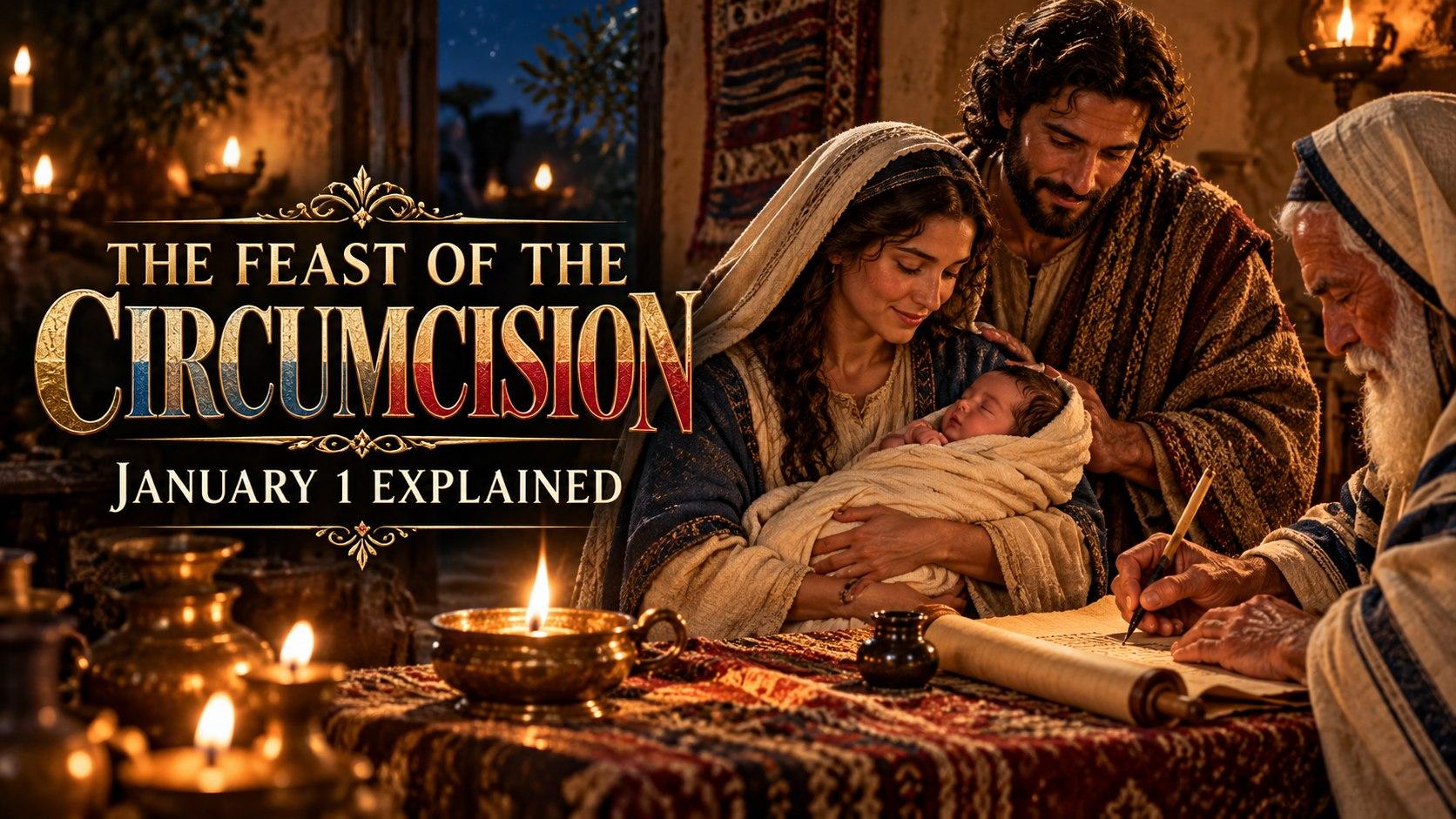
📖 What Is the Feast of the Circumcision of Christ? January 1 Explained
Open an old prayer book to January 1 and you will not find a party.
You will find a small, blunt feast about a baby being cut, eight days after His birth, exactly the way every Jewish boy in His world was cut.
Most churches today call January 1 something else. A few still do not.
📌 Here is the plain answer. The Feast of the Circumcision of Christ marks the Gospel moment, eight days after Christmas, when the infant Jesus was circumcised under the law given to Abraham and formally given the name Jesus. The Western church kept this as the headline event of January 1 for centuries, Rome quietly renamed the day twice in the twentieth century, and the old title never actually disappeared. It still stands today in the Eastern Orthodox calendar and on many Anglican and Lutheran calendars.
This guide walks through what Luke actually records, why the early church built a feast out of it, how Rome moved away from the title, and where it is still kept exactly as it was.
Every historical claim below links back to a named source you can check yourself.
Why This Matters for Your Faith
It is easy to wave this off as a squeamish detail from an old calendar nobody uses anymore.
⚠️ But this is not a side note about ritual surgery. It is the moment Scripture puts Jesus under the exact law He came to fulfill, on the exact schedule that law required, with no shortcut taken.
Paul later makes the stakes plain. Jesus was not born generically into the world. He was born into a specific covenant, under a specific law, so that He could actually redeem the people standing under it.
"But when the fulness of the time was come, God sent forth his Son, made of a woman, made under the law, To redeem them that were under the law, that we might receive the adoption of sons."
💡 Christmas says the Word became flesh. January 1 says that flesh kept the law, down to the eighth day, before it ever did anything else.

What the Feast of the Circumcision Actually Marks
1. The Law Behind the Day: A Sign Given to Abraham
The eighth day did not start with Jesus. It started roughly two thousand years earlier, with God and Abraham.
"This is my covenant, which ye shall keep, between me and you and thy seed after thee; Every man child among you shall be circumcised. And ye shall circumcise the flesh of your foreskin; and it shall be a token of the covenant betwixt me and you."
God names the exact day a few verses later, and makes it non negotiable.
"And he that is eight days old shall be circumcised among you, every man child in your generations, he that is born in the house, or bought with money of any stranger, which is not of thy seed."
📌 This was never a private hygiene choice. It was the visible mark of belonging to God's covenant people, cut into the body of every son born into that covenant, on a day fixed in advance.
Jewish practice has kept that same eighth day schedule for thousands of years. Chabad.org describes the ceremony, called a brit milah, still taking place on the eighth day of a healthy boy's life, and still built around two things happening at once: the actual circumcision, and the giving of the child's name.
2. What Luke Actually Records on the Eighth Day
Luke had already shown readers this exact custom once, a few verses earlier, with a different baby.
"And it came to pass, that on the eighth day they came to circumcise the child; and they called him Zacharias, after the name of his father."
That was John the Baptist. Luke then places Jesus under the identical custom, on the identical schedule, with one deliberate difference in how the name arrived.
"And when eight days were accomplished for the circumcising of the child, his name was called JESUS, which was so named of the angel before he was conceived in the womb."
💡 John's father named him after himself, until a relative stepped in. Jesus was named by an angel, before He was even conceived. Luke is not just reporting a minor surgery. He is reporting that the promised child kept the same law every other Jewish boy kept, on the same day, while carrying a name no human father chose.
3. How the Early Church Turned This Into a Feast
The Catholic Encyclopedia, in its 1908 entry on the feast hosted by New Advent, traces an actual legal order for it. The Council of Tours, in the year 567, told the churches under it to keep a Mass of the Circumcision on January 1.
Rome itself moved slower. The same source says that at Rome in the seventh century, the day was still mainly kept as the octave, the eighth day, of Christmas, rather than as a feast centered on the Circumcision itself. The Circumcision only came to the front of the day later, with the title In Circumcisione Domini et Octava Nativitatis eventually naming both at once.
📌 So the feast grew unevenly, not all at once. Gaul kept a Mass of the Circumcision by law in the sixth century. Byzantine calendars from the eighth and ninth centuries already list the Circumcision alongside the feast of Saint Basil the Great on the same day. Wikipedia's account of the feast's history places Rome's own adoption of the title Circumcision of the Lord later still, in the thirteenth or fourteenth century.
One thing every one of those sources agrees on. Whatever the exact century, the church was reading the same event, the eighth day after the birth of Christ, and deciding it was worth a Mass of its own.

4. Why Rome Renamed the Day Twice in the Twentieth Century
For centuries, Circumcision of the Lord was the title most Western Catholics actually saw printed on January 1. Two popes changed that inside forty years.
Pope John XXIII's 1960 calendar reform dropped the word Circumcision from the title entirely and called the day simply the Octave of the Nativity, a change the 1962 Roman Missal still carries.
Pope Paul VI went further. His 1969 motu proprio Mysterii Paschalis reorganized the whole liturgical calendar, and gave January 1 the name most Catholics know today, the Solemnity of Mary, the Holy Mother of God, while keeping the naming of Jesus as part of the same day rather than its title. The Solemnity of Mary carries its own full story, including the ancient council behind the title Mother of God, but the short version for this guide is simple. The Gospel scene did not move. The sign on the door did.
⚠️ Say exactly what changed, and what did not. The Mass readings for January 1 still include Luke's account of the circumcision and naming. What changed across 1960 and 1969 was which part of that same Gospel scene got the title on the sign out front.
5. Where the Old Title Still Stands Today
Rome's rename never reached every church that kept this feast.
The Eastern Orthodox Church never dropped it. The OCA's own page for the day calls it the Circumcision of our Lord and Savior Jesus Christ, kept every January 1, and states plainly that accounts of the feast continue in the Eastern church right up through the fourth century. Orthodox parishes keep it paired with the feast of Saint Basil the Great, on the same date, the way Byzantine calendars already did over a thousand years ago.
Anglican and Lutheran churches kept it too, for the same reason stated plainly in the Wikipedia account of the feast's history: it is a feast of Christ, tied directly to a specific verse of Scripture, Luke 2:21, which made it the kind of feast the Reformers did not throw out. The Book of Common Prayer called the day the Circumcision of Christ outright. The Church of England's modern Common Worship, in use since the year 2000, renamed it the Naming and Circumcision of Jesus rather than drop the word entirely. Some Lutheran calendars still title the day the Circumcision and the Name of Jesus, and Martin Luther himself preached on it, in a sermon still preserved in his Church Postils.
📌 That is the real shape of this feast's history. Not one church quietly abandoning an old idea, but several churches making their own separate decisions about one shared Gospel event, and landing in different places on what to call it. It is one more entry in the wider list of ways Catholic and Protestant church calendars actually differ, even where both sides are reading the exact same verse.
6. What Circumcision Was Always Pointing Toward
None of this history answers the harder question. Why does any of it matter now, when no church asks a Gentile Christian to be circumcised.
Paul answers that directly, writing to a church arguing over exactly this.
"In whom also ye are circumcised with the circumcision made without hands, in putting off the body of the sins of the flesh by the circumcision of Christ: Buried with him in baptism, wherein also ye are risen with him through the faith of the operation of God, who hath raised him from the dead."
💡 Christ's own circumcision, kept perfectly under the law, is what lets Paul say every believer now carries a circumcision made without hands. The physical sign given to Abraham finds its fulfillment in Jesus keeping it exactly, not in every believer after Him repeating it.
Paul makes the same move again, pushing the sign past the skin entirely.
"For he is not a Jew, which is one outwardly; neither is that circumcision, which is outward in the flesh: But he is a Jew, which is one inwardly; and circumcision is that of the heart, in the spirit, and not in the letter; whose praise is not of men, but of God."
That is why most Protestant churches, outside the Anglican and Lutheran traditions that kept the day on their calendar, never built a feast around January 1 at all. Not because the event did not matter, but because they read Paul as moving the sign from the body to the heart, and saw no reason to keep marking the old location on a calendar.
This was not the only Old Testament law the holy family kept on a strict schedule. The Presentation of Jesus in the temple follows roughly forty days later, obeying a different law from Leviticus about a mother's purification. Both feasts are reading the same thing. Mary and Joseph did not treat the law as optional for their own son.

Practical Tips for Keeping This Day Well
You do not need a Mass on your calendar for this feast to teach you something real.
- Read Luke 2:21 before you read any resolution list. Let the first thing you hear about the new year be that Jesus kept the law before He ever preached a word of it.
- Learn which calendar your own church actually follows. Catholic, Orthodox, Anglican, and Lutheran congregations all treat January 1 differently, and knowing which one yours keeps will help the day actually mean something.
- Do not treat the different titles as a contradiction. Solemnity of Mary, Circumcision of Christ, and Naming and Circumcision of Jesus are three names standing over the same eight verses of Luke.
- Sit with Galatians 4:4 and 5 for a minute. God sending His Son under the law is not abstract theology. It is the reason Jesus could actually redeem anyone standing under it.
- Ask what your own circumcision of the heart looks like this year. Romans 2:29 was not written as a slogan. It names something real Paul expected to change in you.
- If you grew up thinking this feast was just a Catholic oddity, go check an Orthodox or Lutheran calendar. You will find the exact same date, kept with a different name, for the exact same Gospel reason.
- Let January 1 extend Christmas instead of ending it. Christmastide does not stop at the manger, and this feast is proof the church kept unpacking what the birth of Jesus actually meant, one day at a time.
Top Bible Verses for the Feast of the Circumcision
Five passages carry almost the entire meaning of this day.
1. Genesis 17:10 and 11
"This is my covenant, which ye shall keep, between me and you and thy seed after thee; Every man child among you shall be circumcised. And ye shall circumcise the flesh of your foreskin; and it shall be a token of the covenant betwixt me and you."
This is the command Jesus was placed under on the eighth day. Without this verse, Luke 2:21 is just a strange medical detail. With it, Luke 2:21 is Jesus keeping a promise God made two thousand years before He was born.
2. Luke 2:21
"And when eight days were accomplished for the circumcising of the child, his name was called JESUS, which was so named of the angel before he was conceived in the womb."
This single verse is the feast. Two facts sit side by side here, a Gospel detail every church that keeps this day is actually pointing at: the law was kept, and the name came from heaven, not from a father.
3. Galatians 4:4 and 5
"But when the fulness of the time was come, God sent forth his Son, made of a woman, made under the law, To redeem them that were under the law, that we might receive the adoption of sons."
Paul tells you why the eighth day mattered at all. Jesus was placed under the law on purpose, specifically so He could redeem the people who could never keep it well enough on their own.

4. Colossians 2:11 and 12
"In whom also ye are circumcised with the circumcision made without hands, in putting off the body of the sins of the flesh by the circumcision of Christ: Buried with him in baptism, wherein also ye are risen with him through the faith of the operation of God, who hath raised him from the dead."
This is where the Old Testament sign lands for a Christian today. Not repeated on your own body, but fulfilled in Christ's body and applied to you through faith and baptism.
5. Romans 2:28 and 29
"For he is not a Jew, which is one outwardly; neither is that circumcision, which is outward in the flesh: But he is a Jew, which is one inwardly; and circumcision is that of the heart, in the spirit, and not in the letter; whose praise is not of men, but of God."
Paul finishes the thought he started in Galatians. The sign given to Abraham was always pointing past the skin, toward a heart actually changed by God, which is the one part of this feast every tradition, with or without it on the calendar, can agree matters.
Frequently Asked Questions About the Feast of the Circumcision
What is the Feast of the Circumcision of Christ?
It is the Christian observance, kept on January 1, of the Gospel event in Luke 2:21, when the infant Jesus was circumcised on the eighth day under the law given to Abraham and formally given the name Jesus.
Why was Jesus circumcised if He was God?
Galatians 4:4 and 5 answers this directly. Jesus was made under the law on purpose, so that He could redeem the people who were already under it. His circumcision shows Him fully submitting to the same covenant sign every other Jewish son carried.
Is the Feast of the Circumcision still on the Catholic calendar?
Not under that title. Pope John XXIII's 1960 reform renamed the day the Octave of the Nativity, and Pope Paul VI's 1969 reform, Mysterii Paschalis, gave it its current Catholic name, the Solemnity of Mary, the Holy Mother of God. The naming of Jesus is still part of the day's readings.
Do Eastern Orthodox churches still celebrate the Circumcision of Christ?
Yes, under that exact name. The Orthodox Church in America's own calendar keeps January 1 as the Circumcision of our Lord and Savior Jesus Christ, paired with the feast of Saint Basil the Great on the same day.
Do Anglicans and Lutherans still observe this feast?
Many do. The Church of England's Common Worship calls the day the Naming and Circumcision of Jesus, the older Book of Common Prayer called it the Circumcision of Christ outright, and several Lutheran calendars still title it the Circumcision and the Name of Jesus.
What is the connection between circumcision and baptism?
Colossians 2:11 and 12 ties the two together directly, describing believers as circumcised with a circumcision made without hands and buried with Christ in baptism. Baptism carries forward what physical circumcision once marked, entry into God's covenant people.
Why do most Protestant churches not keep this feast?
Most Protestant traditions outside Anglicanism and Lutheranism never built a church calendar around named feast days at all. Where Scripture is read as moving the sign of circumcision from the body to the heart, in Romans 2:28 and 29, many Protestants see no need for a yearly feast marking the old physical sign.
Why is Jesus's circumcision mentioned right before His name?
Luke 2:21 follows the same Jewish custom he already described for John the Baptist in Luke 1:59, where circumcision and naming happened together on the eighth day. Jesus's name, though, came from an angel before He was conceived, not from a parent choosing it on the spot.
What does circumcision of the heart mean?
Romans 2:29 describes a circumcision that is internal and spiritual rather than physical, a change in a person's heart rather than their body. Paul presents this as what the Old Testament sign was always ultimately pointing toward.
Final Thoughts
Strip away the different titles, and three things remain true about January 1.
📌 The Gospel event never moved. Whatever your church calls the day, Luke 2:21 is still the verse behind it. Jesus, circumcised on the eighth day, named by an angel before He was ever conceived.
📌 The titles changed because different churches made different choices, not because the history is actually contested. Rome renamed the day twice in the twentieth century. Orthodox, Anglican, and Lutheran calendars simply never did.
📌 The sign itself was always pointing further than the body. Galatians 4:4 and 5 says why Christ kept it. Romans 2:28 and 29 says where it was always headed.
Whatever your church calls January 1, Epiphany is still five days away, and the manger is not finished teaching you yet. Ask yourself the question Paul actually leaves you with. Not whether you keep an old sign in your body, but whether God has actually gotten to your heart.
📚 Sources
Every claim in this article traces back to one of these. All links checked 7 November 2026.
- Feast of the Circumcision
Catholic Encyclopedia (1908), via New Advent · 1908
The source for the Council of Tours (567) ordering a Mass of the Circumcision, Rome's seventh century emphasis on the Christmas octave over the Circumcision itself, and the theological reading of Jesus fulfilling the law under Galatians 4:4 and 5.
- Feast of the Circumcision of Christ
Wikipedia
The source for Rome adopting the title Circumcision of the Lord by the thirteenth or fourteenth century, the 1960 and 1969 Catholic calendar reforms, and the feast's current titles and status in Anglican and Lutheran churches.
- The Circumcision of our Lord and Savior Jesus Christ
Orthodox Church in America (OCA)
The source for the Eastern Orthodox Church's continued observance of the feast under its original name, its pairing with the feast of Saint Basil the Great, and its theological reading of circumcision through Genesis 17 and Colossians 2:11 and 12.
- Mysterii Paschalis
Pope Paul VI, The Holy See, vatican.va · 1969
The primary source for the 1969 reform that renamed January 1 the Solemnity of Mary, the Holy Mother of God, in the Catholic Church's General Roman Calendar.
- The Bris Ceremony
Chabad.org
The source for the brit milah still being performed on the eighth day of a Jewish boy's life today, and for the naming of the child taking place as part of that same ceremony.