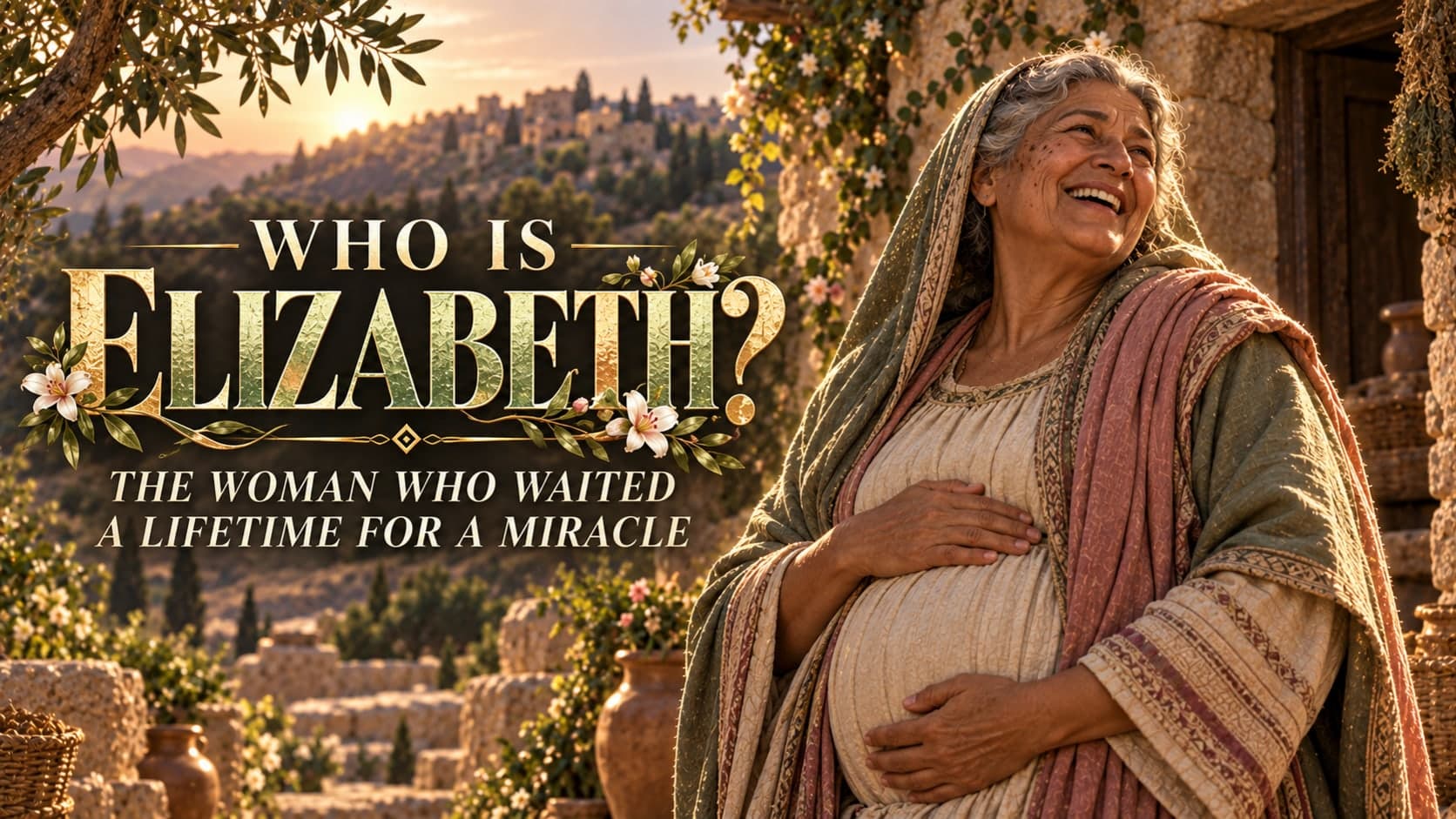
📖 Who Was Elizabeth in the Bible? The Woman Who Waited a Lifetime for a Miracle
Some Bible stories start with a battle.
Elizabeth's starts with a wait.
She was married to a good man. She loved God with her whole life. And year after year, the one thing she wanted most never came.
📌 In her world, a woman without children carried a quiet shame that never really let up.
People whispered. Some pitied her. Some probably wondered what she had done wrong.
Nothing. She had done nothing wrong. The Bible says plainly that she was righteous before God. And still, the years kept passing with an empty cradle.
By the time we meet her in Luke chapter 1, Elizabeth was old. Old enough that having a baby was not just unlikely. It was impossible by every normal measure.
Maybe you know a version of that ache. A prayer you have prayed so many times you almost stopped expecting an answer. A door that seems shut for good.
❓ What do you do when you have run out of reasons to hope, but you have not run out of years to wait?
Elizabeth's story answers that question in a way nobody could have guessed.
God did not just give her a son. He gave her a son at the exact same moment He was setting the stage for the most important birth in human history, the birth of Jesus Himself. Her story and Mary's story cross paths, and neither woman's life makes full sense without the other.
This is the full story of Elizabeth in the Bible, walked through in order. Who she was. What happened to her husband in the temple. The five months she spent in hiding. The moment a young relative showed up at her door carrying a secret of her own. And the son who grew up to prepare the way for the Messiah.
Let's start with who she actually was.
Who Elizabeth Was
Elizabeth was the wife of a priest named Zacharias.
Zacharias belonged to a specific group of priests called the course of Abia. Priests worked in rotating shifts at the temple in Jerusalem, and Zacharias's shift only came up a few times a year.
Elizabeth herself came from priestly stock too. Scripture calls her one of the daughters of Aaron, the very first high priest of Israel.
"There was in the days of Herod, the king of Judaea, a certain priest named Zacharias, of the course of Abia: and his wife was of the daughters of Aaron, and her name was Elisabeth."
💡 Notice the King James Version spells her name Elisabeth. Most people today write it Elizabeth, and that is the spelling used throughout this article.
Luke tells us something important about both of them before anything else happens.
"And they were both righteous before God, walking in all the commandments and ordinances of the Lord blameless."
📌 Elizabeth was not barren because she had done something wrong. The text goes out of its way to say the opposite.
Then comes the hard sentence.
"And they had no child, because that Elisabeth was barren, and they both were now well stricken in years."
Two faithful people. No child. Old age arriving with the door still shut.
Elizabeth was also a relative of Mary, the young woman who would become the mother of Jesus. Luke calls her Mary's cousin, though the Greek word simply means a female relative or kinswoman.
Her whole story is told in the first chapter of Luke, a Gospel written to lay out, in order, exactly how the events around Jesus's birth happened.

Elizabeth's Story
1. Zacharias in the Temple and the Angel Who Interrupted Everything
One day it was finally Zacharias's turn to serve in the temple.
There were so many priests by this point in history that each one might only get this honor once in his whole life. On this day, the lot fell to Zacharias to go into the temple and burn incense before the Lord while the people prayed outside.
"And it came to pass, that while he executed the priest's office before God in the order of his course,"
"According to the custom of the priest's office, his lot was to burn incense when he went into the temple of the Lord."
While he was in there alone, something happened that had not happened to anyone in Israel for hundreds of years. An angel showed up.
"And there appeared unto him an angel of the Lord standing on the right side of the altar of incense."
⚠️ Zacharias did not respond with excitement. He responded with fear.
"And when Zacharias saw him, he was troubled, and fear fell upon him."
If fear is something you wrestle with too, you are in good company. Even a righteous priest, alone with God in the holiest room he would ever stand in, was shaken. Read what the Bible says about fear if that is a battle you know well.
The angel calmed him down and delivered news Zacharias had probably stopped expecting to hear.
"But the angel said unto him, Fear not, Zacharias: for thy prayer is heard; and thy wife Elisabeth shall bear thee a son, and thou shalt call his name John."
📌 Thy prayer is heard. Not just is heard right now, but has been heard this whole time, even during the years when nothing seemed to change.
The angel kept talking, and the promise got bigger with every sentence.
"For he shall be great in the sight of the Lord, and shall drink neither wine nor strong drink; and he shall be filled with the Holy Ghost, even from his mother's womb."
"And he shall go before him in the spirit and power of Elias, to turn the hearts of the fathers to the children, and the disobedient to the wisdom of the just; to make ready a people prepared for the Lord."
This son would not just end Elizabeth's years of shame. He would grow up to be a prophet who prepared an entire nation for the Messiah.
But Zacharias asked for proof.
"And Zacharias said unto the angel, Whereby shall I know this? for I am an old man, and my wife well stricken in years."
❓ Was that such an unreasonable question, given his age and hers?
Maybe not. But the one answering him was Gabriel, one of the highest ranking angels named in Scripture, someone who stands in the very presence of God.
"And the angel answering said unto him, I am Gabriel, that stand in the presence of God; and am sent to speak unto thee, and to shew thee these glad tidings."
⚠️ Doubting Gabriel came with a price.
"And, behold, thou shalt be dumb, and not able to speak, until the day that these things shall be performed, because thou believest not my words, which shall be fulfilled in their season."
Zacharias walked out of the temple that day unable to say a single word. For the next nine months, whatever he felt about becoming a father at his age, he could not speak it out loud.
💡 Sometimes God lets silence do what words could not. Zacharias could not talk his way out of faith. He had to live inside the promise until it was born.
2. Elizabeth's Five Hidden Months
Zacharias went home still unable to speak.
Not long after, Elizabeth conceived, exactly as the angel had promised.
"And after those days his wife Elisabeth conceived, and hid herself five months, saying,"
❓ Why would she hide?
Scripture does not spell out her reasons, but it is not hard to imagine. Maybe she wanted to be sure before she told anyone. Maybe she simply wanted to sit quietly with God in the miracle before the whole town started talking about it. Either way, for five months, Elizabeth kept this news between herself and the Lord.
When she finally spoke about it, here is what she said.
"Thus hath the Lord dealt with me in the days wherein he looked on me, to take away my reproach among men."
📌 Take away my reproach among men. That single phrase carries decades of pain most of us will never fully understand.
Reproach means shame, the kind other people put on you. For years, Elizabeth had likely absorbed sideways looks and quiet judgments simply for being barren, as if it were a punishment or a personal failure.
💡 Notice she does not say the Lord finally rewarded her. She says He looked on her. The miracle was not payment for good behavior. It was God turning His attention toward a woman who had waited a long time.
✅ Whatever shame you have carried for something you never chose and could not control, Elizabeth's life says God is able to take that away too, in His own timing.
3. Mary at the Door
Six months into Elizabeth's pregnancy, the angel Gabriel made another visit, this time to a young relative of hers named Mary, in the town of Nazareth.
Gabriel told Mary she would give birth to the Son of God Himself, and as proof that nothing is impossible with God, he pointed her straight to Elizabeth.
"And, behold, thy cousin Elisabeth, she hath also conceived a son in her old age: and this is the sixth month with her, who was called barren."
So Mary went to find her.
"And Mary arose in those days, and went into the hill country with haste, into a city of Juda; And entered into the house of Zacharias, and saluted Elisabeth."
The moment Mary greeted her, something remarkable happened.
"And it came to pass, that, when Elisabeth heard the salutation of Mary, the babe leaped in her womb; and Elisabeth was filled with the Holy Ghost:"
📌 Before John the Baptist was even born, he responded to the presence of Jesus, who at that point was only an unborn child in Mary's womb.
Elizabeth, filled with the Holy Ghost, did not need anyone to explain what was happening. She knew immediately.
"And she spake out with a loud voice, and said, Blessed art thou among women, and blessed is the fruit of thy womb."
"And whence is this to me, that the mother of my Lord should come to me?"
💡 Elizabeth, an older woman with her own miracle already growing inside her, called her young relative the mother of my Lord. She did not compete with Mary's moment. She recognized it and honored it, out loud, right away.
"For, lo, as soon as the voice of thy salutation sounded in mine ears, the babe leaped in my womb for joy."
"And blessed is she that believed: for there shall be a performance of those things which were told her from the Lord."
✅ Blessed is she that believed. That line is a promise for anyone who takes God at His word before they can see how it will happen.
4. Two Women, One Waiting Room
Mary stayed with Elizabeth for about three months.
"And Mary abode with her about three months, and returned to her own house."
Think about what those three months must have meant for both of them.
Mary was young, unmarried, and pregnant in a way no one around her would easily understand or believe. Elizabeth was old, married, and finally pregnant after decades of waiting. Neither situation was normal. Both were the direct work of God.
📌 God gave each woman a companion who actually understood what she was carrying.
Elizabeth, six months further along, had already lived through the shock, the fear, and the wonder Mary was just beginning to feel. She could offer Mary something no one else in Nazareth could: someone older and steadier who had already seen God do the impossible up close.
💡 God rarely asks His people to carry something enormous completely alone. He tends to put someone nearby who already understands part of the weight.
Compare that to how alone Leah felt for most of her story, and you see how much of a gift these three months really were for two women stepping into the unknown together.
5. Not So, He Shall Be Called John
Elizabeth's full time came, and she gave birth to a son, exactly as the angel had said.
"Now Elisabeth's full time came that she should be delivered; and she brought forth a son."
"And her neighbours and her cousins heard how the Lord had shewed great mercy upon her; and they rejoiced with her."
✅ The reproach was gone. The whole community celebrated with her.
On the eighth day, according to Jewish law, it was time to circumcise the baby. That was also the customary day a child was formally named. Everyone assumed they knew what the name would be.
"And it came to pass, that on the eighth day they came to circumcise the child; and they called him Zacharias, after the name of his father."
Naming a firstborn son after his father was expected. It was how families honored their line.
Elizabeth stopped them cold.
"And his mother answered and said, Not so; but he shall be called John."
📌 Not so. Two small words, spoken by a woman standing against everyone else in the room.
The family pushed back immediately.
"And they said unto her, There is none of thy kindred that is called by this name."
Nobody in the family had ever been named John. Elizabeth had no relative, no tradition, no explanation they would accept as a reason. She simply knew what the angel had told her husband, and she held her ground.
Confused, the family turned to Zacharias, who still could not speak.
"And they made signs to his father, how he would have him called."
"And he asked for a writing table, and wrote, saying, His name is John. And they marvelled all."
💡 A husband who had spent nine months in silence backed up his wife's obedience the moment he had the chance to answer. They were not guessing separately. They had each agreed with God, apart, and arrived at the same answer.
The instant Zacharias confirmed the name, something else happened.
"And his mouth was opened immediately, and his tongue loosed, and he spake, and praised God."
✅ Obedience was the key that opened his mouth again. He had gone silent for doubting God's word, and his voice came back the moment he finally lined up with it completely.

Lessons From Elizabeth's Life
1. Being faithful does not guarantee an easy story
Elizabeth and Zacharias were both righteous before God, walking blameless in every commandment. That did not spare them decades of waiting, disappointment, and public shame.
⚠️ A hard season is not automatic proof that something is wrong with your walk with God. Sometimes the most faithful people simply have to wait the longest.
2. God's silence is not the same as God's absence
Elizabeth spent five months hiding her pregnancy before she said a word to anyone. God had already acted; He just had not announced it yet.
💡 Just because you cannot see what God is doing does not mean He has stopped doing anything at all.
3. Doubt has consequences, but it does not disqualify you
Zacharias doubted Gabriel and lost his voice for nine months. He was not written out of the story. He was still the father of John the Baptist, and he still got to speak the very name that confirmed everything the angel had promised.
📌 God can discipline you for doubt and still use you for something enormous, both at the same time.
4. Older believers can carry younger ones through the unknown
Elizabeth did not need to be told what Mary was carrying. The Holy Ghost showed her immediately, and she poured out blessing instead of confusion or jealousy.
✅ If you are further along in your walk with God than someone near you, your steadiness might be exactly what they need right now.
5. Obedience sometimes means standing alone in the room
Nobody in that room agreed with Elizabeth when she said the baby's name would be John. She said it anyway, and her husband backed her up the second he could speak.
❓ Are you willing to obey God even when everyone around you expects something different? The same quiet obedience runs through Joseph's story, another believer who followed God's instructions even when they made no sense to the people watching him.
Key Verses From Elizabeth's Story
1. Luke 1:13
"But the angel said unto him, Fear not, Zacharias: for thy prayer is heard; and thy wife Elisabeth shall bear thee a son, and thou shalt call his name John."
This is the verse that turns Elizabeth's whole life around, and it is spoken to her husband, not to her directly.
📌 Thy prayer is heard. That prayer had likely been prayed for decades. God was not answering a new request. He was finally answering an old one.
2. Luke 1:25
"Thus hath the Lord dealt with me in the days wherein he looked on me, to take away my reproach among men."
Elizabeth's own words, spoken after months of quiet.
💡 She frames the miracle as God looking at her, not as a reward she earned. The shame other people placed on her, God removed on His own timing.
3. Luke 1:42
"And she spake out with a loud voice, and said, Blessed art thou among women, and blessed is the fruit of thy womb."
Elizabeth speaks these words while filled with the Holy Ghost, not from her own guessing.
📌 An older woman in the middle of her own miracle still had room to loudly celebrate someone else's. That is a rare and beautiful kind of joy.
4. Luke 1:45
"And blessed is she that believed: for there shall be a performance of those things which were told her from the Lord."
Elizabeth says this about Mary, but it could just as easily describe her own life.
💡 Belief does not remove the waiting. It simply trusts that what was promised will still arrive, on time, even if the timeline makes no earthly sense.
5. Luke 1:60
"And his mother answered and said, Not so; but he shall be called John."
Two words of resistance, spoken by a woman with an entire family disagreeing with her.
📌 Obedience to God will sometimes put you at odds with people who love you and still get it wrong. Elizabeth chose the name God gave over the name tradition expected.

Frequently Asked Questions About Elizabeth
Who was Elizabeth in the Bible?
Elizabeth was the wife of a priest named Zacharias. Scripture calls her righteous before God, but she was barren and well along in years. She and Zacharias became the parents of John the Baptist after an angel appeared to Zacharias in the temple. Her story is told in Luke chapter 1.
Was Elizabeth related to Mary?
Yes. Luke calls Elizabeth Mary's cousin, though the Greek word simply means a female relative or kinswoman. The exact family connection is not spelled out further, but the two women were close enough that Mary traveled to stay with her for three months.
How old was Elizabeth when she had John the Baptist?
Scripture never gives an exact age. It only says she and Zacharias were both well stricken in years, and that she had been called barren for her whole marriage. The point of the story is not a specific number, it is that having a child was well past what anyone expected naturally.
Why did Zacharias lose his ability to speak?
The angel Gabriel struck him unable to speak because he doubted the promise of a son, asking for proof instead of simply believing. His silence lasted until John was born and Zacharias confirmed the name in writing, at which point his voice returned immediately.
What does blessed art thou among women mean?
It is a Hebrew style of expressing the highest possible honor, meaning Mary was uniquely favored above every other woman. Elizabeth said it while filled with the Holy Ghost, the moment Mary greeted her, recognizing that Mary was carrying the Lord Himself.
Why did Elizabeth hide herself for five months?
Scripture does not explain her exact reason. It simply says she hid herself and then credited the Lord for taking away her reproach. Many readers believe she wanted time alone with God to absorb the miracle before facing the town's reaction.
What does take away my reproach mean?
Reproach means public shame or disgrace. In her culture, a barren woman often carried quiet blame or pity from her community. Elizabeth's pregnancy publicly removed that shame, which is exactly what she says in Luke 1:25.
Why did Elizabeth insist on the name John?
Because that is the name the angel Gabriel had given Zacharias before John was even conceived. Custom expected the boy to be named after his father, but Elizabeth held firm to what God had already said, and Zacharias confirmed it in writing the moment he was asked.
What does it mean that the baby leaped in her womb?
When Mary greeted Elizabeth, the unborn John moved inside her in a way Elizabeth understood as a response to the presence of Jesus, still unborn in Mary's womb. It is read as an early sign that John, even before birth, recognized and responded to the Messiah.
Was Elizabeth a prophetess?
The Bible does not give her that title directly, but Luke says she was filled with the Holy Ghost right before she spoke out about Mary and the child Mary was carrying. Her words in that moment carry the same weight as prophetic speech elsewhere in Scripture.
Final Thoughts
Elizabeth waited most of her life for one thing, and God answered right on time.
Not her time. His.
📌 God saw her faithfulness during the years nothing seemed to be happening.
📌 He removed a shame she never deserved, in a moment she could not have planned.
📌 And He wove her story into the single most important birth in history without asking her to compete with it.
If you are waiting on something right now that feels impossible, hold onto this. Elizabeth did not manufacture her miracle. She kept walking blameless before God through years that gave her every reason to give up.
Read Luke 1 for yourself this week, slowly, and watch how much happens in the quiet parts most people skip past. If you have never made a habit of reading Scripture that closely, how to read the Bible is a good place to begin.