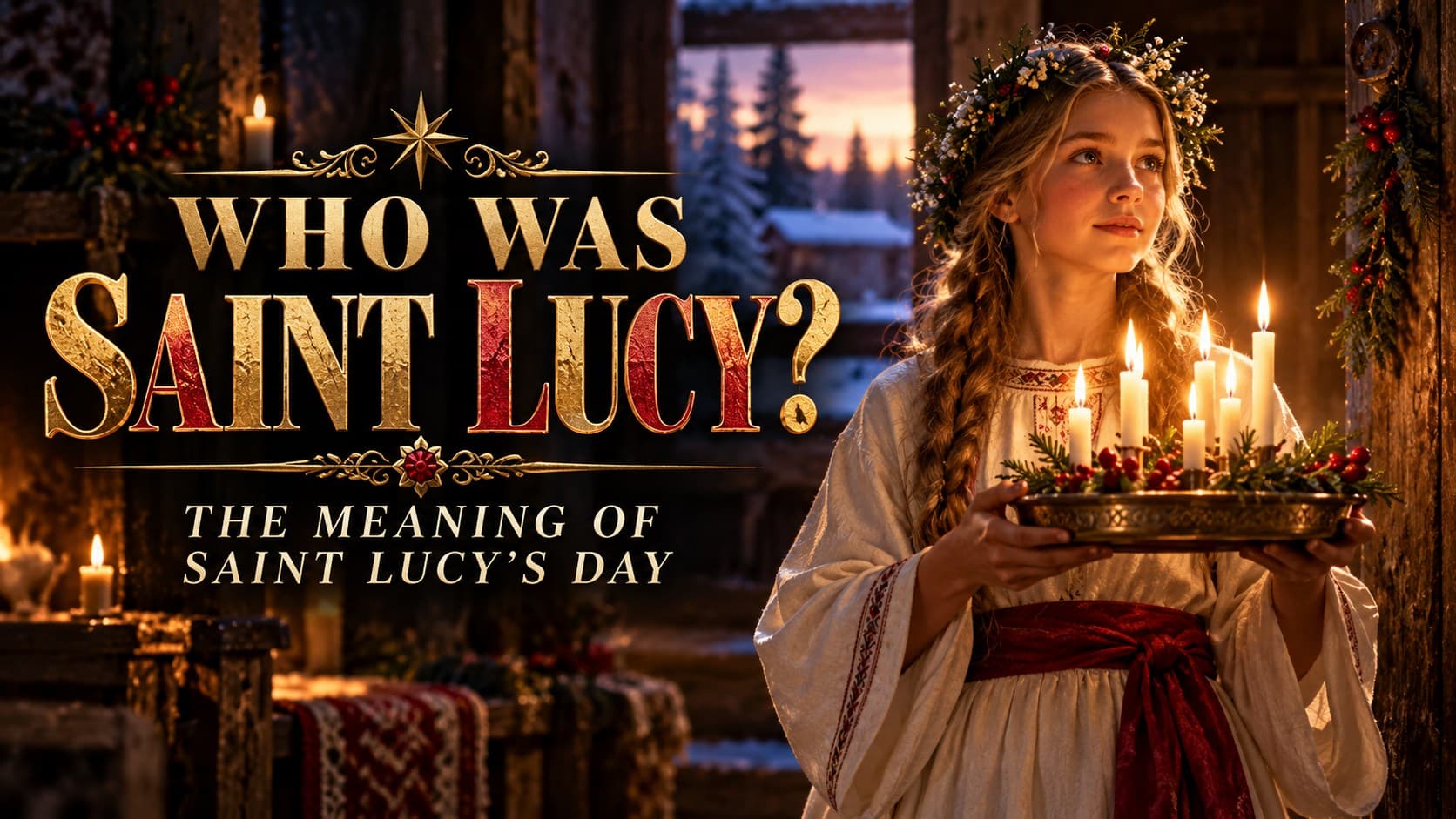
📖 Who Was Saint Lucy? The Meaning of Saint Lucy's Day
Picture the darkest night of the year, back when the old calendar said this was it.
No electric lights. No streetlamps. Just a house, a long winter, and a girl walking in with a crown of candles on her head.
That is not a scene from a Christmas card. It is a tradition still practiced every December 13 across Sweden, and it is named after a teenage girl from Sicily who most people cannot place in history at all.
📌 Saint Lucy was a young Christian in Syracuse who refused a forced marriage, gave away her inheritance, and was killed for her faith around the year 304. Her name means light, and almost everything else about her comes down to us as legend, not record.
That last part matters, and the church says so plainly.
This is Lucy's story the way the earliest Christian sources actually tell it, what later legend added on top, and why her feast day still lights up the darkest week of the year.
Who Saint Lucy Was
Lucy was born in Syracuse, on the island of Sicily, toward the end of the third century, into a wealthy family.
Her father died while she was young, leaving her mother Eutychia to raise her alone. She lived and died during the reign of the Roman emperor Diocletian, whose edicts against Christians triggered one of the harshest waves of persecution the early church faced.
📌 Her feast falls on December 13, which both Western and Eastern churches have kept since the ancient Roman Martyrology.
⚠️ Be honest about the source material from the very first sentence. Lucy's story survives in what the Catholic Church itself calls the Acts of Martyrdom, a later collection of traditions, popular tales, and legends, not a courtroom transcript. The Catholic Encyclopedia calls the surviving account "beautiful" but says it "cannot unfortunately be accepted without criticism."
What historians treat as solid is narrower than the popular story: a real young woman, martyred in Syracuse, in the persecution of Diocletian, remembered on December 13.
Here is how the tradition tells the rest.

The Life of Saint Lucy
1. A Vow Made in Secret
According to the tradition, Lucy privately decided as a young woman to give her life entirely to God and never marry.
She told no one, not even her mother.
Eutychia, not a Christian herself in every account, arranged a marriage for Lucy to a wealthy young pagan man anyway, not knowing about the vow underneath her daughter's silence.
💡 Understand this and the rest of her story makes sense: Lucy was not resisting marriage itself. She was holding onto a promise nobody else knew she had made.
She delayed the wedding as long as she could and waited for an opening.
2. A Pilgrimage for Her Mother's Healing
That opening came through her mother's illness. Eutychia suffered for years from a hemorrhage no physician could stop.
Around the year 301, Lucy convinced her to travel to Catania to pray at the tomb of Saint Agatha, a young woman martyred decades earlier in that same region.
Lucy prayed there herself, and Vatican News records that Agatha appeared to her afterward with a message: her mother's bleeding had already stopped, and Syracuse would be kept safe for Lucy's sake because Christ wanted her to keep her life consecrated to Him.
"What? know ye not that your body is the temple of the Holy Ghost which is in you, which ye have of God, and ye are not your own?"
Paul wrote that line to a church centuries before Lucy was born, describing every believer, not her specifically.
📌 It is still the exact claim Lucy was reportedly making with her life: her body belonged to God first, and no betrothal could override that.
With her mother healed, Lucy finally told her the vow she had been keeping.
3. Giving Away a Dowry, and Making an Enemy
Eutychia agreed to let Lucy break the engagement, and Lucy did something that made the break permanent.
She persuaded her mother to let her give away a large part of their wealth, her own dowry included, to the poor of Syracuse.
"Sell that ye have, and give alms; provide yourselves bags which wax not old, a treasure in the heavens that faileth not, where no thief approacheth, neither moth corrupteth."
⚠️ Her rejected suitor did not take the broken engagement quietly, and he did not take it as a private matter either.
Losing the dowry along with the bride, he denounced Lucy to Paschasius, the Roman governor of Sicily, as a Christian defying Diocletian's edict.
📌 Greed, not just religion, is what the earliest account says actually started her trial. A broken engagement became a capital case the moment money was involved.
4. The Trial Before Paschasius
Brought before the governor, Lucy refused to sacrifice to the Roman gods.
Vatican News records her answer to Paschasius as a direct claim of ownership: "I am a servant of the Eternal God."
When he pressed her about the Holy Spirit supposedly living in her, the tradition has her answering with the same conviction Paul wrote to Corinth:
"What? know ye not that your body is the temple of the Holy Ghost which is in you, which ye have of God, and ye are not your own?"
Paschasius ordered her sent to a brothel as punishment for her defiance.
According to the account, she could not be moved from where she stood, not even when he sent men and oxen to drag her there.
💡 The detail is strange to modern ears, but the point the earliest storytellers were making is plain enough: nothing he commanded could actually touch what she had already given to God.
5. A Death the Fire Could Not Finish
Unable to move her, Paschasius had a fire built around her instead.
The tradition says the flames did not harm her at all.
He finally had her killed by the sword, and the earliest account adds that she foretold the end of the persecution and of Diocletian's reign before she died.
⚠️ That prophecy is one of the exact details the Catholic Encyclopedia flags as historically shaky, since it does not line up cleanly with how the persecution actually ended. Treat it as part of the devotional story the early church told about her, not as a verified fact.
Putting the Catholic Encyclopedia's dates together, born around 283 and killed around 303 or 304, she would have died still in her twenties.
"I have fought a good fight, I have finished my course, I have kept the faith."
📌 Whatever details later centuries added, the core the church has always held onto is simple: a young woman died rather than deny who she belonged to.
6. Why Her Eyes Became Her Symbol
Walk into almost any church painting of Saint Lucy and you will see her holding a small dish with two eyes on it.
The popular legend behind that image says her eyes were gouged out before her death, sometimes by her own hand to discourage the suitor who had admired them, sometimes by her torturers.
⚠️ Neither the Vatican News account of her martyrdom nor the Catholic Encyclopedia's entry on her mentions the eyes at all. It is a later devotional legend, almost certainly attached to her because her name, Lucia, comes from the Latin word for light, and she became the patron saint of those who are blind or have trouble with their sight.
📌 The symbol grew out of her name before it grew out of any record of what actually happened to her body.
That same honesty about legend outrunning fact is worth keeping in hand whenever a tidy story about the old world gets repeated as settled history, the same caution a claim about Christmas and paganism deserves before anyone repeats it as proven.
Lessons From Saint Lucy's Life
1. A promise kept in secret can still hold under pressure
Nobody knew about Lucy's vow until she needed it to matter.
❓ Is there a commitment you have made to God that nobody else knows about yet?
2. Generosity is a decision, not a leftover
Lucy did not give away whatever was left after the wedding. She gave away the dowry itself, the thing the whole arrangement was built on.
📌 Real generosity usually costs you the plan you already had, not just the spare change left over from it.
3. Conviction can cost you comfort before it costs you anything else
Lucy lost a fiance, a fortune, and her safety, in that order, before she lost her life.
⚠️ The first cost of standing on your faith is rarely the last one, and it is almost never the biggest.
4. A name can carry a calling you have to grow into
Lucy means light. The church remembers her on the old calendar's darkest day, and Sweden still crowns a girl with candles in her name every winter.
💡 Whatever your own story holds, it can still end up meaning more than you were able to see while you were living it.

Key Verses From Saint Lucy's Story
1. John 1:5
"And the light shineth in darkness; and the darkness comprehended it not."
John wrote this about Christ himself, long before Lucy was born.
📌 It is still the verse her whole feast day seems to act out: a light placed deliberately on the year's darkest point, where it cannot be missed.
2. Matthew 5:14 to 16
"Ye are the light of the world. A city that is set on an hill cannot be hid. Neither do men light a candle, and put it under a bushel, but on a candlestick; and it giveth light unto all that are in the house. Let your light so shine before men, that they may see your good works, and glorify your Father which is in heaven."
Jesus is describing every one of his followers, not predicting a name or a Swedish tradition centuries ahead.
💡 A thousand years later, Christians still put a literal candle on a girl named Light and send her out where the whole house can see her.
3. Luke 12:33
"Sell that ye have, and give alms; provide yourselves bags which wax not old, a treasure in the heavens that faileth not, where no thief approacheth, neither moth corrupteth."
Jesus is teaching his disciples about where real security actually comes from.
📌 Lucy's dowry was exactly the kind of treasure this verse says not to hold onto too tightly.
4. 1 Corinthians 6:19
"What? know ye not that your body is the temple of the Holy Ghost which is in you, which ye have of God, and ye are not your own?"
Paul is correcting the whole church at Corinth about sexual purity, not writing about any one martyr.
💡 The tradition puts almost this exact claim in Lucy's mouth at her trial, which tells you how deeply this teaching had already settled into the church only a few generations after Paul wrote it.
5. 2 Timothy 4:7
"I have fought a good fight, I have finished my course, I have kept the faith."
Paul wrote this near his own execution, summing up a whole life in three short claims.
📌 Lucy's life was far shorter than Paul's, and the tradition says the same three things could be said of her just as truly.

Frequently Asked Questions About Saint Lucy
Was Saint Lucy a real person?
Historians treat her as a real martyr killed in Syracuse during Diocletian's persecution, around the year 304. The detailed story around that core fact comes from a later legendary account, the Acts of Martyrdom, which the Catholic Church itself does not treat as a precise historical record.
Why is Saint Lucy associated with light?
Her name, Lucia, comes from the Latin word lux, meaning light. That connection, combined with her feast falling on the darkest day of the old Julian calendar, is why candles, crowns of light, and the title patron of the blind all attached themselves to her memory over time.
Did Saint Lucy really pluck out her own eyes?
That specific detail does not appear in the earliest Catholic sources on her martyrdom. It is a later popular legend, most likely grown from her name meaning light and her later patronage over eyesight, not a detail from the original account of her trial and death.
Why does Sweden celebrate Saint Lucy's Day?
Sweden kept December 13 on its church calendar for Lucy centuries before the modern celebration existed. According to Sweden's Nordic Museum, today's white-robed procession grew out of a local 19th century western Swedish custom and only became standard nationwide in the 1950s, long after the original feast day itself.
Is Saint Lucy's Day connected to the winter solstice?
Under the old Julian calendar, December 13 fell on the winter solstice, the shortest day of the year. Most Western nations later adopted the Gregorian calendar and the solstice date moved, but Lucy's feast stayed fixed on December 13, which is why the folk memory of her as a light placed on the darkest day has outlasted the calendar that originally created it.
What is Saint Lucy the patron saint of?
She is best known as the patron of those who are blind or have eye trouble, and she is also honored as the patron of her home city, Syracuse. Both patronages trace back to her name meaning light rather than to any single documented event in her life.
Do Protestants celebrate Saint Lucy's Day?
Mostly in Scandinavia. Lutheran churches in Sweden, Norway, and Finland are among the few Protestant traditions that still keep the day, largely as a cultural and family custom rather than a day of prayer to a saint. The gap between how Catholic and Protestant calendars treat a day like this is exactly what the difference between Catholic and Protestant church calendars explains in full.
What are Lussekatter, the Saint Lucy's Day buns?
They are saffron flavored sweet buns, usually shaped like a curled S and topped with two raisins, traditionally served on the morning of Saint Lucy's Day in Swedish homes. The name comes from lusse, a shortened form of Lucia, and katter, meaning cats.
Why is Saint Lucy's Day during Advent?
December 13 simply falls inside the weeks of Advent, the season leading up to Christmas, which is part of why a feast about light arriving in darkness fits so naturally next to the season's own waiting and anticipation.
Is Saint Lucy's story similar to other December saints?
In one way, yes. Like Saint Nicholas, whose generosity also grew into popular legend far beyond what the earliest records can confirm, Lucy's documented life is much smaller than the tradition built on top of it. Both are remembered for real virtues the legends then dressed up further.
Final Thoughts
Strip away the candle crown, the eyes on the dish, the saffron buns, and one plain fact is still standing underneath it all.
📌 A young woman in Syracuse decided her life belonged to God before anyone else had a claim on it, and she would not let that get undone, even by force.
Everything else, the wealth given away, the trial, the fire that could not touch her, grew out of that one decision made quietly, long before anyone was watching.
Her feast lands on the darkest week of the year on purpose, the same stretch of the calendar that leads straight toward the candles lit one by one on an Advent wreath.
❓ What is the one commitment you are keeping quietly right now, that nobody else would know to ask you about?
📌 Whatever it is, Lucy's story says it can hold, even when everything else around it gets taken away.
📚 Sources
Every claim in this article traces back to one of these. All links checked 3 November 2026.
- Saint of the Day, 13 December: St. Lucy, Virgin and Martyr of Syracuse
Vatican News
The source for Lucy's background, the healing of Eutychia at St. Agatha's tomb, the denunciation, her words to Paschasius, the brothel sentence, the fire, and her death by the sword.
- St. Lucy
James Bridge, Catholic Encyclopedia (1910), New Advent
The source for Lucy's dates (c. 283 to 303), her feast day being kept by Latins and Greeks alike, her inclusion in the ancient Roman Martyrology and Gregory's Sacramentary, and the critical caution that the Acts of Martyrdom 'cannot unfortunately be accepted without criticism.'
- Lucia
Nordiska museet (Nordic Museum, Sweden)
The source for the history of the modern Swedish Lucia procession, its roots in a 19th century western Swedish custom, and the white-robed, candle-crowned form becoming standard nationwide only in the 1950s.
- Advent Calendar: December 13, Saint Lucy
St. Nicholas Center
The source for Lucy's name meaning light, the later legend of her eyes and her patronage of the blind, the Julian calendar's winter solstice falling on December 13, and the Lussekatter saffron buns.