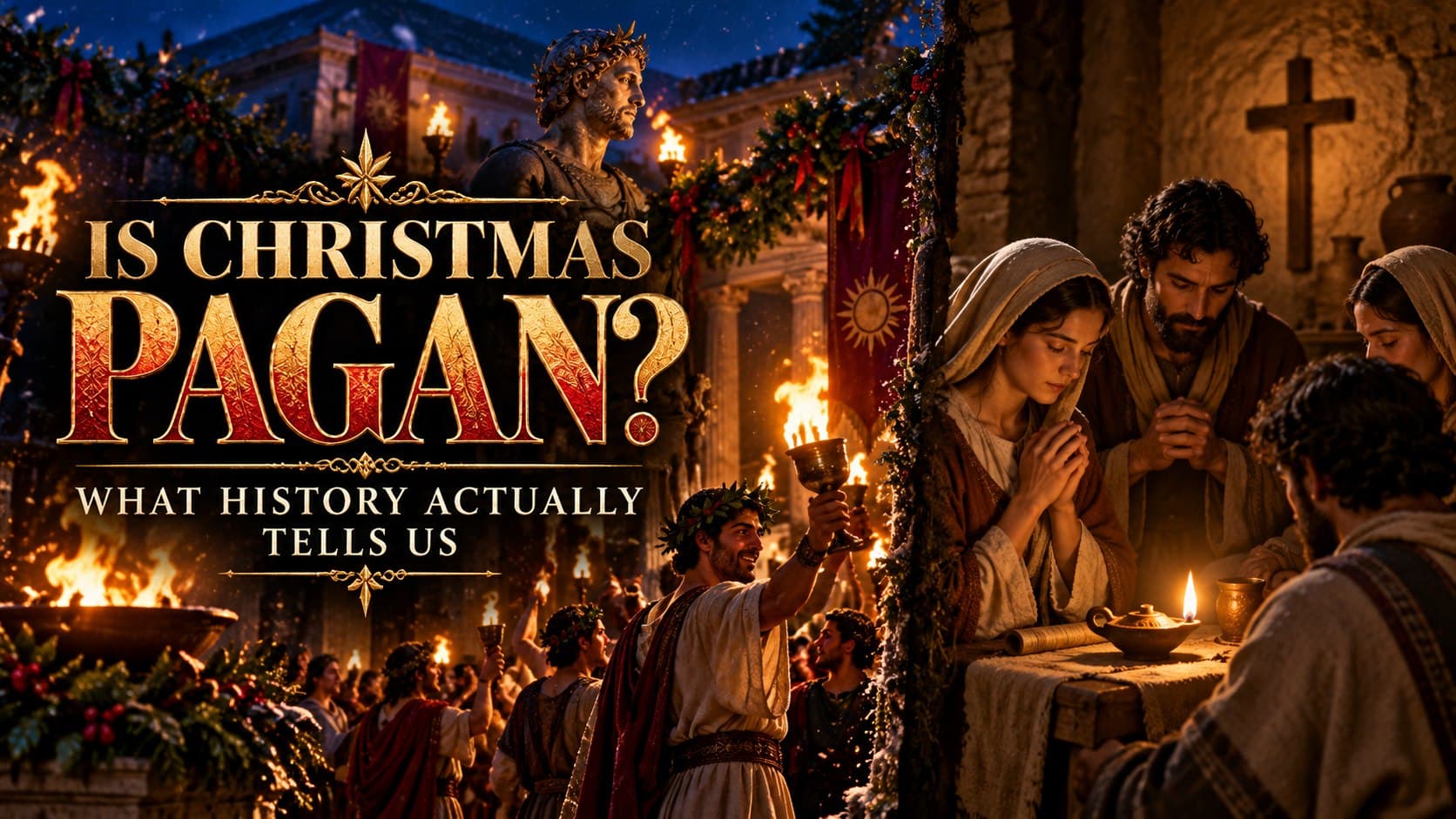
📖 Is Christmas Pagan? What History Actually Tells Us
It happens every December, almost on schedule.
A coworker, a cousin at dinner, or a video that shows up in your feed says it with a little smirk. "You know Christmas is just a pagan holiday with a cross stuck on it, right?"
Maybe you laughed it off. Maybe it actually bothered you, because you did not have a real answer, just a feeling that it could not be that simple.
📌 Here is the honest answer, and it has two halves most people online only ever give you one of. No, Christmas is not a pagan festival wearing a cross as a disguise. And yes, nobody can prove with certainty why the Church landed on December 25, and a few familiar Christmas customs really did start outside the Church, centuries later.
Both of those things are true at the same time. That is the part worth understanding.
This guide walks through where the "Christmas is pagan" claim actually came from, what historians know and do not know about how December 25 was chosen, whether Saturnalia and Sol Invictus really explain it, where the Christmas tree and mistletoe actually come from, and what Jeremiah 10, the verse everyone quotes at this time of year, is actually talking about.
You will not get a slogan here. You will get the actual sources, so you can check them yourself.
Why This Matters for Your Faith
It would be easy to treat this as trivia. A fun fact for a family argument, nothing more.
⚠️ But how you handle this question says something about how your faith handles pressure.
If you panic and cannot answer it, a skeptical friend walks away thinking your faith rests on things you have never actually checked. If you shut the question down with "just don't ask that," you teach the people watching you that honest history is a threat to the gospel. It is not.
The truth is sturdier than either reaction. Christianity does not stand or fall on a calendar date. It stands on what actually happened: God became a human being. That claim does not get weaker if the Church genuinely does not know why it picked December 25, any more than your own birthday certificate would stop being true if nobody could remember exactly who chose your middle name.
💡 Christians have also faced this exact kind of question before, about days and customs that Scripture never commands. Paul answered it directly, and we will get there.

What History Actually Shows About Christmas and Paganism
1. The Bible Never Gives Jesus a Birth Date
Start with the one fact nobody actually disputes.
"And she brought forth her firstborn son, and wrapped him in swaddling clothes, and laid him in a manger; because there was no room for them in the inn. And there were in the same country shepherds abiding in the field, keeping watch over their flock by night."
Luke, who gives us the fullest account of the birth, does not mention a month, a season, or a date. Matthew does not either. Nobody in the New Testament writes down when this happened on a calendar, because nobody in the first century was thinking about Jesus' birth as a holiday to mark every year.
📌 That single fact is the whole reason this question even exists. If Scripture had named a date, there would be nothing to argue about. Because it did not, the Church had to work the date out on its own, later, the same process that eventually shaped the wider Christian calendar as a whole, and that is exactly where the arguments start.
2. Where the "Christmas Is Pagan" Claim Actually Comes From
Most people assume this is an old argument the early church itself had to deal with. It is not, at least not in the form you hear it today.
Andrew McGowan, a historian of early Christianity, traces the first suggestion that the Church deliberately borrowed a pagan date to a note written in the twelfth century by Dionysius bar Salibi, a Syriac bishop, scribbled in the margin of a manuscript. The idea then sat largely unused for centuries before scholars in the eighteenth and nineteenth centuries picked it back up and built it into the theory most people repeat now.
⚠️ Nobody writing in the first three centuries of the Church ever describes choosing December 25 to copy a pagan festival. That argument is a much later guess about the early Church's motives, not a record the early Church left behind itself.
So the claim you hear repeated as settled fact is, historically speaking, a theory about two thousand years old that was not written down until the Church itself was already over a thousand years old.
3. The Calculation Hypothesis: Why December 25 May Come From March 25
Here is the explanation that gets the least attention online, even though it is older than the pagan borrowing theory and comes straight from Christian writers themselves.
Early Christians believed something you may never have heard before: that Jesus was conceived and crucified on the same calendar day. Tertullian, writing around the year 200, calculated the date of the crucifixion as March 25 on the Roman solar calendar. A Latin treatise from the fourth century, probably from North Africa, makes the logic explicit in one line McGowan quotes: "For on that day he was conceived on the same he suffered."
📌 Count nine months forward from March 25, the believed day of conception, and you land on December 25.
Augustine makes the same connection in his work On the Trinity, writing that Jesus "is believed to have been conceived on the 25th of March... but he was born, according to tradition, upon December the 25th." The Eastern Church ran the identical logic off a different calendar and landed on a different pair of dates, January 6 for the birth, which is one reason Eastern Christians still keep a related feast that week, something we cover in what Epiphany actually celebrates.
This idea is called the calculation hypothesis, developed by the historian Louis Duchesne in the early twentieth century and later expanded by Thomas Talley. It does not prove December 25 is the real birthday. It does show that Christians had a reason of their own, rooted in their own theology about Christ's death, for landing on that date, with no pagan festival required to explain it.
4. The Sol Invictus Theory, and Why Many Historians Doubt It
Now the theory you have actually heard. In the year 274, the Roman emperor Aurelian established a feast for Sol Invictus, the Unconquered Sun, on December 25. The popular version of the pagan borrowing theory says the Church picked the same date on purpose, to make the new faith feel familiar to Roman converts.
⚠️ The timeline is the first problem for that theory. Tertullian was already calculating a December birth from the March 25 crucifixion date around the year 200, roughly seventy years before Aurelian's sun festival existed at all. You cannot borrow from a festival that has not been invented yet.
The earliest document that actually names December 25 as Christ's birthday is a Roman almanac from the year 354, sometimes called the Philocalian Calendar, which simply states "natus Christus in Betleem Judeae," Christ was born in Bethlehem of Judea, with no explanation given for the date at all. McGowan also points to Augustine, who records that the Donatists, a splinter group in North Africa that broke away during a persecution in the year 312 and froze their practices at that moment, were already keeping a December 25 Christmas feast. If a group that separated that early already had the date fixed, the date likely predates Aurelian's festival rather than copying it.
Scholars are genuinely split here. Susan Roll argues that liturgical historians broadly accept some real connection to the winter solstice and solar worship. The historian C. Philipp E. Nothaft, on the other side, calls the evidence for the pagan borrowing theory "paltry." McGowan adds one more point worth sitting with: early Christian writers like Ambrose, who do mention the solstice landing near Christmas, treat it as a happy sign that Christ outshines the sun, not as an admission that the Church copied a festival.
💡 Here is the honest summary, and it is not the confident one either side gives you online. Nobody knows for certain why December 25 was chosen. Two real theories exist, built by real historians, and the evidence does not settle which one is right.
5. Does Saturnalia Explain December 25?
This is the version you hear most often, and it has a problem you can check with a calendar.
Saturnalia, Rome's famous midwinter festival of gift giving and feasting, ran from December 17 to December 23, a range the historian Gary Forsythe gives in his study of the Roman calendar. It was already over by December 25.
📌 A festival that finishes two days before Christmas even starts is a weak foundation for the claim that Christmas replaced it.
Saturnalia and Sol Invictus are also two separate Roman observances, even though people online often blend them into one. Sol Invictus landed on December 25 itself. Forsythe suggests Aurelian's sun festival may simply have worked as a welcome extension to Saturnalia's own week of celebration, two festivals close together on the Roman calendar, not one festival renamed as Christmas.
6. The Christmas Tree Has Its Own, Much Later Story
Here is where the conversation usually jumps tracks without anyone noticing. The Christmas tree is not part of the December 25 date argument at all. It is a completely different, and much later, story.
James Lancaster, a historian at the University of Queensland, traces the decorated indoor tree to a localized custom in Strasbourg, in the Alsace region, in the 1600s. It began small: a tree set up as part of a Christmas Day custom where good children found treats underneath it. Johann Wolfgang von Goethe gave the tree its first widely read description in 1774, and the custom did not spread across the rest of Germany until the 1830s.
⚠️ You have probably heard that Martin Luther invented the lit Christmas tree. Lancaster says that story "is not supported by scholarship." The popular version has Luther struck by starlight through snowy branches and recreating the scene with candles at home. It is a charming legend. It is a legend.
From Germany the tree reached British royalty through German born rulers, and Prince Albert made it fashionable to the wider public when he set one up at Windsor Castle in 1840. Pennsylvania German communities had their own trees even earlier, as far back as the early 1800s, independent of the British royal family entirely.
None of that traces back to ancient Rome or to any specific pagan ritual. Evergreen branches in winter are a genuinely old, widespread human habit, found across many cultures, simply because a plant that stays green while everything else goes brown in the cold is a striking thing to notice. That instinct is centuries, even millennia, older than the specific custom of a decorated tree indoors at Christmas, and the two should not be treated as the same claim.
7. Mistletoe, Jeremiah 10, and the Verse Everyone Misquotes
Mistletoe really does have an ancient pagan connection, more clearly than almost anything else on this list. The Roman writer Pliny the Elder described Celtic Druids cutting mistletoe from oak trees as a first century ritual, and Norse mythology ties the plant to the death of the god Baldur. History.com notes that how the plant moved from that old ritual use into a Christmas kissing custom is "up for debate," with the kissing tradition itself only showing up centuries later among servants in England before spreading to the middle class.
Now for the verse that gets passed around every December as if it settles the whole question on its own.
"For the customs of the people are vain: for one cutteth a tree out of the forest, the work of the hands of the workman, with the axe. They deck it with silver and with gold; they fasten it with nails and with hammers, that it move not."
Read the rest of the chapter before you decide this is about your tree in the living room.
"They are upright as the palm tree, but speak not: they must needs be borne, because they cannot go. Be not afraid of them; for they cannot do evil, neither also is it in them to do good."
That is not a decoration. That is a carved idol, shaped with an axe, fastened down so it cannot fall over, and mocked by Jeremiah for having no power to walk, speak, help, or harm anyone. The apologist Tim Barnett makes the point plainly: the whole chapter is contrasting powerless, handmade idols with the living God who actually made the heavens and the earth. Nothing in the passage mentions decoration, a holiday, or a season at all.
📌 Reading "Christmas tree" into Jeremiah 10 is not ancient wisdom. It is anachronism. The decorated evergreen tree, as the history above shows, is a custom from Alsace in the 1600s, roughly two thousand years after Jeremiah wrote this chapter. He could not have been warning against something that did not exist yet.
That does not mean every custom around Christmas is automatically fine just because this one verse does not apply. It means this particular verse, the one quoted the most, is not the argument people think it is.

Established and Unsettled
✅ What is established
- The Gospels never state a date, month, or season for Jesus' birth.
- The earliest document naming December 25 as Christ's birthday is a Roman almanac from 354 CE, which gives no reason for the date.
- Saturnalia ran December 17 to 23, finishing two days before December 25 begins.
- Emperor Aurelian established a feast for Sol Invictus on December 25 in 274 CE, decades after Christian writers had already linked the birth to that date through the March 25 calculation.
- The decorated indoor Christmas tree is documented starting in Strasbourg in the 1600s, not in ancient Rome or pre Christian Europe.
- Jeremiah 10:3 and 4 describes the construction of a carved idol, not a decorated evergreen tree.
- Mistletoe's use in a Druidic ritual is described by the Roman writer Pliny the Elder in the first century.
⚠️ What is still uncertain
- Why the Church actually settled on December 25. Historians are divided between the calculation hypothesis and a connection to Roman solar worship, and no piece of evidence has settled which one is correct.
- Whether the Sol Invictus festival influenced the Christian date or the reverse, since Christian writers were already calculating a December birth decades before Aurelian's 274 CE festival existed.
- The precise, documented path from the Druids' ritual use of mistletoe to the English custom of kissing beneath it, which sources openly call a matter of debate.
- Whether the Martin Luther Christmas tree legend has any historical basis. A historian who studies the custom states plainly that the popular story is not supported by scholarship.
Practical Tips for Talking About This Honestly
Here is how to actually handle this conversation, the next time it comes up.
- Separate the claim from the day. The resurrection, the incarnation, and Jesus Himself do not depend on December 25 being historically accurate. The date is a tradition. The event it marks is a different question entirely.
- Do not repeat the Saturnalia line without checking it. It is the most common version of this argument, and it is the easiest one to disprove. Saturnalia ended on December 23.
- Learn the calculation hypothesis. Most people arguing that Christmas is pagan have never heard that Christians had their own theological reason, tied to the crucifixion date, for landing on December 25.
- Do not weaponize Jeremiah 10 against a tree in someone's living room. Read the whole chapter. It is about idols that cannot walk or speak, not holiday decorations.
- Remember that a custom starting outside the Church is not automatically evil. A tree is not an idol unless you bow down to it. Meaning comes from what something is actually used for now, not from where it first showed up centuries ago.
- Read Romans 14 before you argue with another Christian about any of this. Paul already wrote the playbook for disagreements over days that Scripture never commands.
- If your own conscience is genuinely bothered, you have real freedom not to celebrate it. That freedom runs both ways, and Scripture protects both sides of it.
- Go to the actual historians, not a slideshow. Every source behind this article is linked at the bottom. Read one of them yourself this week.
Top 5 Bible Verses for This Conversation
These five carry the whole conversation, from what we actually know to how to disagree well.
1. Luke 2:7 and 8
"And she brought forth her firstborn son, and wrapped him in swaddling clothes, and laid him in a manger; because there was no room for them in the inn. And there were in the same country shepherds abiding in the field, keeping watch over their flock by night."
The actual record of the night itself, with no date attached. Everything else in this whole debate is people, across two thousand years, trying to fill in a blank Scripture left open on purpose.
2. Galatians 4:4 and 5
"But when the fulness of the time was come, God sent forth his Son, made of a woman, made under the law, To redeem them that were under the law, that we might receive the adoption of sons."
This is the verse underneath the whole claim, whatever the calendar says. The timing of the birth belonged to God, not to Rome, and not to whichever historian eventually guesses right about the date.
3. Jeremiah 10:3 and 4
"For the customs of the people are vain: for one cutteth a tree out of the forest, the work of the hands of the workman, with the axe. They deck it with silver and with gold; they fasten it with nails and with hammers, that it move not."
Read in context, this is a description of a carved idol, mocked two verses later for having no power to walk or speak. It was written centuries before anyone in Alsace ever brought a fir tree indoors.
4. Colossians 2:16 and 17
"Let no man therefore judge you in meat, or in drink, or in respect of an holyday, or of the new moon, or of the sabbath days: Which are a shadow of things to come; but the body is of Christ."
Paul is writing about a different set of disputed days, but the principle lands here too. The substance is Christ. A disputed calendar date is a shadow, never the thing itself.
5. Romans 14:5 and 6
"One man esteemeth one day above another: another esteemeth every day alike. Let every man be fully persuaded in his own mind. He that regardeth the day, regardeth it unto the Lord; and he that regardeth not the day, to the Lord he doth not regard it."
This is the verse to actually live by when a fellow Christian lands differently than you on Christmas. Both convictions can be offered to the Lord honestly. Neither side gets to make the other feel like a lesser Christian over a date Scripture never commands.

Frequently Asked Questions About Christmas and Paganism
Is Christmas a pagan holiday?
No, not in the sense people usually mean. Christmas celebrates a historical claim at the center of Christian faith, that God became a human being. The specific date, December 25, is where the real uncertainty lives, and historians genuinely disagree about why it was chosen. That uncertainty is about a date, not about whether the holiday itself is secretly a pagan festival.
Did the Church copy the Roman festival of Sol Invictus?
It might have, but the timeline makes that hard to prove. Christian writers were already calculating a December birth date from the believed date of the crucifixion decades before Emperor Aurelian established the Sol Invictus feast in 274 CE. Some historians still argue for a real connection to the solstice. Others, like C. Philipp E. Nothaft, call the evidence for direct borrowing weak.
Was Jesus actually born in December?
Nobody knows. The Gospels do not record a date, a month, or even a clear season. December 25 was adopted by Christians centuries after the birth itself, through reasoning that had nothing to do with pinpointing the actual calendar day Jesus was born.
Does Saturnalia explain the Christmas date?
Not well. Saturnalia ran from December 17 to December 23, according to the historian Gary Forsythe, finishing two days before Christmas even begins. The theory confuses Saturnalia with the separate Sol Invictus festival, which did land on December 25 itself.
Is the Christmas tree pagan?
The decorated indoor Christmas tree is documented starting in Strasbourg in the 1600s, a Christian era custom, not a borrowed ancient Roman or Druidic ritual. The much older habit of using evergreen branches in winter shows up across many cultures, but that general instinct is a different claim than the specific tree tradition, which is centuries newer.
Did Martin Luther really invent the Christmas tree?
Probably not. It is a popular story, but a historian who has studied the custom's origins states plainly that the Luther legend "is not supported by scholarship." The tree custom traces to ordinary families in Alsace, not to one reformer's candlelit inspiration.
Does Jeremiah 10 condemn Christmas trees?
No. Jeremiah 10:3 and 4 describes a craftsman carving an idol from wood and covering it with silver and gold, an object Jeremiah mocks for having no power to walk or speak. It is about idol worship, written roughly two thousand years before the decorated evergreen tree existed as a custom.
Is mistletoe pagan?
Mistletoe has the clearest ancient pagan connection on this whole list. The Roman writer Pliny the Elder recorded Celtic Druids cutting it from oak trees in a first century ritual. How it later became a Christmas kissing custom in England is, by History.com's own account, still genuinely debated.
Should a Christian avoid Christmas because parts of its history are disputed?
That is a personal conviction Scripture leaves open. Romans 14 and Colossians 2 both treat disputed days as a matter for each believer's own conscience, not a test of someone else's faith. Protestants have their own long history of questioning extra biblical customs, going back to the split covered in what Reformation Day actually commemorates, and that same freedom runs both ways today. You are free to keep the day, free to abstain, and free to disagree with another Christian without calling their walk with God into question over it.
Final Thoughts
Clear away the memes and three things are left standing.
📌 Christmas is not secretly a pagan festival. Christian writers had their own theological reason, rooted in the believed date of the crucifixion, for landing on December 25, decades before the Roman sun festival most people blame it on even existed.
📌 The honest answer about the date itself is that nobody knows for certain. Real historians disagree, and the evidence has not settled which theory is right. That is a genuinely open question, not a crack in the foundation of the faith.
📌 Jeremiah 10 is not about your tree. It is about an idol that cannot walk, talk, help, or harm anyone, written long before the custom it gets borrowed to condemn ever existed.
You can hold all of that and still mean every word of what Christmas actually claims. The date is a tradition the Church worked out over centuries. The birth it remembers is a historical claim the New Testament stakes everything on. If you liked seeing a disputed claim examined this honestly, the Shroud of Turin gets the same treatment.
Next time someone brings this up with a smirk, you do not need to get defensive. You can just tell them the real history. It turns out to be more interesting than the meme.
📚 Sources
Every claim in this article traces back to one of these. All links checked 28 October 2026.
- How December 25 Became Christmas
Andrew McGowan, Bible History Daily, Biblical Archaeology Society · 2012, adapted from Bible Review, December 2002
The source for the calculation hypothesis, Tertullian's March 25 dating, the Philocalian Calendar, the Dionysius bar Salibi marginal note, and the Donatist evidence.
- Christmas controversies
Wikipedia
Used for Gary Forsythe's dating of Saturnalia to December 17 to 23, and for the Susan Roll and C. Philipp E. Nothaft scholarly disagreement over the solar theory.
- A story of legends, families and capitalism: a candid history of the Christmas tree
James A. T. Lancaster, The Conversation
The source for the Strasbourg origin of the decorated tree in the 1600s, the spread through Germany and to Prince Albert's Windsor tree, and the statement that the Martin Luther legend is not supported by scholarship.
- Why Do We Kiss Under the Mistletoe?
Evan Andrews, History.com
The source for Pliny the Elder's account of Druidic mistletoe use, the Norse Baldur legend, and the English servant era origin of the kissing custom.
- Christmas Trees Are Still Not Pagan
Tim Barnett, Stand to Reason
The source for the reading of Jeremiah 10:1 to 5 as a description of idol making, in contrast to the popular claim that it condemns Christmas trees.