📖 When Does Advent Begin? Dates, Meaning, and Traditions
Your pastor mentions "the First Sunday of Advent" like everyone already marked it on their calendar.
A friend's church lit a wreath candle last week. Yours has not touched one yet.
Somebody online says Advent starts December 1. Someone else swears it is always the Sunday after Thanksgiving. Both answers feel confident. Neither one is quite right.
📌 Advent begins on the Sunday closest to November 30, which means it can actually land anywhere from November 27 to December 3, and it is always exactly four Sundays before Christmas.
That is not a guess and it is not up to your own congregation to decide. It is a fixed rule the Western Church has followed for centuries, tied to a specific day on the calendar rather than a round number.
This guide walks through exactly how that date gets set, this year's actual date, what the word Advent means and why it points at two different comings of Christ, how the season grew into its present shape, and how Catholics, Orthodox Christians, and Protestants have handled it differently, often for reasons that have nothing to do with not caring about Jesus' birth.
Why This Matters for Your Faith
It would be easy to treat this as a scheduling question. When does the wreath come out. When do the purple candles start.
⚠️ But Advent was never built to be a countdown to presents. It was built to be a season of actual waiting.
And waiting, done honestly, is one of the harder things Scripture ever asks of a believer. It is easier to be busy than to watch. It is easier to decorate than to actually examine whether you are ready for Christ to come back, not just ready to unwrap something on December 25.
That is the real stake in knowing when Advent begins and why. The date is not trivia. It marks the start of a season the Church built on purpose to make you look two directions at once: back toward the night Jesus was actually born, and forward toward the day He said He is coming back.
💡 Knowing the date without knowing what the date is for is just another square on a calendar. This guide is about getting both.

What Advent Actually Is, and Exactly When It Begins
1. The Word Advent and What It Is Actually About
The word comes straight from Latin. "Adventus" means coming, or arrival, built from the verb "ad venio," to come to. The Catholic Encyclopedia's own entry on the season puts the purpose in two parts at once. The faithful are called to prepare themselves to celebrate the anniversary of the Lord's first coming into the world, and at the same time to prepare for His coming again as judge, at the end of the world.
That is worth sitting with before anything else. Advent was never aimed at only one event.
"For unto us a child is born, unto us a son is given: and the government shall be upon his shoulder: and his name shall be called Wonderful, Counsellor, The mighty God, The everlasting Father, The Prince of Peace."
Isaiah wrote that centuries before a single person alive to read it would see it answered. Advent exists because that promise eventually had a date. The season asks you to live inside the waiting Isaiah's own readers lived inside, on purpose, every year.
2. The Exact Rule for When Advent Begins
Here is the actual formula, not the rough version people repeat. Advent begins on the Sunday closest to November 30, the feast day of the apostle Andrew, and always runs exactly four Sundays before Christmas.
Because November 30 lands on a different weekday every year, the First Sunday of Advent can fall as early as November 27 or as late as December 3. When it starts on the earliest possible date, the season runs a full 28 days. When it starts on the latest possible date, it only runs 21.
November 30, 2026 falls on a Monday, which puts the nearest Sunday the day before it. So this year, the First Sunday of Advent, and the start of the new Church year, falls on November 29, 2026.
That last detail matters more than it sounds. The United States Conference of Catholic Bishops notes that each new liturgical year actually begins on the First Sunday of Advent, inside what the regular calendar still calls the old year. Catholics start their church year in late November, weeks before anyone else starts theirs on January 1.
📌 So the honest answer to "when does Advent begin" is never a fixed date on the calendar. It is a fixed relationship to one specific day, Saint Andrew's feast, that moves a little every single year.
3. Advent Points at Two Comings, Not One
Most people only know the half of Advent that looks backward. An angel telling a young woman what her son would be.
"And, behold, thou shalt conceive in thy womb, and bring forth a son, and shalt call his name JESUS. He shall be great, and shall be called the Son of the Highest: and the Lord God shall give unto him the throne of his father David: And he shall reign over the house of Jacob for ever; and of his kingdom there shall be no end."
That promise to Mary is the half of Advent everybody already pictures. But the season was never only about looking back at a birth that already happened.
Jesus told His own disciples to live with the other half of that watchfulness too.
"Watch ye therefore: for ye know not when the master of the house cometh, at even, or at midnight, or at the cockcrowing, or in the morning: Lest coming suddenly he find you sleeping. And what I say unto you I say unto all, Watch."
Paul puts both halves of that watching inside the same breath, writing to a church that was not waiting for a baby anymore.
"And that, knowing the time, that now it is high time to awake out of sleep: for now is our salvation nearer than when we believed. The night is far spent, the day is at hand: let us therefore cast off the works of darkness, and let us put on the armour of light."
📌 Advent rehearses both arrivals every single year. The one already kept, and the one still coming.
That is why the season was built with real weight to it, not just decoration. It is asking you to actually wait, the way the whole Old Testament waited, and the way the Church still waits now.
4. How Advent Grew Into a Four Week Season
The New Testament never mentions Advent. The season grew up slowly, centuries after the apostles, and the honest history admits that nobody can date exactly when it started. The Catholic Encyclopedia says no evidence of a season preparing for the Nativity shows up before the late fourth century.
The earliest clear traces come from local church gatherings, not a single decree from Rome. A synod at Saragossa in the year 380 required Christians to attend church daily from December 17 through Epiphany. A later synod at Mâcon in 581 went further, prescribing a fast like Lent's on Mondays, Wednesdays, and Fridays from November 11 all the way to Christmas.
The length of the season itself changed too. The Gelasian Sacramentary, an early Roman liturgical book, originally listed five Sundays of Advent. Pope Gregory VII, who held the papacy from 1073 to 1085, is the one who cut that down to the four Sundays every Western church keeps today. Spain, meanwhile, was still observing all five Sundays as late as the year 650, which shows how unevenly the practice spread even within the Western Church.
The Eastern Church took a different road entirely. The Catholic Encyclopedia notes there are no documents for anything like an Advent observance in the Greek speaking Church earlier than the eighth century. Instead of a season shaped like the Western Advent, Eastern Christians built their own separate preparation for the Nativity, which still runs today.
5. What the Catholic Church Still Does During Advent
Advent carries its own liturgical color, violet, the same penitential shade used for Lent. The Catholic Encyclopedia notes that on the Third Sunday, known as Gaudete Sunday, a lighter rose colored vestment is traditionally permitted instead, a small break in the season's weight. We cover exactly what that one Sunday means on its own elsewhere.
Two things disappear from the Mass for the whole season. The Gloria is omitted, and so is the Te Deum from the Office, while the Alleluia stays in place the entire time. That one detail matters: Advent is penitential, but unlike Lent, it never drops the note of joy entirely.
Writing in 1907, the Catholic Encyclopedia also recorded that marriages could not be solemnized during Advent until after Epiphany, a discipline that reflected how seriously the season was once kept as a time set apart from ordinary celebration.
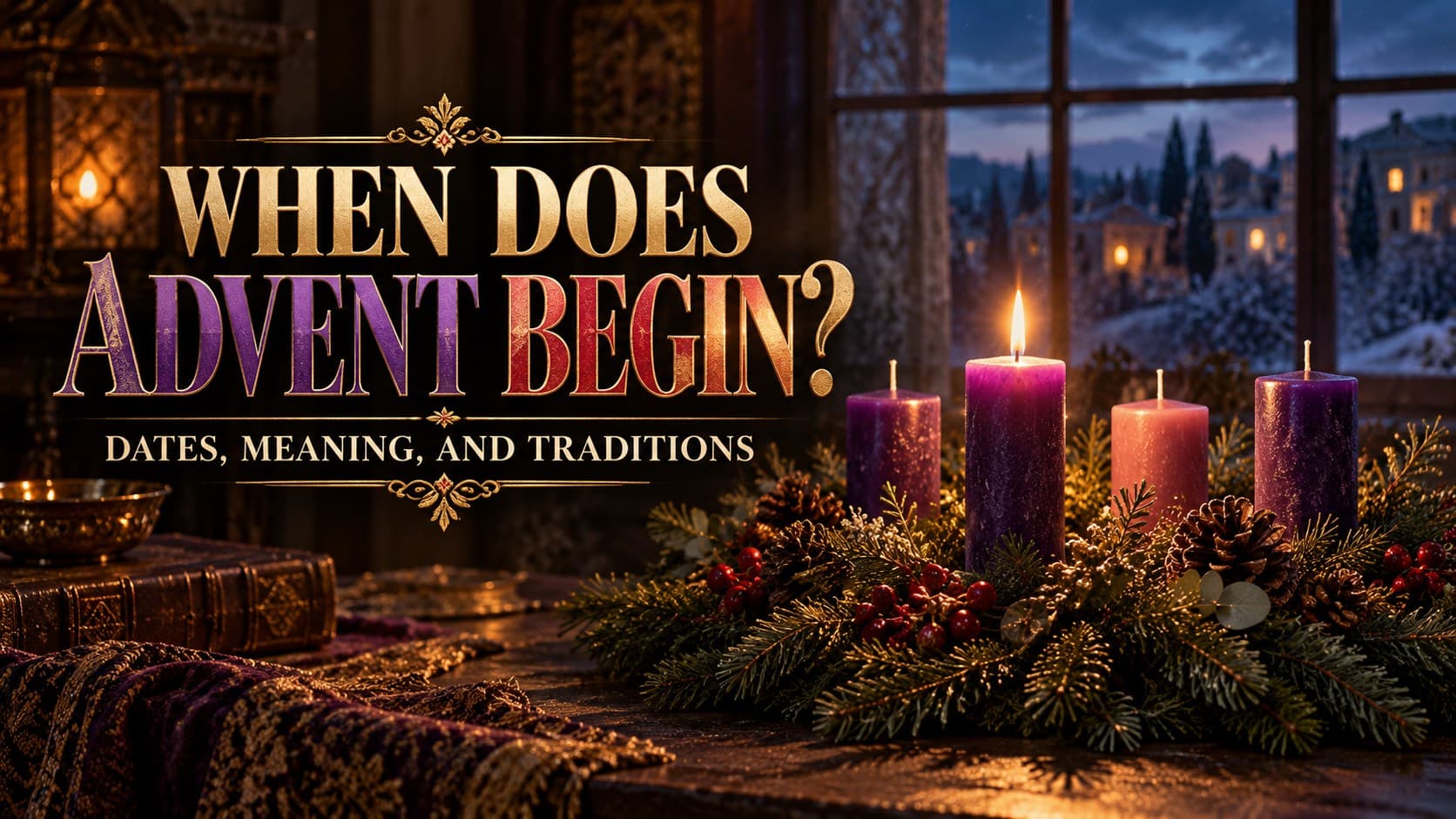
Most Catholic households today know Advent through a different object entirely: the wreath. That tradition is younger than almost everything else in this article. Johann Hinrich Wichern, who ran the Rauhes Haus mission for children in Hamburg, lit the first one in 1839, a wooden wreath roughly the size of a wagon wheel, with red candles for ordinary days and white candles for each Advent Sunday, one more lit every day until Christmas Eve. Hamburg's own tourism authority, which preserves the Rauhes Haus history, notes the wreath did not gain its now familiar evergreen branches until 1860. The simple four candle version most homes use today came later still, once the wreath moved out of mission halls and into ordinary living rooms, and that same source notes the wreath is now found in both evangelical and Catholic churches.
📌 The wreath most Christians now treat as ancient is, historically speaking, one of the newest parts of the whole season.
6. How Orthodox and Protestant Christians Mark the Season Differently
Eastern Orthodox churches do not keep a season called Advent at all. Instead they keep the Nativity Fast, which the Orthodox Church in America's own Department of Christian Education describes as the Eastern counterpart to Advent. It begins on November 15 for churches on the modern Gregorian calendar, and 40 days of simplified eating, prayer, and almsgiving follow, running through December 24. Churches that still follow the older Julian calendar begin the same fast on what the Gregorian calendar calls November 28, because the two calendars now sit 13 days apart.
Lutheran, Anglican, and Methodist churches kept the shape of the four week Advent season through the Reformation, trimming the older penitential rules while holding on to the candles, the readings, and the color. Many Baptist and nondenominational congregations today observe Advent informally, lighting candles and reading the promise texts without treating the season as a formal fast.
Reformed and Puritan churches went the other direction on principle, not by accident. The Westminster Confession of Faith, drafted by English and Scottish Reformed theologians in the 1640s, devotes a full chapter to worship built on what historians call the regulative principle, that acceptable worship must be "instituted by himself, and so limited to his own revealed will." Read that chapter closely and it names exactly one day God set apart across the whole year, "one day in seven for a Sabbath," now kept as the Lord's Day. Advent, like the rest of the church calendar, goes entirely unmentioned. The split that opened the door to that kind of disagreement has its own long story, told in what Reformation Day actually commemorates.
None of that makes one tradition more faithful than another. It means Christians have genuinely disagreed, for centuries and in good conscience, about whether a season like Advent is a gift the Church built to help believers wait well, or a human addition Scripture never commanded. The fuller shape of that whole disagreement is covered in what the liturgical calendar actually is.

Practical Tips for Actually Keeping Advent
Knowing the date is step one. Here is how to let the season actually do something.
- Put this year's real date on your calendar now. November 29, 2026 is the First Sunday of Advent. Set a reminder a week early so the season does not sneak up on you.
- Read one promise passage each week of the season. Isaiah 9:6 and 7, Luke 1:26 to 33, Matthew 1:18 to 23, and John 1:1 to 14 cover the whole arc in under twenty minutes total.
- Let the second half of Advent actually bother you a little. Spend a few minutes each week on Mark 13:35 to 37, honestly asking whether you are living ready for Christ to return, not just ready for December 25.
- Find out what your own church does with this season, and why. Some congregations keep a full four week Advent. Others keep nothing marked at all. Ask your pastor which, and what the reasoning behind it is.
- Start with one practice, not five. A single lit candle each week, or one short reading at dinner, will outlast an ambitious plan that collapses by December 10.
- Learn how Orthodox Christians prepare during the same weeks. The Nativity Fast is not something to copy without understanding it, but knowing it exists stretches how you think about Christian waiting.
- Do not let Advent get swallowed by shopping. Pick one day this season where the only thing on the calendar is prayer, not errands.
- Pray the last line of the Bible at least once this Advent. "Even so, come, Lord Jesus" is the oldest Advent prayer there is, and it still fits exactly.
Top 5 Bible Verses for Advent
If you read nothing else this season, let these five carry you through it.
1. Isaiah 9:6 and 7
"For unto us a child is born, unto us a son is given: and the government shall be upon his shoulder: and his name shall be called Wonderful, Counsellor, The mighty God, The everlasting Father, The Prince of Peace. Of the increase of his government and peace there shall be no end, upon the throne of David, and upon his kingdom, to order it, and to establish it with judgment and with justice from henceforth even for ever. The zeal of the LORD of hosts will perform this."
Written roughly seven centuries before it came true. This is Advent's oldest promise, and the one every other verse in this list is answering.
2. Luke 1:31 to 33
"And, behold, thou shalt conceive in thy womb, and bring forth a son, and shalt call his name JESUS. He shall be great, and shall be called the Son of the Highest: and the Lord God shall give unto him the throne of his father David: And he shall reign over the house of Jacob for ever; and of his kingdom there shall be no end."
The moment the promise got a name and a mother. This is the verse behind every Advent reading about Mary, and the hinge where prophecy turns into history.
3. Romans 13:11 and 12
"And that, knowing the time, that now it is high time to awake out of sleep: for now is our salvation nearer than when we believed. The night is far spent, the day is at hand: let us therefore cast off the works of darkness, and let us put on the armour of light."
Paul was not writing about a holiday. He was writing to people who already believed and still needed to be told to wake up. Advent asks the same thing of you now.
4. Titus 2:13
"Looking for that blessed hope, and the glorious appearing of the great God and our Saviour Jesus Christ;"
"Looking for" is an active word, not a passive one. This is the verse for the half of Advent that looks forward instead of back.
5. Revelation 22:20
"He which testifieth these things saith, Surely I come quickly. Amen. Even so, come, Lord Jesus."
The last prayer in the Bible is an Advent prayer. Whatever else this season asks of you, it can start and end with these six words.

Frequently Asked Questions About Advent
When does Advent begin in 2026?
Advent 2026 begins on Sunday, November 29, the First Sunday of Advent and the start of the new Church year. The date follows the standard rule of the Sunday closest to November 30, and since November 30, 2026 falls on a Monday, the nearest Sunday lands the day before it.
What does the word Advent actually mean?
It comes from the Latin word "adventus," meaning coming or arrival. The Church applies that name to both of Christ's arrivals the season prepares for, His birth already kept, and His promised return still ahead.
Is Advent only a Catholic observance?
No. Lutheran, Anglican, and Methodist churches kept the same four week season through the Reformation, and many Baptist and nondenominational churches now observe it informally. Orthodox Christians keep a related but separate season, the Nativity Fast, built on its own calendar rather than the Western one.
Why does Advent always have exactly four Sundays?
It was not always four. The early Gelasian Sacramentary listed five Sundays of Advent, and Pope Gregory VII reduced the season to four Sundays during his papacy in the late eleventh century. That shorter four Sunday pattern is what Western churches still follow today.
What is the difference between Advent and the Nativity Fast?
Advent is the Western Church's four Sunday season, tied to the date closest to November 30. The Nativity Fast is the Eastern Orthodox equivalent, a fixed 40 day fast that begins every year on November 15 on the Gregorian calendar, built around abstaining from meat, dairy, and other foods rather than around a Sunday count.
Do Protestants celebrate Advent?
It depends on the church. Lutheran, Anglican, and Methodist congregations generally kept Advent at the Reformation. Reformed and Puritan churches in the Westminster tradition rejected any yearly calendar beyond the weekly Lord's Day, on the conviction that Scripture never commands one, so some Reformed churches today still keep no Advent at all.
Does the Bible command Christians to observe Advent?
No single verse commands an Advent season by name. What Scripture does command is the posture behind it, watching and waiting for Christ, which is why churches that keep no formal Advent calendar at all can still take that command just as seriously as ones that do.
Is the Advent wreath in the Bible?
No. The wreath is a nineteenth century German tradition, built in 1839 by Johann Hinrich Wichern to help children at his Hamburg mission count down to Christmas. It is a teaching tool the Church later adopted widely, not a practice described anywhere in Scripture.
Can Advent start in November, or does it always start in December?
It can start in either month. Because the rule ties Advent to the Sunday closest to November 30, the First Sunday of Advent can fall as early as November 27 or as late as December 3, depending on where that Sunday lands each year.
What is the new Church year, and why does it start with Advent?
The liturgical year is the Church's own yearly calendar of seasons and feasts, and the First Sunday of Advent is officially where it begins, weeks before the regular calendar starts its own new year on January 1. Starting with Advent means the Church year opens on waiting, not celebration, every single year.
Final Thoughts
Strip away the confusion about the date and three things remain.
📌 The date is not random and it is not up for a vote. Advent begins on the Sunday closest to November 30. This year, that is November 29, 2026.
📌 Advent was built to point two directions at once. Back toward a birth already kept, and forward toward a return still coming. Either half on its own is only half the season.
📌 Christians have genuinely disagreed about keeping it, in good conscience, for centuries. Catholics built a structured four week season around it. Orthodox Christians built a parallel fast on their own calendar. Reformed Christians rejected any yearly calendar beyond the Lord's Day and meant it as faithfulness, not indifference.
So here is one way to start this year, whatever your own church does or does not keep. Mark November 29 down. Read one promise passage from this guide each week between now and Christmas. And somewhere in the middle of the lights and the shopping, let yourself actually wait for a minute, the way the whole season was built to make you.
He already came once.
He said He is coming again.
Advent is the season that refuses to let you forget either one.
📚 Sources
Every claim in this article traces back to one of these. All links checked 27 October 2026.
- Advent
The Catholic Encyclopedia, New Advent · 1907
On the etymology of 'Advent', the Sunday-nearest-November-30 rule, the two-fold purpose of preparing for the Nativity and the Second Coming, the Saragossa and Macon synods, the Gelasian Sacramentary's five Sundays reduced to four by Pope Gregory VII, and the liturgical practices of the season.
- Liturgical Year & Calendar
United States Conference of Catholic Bishops (USCCB)
On Advent as the start of the Church's new liturgical year, ahead of the Nativity.
- The Nativity Fast: Why We Fast
Orthodox Church in America (OCA)
On the Nativity Fast as the Eastern Orthodox counterpart to Advent, its November 15 start on the Gregorian calendar, its 40-day length, and the later start date on the Julian calendar.
- Westminster Confession of Faith, Chapter 21: Of Religious Worship and the Sabbath Day
A Puritan's Mind · 1646
On the regulative principle of worship and the Confession naming only the weekly Lord's Day as divinely appointed, with no mention of Advent or any other annual season.
- Der Adventskranz: Vier Kerzen erobern die Welt
Hamburg Tourismus (Hamburg Tourism Board)
On Johann Hinrich Wichern's creation of the first Advent wreath in 1839 at the Rauhes Haus in Hamburg, and its adoption of evergreen branches in 1860.