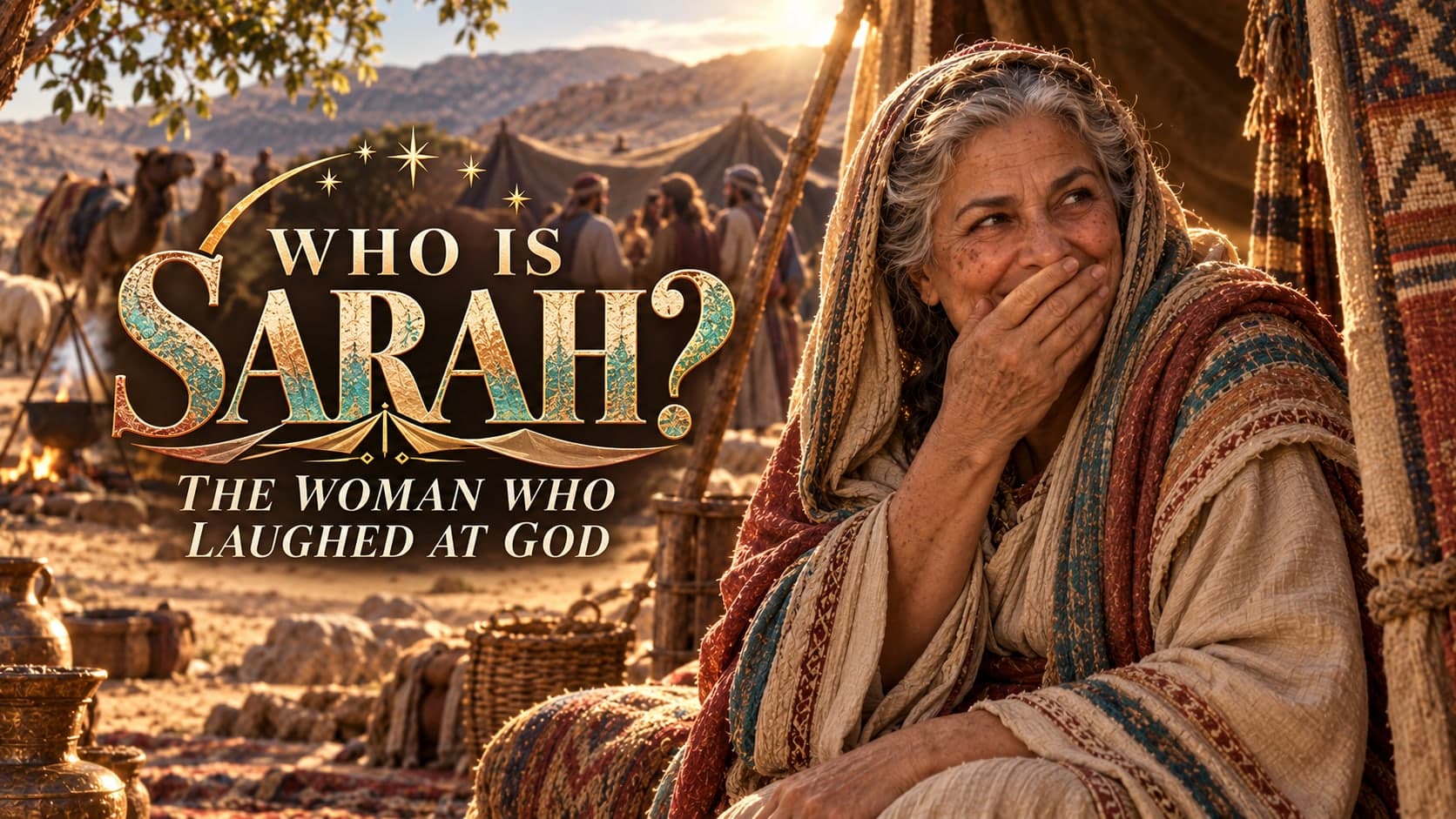
📖 Who Was Sarah in the Bible? The Woman Who Laughed at God
God made her husband a promise. She waited decades to see it happen.
She was still childless at sixty. Still childless at seventy. Still childless at eighty.
In the world Sarah lived in, a woman without children had no safety net and almost no standing at all. Children were how a family survived, how land stayed in the family, and how a woman was cared for in old age. Every year without a child was another year of quiet shame that everyone around her could see.
📌 So when God finally said the promise was about to come true, at ninety years old, Sarah did not shout for joy. She laughed. Not the good kind of laugh. The kind that slips out when something sounds flat out impossible.
Maybe you know a smaller version of that laugh. The one that escapes when someone tells you God is still going to fix the thing you gave up praying about years ago. You have asked so many times that the prayer stopped feeling like faith and started feeling like a habit you cannot quite put down.
This is the full story of Sarah in the Bible, walked through in order, straight from Genesis. Her long wait. Her trip to Egypt. The plan she came up with using her servant Hagar. The night she overheard a promise and laughed at it in the dark. The son she finally held. And a death that closed her story exactly where a story like hers should close: in hope.
Who Sarah Was
Sarah was not always called Sarah. Her first name was Sarai.
She married a man named Abram, who God would later rename Abraham. Genesis introduces their marriage in a single quiet sentence, no ceremony, no detail, just a name added to a family list in Genesis 11:29.
📌 Her story runs from Genesis 11 through Genesis 23, more chapters than almost any other woman gets in the whole Old Testament.
She left her homeland with Abram, trusting a promise God had given him, a promise that God would make his family into a great nation. There was one huge problem built right into that promise. Sarai could not have children.
💡 Every part of her story sits inside one long test. Could she keep believing God after year after year of nothing happening? Eve, the very first woman, was told to be fruitful and fill the earth. If you want to see where that command started, read who Eve was and how her story opens the Bible. Sarah spent most of her life watching that exact command feel completely out of reach.
Now let's walk through what actually happened to her, in order.
Sarah's Story
1. A Woman Named Barren
Before Scripture tells you anything else about her, it tells you this.
"But Sarai was barren; she had no child."
⚠️ That is the very first thing the Bible says about her, before her name is even fully explained.
In a culture built around family lines and inheritance, a woman with no children was seen as a woman with no future. It was not just sad. It was treated as a kind of failure, even though it was completely out of her control.
Sarai carried that single sentence for most of her adult life.
2. Called My Sister in Egypt
A famine forced Abram and Sarai to travel down into Egypt to survive.
As they got close, Abram grew afraid, and he made a request of his wife.
"And it came to pass, when he was come near to enter into Egypt, that he said unto Sarai his wife, Behold now, I know that thou art a fair woman to look upon: Therefore it shall come to pass, when the Egyptians shall see thee, that they shall say, This is his wife: and they will kill me, but they will save thee alive. Say, I pray thee, thou art my sister: that it may be well with me for thy sake; and my soul shall live because of thee."
⚠️ Abram protected his own life by asking his wife to hide the truth about theirs.
It worked exactly the way Abram feared, and worse.
"And it came to pass, that, when Abram was come into Egypt, the Egyptians beheld the woman that she was very fair. The princes also of Pharaoh saw her, and commended her before Pharaoh: and the woman was taken into Pharaoh's house."
Sarai was taken into a king's house, with no say in the matter at all. Scripture does not record a single word from her in this whole scene.
💡 She had no power over what happened to her body. Her husband had asked her to lie to protect himself, and she paid the price for it. God stepped in and struck Pharaoh's house with plagues, and Pharaoh sent them both away untouched, but the fear underneath that whole trip never fully left Abram. He asked her to do the same thing again years later with another king.
3. Giving Hagar to Abram
Ten more years passed in Canaan. Still no child.
So Sarai came up with a plan of her own.
"Now Sarai Abram's wife bare him no children: and she had an handmaid, an Egyptian, whose name was Hagar. And Sarai said unto Abram, Behold now, the LORD hath restrained me from bearing: I pray thee, go in unto my maid; it may be that I may obtain children by her. And Abram hearkened to the voice of Sarai."
💡 In that culture, giving a servant to a husband so she could bear children on the wife's behalf was an accepted custom. It was not something God commanded. It was a solution people reached for when they got tired of waiting on God to act.
"And Sarai Abram's wife took Hagar her maid the Egyptian, after Abram had dwelt ten years in the land of Canaan, and gave her to her husband Abram to be his wife."
⚠️ The plan worked, and it also broke something. Once Hagar conceived, the two women despised each other, and the pain from this one decision would follow this family for the rest of the story.
Sarai had tried to build the promise with her own hands. It was not what God had in mind.
4. A New Name and an Impossible Promise
Thirteen years after Hagar bore a son named Ishmael, God spoke again. This time He changed her name.
"And God said unto Abraham, As for Sarai thy wife, thou shalt not call her name Sarai, but Sarah shall her name be. And I will bless her, and give thee a son also of her: yea, I will bless her, and she shall be a mother of nations; kings of people shall be of her."
📌 Notice what God did not say. He did not tell Abraham to try Hagar's line again, or to find another solution. He said Sarah herself would have a son.
Her new name still meant something like princess, but it no longer pointed to just one household. It pointed to nations. God was telling a woman in her late eighties that she would still become a mother, and that whole nations and kings would trace back to her.
💡 God did not need Sarai's plan from years earlier to work. He was going to do this Himself, on His own timing, His own way.
5. Laughing Behind the Tent Door
Not long after that, three visitors came to Abraham's tent. One of them spoke as the LORD Himself, and He asked a very specific question.
"And they said unto him, Where is Sarah thy wife? And he said, Behold, in the tent. And he said, I will certainly return unto thee according to the time of life; and, lo, Sarah thy wife shall have a son. And Sarah heard it in the tent door, which was behind him."
Sarah was listening from inside the tent. Here is what happened next.
"Now Abraham and Sarah were old and well stricken in age; and it ceased to be with Sarah after the manner of women. Therefore Sarah laughed within herself, saying, After I am waxed old shall I have pleasure, my lord being old also?"
❓ Put yourself in that tent for a second. You have prayed for one thing your whole married life. A stranger tells you it is finally about to happen, at an age when your own body says it is over. What would you do?
📌 Sarah laughed within herself. Not out loud, not at anyone, just a private, disbelieving laugh at a promise that sounded too good to be true.
God heard it anyway.
"And the LORD said unto Abraham, Wherefore did Sarah laugh, saying, Shall I of a surety bear a child, which am old? Is any thing too hard for the LORD? At the time appointed I will return unto thee, according to the time of life, and Sarah shall have a son."
✅ Is any thing too hard for the LORD? That question is the heart of Sarah's whole story.
Then came her response, and it tells you something true about fear.
"Then Sarah denied, saying, I laughed not; for she was afraid. And he said, Nay; but thou didst laugh."
⚠️ She denied laughing because she was afraid. Not defiant, not proud. Afraid. If fear makes you cover up your honest reaction to God too, you are not the only one. Reading what the Bible says about fear is a good next step if that is where you are right now.
💡 God did not scold her for laughing. He simply corrected the lie and restated the promise. He was patient with her doubt, and He is patient with yours.
6. The Son Named Laughter, and the Cost That Followed
A year later, at ninety years old, Sarah held a son of her own for the first time in her life.
"And the LORD visited Sarah as he had said, and the LORD did unto Sarah as he had spoken. For Sarah conceived, and bare Abraham a son in his old age, at the set time of which God had spoken to him. And Abraham called the name of his son that was born unto him, whom Sarah bare to him, Isaac."
📌 The name Isaac means he laughs. Every time anyone said her son's name for the rest of his life, it echoed back to a promise Sarah once thought was impossible.
Sarah put words to it herself.
"And Sarah said, God hath made me to laugh, so that all that hear will laugh with me. And she said, Who would have said unto Abraham, that Sarah should have given children suck? for I have born him a son in his old age."
✅ The laugh of disbelief in the tent became a laugh of pure joy at ninety years old.
But joy for Sarah brought pain for another family in her own household. When Isaac was a little older, Sarah saw Hagar's son Ishmael mocking, and she reacted fast.
"And Sarah saw the son of Hagar the Egyptian, which she had born unto Abraham, mocking. Wherefore she said unto Abraham, Cast out this bondwoman and her son: for the son of this bondwoman shall not be heir with my son, even with Isaac."
Abraham was heartbroken over it. It was his son too.
"And the thing was very grievous in Abraham's sight because of his son. And God said unto Abraham, Let it not be grievous in thy sight because of the lad, and because of thy bondwoman; in all that Sarah hath said unto thee, hearken unto her voice; for in Isaac shall thy seed be called. And also of the son of the bondwoman will I make a nation, because he is thy seed."
⚠️ This is a hard, uncomfortable moment. God told Abraham to listen to Sarah, and Hagar and Ishmael were sent away into the wilderness. Scripture does not pretend this was painless. It also does not leave Hagar and Ishmael without hope. God met them in the wilderness and promised to care for the boy, but that is its own story, separate from Sarah's.
💡 The plan Sarai started years earlier out of impatience kept producing pain long after she thought it was finished.
7. Sarah's Death and a Grave Bought With Grief
Sarah lived a long life after Isaac was born. Genesis tells you exactly how long.
"And Sarah was an hundred and seven and twenty years old: these were the years of the life of Sarah. And Sarah died in Kirjatharba; the same is Hebron in the land of Canaan: and Abraham came to mourn for Sarah, and to weep for her."
📌 Sarah is the only woman in the whole Bible whose exact age at death is recorded. That small detail tells you how much weight her life was given in Scripture.
Abraham refused to bury her in borrowed ground. He bought a permanent resting place.
"And after this, Abraham buried Sarah his wife in the cave of the field of Machpelah before Mamre: the same is Hebron in the land of Canaan."
That cave became the family tomb for generations. Isaac was buried there. So was Jacob, and so was Leah, his first wife. If you want to see who ended up resting beside Sarah in that same cave, and why it mattered so much, Leah's story picks the thread up two generations later.
💡 The woman who once had no future because she had no child became the mother a whole nation traced its beginning back to, and a permanent piece of ground in Canaan was bought because of her.

Lessons From Sarah's Life
1. Waiting does not mean God has forgotten you
Decades passed between the promise and the birth of Isaac.
God had not forgotten. He was simply working on a timeline Sarah could not see from inside her own waiting.
2. Taking matters into your own hands can create pain that outlasts the problem
Giving Hagar to Abram felt like a reasonable plan at the time.
⚠️ Years later, it produced heartbreak that touched two families instead of one.
3. Doubt and faith can live in the very same moment
Sarah laughed at a promise she later believed enough to become pregnant by.
Hebrews later says her faith is what made that happen. Both things were true of her at once.
4. God answers honest doubt with patience, not punishment
God did not strike Sarah down for laughing.
💡 He asked a question, restated the promise, and kept His word anyway.
5. God can still be trusted even when a family gets things wrong
Sarah and Abraham both made choices that hurt other people along the way.
📌 God still kept His promise, and He still cared for the people hurt by their mistakes. He was not limited by their failures.
Key Verses From Sarah's Story
1. Genesis 11:30
"But Sarai was barren; she had no child."
The problem is named before anything else about her.
💡 The Bible never hides the hard part of anyone's story to make it easier to read.
2. Genesis 17:15 and 16
"And God said unto Abraham, As for Sarai thy wife, thou shalt not call her name Sarai, but Sarah shall her name be. And I will bless her, and give thee a son also of her: yea, I will bless her, and she shall be a mother of nations; kings of people shall be of her."
A new name arrived with a promise attached to it.
📌 God was not going to work around Sarah. He was going to work through her.
3. Genesis 18:14
"Is any thing too hard for the LORD? At the time appointed I will return unto thee, according to the time of life, and Sarah shall have a son."
This is the question at the center of Sarah's whole life.
✅ It is also a promise you can hold onto for whatever feels impossible in your own life right now.
4. Genesis 21:6
"And Sarah said, God hath made me to laugh, so that all that hear will laugh with me."
The laugh of disbelief became a laugh of joy.
💡 What starts as a doubtful laugh can end as a grateful one, once you have seen what God actually does.
5. Hebrews 11:11
"Through faith also Sara herself received strength to conceive seed, and was delivered of a child when she was past age, because she judged him faithful who had promised."
The New Testament spells her name Sara here, but it is the same woman. This verse looks back at Sarah's life and calls her whole story faith, even with the laughing and the fear included.
📌 God did not need her to feel confident. He needed her to keep trusting Him, even in the middle of her doubt. If you have ever wondered whether your own faith counts when it feels shaky, reading how you know you are saved can help settle that question.

Frequently Asked Questions About Sarah
Was Sarah a real person?
Genesis presents her as a real, historical woman, the wife of Abraham and the mother of Isaac. The New Testament treats her the same way, naming her directly in Hebrews, Romans, and 1 Peter as a real ancestor of the faith, not a legend or a symbol.
What was Sarah's original name, and why did it change?
Her original name was Sarai. God changed it to Sarah in Genesis 17, right when He renewed His promise that she would personally bear a son. The name change came with the promise attached, not after it was fulfilled.
How old was Sarah when Isaac was born?
Ninety. Genesis 17 records God telling Abraham that Sarah, who was ninety, would bear a son, and Genesis 21 says Abraham was a hundred years old when Isaac was born. She had waited roughly twenty five years from the time the promise was first given.
Why did Sarah laugh at God?
Because the promise sounded impossible. She was well past the age of having children, and a stranger sitting in her husband's tent told her she would have a son within a year. Her laugh was not mockery. It was disbelief, the kind that comes out on its own when something sounds too good to be real.
Why did Sarah give Hagar to Abraham?
After ten years in Canaan with still no child, Sarah acted on a custom of her time and gave her servant Hagar to Abraham so she could have children through her. It was a common practice in that culture, but Scripture presents it as Sarah trying to solve the problem herself rather than continuing to wait on God.
Was Sarah really Abraham's sister?
Genesis 20 later reveals that Sarah was Abraham's half sister, the daughter of his father but not his mother. So when Abraham told her to say she was his sister, it was technically true, but it was still meant to hide the fact that she was also his wife, which put her in real danger both times he asked her to do it.
What happened between Sarah and Hagar?
Once Hagar became pregnant, tension grew between the two women, and Sarah treated Hagar harshly. Years later, after Isaac was born, Sarah saw Hagar's son Ishmael mocking and insisted that Abraham send Hagar and Ishmael away. It is one of the most painful, honest parts of the whole account.
How did Sarah die, and where was she buried?
Sarah died at a hundred and twenty seven years old in Hebron. Abraham bought the cave of Machpelah as a permanent family burial place and buried her there. That same cave later held Abraham, Isaac, Rebekah, Jacob, and Leah.
Is Sarah mentioned in the New Testament?
Yes. Hebrews 11 lists her by faith among the great examples of trusting God. Romans 4 and 9 point back to the promise she carried. And 1 Peter 3 holds her up as an example for wives, noting that she called Abraham lord and did not give in to fear.
What can we learn from Sarah's story?
That waiting on God does not mean He has forgotten you. That trying to force a promise into being on your own timeline can cause pain that lasts for years. And that doubt, even doubt that shows up as laughter, does not disqualify you from being counted as a woman of faith.
Final Thoughts
Sarah spent most of her life waiting for something that felt impossible.
Hold three things next to each other.
📌 God kept His promise on His own timeline, not hers.
📌 Her doubt, laughter included, did not disqualify her from being called a woman of faith.
📌 Is any thing too hard for the LORD is still the right question to ask about whatever feels impossible in your life right now.
Her worth was never tied to how quickly the promise arrived.
It was tied to the God who kept it.
If you are in a season of waiting, read Genesis 18 tonight and sit with that one question God asked Abraham. Then, if you want a simple way to start reading Scripture on your own like this, how to read the Bible is a good place to begin.