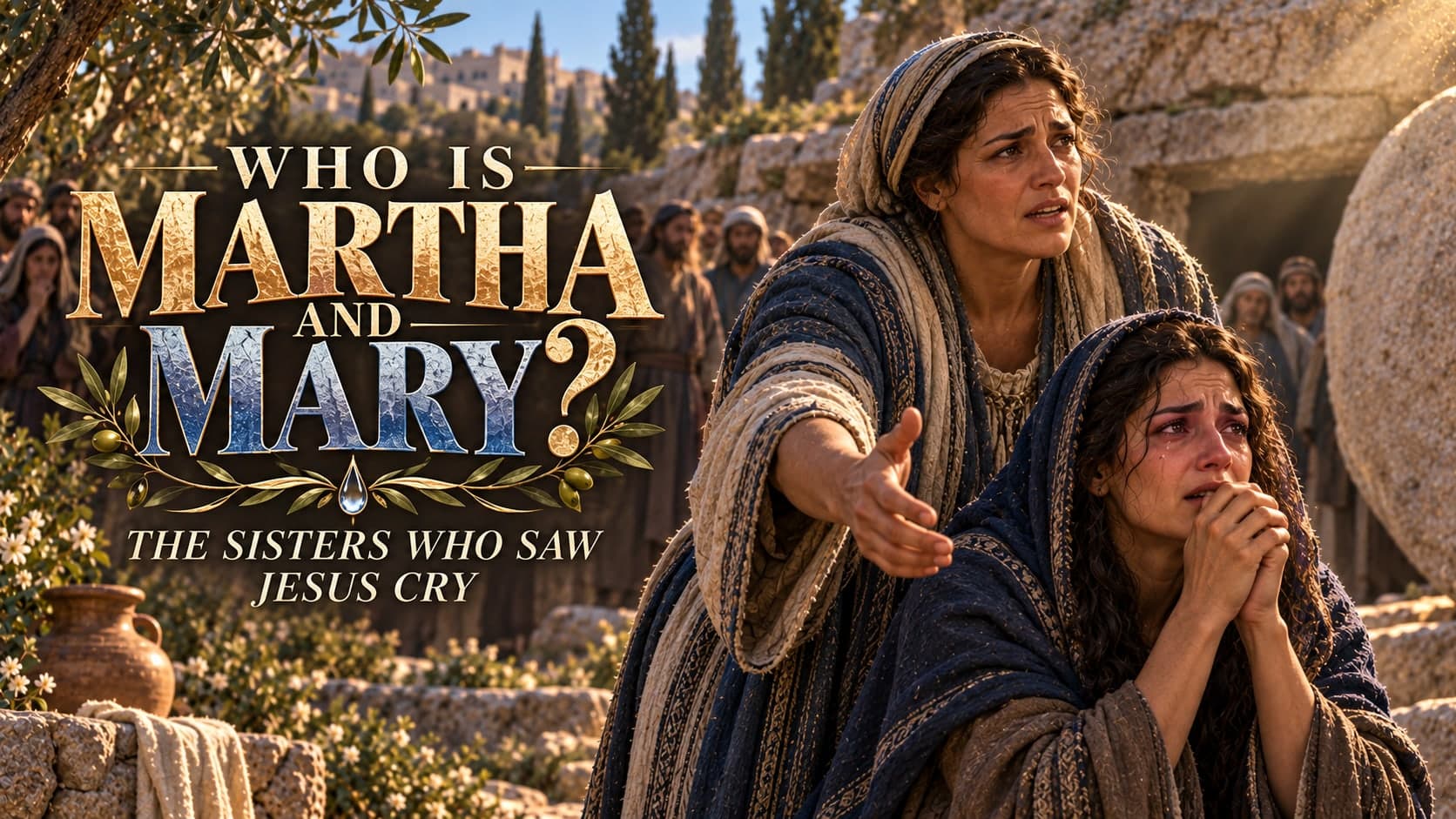
📖 Who Were Martha and Mary of Bethany? The Sisters Who Saw Jesus Cry
Two sisters loved Jesus with everything they had.
They just did not love Him the same way.
One sister ran to the kitchen the moment He walked through the door.
The other sister sat down on the floor and listened.
Then their brother got sick. Then he died.
📌 Both sisters stood at that grave asking the exact same question. Where was Jesus when we needed Him?
Maybe you already know which sister you are.
Maybe you are the one who cooks, plans, and serves, and quietly wonders if anyone notices how tired you are.
Or maybe you are the one who would rather sit still and listen, and you feel guilty for not doing more.
❓ Have you ever wondered if the way you love God is the wrong way?
Martha and Mary both wrestled with that, without ever saying it out loud.
This is the full story of Martha and Mary of Bethany, told in order, straight from the text. Their home in Bethany. The day Martha got frustrated with her sister. The death of their brother Lazarus. The tears Jesus cried at his grave. The miracle that followed. And the costly, strange, beautiful thing Mary did with a jar of perfume that Jesus said the world would never forget.
Let's start with who these two women actually were.
Who Martha and Mary Were
Martha and Mary were sisters who lived in a small village called Bethany, about two miles outside Jerusalem.
They had a brother named Lazarus, and the three of them shared a home there.
📌 Jesus loved this family. Scripture says so in plain words, and He stayed at their house more than once during His ministry.
Their story appears in three places: Luke 10, and John 11 and 12. Luke shows us a normal afternoon in their home. John shows us the hardest week of their lives.
Martha is usually named first, which in that culture often meant she was the older sister, or perhaps the one who owned the house. Whatever the reason, she is the one who answers the door and runs the kitchen.
Mary is the quieter one on the page. She speaks only a handful of words in the entire Bible, but what she does speaks louder than words ever could.
💡 Neither sister is ever called Jesus' disciple in the way the twelve men who traveled with Him are. But they were something just as real. They were His friends, in a home He could actually rest in.
Now let's walk through what actually happened.

Their Story
1. One Sister Serves, One Sister Sits
The first time we meet these sisters, Jesus has just arrived at their village.
"Now it came to pass, as they went, that he entered into a certain village: and a certain woman named Martha received him into her house."
Martha is the one who opens her home to Him. That is not a small thing. Feeding and housing a traveling teacher and likely His followers took real work.
"And she had a sister called Mary, which also sat at Jesus' feet, and heard his word."
While Martha is busy in the kitchen, Mary sits down at Jesus' feet, the position of a student learning from a teacher.
📌 In that culture, sitting at a rabbi's feet to learn was almost always something only men did. Mary sat there anyway, and Jesus let her stay.
Martha kept working. And the work kept piling up.
"But Martha was cumbered about much serving, and came to him, and said, Lord, dost thou not care that my sister hath left me to serve alone? bid her therefore that she help me."
Cumbered means pulled in every direction, weighed down, distracted. Martha was not lazy or petty. She was exhausted, and she felt alone in it.
⚠️ Notice what she actually says to Jesus. Not just come tell my sister to help. She says, dost thou not care. That is the sound of a tired heart, not just a tired body.
💡 If you have ever felt invisible while you served, notice that Martha said that exact feeling out loud, to Jesus Himself, and He did not scold her for saying it.
Jesus answered her gently, but honestly.
"And Jesus answered and said unto her, Martha, Martha, thou art careful and troubled about many things: But one thing is needful: and Mary hath chosen that good part, which shall not be taken away from her."
Saying her name twice is a sign of tenderness, not anger. Martha, Martha.
📌 Jesus never says Martha's serving was wrong. He says she was careful and troubled about many things, when only one thing was needed in that moment.
Mary had chosen the good part, and Jesus said it would not be taken from her. He did not say Martha's part was bad. He said Mary's choice, in that moment, was the better one.
❓ If you have ever felt anxious trying to manage everything at once, you are not alone in that feeling. You can read more in what the Bible says about anxiety.
2. A Brother Falls Sick, and Jesus Waits
Some time later, their brother Lazarus became seriously ill. The sisters knew exactly who to call.
"Now a certain man was sick, named Lazarus, of Bethany, the town of Mary and her sister Martha."
"Therefore his sisters sent unto him, saying, Lord, behold, he whom thou lovest is sick."
Notice how they describe Lazarus. Not just our brother. He whom thou lovest. They were confident enough in Jesus' love for this family to say it plainly.
Then the Bible tells us something remarkable, right before the hardest part.
"Now Jesus loved Martha, and her sister, and Lazarus."
📌 Scripture states it directly. Jesus loved this family. Full stop.
Then comes the verse that has confused readers for two thousand years.
"When he had heard therefore that he was sick, he abode two days still in the same place where he was."
He loved them, and He stayed put anyway. Two more days passed while Lazarus got worse and then died.
⚠️ This is one of the hardest verses in this whole story to sit with. Jesus' love for this family did not mean an instant rescue. It meant something the sisters could not see yet.
💡 If you have ever wondered why God allows suffering to run its course instead of stopping it right away, this family lived that question before you did. It is worth reading why God allows suffering if that question is sitting heavy on you right now.
3. Martha Runs to Meet Him on the Road
By the time Jesus finally arrived in Bethany, Lazarus had already been buried.
"Then when Jesus came, he found that he had lain in the grave four days already."
📌 Four days mattered to the people watching this story unfold. Many Jewish people at that time believed a person's spirit stayed near the body for three days. By day four, there was no doubt left. Lazarus was truly, completely gone.
Friends and neighbors had come from Jerusalem to sit with the grieving sisters, as was the custom. Then word came that Jesus was on His way.
"Then Martha, as soon as she heard that Jesus was coming, went and met him: but Mary sat still in the house."
True to who she is, Martha gets up and moves toward Him. And true to who she is, Mary stays where she is.
Then Martha says one of the most honest sentences in the whole Bible.
"Then said Martha unto Jesus, Lord, if thou hadst been here, my brother had not died. But I know, that even now, whatsoever thou wilt ask of God, God will give it thee."
⚠️ Lord, if thou hadst been here, my brother had not died. That is not a polite greeting. That is grief and a little bit of blame, spoken straight to His face.
📌 And in the very next breath, she still says, I know God will give you whatever you ask. Grief and faith, held together in the same sentence.
Jesus answers her with a promise.
"Jesus saith unto her, Thy brother shall rise again."
Martha answers like a woman with good, correct theology and a broken heart.
"Martha saith unto him, I know that he shall rise again in the resurrection at the last day."
She believed in the resurrection at the end of time. That was standard Jewish teaching. What she did not yet see was standing right in front of her.
"Jesus said unto her, I am the resurrection, and the life: he that believeth in me, though he were dead, yet shall he live: And whosoever liveth and believeth in me shall never die. Believest thou this?"
📌 Jesus was not only talking about someday. He was saying, that promise is standing right in front of you, right now.
Martha's answer is one of the clearest confessions of faith in the entire Bible.
"She saith unto him, Yea, Lord: I believe that thou art the Christ, the Son of God, which should come into the world."
✅ Martha said this before Lazarus was raised. Before she saw the miracle. She believed first, and saw second.
The woman we usually remember for being cumbered about much serving is the same woman who spoke one of the boldest statements of faith in Scripture, in the middle of the worst week of her life.
4. Mary Falls at His Feet, and Jesus Weeps
After talking with Martha, Jesus called for Mary.
"Then when Mary was come where Jesus was, and saw him, she fell down at his feet, saying unto him, Lord, if thou hadst been here, my brother had not died."
💡 Mary says the exact same words her sister said. Same grief, same ache, same question. But Mary says it on her knees at His feet, the same place we first found her back in Luke 10.
Jesus does not answer her with a theology lesson. He responds with His whole heart.
"When Jesus therefore saw her weeping, and the Jews also weeping which came with her, he groaned in the spirit, and was troubled, And said, Where have ye laid him? They said unto him, Lord, come and see."
Then comes the shortest verse in the entire Bible, and one of the most human.
"Jesus wept."
📌 Jesus already knew He was about to raise Lazarus from the dead. He wept anyway.
💡 God, in the flesh, standing feet away from a miracle He was about to perform, still let Himself cry over the grief of people He loved.
❓ Why cry if you already know the ending will be good? Because sorrow is real even when hope is real too. Jesus did not need to grieve for information. He grieved because He loved them, and death is an enemy even to the God who is about to defeat it.
5. Lazarus, Come Forth
Jesus walked to the tomb, a cave with a stone across the entrance.
"Jesus said, Take ye away the stone. Martha, the sister of him that was dead, saith unto him, Lord, by this time he stinketh: for he hath been dead four days."
⚠️ Even after everything Martha had just confessed, she still spoke up with the hard, practical truth. Four days in that climate meant real decay. Faith did not erase her common sense.
Jesus reminded her of what He had already told her.
"Jesus saith unto her, Said I not unto thee, that, if thou wouldest believe, thou shouldest see the glory of God?"
They removed the stone. Jesus prayed out loud, for the sake of the crowd watching.
"And when he thus had spoken, he cried with a loud voice, Lazarus, come forth. And he that was dead came forth, bound hand and foot with graveclothes: and his face was bound about with a napkin. Jesus saith unto them, Loose him, and let him go."
✅ A man dead four days walked out of his own grave at the sound of Jesus' voice.
📌 The One who wept at that tomb is the same One who had the power to empty it. Grief and power were never opposites in Jesus. They stood side by side at the same grave.
6. A Supper, a Jar of Perfume, and a Costly Gift
Some time later, Jesus came back to Bethany, six days before the Passover, the yearly Jewish feast remembering God rescuing His people out of Egypt.
"There they made him a supper; and Martha served: but Lazarus was one of them that sat at the table with him."
💡 Martha is still Martha. She is still serving. Notice this time nobody is arguing about it. She had learned, or maybe just stayed exactly herself in the way that honored God.
Then Mary did something nobody at that table expected.
"Then took Mary a pound of ointment of spikenard, very costly, and anointed the feet of Jesus, and wiped his feet with her hair: and the house was filled with the odour of the ointment."
📌 A pound of pure spikenard was worth close to a year's wages for an ordinary worker. This was not a small gift. It may have been Mary's entire savings.
She poured it on His feet and wiped it with her hair, something a respectable woman in that culture simply did not do in public. She did not care. Not one person besides Jesus mattered to her in that room.
Not everyone thought it was beautiful.
"Then saith one of his disciples, Judas Iscariot, Simon's son, which should betray him, Why was not this ointment sold for three hundred pence, and given to the poor?"
The Bible does not let Judas hide behind that question.
"This he said, not that he cared for the poor; but because he was a thief, and had the bag, and bare what was put therein."
⚠️ Not every objection that sounds reasonable is honest. Judas asked a question that sounded caring and meant something else entirely.
Jesus defended Mary Himself.
"Then said Jesus, Let her alone: against the day of my burying hath she kept this."
📌 Out of everyone in that room, Mary may have been the only one who understood what was actually coming. Jesus had told the disciples plainly that He would die, and they kept missing it. Mary, in her own quiet way, was ready.
💡 Sometimes the person who loves quietly is paying closer attention than the ones doing all the talking. Compare that to Leah's story, another woman in Scripture whose quiet faithfulness outlasted everyone else's opinion of her.

Lessons From Their Lives
1. There is more than one right way to love Jesus
Martha served. Mary sat and listened. Jesus loved them both.
✅ You do not have to choose between being a Martha and being a Mary. You need the wisdom to know which one the moment calls for.
2. Serving becomes a problem when it crowds out sitting with Jesus
Jesus never told Martha to stop serving. He told her serving was not the one thing needed in that specific moment.
⚠️ Busy hands and a distant heart can happen even while doing good, useful things.
3. Honest grief and real faith can live in the same sentence
Both sisters said the same painful words to Jesus. Lord, if thou hadst been here, my brother had not died.
Neither one got scolded for saying it.
💡 You can tell God exactly how you feel and still trust Him in the very next breath, the way Martha did.
4. Jesus grieves with people even when He is about to fix the problem
Jesus wept knowing the tomb was about to be empty.
📌 God does not require you to stop hurting before He will act. He is willing to grieve beside you on the way to the miracle.
5. Delayed does not mean denied
Jesus loved this family, and He still waited two days before going to them.
⚠️ His love was never in question. His timing was simply not theirs, and it turned out to be for something bigger than they could have asked for.
6. Costly love is never wasted on Jesus
Judas called Mary's gift a waste. Jesus called it a treasure worth remembering.
📌 What you pour out for Jesus, even if the world calls it excessive, is never wasted on Him.
Key Verses From Their Story
1. Luke 10:41 and 42
"And Jesus answered and said unto her, Martha, Martha, thou art careful and troubled about many things: But one thing is needful: and Mary hath chosen that good part, which shall not be taken away from her."
The heart of the whole Martha and Mary story sits in this one gentle correction.
💡 Jesus names the problem as anxiety and distraction, not service itself.
2. John 11:5
"Now Jesus loved Martha, and her sister, and Lazarus."
Three names, one plain statement of love, right before the hardest chapter of their lives.
📌 God's love for you is not measured by how quickly He rescues you.
3. John 11:25 and 26
"Jesus said unto her, I am the resurrection, and the life: he that believeth in me, though he were dead, yet shall he live: And whosoever liveth and believeth in me shall never die. Believest thou this?"
One of the boldest claims Jesus ever made about Himself, spoken to a grieving woman at a graveside.
❓ He still asks that same question. Believest thou this?
4. John 11:35
"Jesus wept."
Two words. The shortest verse in the Bible, and one of the most comforting.
💡 God is not distant from your tears. He has shed His own.
5. John 12:7
"Then said Jesus, Let her alone: against the day of my burying hath she kept this."
Jesus defended a quiet act of love that others could not understand.
📌 He still sees what you give Him in private, even when nobody else does.

Frequently Asked Questions About Martha and Mary
Who were Martha and Mary in the Bible?
Martha and Mary were sisters who lived in Bethany, a village near Jerusalem, along with their brother Lazarus. Jesus loved this family and often stayed in their home. Their story appears in Luke 10 and in John 11 and 12.
Was Jesus wrong to correct Martha?
No, and He was gentle about it. He never said her serving was wrong or unimportant. He said she was careful and troubled about many things when only one thing was needed in that moment. It was a correction spoken in love, using her name twice, not a rebuke meant to shame her.
Is Mary of Bethany the same as Mary Magdalene?
No, they are two different women. This is one of the most common mix ups in the Bible. Mary of Bethany was the sister of Martha and Lazarus. Mary Magdalene was a separate woman from the town of Magdala, whom Jesus delivered from seven demons, and who was the first person to see Him after His resurrection. Scripture never says they are the same person.
Why did Jesus wait two days before going to Lazarus?
The Bible does not give a full explanation. John simply says Jesus loved the family, and then stayed two more days anyway. What we do know is what happened because of the delay. A miracle took place that a smaller, quicker healing never could have shown, a man raised from the dead after four days in the grave.
What does Jesus wept mean?
It means exactly what it says. Jesus cried real tears at the grave of His friend Lazarus, even though He already knew He was about to raise him from the dead. It shows that Jesus fully shared in human sorrow. His power to fix a problem did not stop Him from feeling the pain of it first.
Why did Martha say Lord, if thou hadst been here, my brother had not died?
It was an honest mix of grief and faith. She believed Jesus could have prevented the death, and she was hurting that He had not arrived in time. In the very next breath she also said she still believed God would give Jesus whatever He asked. Mary later said the identical words to Him at the same spot.
What was the ointment of spikenard that Mary used?
Spikenard was a rare, fragrant oil imported from far away, and a pound of the pure kind was extremely expensive, worth close to a year of ordinary wages. Mary used it to anoint Jesus' feet and then wiped them with her hair, an act of humility and devotion, not just a costly gift.
Why did Judas object to what Mary did?
He asked why the perfume was not sold and the money given to the poor. Scripture is direct about his real motive. He did not actually care about the poor. He was a thief who managed the disciples' money bag and used to help himself to what was in it.
Did Martha and Mary ever get married?
The Bible does not say. Scripture gives no record of either sister having a husband or children. Their identity in the text is built entirely around their relationship with Lazarus and with Jesus, not around a marriage.
What happened to Lazarus after he was raised from the dead?
The Bible tells us he sat at the table with Jesus at the supper in John 12, alive and well. It also says the chief priests planned to kill him too, because his living, breathing presence was drawing so many people to believe in Jesus. Scripture does not record any further details about his life after that.
What can we learn from Martha and Mary today?
That Jesus values both busy hands and a quiet heart, and that neither sister was loved more than the other. That grief and faith can sit in the same sentence. And that the love you give Jesus quietly, even when others do not understand it, is never wasted on Him.
Final Thoughts
Martha served. Mary sat. Both of them wept at the same grave.
📌 Jesus never made either sister choose between serving Him and sitting with Him. He simply asked each of them, in her own moment, to notice what mattered most.
📌 He wept with them before He worked the miracle, proving that grief and power are never opposites in Him.
📌 And He defended the quiet, costly love Mary gave Him, even when the people closest to Him could not understand it.
Whichever sister you relate to more, the same Jesus loves you the way He loved them.
Read John 11 for yourself tonight, slowly, and watch how close Jesus stays to two grieving sisters. If you are still learning your way around passages like this one, how to read the Bible is a good next step.