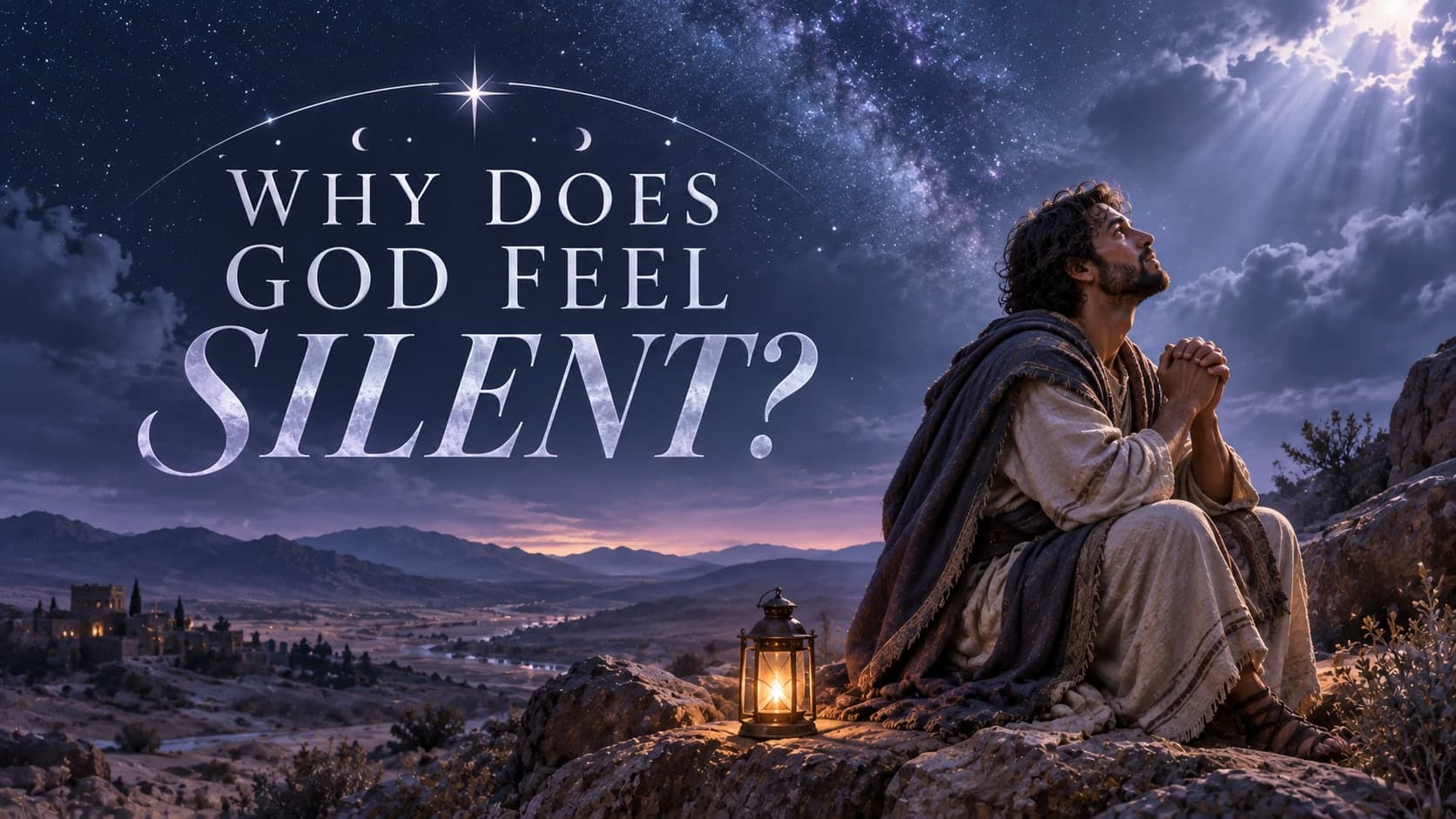
📖 Why Does God Feel Silent?
You pray. Nothing happens.
You open your Bible looking for an answer. It feels like words on a page.
You ask God the same question for the third week in a row and heaven says nothing back.
📌 So here is the honest answer to why God is silent, right up front. Most of the time it is not because you did something wrong.
Silence in Scripture is not rare. It shows up next to some of the most faithful people who ever lived.
If you are in a season where God feels quiet, you are not the first. You will not be the last.
Maybe someone has already told you the reason.
- 🔲 You must have some sin you have not confessed.
- 🔲 Your faith must not be strong enough.
- 🔲 You must not be praying the right way.
And maybe you have quietly believed it. Combed back through your week looking for the reason.
Put that search down for a minute.
📖 The Bible has a lot to say about silence. And almost none of it is a scolding.
There were 400 years between the last word of the Old Testament and the first word of the New. There is a king writing "how long, O Lord" out loud in the Psalms. There is Jesus Himself, in a garden and on a cross, feeling the weight of a Father who did not answer.
- ✅ What silence in Scripture actually looked like, and how long it lasted
- ✅ Permission to ask God "how long" without guilt
- ✅ The difference between God being silent and God being absent
- ✅ What to actually do while you wait for Him to speak
This is not going to tell you the silence means nothing.
It is going to show you that it does not mean what you fear it means.
Let's walk through it together.
Why This Matters for Your Faith
It would be easier if God were only silent toward people who deserve it.
Then you could fix it. Find the sin. Confess it. Get the answer back.
But that is not the God of the Bible.
⚠️ The lie underneath this struggle says silence equals absence.
That if God is not speaking, He is not there. Not listening. Maybe not even real. Left alone, that lie grows into the kind of fear Scripture speaks to directly.
That lie will not just cost you a few quiet weeks.
It will cost you the discipline of showing up when nothing feels like it is happening.
And showing up when nothing is happening is most of what a real walk with God looks like.
- ❓ Is God still good when He is not talking?
- ❓ Is He still working when you cannot see it?
- ❓ Can you trust a Father you cannot currently hear?
Every believer eventually faces those questions. Some face them for a season. Some face them for years.
Learning how to spend real time with God when He feels close is one skill. Staying there when He feels far is a different, harder one.
📌 This matters because the silent seasons are where real faith gets built, not just tested.
You do not grow much in the seasons where every prayer gets an instant answer.
You grow in the ones where you keep praying anyway.

When Heaven Feels Quiet
1. It Is Probably Not What You Think
Let's deal with the assumption first, because it is usually the loudest voice in the room.
⚠️ "God must be silent because of some sin I have not confessed."
Say that sentence out loud and notice how heavy it is.
That is not always the reason. It is not even usually the reason.
Scripture does say sin can hinder your relationship with God. But Scripture never says every silent season is a sin scoreboard.
Job was silent under thirty seven chapters of unexplained suffering, and God Himself said Job had done nothing to deserve it.
📌 If your first move when God goes quiet is to spiral into guilt, you are treating your Father like a landlord keeping score, not a Father who loves you.
Confess what you actually know is wrong. But do not turn confession into a frantic search for a crime that may not exist.
Sometimes God is quiet and you have done nothing wrong at all. That is where the rest of this section starts.
2. The 400 Years Between Malachi and Matthew
Open your Bible and find the last page of Malachi. Then turn one page to Matthew.
Between those two pages sits roughly 400 years of history, and for every one of those years, God did not send a single prophet. No new word. No new vision.
The last thing God said through Malachi was this:
"Behold, I will send you Elijah the prophet before the coming of the great and dreadful day of the LORD: And he shall turn the heart of the fathers to the children, and the heart of the children to their fathers, lest I come and smite the earth with a curse."
Then nothing. Empires rose and fell during those 400 years, and generations of faithful families lived and died without ever hearing a fresh word from God.
📌 An entire generation raised their children on a Bible that had not grown in their lifetime, waiting on a promise that had not yet arrived.
Then one day, an angel appeared to an old priest named Zacharias in the temple.
"But the angel said unto him, Fear not, Zacharias: for thy prayer is heard; and thy wife Elisabeth shall bear thee a son, and thou shalt call his name John."
The silence broke. And it broke with the birth that led straight to Jesus.
💡 The 400 silent years were not God forgetting His people. They were God preparing the exact moment His answer would arrive, right on schedule, even though nobody alive could see it happening.
If God can stay faithful through four centuries of silence, He can stay faithful through your four weeks. Or four years.
3. David Gives You Permission to Ask "How Long"
Some Christians think asking God a hard question is a sign of weak faith.
David did not think that. David wrote it into Scripture.
"How long wilt thou forget me, O LORD? for ever? how long wilt thou hide thy face from me?"
Read that again. A king of Israel, a man God Himself called a man after His own heart, asking God if He has been forgotten. Not once. Twice, in the same breath.
David was not disciplined for that prayer. It became scripture that believers have prayed for three thousand years.
The prophet Habakkuk prayed this way too:
"O LORD, how long shall I cry, and thou wilt not hear! even cry out unto thee of violence, and thou wilt not save!"
📌 "How long, O Lord" is one of the most repeated prayers in the book of Psalms. It is the prayer of someone with enough faith to still be talking to God about it.
❓ Have you ever felt guilty for praying something close to that? You do not need to. Scripture gives you the words. Use them.
4. Even Jesus Felt the Silence
If silence were always proof of unconfessed sin, this next part could not be true.
The night before the cross, Jesus knelt in a garden called Gethsemane and asked His Father for another way.
"Saying, Father, if thou be willing, remove this cup from me: nevertheless not my will, but thine, be done."
No cup was removed. No angel stopped the arrest that followed.
Then came the cross itself. And the words Jesus cried out from it.
"And about the ninth hour Jesus cried with a loud voice, saying, Eli, Eli, lama sabachthani? that is to say, My God, my God, why hast thou forsaken me?"
Read those words slowly. The sinless Son of God, at the moment of His greatest need, felt forsaken. He was quoting Psalm 22, a psalm David wrote centuries earlier that opens with the same cry.
📌 This is the single clearest proof in the whole Bible that felt silence is not evidence of God's actual absence.
Jesus was never more obedient than He was on that cross, and He still felt the weight of a Father who did not answer.
💡 If the Son of God walked through that and it was not a sign of His Father abandoning Him, then your silent season is not proof God has abandoned you either. This is a real feature of the life of faith. Jesus walked it first.
5. Silence Is Not the Same Thing as Absence
Here is the distinction that changes everything, so read it slowly.
God not speaking audibly, and God not answering a specific prayer the way you want, is different from God not being present.
God made a promise that covers His presence, not your ability to hear Him:
"Be strong and of a good courage, fear not, nor be afraid of them: for the LORD thy God, he it is that doth go with thee; he will not fail thee, nor forsake thee."
Notice what God does not promise. He does not promise you will always feel Him, or hear Him, or understand what He is doing.
He promises He will not fail thee, nor forsake thee. That is a promise about His presence, not about your feelings.
During the 400 silent years, God had not left His people. In Gethsemane, the Father had not left the Son. Both were exact fulfillments of a plan moving forward on schedule.
📌 You can be in the will of God, walking with God, loved by God, and still not be able to hear Him right now. Those are not contradictions.
Your job is not to prove God is present by feeling Him. Your job is to trust the promise even when the feeling has not caught up yet.
6. What To Actually Do While You Wait
So what do you do with your Tuesday afternoon while heaven stays quiet?
You keep showing up. Not because it feels productive. It usually will not.
Moses spent forty silent years tending sheep in the wilderness before God ever spoke from a burning bush. Those were not wasted years. They were preparation years.
You keep praying even when the words seem to hit the ceiling, keep opening the Word even when it does not light up, and keep obeying whatever God already told you, even when He is not telling you anything new.
"For the vision is yet for an appointed time, but at the end it shall speak, and not lie: though it tarry, wait for it; because it will surely come, it will not tarry."
Notice the word tarry. Habakkuk was told the answer might be slow. And he was told to wait for it anyway, because it was still coming.
Lamentations was written in the middle of a national disaster, and even there the writer found a reason to keep going:
"The LORD is good unto them that wait for him, to the soul that seeketh him. It is good that a man should both hope and quietly wait for the salvation of the LORD."
Here is the part that most people never get told, and it needs saying plainly.
📌 Obedience offered in the silence, with no feeling attached and no reward you can see, is worth more, not less, than obedience that comes easy.
Anybody can obey God when the answer feels close. It takes real faith to keep your Bible reading habit, keep tithing, keep telling the truth, when none of it feels like it is doing anything. That kind of obedience is not wasted. Paul pleaded three times for his thorn to be removed and received grace instead of the answer he asked for.
If you are trying to build a real rhythm of time with God during a quiet season, the goal is not to force a feeling. The goal is to keep the appointment.
Faithfulness in the dark is what faithfulness in the light was preparing you for all along.

Practical Tips: What To Do When God Feels Silent
You do not need a spiritual breakthrough to survive a silent season.
You need small, faithful habits that keep you at the door until it opens.
Here are eight to start with.
- Pray the honest prayer, not the polished one. Tell God exactly what you told Him in your head, the "how long" and the "why not." He can handle it. David and Habakkuk already proved that.
- Keep a short, ordinary confession list. Do not treat silence as a crime scene. Confess the sin you actually know about, briefly, and move on instead of hunting for a hidden reason.
- Read Scripture even when it feels flat. A dry reading still plants a seed. Do not judge the value of the habit by how it feels that day.
- Keep the last thing God told you. If He has not given you a new instruction, obey the last one fully. That is not standing still. That is faithfulness.
- Write down the date and the question. Silent seasons often break without you noticing exactly when. A written record lets you look back later and see that God did answer, on His timing.
- Talk to someone who has walked through it. A silent season feels heavier carried alone. Find a believer who has been through a dry stretch and let them remind you it ends.
- Watch for God speaking through other means. He does not only speak in a felt moment of prayer. Watch for Him in Scripture, in wise counsel, and in circumstances lining up in ways you did not arrange.
- Get real help if the silence has turned into despair. If weeks of quiet have slid into hopelessness that will not lift, talking to a doctor or a counselor is not weak faith. God works through wise helpers too.
None of these will make God speak on your timeline.
All of them keep you standing at your post, like Habakkuk on the tower, until He does.
Top 5 Bible Verses About God's Silence
If you only take five verses out of this whole guide, start with these.
1. Psalm 13:1
"How long wilt thou forget me, O LORD? for ever? how long wilt thou hide thy face from me?"
This is the verse to pray the moment the frustration hits, before you have found any nicer words for it.
David does not soften the question. He asks it twice, back to back.
And here is what most people miss about Psalm 13. It does not end on that question. By verse five, David is declaring trust again, before anything in his circumstances has changed.
That is the shape a lot of real faith takes. The hard question first. The trust chosen after, not because the silence broke, but because God is still God.
2. Matthew 27:46
"And about the ninth hour Jesus cried with a loud voice, saying, Eli, Eli, lama sabachthani? that is to say, My God, my God, why hast thou forsaken me?"
This is the verse for when you feel like you cannot even tell God what is wrong without sounding faithless.
Jesus said it out loud, in public, on the cross.
If He could voice that cry and still be exactly where the Father wanted Him, your honest cry is not a failure either.
3. Lamentations 3:22 and 23
"It is of the LORD's mercies that we are not consumed, because his compassions fail not. They are new every morning: great is thy faithfulness."
Written in the ashes of a destroyed city, this is not a verse from an easy season.
New every morning means God's faithfulness does not run out while He is being quiet. It refreshes daily, whether you can feel it or not.
This is the verse for the morning you do not want to get up and pray again. Get up anyway. The mercy is new today too.
4. Isaiah 40:31
"But they that wait upon the LORD shall renew their strength; they shall mount up with wings as eagles; they shall run, and not be weary; and they shall walk, and not faint."
Notice the order. Waiting comes before the strength, not after.
God does not promise to remove the waiting. He promises to meet you inside it.
This is the verse for the long stretch, when the silence has lasted longer than you expected.
5. Hebrews 4:16
"Let us therefore come boldly unto the throne of grace, that we may obtain mercy, and find grace to help in time of need."
This verse gives you the posture for every silent season.
Not timidly. Not apologizing for showing up again. Boldly.
You are not bothering God by praying the same request for the tenth time. You are exactly where He tells you to come.

Frequently Asked Questions About God's Silence
Why is God silent when I pray?
There is rarely one single reason, and it is almost never a punishment. Scripture shows silent seasons happening to faithful people, from David to Job to Jesus Himself. Sometimes God is preparing something you cannot see yet, or teaching you to trust Him apart from a felt answer. Keep praying. The silence is not the end of the story.
Is God silent because of sin in my life?
It can happen, but it is not the default explanation and you should not assume it. Confess anything you genuinely know is wrong, briefly and honestly, then move on. Do not turn every quiet season into a guilt hunt. Job, David, and Jesus all experienced God's apparent silence without it being tied to personal sin.
How long does it take for God to answer prayer?
There is no set timeline. Some prayers get answered in a moment. Some, like Israel waiting for the Messiah, take generations. Habakkuk was told the vision might "tarry," and to wait for it anyway, because it would surely come.
What is the difference between God being silent and God being absent?
Silence is about what you can hear right now. Absence is about where God actually is. God promises He will never leave you or forsake you, but He never promises you will always feel or hear Him clearly.
Did Jesus really feel forsaken by God?
Yes. On the cross He cried, "My God, my God, why hast thou forsaken me," quoting Psalm 22. That was a real experience of the Father's silence at His moment of greatest need, and it happened while He was perfectly obedient, proof that felt silence is not evidence of hidden sin.
What were the 400 years of silence between the Old and New Testament?
After the prophet Malachi, God did not send another prophetic word for roughly 400 years, until the angel appeared to Zacharias in Luke chapter one. That stretch is sometimes called the intertestamental period. God had not abandoned His people during it. He was moving history toward the exact arrival of Jesus.
Is it okay to ask God "how long" or get frustrated with Him?
Yes. David asked it in Psalm 13. Habakkuk asked it in his first chapter. These honest questions are preserved in Scripture as examples for you to pray, not sins to avoid. God is not fragile. He can handle your frustration far better than your silence toward Him.
What should I do while I wait for God to speak?
Keep praying honestly, keep reading Scripture even when it feels dry, and keep obeying the last clear thing God told you. Obedience offered with no felt reward attached is not wasted. It is often worth more than obedience that comes easily with clear direction.
Does silence mean God is angry with me?
Not necessarily, and usually not at all. God is near to the brokenhearted, not distant from them. If persistent anxiety or despair during a silent season becomes overwhelming, talking to a doctor or a counselor is wise, not a sign of weak faith. God works through wise helpers too.
How do I know when God has finally answered?
Sometimes it is unmistakable, like the angel appearing to Zacharias after 400 years. More often it is quieter, a growing peace, a door opening, a verse that suddenly lands differently. Keep a record of what you are praying and when. Looking back often shows an answer you almost missed in the moment.
Final Thoughts
If you remember nothing else from this guide, remember these three things.
📌 Silence is not usually about unconfessed sin. David, Job, and Jesus all walked through it without that being the reason.
📌 Silence is not absence. God kept every promise through 400 silent years and through the darkest hour on the cross. He is keeping His promises now, even in the quiet.
📌 Obedience in the silence counts for more, not less. Anyone can obey with clear direction. It takes real faith to obey with none.
You may not get an audible answer tonight. Or this month.
That is okay.
A faith worth defending is one that has already learned to stand in the quiet, not just in the loud moments of certainty.
So here is your one next step.
Pray the honest "how long" tonight, the way David did.
Then keep the last thing God already told you to do, one more day.
He has not gone anywhere.
He is nearer than the silence feels.