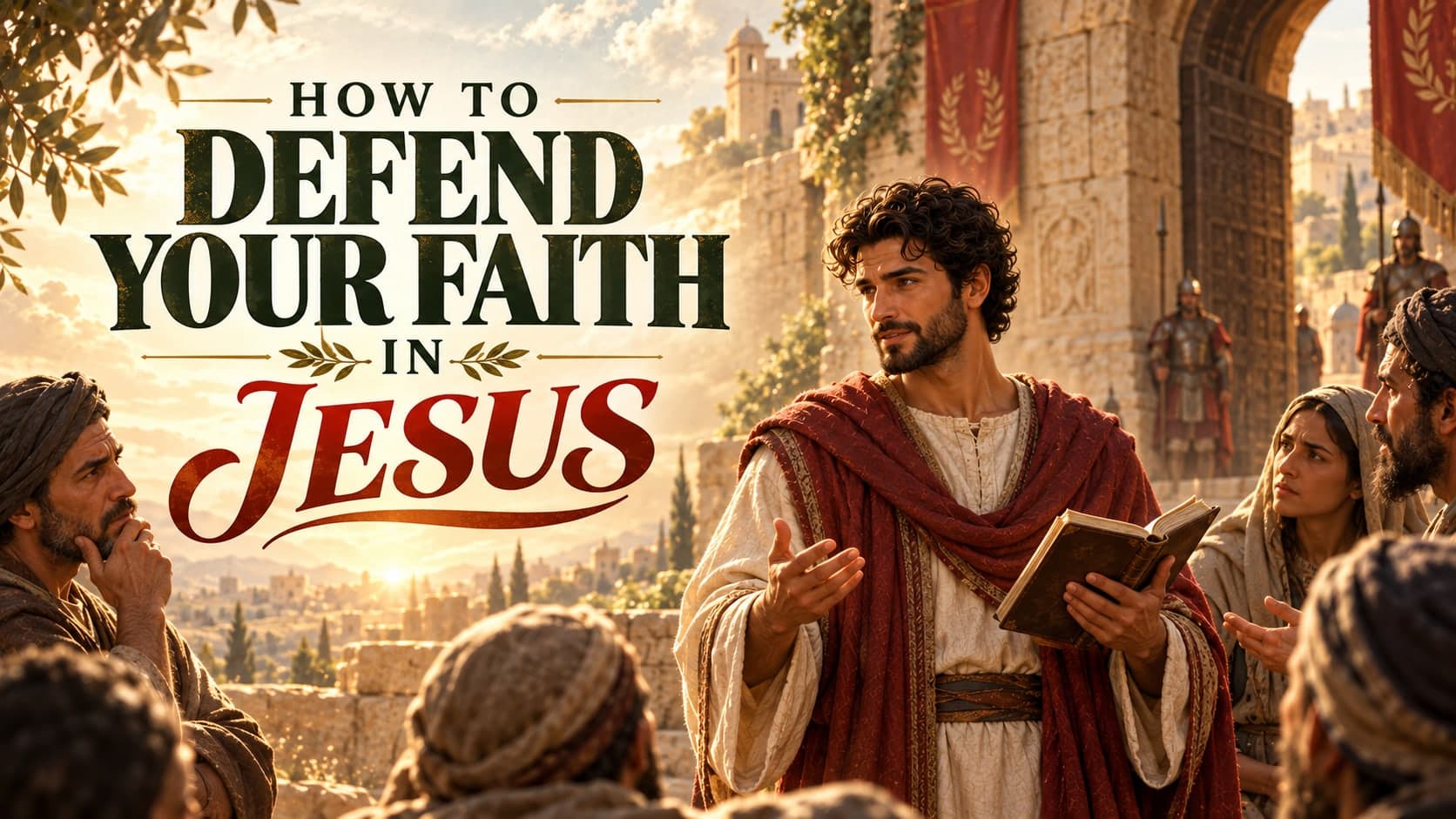
📖 How to Defend Your Faith in Jesus
📌 Most Christians can't explain why.
If someone stopped you today and asked, "Why do you believe in Jesus?", what would you say?
Most Christians answer "Because I just believe."
Or "Because I have faith."
That is not wrong. But it does not go deep enough.
The Bible tells us to be ready with a clear answer.
Faith is not blind. It is built on truth.
And if you can understand the foundation of that truth, you can explain your faith with confidence.
Maybe someone at work has asked you a hard question and you froze.
You believed every word of your answer. You just could not find it fast enough.
Maybe a family member calls your faith naive. A crutch. Something you needed once.
And you nodded along, because you did not have a better response ready.
Maybe you have never been asked at all, and that is exactly what worries you.
What happens the first time someone actually pushes back?
You want to be ready. You just do not know where to start.
This guide will show you how to defend your faith in Jesus, starting from the one piece of evidence the whole thing stands on.
Not a debate trick. Not a clever comeback.
An actual answer, built on actual history, that you can carry into any conversation.
The same answer the disciples themselves staked their lives on.
Get a cup of coffee. Take a breath.
Let's walk through what God's Word actually says.
Why This Matters for Your Faith
You do not need to win a debate to be a faithful Christian.
But you do need to know why you believe what you believe.
📌 Because the world is not going to stop asking.
Coworkers ask. Kids ask. Your own doubts ask, usually at the worst possible hour of the night.
If you have no answer ready, doubt gets to speak first, and doubt is a persuasive speaker.
This is bigger than winning an argument. This is about your own confidence in the God you have given your whole life to.
A shaky foundation makes for a shaky faith. Learning how to defend the Bible itself and how to defend your faith in Jesus go hand in hand.
Paul told Timothy to know whom he had believed, not just what he had believed.
That is the difference between a faith that can be shaken and one that cannot.
Think about what actually happens when a hard question catches you flat footed.
You do not just lose the conversation. Something in you quietly starts to wonder too.
⚠️ Unanswered questions do not stay quiet. They grow.
That is not a risk you have to keep taking.
And it is not only about you. Somebody in your life is watching how you handle their hardest questions about God.
A shrug or a defensive reaction tells them the questions are too dangerous to ask. A calm, honest answer tells them the opposite: that faith can survive their honest doubt.
That could be your child. Your spouse. A friend who left the church years ago and is quietly wondering if there was ever anything real underneath it.
The stakes are not just winning a conversation.
📌 The stakes are whether you can stand firm when your faith gets tested.
This guide is about making sure you can.

How to Actually Defend Your Faith in Jesus
You do not need a hundred arguments memorized.
You need one, understood well.
Everything here builds toward the resurrection, because everything in Christianity actually does. Get this one right and the rest of your faith has somewhere solid to stand.
1. Be Ready to Give an Answer
Start here, because this is where the Bible starts.
"But sanctify the Lord God in your hearts: and be ready always to give an answer to every man that asketh you a reason of the hope that is in you with meekness and fear:"
That one verse carries six commands, and every one of them matters.
- 🟢 Be prepared to give an answer.
- 🟢 Know what you believe, and know why you believe it.
- 🟢 Speak with gentleness and respect.
- 🟢 It is not about winning arguments.
- 🟢 It is about pointing people to Jesus.
- 🟢 Know where your hope comes from.
Look at those six things again, slowly.
Three of them are about the answer itself. Be prepared. Know what you believe. Know where your hope comes from.
The other three are about how you deliver it. Speak with gentleness and respect. It is not about winning. It is about pointing to Jesus.
📌 A right answer delivered wrong still misses the point of the verse.
Notice what Peter does not say.
He does not say crush every objection. He does not say prove them wrong.
⚠️ He says give an answer, with meekness and fear.
The goal was never to win. The goal was always to point to the reason for the hope inside you.
Look at where Peter puts that command. Right after telling believers how to respond when they suffer for doing right.
He is not writing to comfortable people with time for theology debates.
He is writing to people under pressure, and he still tells them to be ready.
💡 That tells you something. Readiness is not for the easy seasons.
It is for exactly the moments you feel least prepared for one.
2. Why Christianity Is Different From Blind Faith
Most people think faith is wishful thinking.
Believing something because it feels nice.
Closing your eyes and hoping hard enough.
But our faith is grounded in real history. Real events. Real people.
📌 We do not believe just because we believe.
We believe because something actually happened.
Something that changed everything.
And that is where apologetics starts, right alongside knowing what the Bible actually is and where it came from.
Other worldviews ask you to feel something and call it truth. Christianity asks you to look at what happened in a specific place, at a specific time, in front of specific people.
📖 Luke, a doctor writing to an official named Theophilus, said he had traced everything carefully from the beginning.
He was not writing a fable. He was writing a report.
That is not how you build a myth. That is how you build a case.
And a case can be examined. You can ask when it was written. You can ask who wrote it. You can ask whether the people named in it actually lived.
📌 Blind faith cannot survive that kind of scrutiny. Biblical faith invites it.
That is not a weakness in Christianity. It is one of the strongest things about it.
3. Everything Starts With the Resurrection
If you want one clear defense of your faith, start here.
"And if Christ be not risen, then is our preaching vain, and your faith is also vain."
Paul is not hedging in that verse. He is staking everything on one claim.
💡 If the resurrection did not happen, Christianity falls apart.
If it did happen, Jesus is who He said He is. The Son of God. The Savior of the world.
This is why the resurrection is not one doctrine among many. It is the hinge everything else swings on.
Paul says it again a few verses later, from a different angle.
"And if Christ be not raised, your faith is vain; ye are yet in your sins."
Not raised, still in your sins. Raised, forgiven and free.
📌 There is no middle position here. Paul refuses to give you one.
That is actually good news for someone trying to defend their faith. You are not defending a feeling. You are defending a claim that can be tested.
A claim you cannot test is a claim you can only feel your way toward. A claim you can test is a claim you can actually defend.
So the question worth asking is simple.
❓ What is the actual evidence that it happened?
4. It Was Seen by More Than 500 Witnesses
Here is the first piece of evidence, and it is a big one.
"After that, he was seen of above five hundred brethren at once; of whom the greater part remain unto this present, but some are fallen asleep."
Over 500 people witnessed Jesus alive after the crucifixion.
Think about that in courtroom terms. Today, the testimony of one or two witnesses can put someone in prison for life.
Now imagine 500 eyewitnesses confirming the same event.
📌 That is not just faith. That is evidence rooted in history.
And Paul does something bold in that verse. He says most of those witnesses are still alive. He is telling the Corinthians, in effect, go ask them yourself.
You do not say that about a story you made up.
You do not hand your reader a list of names and dates for a lie, knowing full well some of them could walk over and check.
💡 An invented story shrinks the witness list. A true one can afford to grow it.
And this was not a private vision seen by one grieving follower. It was a crowd, seeing the same risen man, at the same time, in broad daylight.
Five hundred people do not share the exact same hallucination at the exact same moment. Grief plays tricks on one mind at a time, not on a crowd all at once.
❓ Could it have been a vision? A trick of grief playing on their minds?
Look at what happened when Jesus appeared to the disciples in Jerusalem.
"Behold my hands and my feet, that it is I myself: handle me, and see; for a spirit hath not flesh and bones, as ye see me have."
He did not just let them look. He told them to touch Him.
Then He asked for something to eat, and ate a piece of broiled fish in front of them.
💡 A vision does not eat breakfast. A ghost does not have hands you can hold.
Whatever the disciples experienced, it was not a feeling in their hearts. It was a body they could see, touch, and watch eat a meal.
5. The First Witnesses Were Women
This detail is easy to skip past. Do not skip past it.
It is small enough to miss on a fast read, and important enough to change how you see the whole account once you notice it.
"In the end of the sabbath, as it began to dawn toward the first day of the week, came Mary Magdalene and the other Mary to see the sepulchre."
In the first century, a woman's testimony was not considered valid in court.
Jewish writers of that era said plainly that women were not accepted as reliable witnesses in a legal case.
So if the disciples were inventing this story, they made a strange choice. They made women the first witnesses.
If you were fabricating the greatest claim in history and wanted it believed, you would put your most credible witnesses first. Peter. John. One of the men.
Instead, all four gospels agree. Women got there first.
That is exactly what the text says happened.
"And as they went to tell his disciples, behold, Jesus met them, saying, All hail. And they came and held him by the feet, and worshipped him. Then said Jesus unto them, Be not afraid: go tell my brethren that they go into Galilee, and there shall they see me."
❓ Why would you write it this way if you were trying to make the story more believable to your own culture?
You would not.
💡 The only reason to write it this way is because it is what actually happened.
The gospel writers were not trying to make the resurrection more convincing. They were just telling you who got there first.
Historians actually have a name for this kind of detail. It embarrasses the very people telling the story, or works against their own case, and that is exactly why it is so hard to explain away as an invention.
A made up story gets edited until it sounds better. This detail never got edited out.
📌 The women stayed the first witnesses in every single gospel account.
6. They Ran, Then They Died for It
Watch what happens to the same group of men across a few days.
When Jesus was arrested, the disciples ran in fear.
Peter, the boldest of them, denied even knowing Jesus. Three times.
These were not brave men in that moment. They were terrified men.
Then something changes.
After the resurrection, those same men boldly preached Jesus, even when it could cost them their lives.
⚠️ People can die for something they believe is true.
But they do not willingly die for something they know they made up.
These men did not just believe. They claimed they had seen the risen Jesus, with their own eyes.
Peter, who folded under pressure from a servant girl by a fire, later stood before the same council that condemned Jesus and refused to stop preaching.
James, the brother of Jesus, did not even believe in Him during His ministry. He became a leader of the Jerusalem church after he claimed to see his risen brother alive.
Think about that from the inside. James grew up in the same house as Jesus, and he still did not believe until something changed his mind completely.
Something turned frightened men into fearless witnesses.
📌 A lie does not do that to a person.
People will die defending something they sincerely believe. History is full of that.
📌 But people do not willingly die defending something they personally invented, and gained nothing from but suffering.
The same men who once ran in fear now stood in front of the people who could kill them, and did not run again.
7. The Resurrection Changes Everything
Put it all together and the resurrection changes everything.
If Jesus rose, He is who He claimed to be.
"Jesus saith unto him, I am the way, the truth, and the life: no man cometh unto the Father, but by me."
He really is the only way to God.
Forgiveness of sins is real.
Eternal life is real.
💡 Our hope is not in vain.
Walk back through the whole chain for a second. Over 500 people saw Him. Women, whose word carried no legal weight, were trusted to tell it first. And the men who ran in terror on Friday were preaching boldly by Sunday, with nothing to gain and everything to lose.
Each one of those facts is strange on its own.
Together, they point at one explanation. It actually happened.
People have offered other explanations across the centuries. That the disciples stole the body. That they saw a shared hallucination. That the whole thing was legend.
Every one of those has to explain away the empty tomb, the hundreds of witnesses, and the willingness of ordinary men to die rather than deny what they had seen.
💡 The simplest explanation is still the one Scripture gives you. He is risen.
So when people ask why you believe in Jesus, you have a real answer, because the resurrection is true.

Practical Tips: How to Defend Your Faith Today
Defending your faith is not about memorizing a debate script.
It is about becoming a person who knows what they believe and why.
None of the eight tips below are complicated. What they require is consistency, the same way strength comes from small repeated effort rather than one big push.
Here are eight ways to start today.
- Learn the resurrection evidence cold. The 500 witnesses, the women at the tomb, and the disciples' transformation. You do not need a seminary degree. You need these three facts down well enough to explain them in your own words, not recite them like a script.
- Memorize 1 Peter 3:15. It is your job description. Be ready. Know why. Speak with gentleness and respect. Say it enough times that it becomes how you approach every hard question, not just a verse you can quote when asked.
- Ask questions before you answer them. "What makes you say that?" often opens more doors than a quick rebuttal ever will. You usually learn what the real question underneath the question actually is, and people open up more when they feel heard first.
- Stay gentle when you feel challenged. The moment a conversation turns into a fight, you have already lost the thing that mattered most: the person in front of you. Meekness is not weakness. It is strength held with an open hand, the same posture Jesus took with a doubting Thomas.
- Admit what you do not know. You do not have to answer every question on the spot. "I do not know, but I will find out" is an honest and respectable answer, and it keeps the door open for another conversation later.
- Read your Bible, not just books about your Bible. Secondhand confidence runs out fast. Firsthand confidence comes from spending time in the text yourself.
- Practice out loud. Say your answer to a friend before you ever need it with a stranger. It sounds different once it leaves your mouth, and the practice takes the panic out of the real moment.
- Remember the goal. The goal is never to win the argument. The goal is to point to Jesus. Keep that in front of you every single time, especially when the conversation gets tense.
None of these require you to be a scholar.
They just require you to actually know what you believe.
Pick two to start. Not all eight.
Build from there, the same way you would build any other habit worth keeping. Slowly, and on purpose.
Top 5 Bible Verses About Defending Your Faith
Keep these five close. Every one of them earns its place in this list.
1. 1 Peter 3:15
"But sanctify the Lord God in your hearts: and be ready always to give an answer to every man that asketh you a reason of the hope that is in you with meekness and fear:"
This is the command that starts it all.
Not be ready to argue. Be ready to give an answer, and to give it gently. If you memorize one verse from this whole guide, make it this one.
Peter wrote it to Christians facing real persecution, not to people debating for sport. It was never meant to be theoretical.
He wanted ordinary believers, not scholars, to be able to give this answer, because he knew most of the people asking would never sit down with a scholar at all.
2. 1 Corinthians 15:3 and 4
"For I delivered unto you first of all that which I also received, how that Christ died for our sins according to the scriptures; And that he was buried, and that he rose again the third day according to the scriptures:"
Paul calls this the gospel he received and passed on. Scholars date this creed to within just a few years of the resurrection itself.
This is not a legend that grew over centuries. It was the earliest belief there was.
Notice the phrase "according to the scriptures." Paul is not inventing a new idea. He is pointing back to what the Hebrew Scriptures already promised.
This short creed likely predates Paul's own letter by years, passed down almost certainly within the first few years after the crucifixion itself.
3. John 14:6
"Jesus saith unto him, I am the way, the truth, and the life: no man cometh unto the Father, but by me."
Jesus did not present Himself as one good teacher among many.
He claimed to be the way. That claim is either true, or it is not a minor claim at all.
A merely good teacher does not say no one comes to the Father except through him. That leaves you only two honest options, not a comfortable third one.
Either He is exactly who He claimed to be, or His claim was so large that good teacher stops being an available category at all.
4. Acts 4:12
"Neither is there salvation in any other: for there is none other name under heaven given among men, whereby we must be saved."
Peter said this to the same religious leaders who had Jesus crucified weeks before.
The man who denied Jesus three times out of fear was now standing in front of the same council that had just crucified his Lord, saying it plainly. That change in Peter is itself a piece of evidence.
He was not reciting a rehearsed line. He was answering a real threat with a settled conviction, because he had seen the risen Jesus with his own eyes. The council could threaten him, jail him, even kill him. They could not make him unsee what he had seen.
5. Romans 10:9
"That if thou shalt confess with thy mouth the Lord Jesus, and shalt believe in thine heart that God hath raised him from the dead, thou shalt be saved."
Notice what saving faith is tied to here. Not a feeling. A historical claim.
That God raised Jesus from the dead. Defending your faith and having saving faith run through the exact same door. You cannot separate the gospel from the historical claim underneath it, and Paul never tries to.
Which means every time you explain the resurrection evidence to someone else, you are not just winning an argument. You are handing them the very thing Scripture says they need to believe.

Frequently Asked Questions About Defending Your Faith
What is Christian apologetics?
Apologetics is the practice of giving reasoned answers for the Christian faith. The word comes from the Greek apologia, meaning a defense, the same word used in 1 Peter 3:15. It is not about being sorry for your beliefs. It is about being ready to explain them. You do not need a degree in it. You just need to know the reasons behind the hope you already carry. Anyone who has ever explained why they trust a good friend has already done a simple version of apologetics without realizing it.
Isn't faith supposed to be blind?
No. Biblical faith is trust placed in a God who has already shown Himself trustworthy through real events, especially the resurrection. It is not a leap in the dark. It is confidence built on evidence, then lived out even when you cannot see every step ahead. A husband trusting his wife after years of faithfulness is not blind either. It is trust earned by a track record, and Scripture gives you exactly that kind of record. The next time someone calls your faith blind, ask them what they mean, and then show them the evidence instead of just disagreeing.
What is the single best piece of evidence for Christianity?
The resurrection of Jesus. Paul said if it did not happen, the whole faith is worthless. It is also the best attested, with over 500 eyewitnesses, women as the first witnesses, and disciples who died for what they claimed to have seen. Almost every other question about Christianity, from miracles to the reliability of Scripture, becomes easier to answer once this one is settled first. Start every conversation there, even if the other person's question was about something else entirely.
What if I do not know how to answer a hard question?
Say so. "I do not know, but I will find out" is an honest answer that builds trust instead of losing it. Nobody expects you to have every answer memorized. They do expect honesty. Then actually go find the answer, and come back to the conversation. That follow through says more than a perfect answer on the spot ever could.
Can I defend my faith without being confrontational?
Yes, and 1 Peter 3:15 requires it. The verse pairs be ready with meekness and fear in the same breath. A defense that wins the argument but wounds the person has missed the point of the verse it is quoting. Jesus never once shamed a doubter, and neither should you when you are speaking for Him.
Why does it matter that the first witnesses were women?
Because in first century culture, a woman's testimony held little weight in court. If the disciples had invented the resurrection story, making women the first witnesses would have been a strange choice. The detail only makes sense if it is simply what happened. Historians treat a detail that works against the storyteller's own interest as one of the strongest signs that a story is telling the truth.
Did the disciples really die for their faith?
Church history and early sources outside Scripture record that most of the apostles faced persecution and martyrdom for continuing to preach the resurrection. People will die for something they sincerely believe is true. They do not willingly die for something they know they invented. Every single one of them had the easy option of recanting and walking away. None of them took it.
How do I start learning to defend my faith?
Start with the resurrection evidence in this guide, memorize 1 Peter 3:15, and read your Bible for yourself rather than only reading about it. Confidence grows from time spent in the text, not from a single article. Give yourself permission to grow into this slowly. Nobody becomes ready overnight, and you are not behind.
What do I say if someone says Christianity is just a copy of older myths?
Ask them for the specific parallel and check it. Most claimed parallels fall apart under a close look, and the earliest Christian creed in 1 Corinthians 15:3 and 4 dates to within a few years of the crucifixion, far too soon to be a borrowed legend. A myth usually takes generations to form. This claim was already being preached while eyewitnesses were still alive to contradict it.
Is it okay to have doubts while I learn to defend my faith?
Yes. Thomas doubted and Jesus met him with evidence, not shame. Wrestling with hard questions is often what leads to a stronger, more thought through faith than one that never got tested at all. A faith that has never asked a hard question tends to break the first time one shows up uninvited, and it is the same honest wrestling behind questions about assurance and salvation.
Do I need to be a scholar to defend my faith?
No. Peter and John were called unlearned and ignorant men by the religious leaders of their day, and it was obvious to everyone that they had been with Jesus. Knowing the resurrection evidence in this guide, and being able to explain it plainly, is enough for almost every conversation you will actually have.
Final Thoughts
If you remember nothing else from this guide, remember these three things.
📌 Be ready to give an answer, with gentleness and respect. That is the command of 1 Peter 3:15, and it is the whole posture of defending your faith. Knowing the answer matters. Delivering it with love matters just as much.
📌 The resurrection is the hinge everything swings on. Over 500 witnesses. Women as the first ones there. A body that could be touched and that ate a meal. Frightened men who became fearless witnesses. That is not just faith. That is evidence rooted in history.
📌 If Jesus rose, He is who He said He is. The way, the truth, and the life. Forgiveness is real. Eternal life is real. Your hope is not in vain, and neither is the confidence you are building right now.
Understanding Scripture and learning to defend your faith in Jesus grow together, one page at a time.
You do not need to become a debater overnight.
You just need to become someone who actually knows the case for what they believe.
So here is your one next step.
Pick one piece of evidence from this guide. Just one.
Learn it well enough to explain it to a friend this week.
The disciples went from hiding in fear to preaching boldly in public because of what they had seen. The same truth that changed them is still true today, and it is still able to steady whatever keeps you from speaking up.
You do not need to know everything.
You just need to know enough to point someone to Jesus.
The next time someone asks why you believe, you will not have to reach for "I just do."
You will have an answer, and you will have it ready, with gentleness and respect.