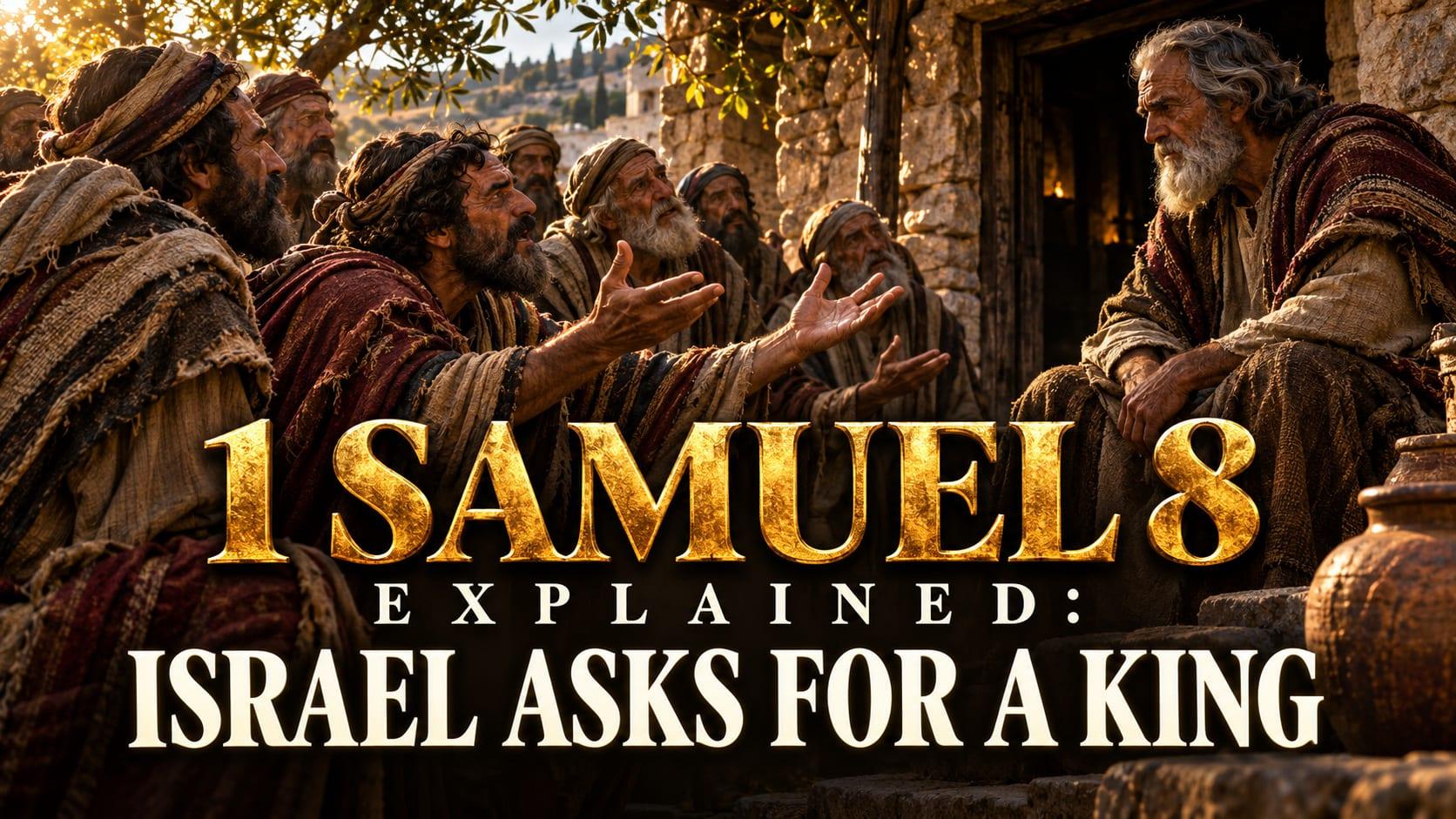
📖 1 Samuel 8 Explained: Israel Asks for a King Like the Nations
Samuel is old now, and his own sons turn out to be exactly the kind of judges Israel was supposed to be rescued from.
So the elders do not ask God to fix the problem. They ask for a whole new system.
1 Samuel 8 explained is the chapter where Israel stops bringing its broken leadership to the LORD and starts asking for the thing every surrounding nation already has. Samuel is hurt. God is not surprised. And what gets granted here will shape the rest of this book, and the next several books after it.
Maybe you have tried to solve a trust problem by changing the structure around it instead of dealing with what actually broke the trust.
- ❓ Why did Samuel let his own sons become judges in the first place?
- ❓ What does it mean that Israel wanted to be "like all the nations"?
- ❓ Is wanting a king the same thing as rejecting God?
- ❓ Why does God tell Samuel to give the people exactly what they are asking for?
📌 God does not call this request a request for a king. He calls it a rejection of Himself.
Here is the whole chapter, in order: Samuel's corrupt sons, the elders' demand at Ramah, God's diagnosis of what is really happening, Samuel's long warning about what a king will cost, the people's flat refusal to listen, and God handing them exactly what they asked for.
What Happened Just Before This Chapter
1 Samuel 7 ended on the most settled note this book has struck yet. Israel had put away its idols, confessed its sin at Mizpeh, and watched God win a battle with thunder instead of a sword. Samuel set up a stone called Ebenezer to remember it, then spent years riding a steady circuit between Bethel, Gilgal, and Mizpeh, always returning home to Ramah, where he had built his own altar and judged Israel in peace.
1 Samuel 8 explained picks up years later, with that same Samuel now old, and with a problem the previous chapter never had to face. The man who held this whole system together is running out of time, and the people he raised to carry it forward are not carrying it the way he did.

1 Samuel 8 Explained Verse by Verse
1. Samuel's Sons, and Why the Elders Came to Ramah (verses 1 to 5)
The chapter opens with a simple fact that explains everything that follows it.
"And it came to pass, when Samuel was old, that he made his sons judges over Israel."
"Now the name of his firstborn was Joel; and the name of his second, Abiah: they were judges in Beersheba."
Beersheba sat at the far southern edge of Israel's territory, a long way from Samuel's own base in Ramah. Putting Joel and Abiah in charge there meant Samuel could not watch over their work closely, and the text makes clear that mattered.
"And his sons walked not in his ways, but turned aside after lucre, and took bribes, and perverted judgment."
⚠️ Lucre means dishonest profit, gain chased without caring how it is gotten. Joel and Abiah did not simply disappoint their father. They sold justice to whoever paid for it, the exact failure Israel's law condemned by name.
This is not the first time in this book that a godly father's sons have gone bad. Eli's sons Hophni and Phinehas corrupted the priesthood at Shiloh, and now Samuel's own sons corrupt the judgeship at Beersheba. The elders have watched this pattern before, and they are done waiting to see if it repeats a third time.
"Then all the elders of Israel gathered themselves together, and came to Samuel unto Ramah,"
"And said unto him, Behold, thou art old, and thy sons walk not in thy ways: now make us a king to judge us like all the nations."
📌 Notice what the elders diagnose, and what they prescribe for it. The diagnosis is accurate. Samuel is old, and his sons are corrupt. The prescription does not follow from it at all. A corrupt judge does not require a king. It requires a better judge, or better accountability, or God raising up someone faithful the way He always had before.
The phrase "like all the nations" is the real request hiding underneath the complaint about Samuel's sons. It shows up twice in this chapter, and both times it names the actual want: not justice restored, but a system that looks like everyone else's.
2. God's Diagnosis: Not Rejecting Samuel, Rejecting God (verses 6 to 9)
Samuel takes the request personally at first, and understandably so.
"But the thing displeased Samuel, when they said, Give us a king to judge us. And Samuel prayed unto the LORD."
He does not argue with the elders directly. He takes the hurt to God first, which is its own quiet lesson sitting underneath the louder one in this chapter. Then comes God's answer, and it reframes the whole request before Samuel has a chance to.
"And the LORD said unto Samuel, Hearken unto the voice of the people in all that they say unto thee: for they have not rejected thee, but they have rejected me, that I should not reign over them."
📌 God corrects Samuel's read of his own pain. This was never really about Samuel. Israel is not firing a disappointing judge. It is stepping away from being ruled directly by the LORD, the arrangement every judge from Gideon onward had actually served under.
Gideon himself had turned down exactly this offer, generations earlier, in words that make the contrast with this chapter sharp:
"Then the men of Israel said unto Gideon, Rule thou over us, both thou, and thy son, and thy son's son also: for thou hast delivered us from the hand of Midian."
"And Gideon said unto them, I will not rule over you, neither shall my son rule over you: the LORD shall rule over you."
💡 Gideon was offered a crown after winning a war, and refused it on exactly the principle Israel abandons here. The LORD was already their king. 1 Samuel 8 is the generation that stops being satisfied with that answer.
God then widens the lens past this one request, to the whole pattern behind it:
"According to all the works which they have done since the day that I brought them up out of Egypt even unto this day, wherewith they have forsaken me, and served other gods, so do they also unto thee."
"Now therefore hearken unto their voice: howbeit yet protest solemnly unto them, and shew them the manner of the king that shall reign over them."
God does not refuse the request. He tells Samuel to grant it, but only after warning the people plainly what it will actually cost them. Permission is given. A full account of the price comes first.

3. The Manner of the King: Six Times "He Will Take" (verses 10 to 18)
Samuel delivers the warning in full, and it is longer, and more specific, than anything the elders asked for.
"And Samuel told all the words of the LORD unto the people that asked of him a king."
"And he said, This will be the manner of the king that shall reign over you: He will take your sons, and appoint them for himself, for his chariots, and to be his horsemen; and some shall run before his chariots."
"And he will appoint him captains over thousands, and captains over fifties; and will set them to ear his ground, and to reap his harvest, and to make his instruments of war, and instruments of his chariots."
To ear his ground is an old way of saying to plow it. The sons a family once raised for its own fields and its own future would belong to the king's war machine instead.
"And he will take your daughters to be confectionaries, and to be cooks, and to be bakers."
"And he will take your fields, and your vineyards, and your oliveyards, even the best of them, and give them to his servants."
"And he will take the tenth of your seed, and of your vineyards, and give to his officers, and to his servants."
"And he will take your menservants, and your maidservants, and your goodliest young men, and your asses, and put them to his work."
"He will take the tenth of your sheep: and ye shall be his servants."
📌 "He will take" is the drumbeat of this whole warning, repeated six times across eight verses. Sons, daughters, fields, a tenth of the harvest, servants, a tenth of the flocks. Nothing here is theoretical. Samuel names exactly what a king costs a household, one line at a time, until the list itself becomes the argument.
Confectionaries did not mean candy makers. It meant women trained to prepare perfumes and ointments, pulled out of their own families to staff a palace. The tenth Samuel names twice, once on seed and once on flocks, is the same portion the law had always asked Israel to give the LORD. A king, Samuel is saying, will charge the same tithe a household already owed to God, and keep it for himself.
Then the warning ends on the hardest line in it.
"And ye shall cry out in that day because of your king which ye shall have chosen you; and the LORD will not hear you in that day."
⚠️ This is not a threat that God will stop listening in general. It is a specific warning about this specific complaint. A request this well informed, made with eyes fully open, cannot later be undone by crying about the very thing that was asked for and explained in advance.
4. The People Refuse to Listen (verses 19 and 20)
Samuel finishes the entire warning, and nothing in it changes a single mind.
"Nevertheless the people refused to obey the voice of Samuel; and they said, Nay; but we will have a king over us;"
"That we also may be like all the nations; and that our king may judge us, and go out before us, and fight our battles."
📌 "Like all the nations" returns, word for word, from verse 5. Six verses of specific, detailed cost have changed nothing about what the people actually want. They are not disputing a single item on Samuel's list. They are restating the same wish that started the chapter, now with the price tag fully in view.
Notice the last clause too. "Go out before us, and fight our battles" is the job the LORD had been doing for Israel through every judge in this book so far, including the thunder that broke the Philistines without Israel swinging a sword in 1 Samuel 7. The people are not only asking for a king. They are asking to trade God's fighting for a man's.

5. God Gives Them What They Asked For (verses 21 and 22)
Samuel does not argue a second time. He takes the answer back to the only place he took the first hurt.
"And Samuel heard all the words of the people, and he rehearsed them in the ears of the LORD."
"And the LORD said to Samuel, Hearken unto their voice, and make them a king. And Samuel said unto the men of Israel, Go ye every man unto his city."
💡 The chapter ends without a king actually chosen yet. God grants the request in principle, then sends everyone home. The man who will wear the crown has not even been introduced. He is still out looking for his father's lost donkeys, in a story the very next chapter is about to tell.
Hard Questions 1 Samuel 8 Raises
If Deuteronomy already allowed Israel to have a king, how can asking for one be a rejection of God? What the text says: verse 7 calls the request a rejection of the LORD's reign, with no exception noted for kingship itself. How this is read: Moses had already given Israel instructions for a future king long before Samuel was born.
"When thou art come unto the land which the LORD thy God giveth thee, and shalt possess it, and shalt dwell therein, and shalt say, I will set a king over me, like as all the nations that are about me;"
"Thou shalt in any wise set him king over thee, whom the LORD thy God shall choose: one from among thy brethren shalt thou set king over thee: thou mayest not set a stranger over thee, which is not thy brother."
A king was never forbidden. Deuteronomy 17 even names the exact phrase, "like as all the nations that are about me," years ahead of this chapter using it. What God objects to in 1 Samuel 8 is not the office. It is the motive and the timing. Israel does not ask because God told them it was time. They ask out of panic over Samuel's sons, wanting a human guarantee instead of trusting the LORD to raise up someone faithful the way He always had.
Why did Samuel put his own sons in charge if he knew how badly Eli's sons had turned out? What the text says: verse 1 reports the appointment without explaining Samuel's reasoning. How this is read: the text does not excuse him. It simply leaves the question sitting there, the same way it leaves Eli's failure with his own sons sitting unexplained earlier in this book. Good men raising disappointing children is treated here as a real cost of leadership, not a problem Samuel is shown solving well.
Does verse 18 mean God permanently stopped listening to Israel after this? What the text says: the warning is bound to "in that day," tied to the specific complaint Samuel is predicting, not a blanket statement about every future prayer. How this is read: later chapters show God still hearing and answering Israel plenty of times after a king is crowned. The warning is about the uselessness of complaining about a cost that was explained in full before anyone agreed to it.
Is wanting structure and leadership always the same sin on display here? What the text says: the chapter never condemns leadership itself, since judges, priests, and now a promised king are all part of God's own design for Israel. How this is read: the sin this chapter names is specific. It is reaching for a human system as a substitute for trusting God, not the simple fact of wanting order or accountability.

Top Verses From 1 Samuel 8
1. 1 Samuel 8:7
"And the LORD said unto Samuel, Hearken unto the voice of the people in all that they say unto thee: for they have not rejected thee, but they have rejected me, that I should not reign over them."
God reframes Samuel's hurt before Samuel can process it himself. The real wound in this chapter was never aimed at a man.
2. 1 Samuel 8:11
"And he said, This will be the manner of the king that shall reign over you: He will take your sons, and appoint them for himself, for his chariots, and to be his horsemen; and some shall run before his chariots."
The first of six times this chapter uses the word take to describe what a king will cost a household that asked for one.
3. 1 Samuel 8:18
"And ye shall cry out in that day because of your king which ye shall have chosen you; and the LORD will not hear you in that day."
A warning spoken plainly, in advance, to people about to choose this outcome with their eyes fully open.
4. 1 Samuel 8:19 and 20
"Nevertheless the people refused to obey the voice of Samuel; and they said, Nay; but we will have a king over us; That we also may be like all the nations; and that our king may judge us, and go out before us, and fight our battles."
The same wish from verse 5, repeated word for word, after a full accounting of its price. Nothing about the warning changed what the people wanted.
Frequently Asked Questions About 1 Samuel 8
What happened in 1 Samuel 8?
Samuel grew old and appointed his sons Joel and Abiah as judges, but they took bribes and perverted justice. The elders of Israel came to Samuel at Ramah and demanded a king like the surrounding nations. God told Samuel the request was really a rejection of His own rule, had Samuel warn the people in detail what a king would cost them, and then told him to grant the request anyway.
Why did Israel want a king?
The elders pointed to Samuel's age and his corrupt sons as the reason, but their own words in verses 5 and 20 name the deeper want twice: to be like all the other nations, with a human king to judge them and fight their battles instead of the LORD.
Was it sinful for Israel to want a king?
Having a king was not itself forbidden. Deuteronomy 17 had already given instructions for one. What God calls sinful here is the motive behind this particular request, reaching for a human system out of panic and a wish to match other nations instead of trusting the LORD to keep leading them.
Who were Samuel's sons Joel and Abiah?
They were the judges Samuel appointed over Beersheba in his old age. Verse 3 says they turned aside after dishonest profit and took bribes, perverting the justice they were supposed to protect, which is the immediate reason the elders give for wanting a different system entirely.
What does "like all the nations" mean in 1 Samuel 8?
It is the phrase Israel uses twice, in verses 5 and 20, to describe the kind of leadership it wants. It names the real request underneath the complaint about Samuel's sons: not better justice, but a government that looks like the ones surrounding Israel already had.
What is the manner of the king Samuel describes?
It is Samuel's detailed warning in verses 11 through 17 of exactly what a king will take from the people who crown him: sons for his army, daughters for his household, fields, a tenth of their crops and flocks, and servants for his own work, ending with the plain statement that the people themselves will become his servants.
Why did God let Israel have a king if the request displeased Him?
Verse 9 has God telling Samuel to warn the people plainly and then grant the request anyway. God does not force Israel to want Him as king. He lets them choose, after making sure the cost of their choice could never honestly be called a surprise later.
How does 1 Samuel 8 connect to Gideon in Judges?
Judges 8 records Israel offering Gideon a hereditary crown after a great victory, and Gideon refusing it outright, saying the LORD alone would rule over them. 1 Samuel 8 is the generation that stops accepting that answer and asks for exactly what Gideon turned down.
What happens right after 1 Samuel 8?
The chapter ends with the request granted in principle but no king chosen yet. The very next chapter introduces the man who will fill that role, found first through an ordinary errand that has nothing to do with a throne.
Does 1 Samuel 8 mean leadership structures are always a rejection of God?
No. Judges, priests, and eventually kings were all part of how God led Israel across the Old Testament. The chapter targets one specific failure, trading trust in God for a human guarantee out of fear, not the existence of leadership itself.
Final Thoughts
1 Samuel 8 is a quiet chapter compared to the ark narrative before it, and it may matter more than any of them.
📌 What looks like a complaint about leadership can really be a rejection of who is actually leading. God saw past Samuel's sons to the deeper want Israel was voicing underneath them.
📌 A full warning does not guarantee a changed mind. Samuel told the people exactly what a king would take, item by item, and they asked for him anyway, in the very same words they started with.
The chapter ends with permission given but no king yet chosen. Israel will not stay in that waiting room for long.
So here is your one next step.
Name one place in your own life where you have been asking for a different system instead of asking God to keep leading you through the one you already have.