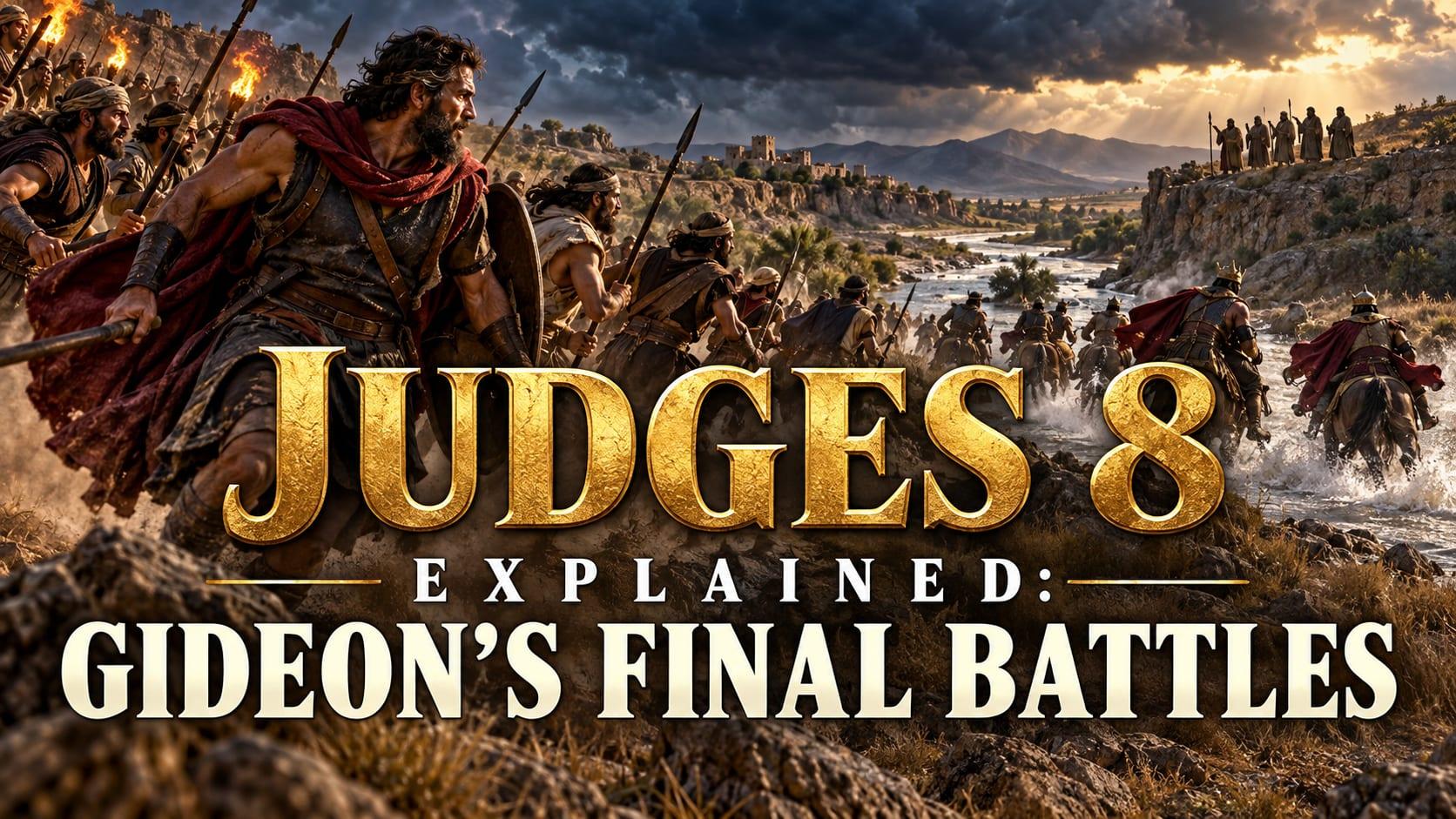
📖 Judges 8 Explained: Gideon Says No to a Crown and Yes to an Idol
Judges 7 ended at the edge of a total, one sided win. Judges 8 is what Gideon does with it, and winning turns out to be the easy part.
Judges 8 explained is the chapter where the hero of the last two chapters starts making choices nobody commanded him to make. He punishes two Israelite towns that would not feed his men. He executes two captured kings with his own hand. He turns down a crown in one verse and melts a fortune in gold into an object his own nation starts worshipping a few verses later.
Maybe you have watched someone handle a crisis well, then struggle with what came right after it, once the adrenaline wore off and the decisions got quieter and more personal.
- ❓ Why does Ephraim get angry at the man who just won the war for everyone?
- ❓ Why does Gideon punish two Israelite towns instead of simply moving past their refusal?
- ❓ If Gideon really believed "the LORD shall rule over you," why did he build an ephod Israel ended up worshipping?
- ❓ Why does Gideon name his own son Abimelech, "my father is king," right after refusing to be king?
📌 Judges 8 is the chapter where defeating an enemy army turns out to be a smaller test than defeating pride, revenge, and an ego that outlives the battle that built it.
This walkthrough goes through the whole chapter in order: Ephraim's complaint, bread refused at two towns, the chase and capture of two Midianite kings, the reckoning Gideon brings home, his famous refusal of a throne, the ephod that undid his own good name, and the quiet, ominous paragraph that sets up everything that goes wrong in the very next chapter.
Thirty five verses, one unfinished war finally finished, and a new kind of trouble already started before the old one is even buried.
What Happened Just Before This Chapter
Judges 7 cut Gideon's army from thirty two thousand down to three hundred, then routed Midian's camp at night with nothing but trumpets, clay pitchers, and hidden lamps. No Israelite swung a sword. The LORD turned the enemy camp against itself in the dark, and the host fled in panic. Naphtali, Asher, and Manasseh joined the chase once the outcome was no longer in doubt, and Gideon called the tribe of Ephraim in specifically to hold the river crossings and cut off the retreat.
That chapter ended mid motion. Ephraim captured and killed two Midianite princes, Oreb and Zeeb, and brought their heads to Gideon across the Jordan. But the two actual kings who commanded the whole invasion, Zebah and Zalmunna, were still alive and still running. Judges 8 opens with the chase not yet over and a complaint already waiting for Gideon before he can even finish it.

Judges 8 Explained Verse by Verse
1. Ephraim's Complaint, and a Soft Answer (verses 1 to 3)
Before Gideon can finish the chase, his own countrymen stop him with a grievance.
"And the men of Ephraim said unto him, Why hast thou served us thus, that thou calledst us not, when thou wentest to fight with the Midianites? And they did chide with him sharply."
💡 Ephraim was never part of Gideon's original muster back in Judges 6, which called Abiezer, Manasseh, Asher, Zebulun, and Naphtali. Ephraim was only brought in afterward to guard the fords and finish a battle Gideon's three hundred had already decided. Even so, they capture two enemy princes and still feel slighted at having missed the main glory. "Chide him sharply" is not a mild word. This is a real confrontation, close to the edge of a civil quarrel, happening while the real enemy kings are still loose.
"And he said unto them, What have I done now in comparison of you? Is not the gleaning of the grapes of Ephraim better than the vintage of Abiezer? God hath delivered into your hands the princes of Midian, Oreb and Zeeb: and what was I able to do in comparison of you? Then their anger was abated toward him, when he had said that."
📌 Gideon answers an insult with deliberate self deflation, not a defense. He compares his own tribe's full grape harvest unfavorably to Ephraim's leftover gleanings, insisting Ephraim's scraps outshine Abiezer's whole crop. It works. The anger that could have split Israel's own army in the middle of a chase cools in two sentences.
That same patience will be nowhere in sight two paragraphs from now, once Gideon reaches two towns of his own people who refuse him far less than Ephraim's pride ever cost him.
2. Bread Refused at Succoth and Penuel (verses 4 to 9)
The chase continues across the Jordan, and the men doing it are running out of strength.
"And Gideon came to Jordan, and passed over, he, and the three hundred men that were with him, faint, yet pursuing them."
💡 These are the same three hundred who stayed alert at the water test in Judges 7, the ones who did not kneel and lose their edge. Days into the chase, worn thin and faint, they are still the ones pursuing. The verse pairs two words on purpose: faint and pursuing. Exhausted does not mean finished.
"And he said unto the men of Succoth, Give, I pray you, loaves of bread unto the people that follow me; for they be faint, and I am pursuing after Zebah and Zalmunna, kings of Midian. And the princes of Succoth said, Are the hands of Zebah and Zalmunna now in thine hand, that we should give bread unto thine army? And Gideon said, Therefore when the LORD hath delivered Zebah and Zalmunna into mine hand, then I will tear your flesh with the thorns of the wilderness and with briers."
⚠️ Succoth and Penuel were not Midianite towns. They were Israelite towns, east of the Jordan in Gilead, Gideon's own countrymen. Their refusal reads as cold calculation more than hatred. Fifteen thousand Midianite soldiers were still out there at this point, and siding openly with the man chasing their kings was a real gamble if that chase failed. Gideon treats the calculation as cowardice and answers it with a threat, not a plea.
"And he went up thence to Penuel, and spake unto them likewise: and the men of Penuel answered him as the men of Succoth had answered him. And he spake also unto the men of Penuel, saying, When I come again in peace, I will break down this tower."
💡 Many Bible teachers connect this Penuel with the same place Jacob named Peniel generations earlier, after wrestling through the night with God Himself. If that is the same spot, the irony is pointed. A place once marked by meeting God's face now turns away God's chosen deliverer at its own gate.

3. Fifteen Thousand Left, and Two Kings Captured (verses 10 to 12)
Only now does the chapter give an actual count of the army that has been described twice already as too large to number.
"Now Zebah and Zalmunna were in Karkor, and their hosts with them, about fifteen thousand men, all that were left of all the hosts of the children of the east: for there fell an hundred and twenty thousand men that drew sword."
📌 A hundred and twenty thousand men already fell, and fifteen thousand were all that remained, out of a host Judges 6 and 7 only ever described as grasshoppers and sand by the sea. Gideon's three hundred, now joined by men from Naphtali, Asher, and Manasseh who rallied once the outcome turned, are still a tiny force next to that number.
"And Gideon went up by the way of them that dwelt in tents on the east of Nobah and Jogbehah, and smote the host: for the host was secure. And when Zebah and Zalmunna fled, he pursued after them, and took the two kings of Midian, Zebah and Zalmunna, and discomfited all the host."
💡 "The host was secure" means the remaining Midianites believed the danger had already passed. The same kind of complacency that let three hundred men surprise an entire camp at night in the last chapter costs this smaller force the same way in daylight. The two kings Judges 7 left alive at its very last verse are finally caught here.
4. Gideon Settles Accounts: Succoth, Penuel, and Two Executed Kings (verses 13 to 21)
With the kings in hand, Gideon turns back toward the two towns that refused him, and the threat from verse 7 is not forgotten.
"And he came unto the men of Succoth, and said, Behold Zebah and Zalmunna, with whom ye did upbraid me, saying, Are the hands of Zebah and Zalmunna now in thine hand, that we should give bread unto thy men that are weary? And he took the elders of the city, and thorns of the wilderness and briers, and with them he taught the men of Succoth."
"And he beat down the tower of Penuel, and slew the men of the city."
⚠️ The text never explains why the two punishments land so differently. Succoth's seventy seven elders are beaten with thorns and briers, exactly as threatened, but they survive. Penuel's tower is torn down and its men are killed outright, even though verse 8 already said Penuel "answered him as the men of Succoth had answered him," meaning the same refusal, word for word. Whatever separated the two outcomes, the chapter simply reports it without defending it.
Only now, with that settled, does Gideon turn to the two kings and reveal why their deaths were never only about the war.
"Then said he unto Zebah and Zalmunna, What manner of men were they whom ye slew at Tabor? And they answered, As thou art, so were they; each one resembled the children of a king. And he said, They were my brethren, even the sons of my mother: as the LORD liveth, if ye had saved them alive, I would not slay you."
📌 Scripture never records the killing of Gideon's brothers at Tabor anywhere else. This single verse is the only place it is mentioned, and it reframes the whole execution. Zebah and Zalmunna are not dying only as defeated enemy kings. They are dying because they killed Gideon's own brothers, and Gideon says plainly that mercy would have gone the other way if they had shown it first.
"And he said unto Jether his firstborn, Up, and slay them. But the youth drew not his sword: for he feared, because he was yet a youth. Then Zebah and Zalmunna said, Rise thou, and fall upon us: for as the man is, so is his strength. And Gideon arose, and slew Zebah and Zalmunna, and took away the ornaments that were on their camels' necks."
💡 Gideon once stood frozen at a winepress, needing fire from a rock and a fleece of wool before he could believe he was fit for this. Here, his own son Jether freezes the same way, too young and too afraid to swing the blade his father hands him. There is no angel waiting to coach the boy forward this time. Gideon simply finishes it himself, and the two condemned kings ask for exactly that, a death at a proven soldier's hand rather than a trembling boy's.

5. "The LORD Shall Rule Over You," and the Ephod That Became a Snare (verses 22 to 27)
With the war actually finished, Israel offers Gideon something no judge before him was ever offered.
"Then the men of Israel said unto Gideon, Rule thou over us, both thou, and thy son, and thy son's son also: for thou hast delivered us from the hand of Midian. And Gideon said unto them, I will not rule over you, neither shall my son rule over you: the LORD shall rule over you."
📌 Israel is not asking Gideon to be a judge for a season. It is asking for a hereditary throne, generations before the nation ever asks Samuel for a king. Gideon's refusal is one of the clearest lines in the entire Old Testament: the law already written for a future king assumed Israel would eventually ask for one. Gideon simply declines to be that answer.
Then, in the very next breath, he asks for something else.
"And Gideon said unto them, I would desire a request of you, that ye would give me every man the earrings of his prey. (For they had golden earrings, because they were Ishmaelites.) And they answered, We will willingly give them. And they spread a garment, and did cast therein every man the earrings of his prey."
"And the weight of the golden earrings that he requested was a thousand and seven hundred shekels of gold; beside ornaments, and collars, and purple raiment that was on the kings of Midian, and beside the chains that were about their camels' necks."
💡 Seventeen hundred shekels of gold, before the robes and chains are even counted, is an enormous amount of wealth to pass through one man's hands. "Ishmaelites" is used here as a broader term for the desert peoples of that region, the same loose overlap Genesis 37:28 shows when Joseph is sold to a caravan called both Midianite and Ishmeelite in the same story.
"And Gideon made an ephod thereof, and put it in his city, even in Ophrah: and all Israel went thither a whoring after it: which thing became a snare unto Gideon, and to his house."
⚠️ An ephod was supposed to be the high priest's garment, not an object set up to be worshipped on its own. Scripture never fully describes what Gideon actually built, but the text's own verdict is unmistakable. "A whoring after it" is the exact phrase this book keeps using for idolatry, and the chapter says outright it became a snare to the very man who once tore his own father's altar of Baal down by night. It is the same pattern as the golden calf in Exodus 32, gold stripped from a defeated or surrendering people, shaped by a leader who had just proven faithful, turned almost immediately into something the whole camp worships instead of the God who won the victory.
6. Forty Years of Peace, Seventy Sons, and a Name That Already Sounds Like Trouble (verses 28 to 31)
The war itself is finally, fully over.
"Thus was Midian subdued before the children of Israel, so that they lifted up their heads no more. And the country was in quietness forty years in the days of Gideon."
💡 Forty years of rest matches the number Judges 5 already gave after Deborah and Barak's victory, not Ehud's eighty years before it. Peace never grows in a straight line in this book, only in uneven stretches that always run out eventually.
"And Gideon had threescore and ten sons of his body begotten: for he had many wives. And his concubine that was in Shechem, she also bare him a son, whose name he called Abimelech."
📌 Seventy sons from many wives is the household of a king in every way except the title. Gideon refused the crown in verse 23 and then lived the rest of his life exactly like someone who had taken it. The sharpest detail of all is the name he gives the son of his concubine in Shechem: Abimelech, meaning "my father is king." It is an audacious thing to name a child, from the same man who just said, in plain words, that he would not rule and his son would not rule either.

7. After Gideon: Israel Forgets, and a Debt Goes Unpaid (verses 32 to 35)
Gideon's own story closes quietly. What happens right after it does not.
"And Gideon the son of Joash died in a good old age, and was buried in the sepulchre of Joash his father, in Ophrah of the Abiezrites."
"And it came to pass, as soon as Gideon was dead, that the children of Israel turned again, and went a whoring after Baalim, and made Baalberith their god. And the children of Israel remembered not the LORD their God, who had delivered them out of the hands of all their enemies on every side: Neither shewed they kindness to the house of Jerubbaal, namely, Gideon, according to all the goodness which he had shewed unto Israel."
⚠️ "As soon as Gideon was dead" leaves no room for a slow drift. The turn back to idolatry is immediate, which says something uncomfortable about how much of Israel's faithfulness depended on one living leader rather than a lasting conviction of its own. Baalberith means "Baal of the covenant," a name that mocks the very word Israel's own relationship with the LORD was built on. This is the exact cycle Judges 2 already named at the start of this book, and the last line is the real hinge. Israel's failure to show kindness to Gideon's house is the unguarded door Abimelech walks through next.
Hard Questions Judges 8 Raises
Why does Gideon punish Succoth and Penuel so differently for the exact same refusal? What the text says: verse 8 states Penuel "answered him as the men of Succoth had answered him," the identical response, yet Succoth's elders are only beaten with thorns while Penuel's men are killed and its tower destroyed. How this is read: Scripture gives no stated reason for the difference in severity. The honest reading leaves this unresolved rather than inventing a justification the text never offers.
Is Gideon's execution of Zebah and Zalmunna justice or personal revenge? What the text says: verse 19 has Gideon name the real reason himself, that these kings killed his own brothers at Tabor, and swears he would have spared them if they had spared his family. How this is read: avenging a slain relative had real standing under Israel's own law, yet Judges 7 spent an entire chapter making sure no one could credit the victory to human strength or motive. Here Gideon's own grievance, not God's instruction, is what drives the final blow.
Was Gideon's refusal of the crown in verse 23 sincere, given everything that follows it? What the text says: Gideon says plainly, "I will not rule over you, neither shall my son rule over you: the LORD shall rule over you," then takes many wives, fathers seventy sons, and names one Abimelech, "my father is king." How this is read: the chapter never accuses Gideon of lying. It simply shows a man whose actions did not fully match the conviction he stated out loud, which many Bible teachers read as a warning about how easily a right answer in one moment can be undone by smaller choices in the years after it.
What exactly was the ephod Gideon made, and did he mean for it to be worshipped? What the text says: verse 27 only says he made an ephod and put it in Ophrah, without describing its shape or his intent. How this is read: the normal ephod was a priestly garment, not an idol, so most Bible teachers read this as something closer to a gold covered image or oracle object rather than ordinary priestly clothing. Whatever Gideon intended, the result the text names is plain: "all Israel went thither a whoring after it," the same language this book uses everywhere else for idolatry.
Top Verses From Judges 8
1. Judges 8:23
"And Gideon said unto them, I will not rule over you, neither shall my son rule over you: the LORD shall rule over you."
One of the clearest refusals of a throne in the whole Old Testament, offered generations before Israel ever asks Samuel for a king.
2. Judges 8:27
"And Gideon made an ephod thereof, and put it in his city, even in Ophrah: and all Israel went thither a whoring after it: which thing became a snare unto Gideon, and to his house."
The same man who tore down his father's altar of Baal builds the thing that becomes his own family's undoing, a few verses after declining a crown.
3. Judges 8:4
"And Gideon came to Jordan, and passed over, he, and the three hundred men that were with him, faint, yet pursuing them."
Two words that carry the whole chase: exhausted and still not done, a fitting portrait of the three hundred who already proved themselves at the water.
4. Judges 8:19
"And he said, They were my brethren, even the sons of my mother: as the LORD liveth, if ye had saved them alive, I would not slay you."
The only place in Scripture that mentions Gideon's brothers dying at Tabor, and the verse that quietly turns a war story into a personal one.
5. Judges 8:34 and 35
"And the children of Israel remembered not the LORD their God, who had delivered them out of the hands of all their enemies on every side: Neither shewed they kindness to the house of Jerubbaal, namely, Gideon, according to all the goodness which he had shewed unto Israel."
The verse that opens the door for everything Abimelech does next, an ingratitude toward Gideon's own family that leaves his seventy sons unprotected.
Frequently Asked Questions About Judges 8
What happened in Judges 8?
Gideon calmed Ephraim's anger over being called late to the fight, then crossed the Jordan still chasing the Midianite kings Zebah and Zalmunna. Succoth and Penuel refused to feed his exhausted men, so after capturing the kings he punished both towns, then executed the kings himself for killing his brothers. Israel offered him a hereditary throne, which he refused, but he then took the gold from the battle and made an ephod that Israel ended up worshipping. The chapter ends with his death and Israel turning back to idolatry immediately afterward.
Why was Ephraim angry with Gideon?
Ephraim was only called in late, to guard the river crossings, after Gideon's three hundred had already broken the Midianite camp. Even after capturing two enemy princes themselves, they still confronted Gideon sharply in verse 1 for not being summoned to the original fight.
Why did Succoth and Penuel refuse to help Gideon?
Both towns doubted the kings were really defeated yet, since fifteen thousand Midianite soldiers were still active at that point. Helping the man chasing their kings was a real risk if Midian regrouped, and both towns refused in almost identical words in verses 6 and 8.
What did Gideon do to Succoth and Penuel?
He beat Succoth's seventy seven elders with thorns and briers, exactly as he had threatened, in verses 15 and 16. Penuel received a harsher punishment, its defensive tower torn down and its men killed, in verse 17, even though their refusal matched Succoth's word for word.
Who were Zebah and Zalmunna?
They were the two kings of Midian who commanded the invasion force Gideon defeated. They had also killed Gideon's own brothers at an earlier battle at Tabor, which verse 19 names as the real reason Gideon executes them himself after his son refuses to.
Why did Gideon refuse to be king?
When Israel offered him a hereditary throne in verse 22, Gideon answered in verse 23 that the LORD, not himself or his son, should rule Israel. It stands as one of the clearest refusals of kingship in the Old Testament, generations before Israel asks Samuel for a king of its own.
What was Gideon's ephod, and why did it become a snare?
Scripture does not fully describe its shape, only that Gideon made it from gold earrings taken in battle and set it up in Ophrah in verse 27. Whatever its exact form, the text says plainly that all Israel worshipped it, calling it a snare to Gideon and his own household.
Why did Gideon name his son Abimelech if he refused to be king?
The text never explains the choice directly. Abimelech means "my father is king," a striking name coming from a man who had just said out loud that neither he nor his son would rule, and it sits uneasily beside the seventy sons and many wives Gideon had by the end of his life.
How does Judges 8 connect to Judges 9?
The final verses of Judges 8 describe Israel's ingratitude toward Gideon's family right after his death, leaving his seventy sons without protection. That unguarded household, along with the son named Abimelech, sets up the violence that follows in the next chapter.
What is the lesson of Judges 8 for today?
That saying the right thing, as Gideon does in verse 23, does not automatically protect the years that follow it. A life can decline a crown in words and still build its replacement in gold, a few verses later.
Final Thoughts
Judges 8 proves that the hardest part of Gideon's story was never the battle.
📌 Winning the war did not disarm Gideon's pride, grief, or appetite for gold. He calmed Ephraim with real humility, then answered two Israelite towns with far less patience, then took personal revenge on the men who killed his brothers.
📌 A right answer spoken once does not finish the question. Gideon said the LORD alone should rule, then spent the rest of his life gathering wives, sons, and gold in a way that quietly argued otherwise.
📌 What a leader builds after the victory can undo what the victory accomplished. The ephod meant to mark a triumph became exactly the kind of snare Gideon had destroyed at his father's altar back in Judges 6.
You may have already won whatever battle was in front of you this year. Judges 8 is a warning that the next test rarely looks like that battle at all.
So here is your one next step.
Look honestly at whatever you built right after your last real victory, and ask whether it is pointing people toward God or quietly toward you.