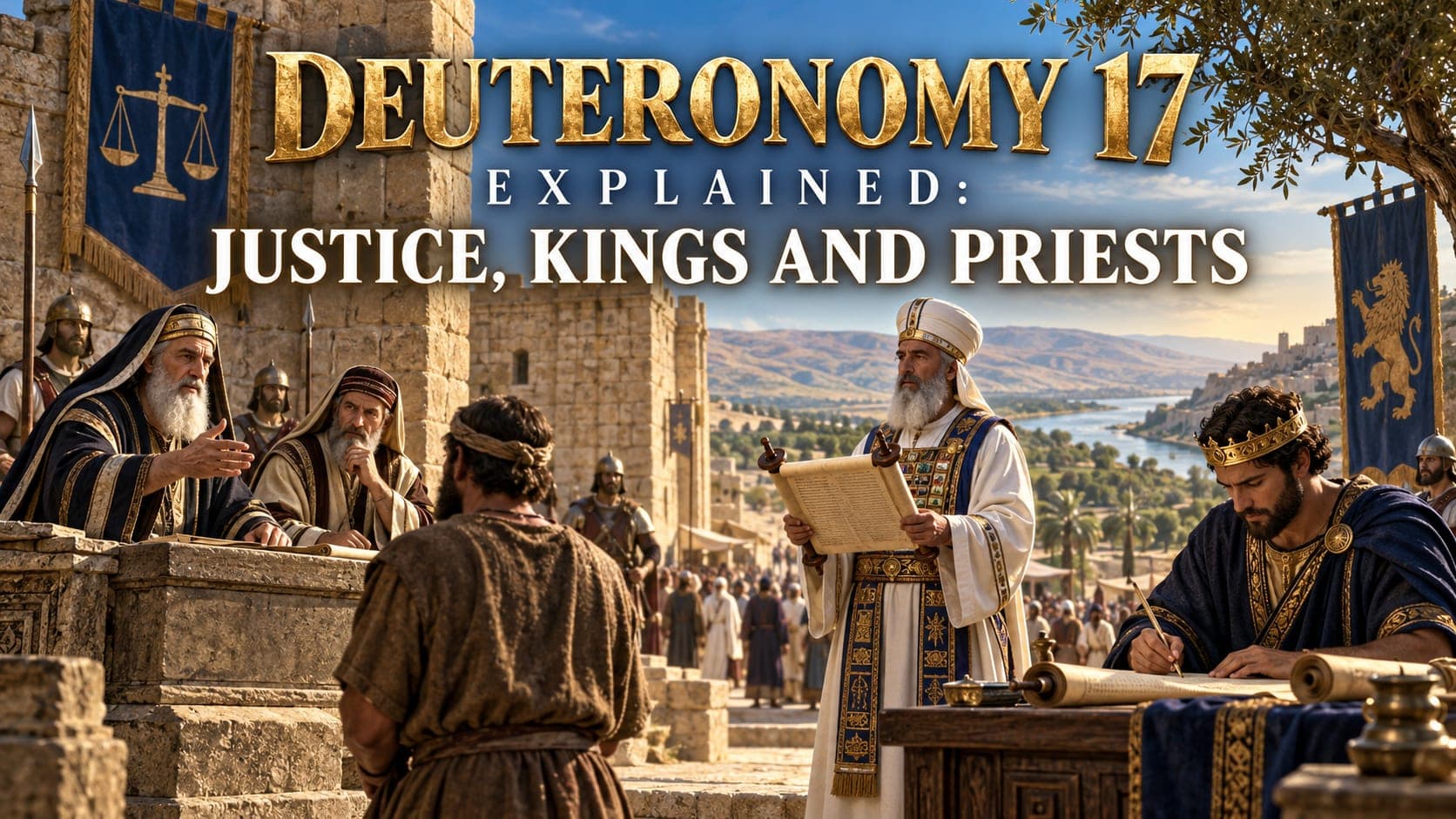
📖 Deuteronomy 17 Explained: Honest Courts and a King With Limits
Two witnesses, not one. A court that cannot be skipped. A king who is told no before he even exists.
Deuteronomy 17 explained is Moses closing out the courtroom laws he opened in the last chapter, then reaching forward into a future Israel had not even asked for yet. A king is coming one day. Moses writes the rules for him centuries before he takes the throne.
Maybe you have only ever read this chapter as ancient legal procedure, with nothing left to say to you.
- ❓ Why does a secret sin against God require two or three witnesses to prove?
- ❓ Why does refusing a court ruling carry the death penalty?
- ❓ Why does God plan for a king Israel has not even requested yet?
- ❓ What does it mean that the king has to copy out his own law by hand?
📌 This chapter protects Israel from two different dangers at once: a court that convicts on a rumor, and a king who forgets he is not God.
Twenty verses, and they move from a flawed animal on the altar to witnesses at the gate to a throne that does not even exist yet, three warnings aimed at the same target: keeping power honest, whether it belongs to a judge or a crown.
Read slowly. This chapter wrote the job description for a king four hundred years before Israel asked for one.
What Happened Just Before This Chapter
Deuteronomy 16 ended with judges who could not be bribed and an altar that had to stay clear of groves and pillars borrowed from Canaanite worship. Moses had just said that a faithful feast and an honest gate were never two separate loyalties.
Deuteronomy 17 keeps standing at that same gate and widens the view. It finishes the thought about honest judgment, then climbs the ladder of Israel's legal system one rung at a time: from a local court, to a central court Israel has not built yet, to a throne Israel has not asked for yet. Honesty was never only about the gate. It was about every level of authority Israel would ever answer to.

Deuteronomy 17 Explained Verse by Verse
1. No Sacrifice With a Flaw (verse 1)
Moses closes the altar instructions from the previous chapter with one short, blunt rule.
"Thou shalt not sacrifice unto the LORD thy God any bullock, or sheep, wherein is blemish, or any evilfavouredness: for that is an abomination unto the LORD thy God."
📌 The word "abomination" is strong, and Moses means it that way. Offering God a damaged, inferior animal was not a small shortcut. It treated worship as a place to get rid of what a household could not use anyway, instead of a place to give God the best of what a household had.
💡 A worshipper could always tell what he actually believed about God by what he was willing to hand Him. A flawed animal on the altar was not really about livestock. It was a quiet statement that God deserved whatever was left over, not whatever was best.
2. When Someone Secretly Turns to Other Gods (verses 2 to 7)
From the altar, Moses turns to a harder scenario: a crime nobody saw happen in public.
"If there be found among you, within any of thy gates which the LORD thy God giveth thee, man or woman, that hath wrought wickedness in the sight of the LORD thy God, in transgressing his covenant, And hath gone and served other gods, and worshipped them, either the sun, or moon, or any of the host of heaven, which I have not commanded;"
This is the same loyalty test Deuteronomy 13 already ran three times, now written into actual courtroom procedure. Worshipping the sun, moon, or stars was common across Israel's neighbors, but the first and second of the Ten Commandments had already ruled out every one of them.
Moses refuses to let a rumor become a verdict.
"And it be told thee, and thou hast heard of it, and enquired diligently, and, behold, it be true, and the thing certain, that such abomination is wrought in Israel:"
⚠️ Four separate steps sit inside that one verse: hearing a report, hearing it directly, investigating it diligently, and confirming it is actually true. A charge of idolatry could not move forward on gossip. It had to survive real scrutiny first.
"Then shalt thou bring forth that man or that woman, which have committed that wicked thing, unto thy gates, even that man or that woman, and shalt stone them with stones, till they die."
"At the mouth of two witnesses, or three witnesses, shall he that is worthy of death be put to death; but at the mouth of one witness he shall not be put to death."
📌 One accuser was never enough to end a life, no matter how certain that one accuser sounded. This same rule repeats at Numbers 35, and the New Testament keeps using it long after Israel's courts are gone: Jesus tells His disciples to settle disputes before two or three witnesses, and Paul tells Timothy not to receive an accusation against an elder on a single voice.
"The hands of the witnesses shall be first upon him to put him to death, and afterward the hands of all the people. So thou shalt put the evil away from among you."
💡 The people who testified had to be the first ones to carry out the sentence they asked for. A false witness could not hide behind the crowd. Accusing someone of a capital crime meant staking your own hands on being right, which made a lie far more costly to tell.
3. When a Case Is Too Hard for the Local Gate (verses 8 to 13)
Not every case was this clear. Moses already told Israel at Deuteronomy 1 to appoint judges in every town. Here he plans for the case those local judges cannot settle.
"If there arise a matter too hard for thee in judgment, between blood and blood, between plea and plea, and between stroke and stroke, being matters of controversy within thy gates: then shalt thou arise, and get thee up into the place which the LORD thy God shall choose;"
"And thou shalt come unto the priests the Levites, and unto the judge that shall be in those days, and enquire; and they shall shew thee the sentence of judgment:"
📌 A hard case did not get decided by whoever argued loudest at the local gate. It traveled up to one central court, staffed by priests and a judge, at the same chosen place every other major decision in this book keeps returning to. Israel's legal system had a top, and difficult questions were meant to actually reach it.
"And thou shalt do according to the sentence, which they of that place which the LORD shall choose shall shew thee; and thou shalt observe to do according to all that they inform thee: According to the sentence of the law which they shall teach thee, and according to the judgment which they shall tell thee, thou shalt do: thou shalt not decline from the sentence which they shall shew thee, to the right hand, nor to the left."
💡 Once the ruling came down, it was final. Not partially final, not open to a second opinion from a more sympathetic judge somewhere else. A legal system only works if its last word is actually the last word.
"And the man that will do presumptuously, and will not hearken unto the priest that standeth to minister there before the LORD thy God, or unto the judge, even that man shall die: and thou shalt put away the evil from Israel."
"And all the people shall hear, and fear, and do no more presumptuously."
⚠️ The death penalty here does not fall on losing a case. It falls on refusing to accept the verdict. Moses is not punishing the side that argued wrong. He is punishing contempt for the court itself, the one thing that would make every other law in this book unenforceable if it were allowed to spread.
4. If Israel Ever Asks for a King (verses 14 to 17)
Without transition, Moses jumps from courtrooms to a throne that does not exist yet.
"When thou art come unto the land which the LORD thy God giveth thee, and shalt possess it, and shalt dwell therein, and shalt say, I will set a king over me, like as all the nations that are about me;"
📌 Notice the exact phrase Moses puts in Israel's future mouth: a king "like as all the nations." That is almost word for word what the elders actually say to Samuel generations later, when they finally ask for a king because they want to look like every nation around them instead of being led directly by God. Moses is not caught off guard by that request. He is answering it centuries before anyone makes it.
"Thou shalt in any wise set him king over thee, whom the LORD thy God shall choose: one from among thy brethren shalt thou set king over thee: thou mayest not set a stranger over thee, which is not thy brother."
💡 A king was permitted, never commanded. And the choice was never fully Israel's to begin with. The LORD would do the choosing, and whoever sat on that throne had to be a brother, a fellow Israelite under the same covenant, never a foreign ruler with no stake in the law he would be expected to keep.
Then come three specific warnings, aimed at three specific temptations power brings.
"But he shall not multiply horses to himself, nor cause the people to return to Egypt, to the end that he should multiply horses: forasmuch as the LORD hath said unto you, Ye shall henceforth return no more that way."
"Neither shall he multiply wives to himself, that his heart turn not away: neither shall he greatly multiply to himself silver and gold."
⚠️ Horses, wives, silver and gold, in that exact order. Centuries later, one Israelite king breaks all three in the exact same order. Egypt was famous for its horses and chariots, so building up a cavalry meant leaning back on the very nation Israel had been rescued from. A king with many foreign wives risked exactly what the second warning names, a heart pulled toward other gods. And a throne stacked with silver and gold tends to trust its own wealth more than the God who gave the land in the first place.
5. The King Who Has to Copy His Own Law (verses 18 to 20)
After three warnings about what the king must not do, Moses finally says what the king must actually do.
"And it shall be, when he sitteth upon the throne of his kingdom, that he shall write him a copy of this law in a book out of that which is before the priests the Levites:"
📌 Not a scribe's copy. His own. Every other ancient king in this world had scribes to write things for him. Israel's king had to sit down and write out the law himself, in his own hand, straight from the copy kept with the priests.
"And it shall be with him, and he shall read therein all the days of his life: that he may learn to fear the LORD his God, to keep all the words of this law and these statutes, to do them:"
💡 Not read once at his coronation and set aside. Read every day he held the throne. A king who stopped reading the law was a king who had stopped remembering whose law it actually was.
"That his heart be not lifted up above his brethren, and that he turn not aside from the commandment, to the right hand, or to the left: to the end that he may prolong his days in his kingdom, he, and his children, in the midst of Israel."
✅ The chapter that opened with an animal too flawed for the altar ends with a king who is never allowed to think he outranks the brothers standing next to him. A throne in Israel was never supposed to lift a man above the law. It was supposed to put him under it, in public, every single day.

Hard Questions Deuteronomy 17 Raises
If Moses already planned for a king here, why was it sinful for Israel to ask for one in 1 Samuel 8? The sin was never wanting any king at all, since Deuteronomy 17 already permits one. The sin was the reason behind the request. Israel asked so they could look like the nations around them and lean on a visible ruler instead of the LORD who had led them directly. Moses anticipates the words; Samuel exposes the motive behind them.
Why does the text wait until verses 14 to 20 to mention a king at all, when Israel does not even have one yet? Deuteronomy is Moses preparing Israel for a future he will not see. Writing the king's limits into the law before the throne exists meant no future king could claim the rules were invented just to target him personally. The limits came first, for whoever eventually sat there.
Why does refusing a court's ruling in verses 12 and 13 carry the death penalty, when losing a case does not? The text is specific about what earns the sentence: doing presumptuously and refusing to hearken, not simply being on the losing side of a judgment. A legal system that lets its final rulings be ignored at will stops functioning as a legal system, which is the exact evil Moses says this law puts away.
Does requiring two or three witnesses mean the Bible never allows a conviction on one person's word? This chapter is specifically about a capital case, a matter where a life is at stake. The same two or three witness principle shows up again at Numbers 35 for taking a life, and Jesus and Paul both reapply the standard later for serious accusations within the church, but the Old Testament does not apply it to every single everyday dispute.
Top Verses From Deuteronomy 17
1. Deuteronomy 17:6
"At the mouth of two witnesses, or three witnesses, shall he that is worthy of death be put to death; but at the mouth of one witness he shall not be put to death."
A safeguard quoted for the rest of Scripture. No life was ever taken on a single accuser's word alone, no matter how confident that one voice sounded.
2. Deuteronomy 17:11
"According to the sentence of the law which they shall teach thee, and according to the judgment which they shall tell thee, thou shalt do: thou shalt not decline from the sentence which they shall shew thee, to the right hand, nor to the left."
A final court ruling that actually stayed final. Israel's legal system depended on its last word being the last word, not an invitation to keep arguing elsewhere.
3. Deuteronomy 17:15
"Thou shalt in any wise set him king over thee, whom the LORD thy God shall choose: one from among thy brethren shalt thou set king over thee: thou mayest not set a stranger over thee, which is not thy brother."
The throne was never fully Israel's to hand out. Even the choice of a king still belonged to the LORD first.
4. Deuteronomy 17:17
"Neither shall he multiply wives to himself, that his heart turn not away: neither shall he greatly multiply to himself silver and gold."
A warning one Israelite king would later ignore in nearly every detail. A full treasury and a full palace were never proof of a faithful throne.
5. Deuteronomy 17:20
"That his heart be not lifted up above his brethren, and that he turn not aside from the commandment, to the right hand, or to the left: to the end that he may prolong his days in his kingdom, he, and his children, in the midst of Israel."
The whole point of the king law in one line. Power in Israel was meant to sit under the commandment, never above the brothers standing next to the throne.

Frequently Asked Questions About Deuteronomy 17
What is Deuteronomy 17 about?
Deuteronomy 17 forbids sacrificing a flawed animal, lays out how a secret case of idolatry must be proven and judged, sets up a central court for cases too hard for a local gate, and gives the rules for a future king Israel has not yet asked for.
Why did Israel need two or three witnesses to execute someone?
Deuteronomy 17:6 states plainly that one witness was never enough to put someone to death. The rule protected against a single accuser's grudge, error, or lie ending a life, and the same principle appears again in Numbers 35 and is reapplied by Jesus and Paul in the New Testament.
Why did the witnesses have to be first to carry out the execution?
Deuteronomy 17:7 required the accusing witnesses to personally begin the sentence they had asked for. Staking your own hands on the outcome made a false accusation far more costly to bring in the first place.
What was the central court in Deuteronomy 17?
Verses 8 to 13 describe a court of priests and a judge at the place the LORD would choose, meant to decide cases too difficult for the judges appointed in each town. Its ruling was final, and refusing to accept it carried the death penalty.
Did God want Israel to have a king?
Deuteronomy 17:14 and 15 permit a king but never command one, and even then the LORD would do the choosing. The later request for a king in 1 Samuel 8 was judged not for wanting a king at all, but for wanting one for the wrong reason, to look like the surrounding nations.
What were the three restrictions placed on Israel's king?
Deuteronomy 17:16 and 17 forbid the king from multiplying horses, multiplying wives, or multiplying silver and gold. Each restriction targeted a specific risk: dependence on Egypt, a heart turned from the LORD, and trust placed in wealth instead of God.
Which Israelite king broke the laws in Deuteronomy 17?
Solomon is the clearest example. 1 Kings 10 and 11 describe him importing horses from Egypt, marrying many foreign wives whose influence turned his heart after other gods, and accumulating vast silver and gold, breaking all three warnings almost in the exact order Moses gave them.
Why did the king have to write his own copy of the law?
Deuteronomy 17:18 and 19 required the king to personally copy the law from the priests' scroll and read it every day of his life, so he would learn to fear the LORD and never forget he ruled under the law, not above it.
Does Deuteronomy 17 still matter if Israel no longer has kings or that court system?
Yes. The principle behind every section still stands: careful investigation before judgment, a final ruling that actually stays final, and a leader who stays under the same law he expects everyone else to keep. Those are not laws tied only to Israel's monarchy.
Final Thoughts
Deuteronomy 17 is a chapter about power, long before anyone in Israel holds very much of it.
📌 A serious charge needed serious proof. Diligent investigation and multiple witnesses stood between a rumor and a verdict, especially when a life was on the line.
📌 A final ruling had to actually be final. Presumptuous refusal to accept a court's decision threatened the whole system, not just one case.
📌 Even a king answered to the law, not the other way around. Horses, wives, silver and gold were each named as specific traps, and one king later fell into every one of them.
You do not sit under judges at a city gate or wonder who will take Israel's throne. But you still decide how much weight you give a rumor before you repeat it, and whether whatever authority you hold, at home, at work, anywhere, stays under the same standard you expect from everyone else.
So here is your one next step.
Before you repeat the next accusation you hear, ask whether you actually have more than one voice behind it.