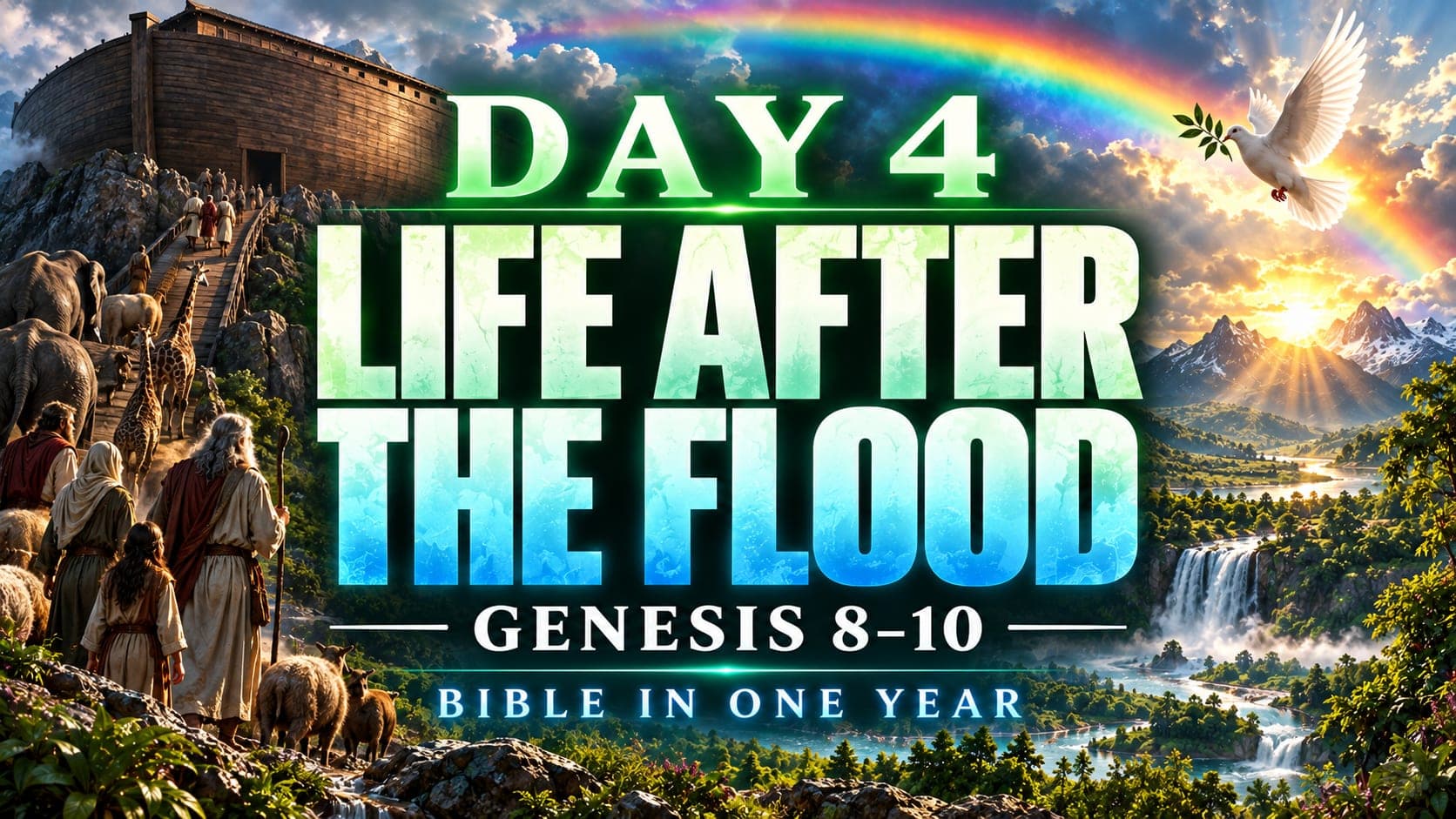
📖 Bible in One Year Day 4 Study Notes: Genesis 8-10
Hey. You made it back.
Yesterday we left you in the worst place this book has gone so far. Water over everything, and one boat.
Today the water goes down.
But this is not a story about weather.
It starts with three words.
God remembered Noah.
Today is Day 4 of Bible in One Year, and the reading is Genesis 8, 9, and 10. A dove, an altar, a rainbow, and a long list of nations that matters more than it looks.
These are the written notes for Bible in One Year Day 4. If you listened to today's teaching already, this is the same walk in writing. Take a breath. Let's go.
Here is what Day 4 puts in front of you.
- 🕊️ A dove sent out three times, and the small sign that finally means it is over
- 🔥 The first thing Noah does on dry ground, before anything else
- 🌈 A bow hung in the sky, and the reason God says He put it there
- 🍷 The man who survived the flood, and the sin the water could not wash out of him
- 🌍 A list of names that quietly says there is no such thing as a stranger
📌 The flood did not make the world new by making people new. It made the world new by God promising to hold it steady anyway.
God remembered Noah
Genesis 8 opens with three words that turn the whole story around.
"And God remembered Noah, and every living thing, and all the cattle that was with him in the ark: and God made a wind to pass over the earth, and the waters asswaged."
Remembered does not mean God had forgotten. He was never gone from that boat. In the Bible, to remember someone is not about memory at all. It is about acting on a promise. When God remembers, something starts to move.
And what moves here is a wind over the waters. That is the same picture as Genesis 1, when the Spirit of God moved over the face of the deep before anything existed. Here it is again, moving over water, before a world can start over.
📌 God is making a world again. Not from nothing this time, but out of the one boat still floating on it.
The water does not vanish. It goes down slowly, over months, the ark coming to rest on the mountains of Ararat in the seventh month, the tops of the mountains not visible until the tenth. Rescue is real here, and it is not instant. Noah still has to wait it out.
Maybe you know what that kind of waiting feels like. You have already been rescued from something, and the water still has not fully gone down. Genesis 8 does not rush past that. It names the months.
Prefer to listen? This is Day 4 of the Bible in One Year, the same walk through Genesis 8, 9, and 10.
A dove that finally does not come back
After forty more days, Noah opens a window and sends out a raven, which just goes back and forth until the ground dries. Then he tries something gentler. He sends out a dove.
The dove cannot find anywhere to land. The water is still over everything, so she comes back to the ark, and Noah reaches out his hand and pulls her back in to him. There is something tender in that. A tired bird returning to the one place left that will still hold it.
Seven days later he sends her out again.
"And the dove came in to him in the evening; and, lo, in her mouth was an olive leaf pluckt off: so Noah knew that the waters were abated from off the earth."
An olive leaf, torn fresh off a branch. Something out there is growing again. That small, ordinary leaf is the first proof Noah has had in months that the world is coming back.
Then he waits seven more days and sends her out a third time.
📌 She does not come back at all. That silence is the good news. It means she finally found somewhere to land that was not this boat.
Noah waited to be told to leave
Genesis is careful to tell you what Noah does next, which is nothing. He removes the covering of the ark and looks out, and the ground is dry. And he still does not leave.
The text lays out the timeline in enough detail to make the point unmissable: the ground had been drying out for weeks before that door finally opened. Noah could have climbed down on his own. He waited, the same way he waited to be told to get in, a year earlier.
Then God speaks.
"And God spake unto Noah, saying, Go forth of the ark, thou, and thy wife, and thy sons, and thy sons' wives with thee. Bring forth with thee every living thing that is with thee, of all flesh, both of fowl, and of cattle, and of every creeping thing that creepeth upon the earth; that they may breed abundantly in the earth, and be fruitful, and multiply upon the earth."
Be fruitful, and multiply. Those are the exact words spoken over the first man and woman in Genesis 1, said again here on the other side of the flood. This is not a brand new command for a brand new world. It is the same world, the same mission, picked back up.
📌 Noah waited for God to tell him to leave the same way he waited to be told to go in. Obedience here is not one dramatic act. It is patience, held all the way through.
The first thing Noah does on dry ground
Genesis even hands you the exact dates. On the first day of the first month of Noah's six hundred and first year, he removes the covering of the ark and sees dry ground. By the twenty-seventh day of the second month, the earth is fully dried. Almost two more months pass, ground dry the whole time, before God finally speaks and tells him to come out.
Everyone finally steps out onto solid ground, and before Noah builds a house, or a fence, or plants a single seed, he builds an altar.
"And Noah builded an altar unto the LORD; and took of every clean beast, and of every clean fowl, and offered burnt offerings on the altar. And the LORD smelled a sweet savour; and the LORD said in his heart, I will not again curse the ground any more for man's sake; for the imagination of man's heart is evil from his youth; neither will I again smite any more every thing living, as I have done."
📌 Read that carefully. The reason God gives for this mercy is not that people got better. He says the imagination of man's heart is evil from his youth, the very thing that led to the flood in the first place, and He decides to hold the world steady anyway.
The flood did not change what is in a human heart. What changes here is what God decides to do about it. He commits Himself to the ground staying reliable, seedtime and harvest, cold and heat, summer and winter, day and night, without a break, for as long as the earth remains.
Blessing repeated, and a rule about blood
Genesis 9 opens with God blessing Noah and his sons and repeating the same commission He gave Adam. Fill the earth.
But the world these words land in has changed.
"And the fear of you and the dread of you shall be upon every beast of the earth, and upon every fowl of the air, upon all that moveth upon the earth, and upon all the fishes of the sea; into your hand are they delivered. Every moving thing that liveth shall be meat for you; even as the green herb have I given you all things. But flesh with the life thereof, which is the blood thereof, shall ye not eat."
Before the flood, Genesis 1 gave people green plants to eat and never mentions meat. Now animals fear people for the first time, and meat is permitted, with one rule attached: never eat it with the blood still in it. Blood stands for life in this passage, and life belongs to God to give and take, not to be treated carelessly. And in the middle of all this sits a line that reaches all the way back to Genesis 1.
"Whoso sheddeth man's blood, by man shall his blood be shed: for in the image of God made he man."
📌 Human life is protected because of what a human being is. Not because of what someone has done, or how useful they are, or who is watching. Genesis 1:27 said every person carries God's image. That has not changed since the fall, and it has not changed after the flood either. It is the reason this rule exists at all.
A bow hung in the clouds
Then God makes a covenant, and it is worth noticing exactly who it is with. Not just Noah. Not just people.
"And I, behold, I establish my covenant with you, and with your seed after you; And with every living creature that is with you, of the fowl, of the cattle, and of every beast of the earth with you; from all that go out of the ark, to every beast of the earth. And I will establish my covenant with you; neither shall all flesh be cut off any more by the waters of a flood; neither shall there any more be a flood to destroy the earth."
Every living creature and the earth itself are named in this promise, not only the family that walked off the ark. Nobody is asked to do anything in return. This is a promise God makes and God keeps, unconditionally, on His side alone.
And He gives it a sign.
"I do set my bow in the cloud, and it shall be for a token of a covenant between me and the earth."
A war bow, the kind used for shooting arrows, hung up in the clouds. Then listen to the reason He gives for putting it there.
"And I will remember my covenant, which is between me and you and every living creature of all flesh; and the waters shall no more become a flood to destroy all flesh. And the bow shall be in the cloud; and I will look upon it, that I may remember the everlasting covenant between God and every living creature of all flesh that is upon the earth."
📌 The rainbow is not there to remind you. It is there so that God will look at it. The promise is held on His side of the sky, not on how well anyone below it behaves.
That changes what a rainbow can mean to you the next time you see one. It is not a reward for having your life together. It is a sign hung up by a God who binds Himself to keep His word whether you are watching or not.
The flood did not wash away the human heart
Then the man who just survived the judgment of the entire world plants a vineyard.
"And Noah began to be an husbandman, and he planted a vineyard: And he drank of the wine, and was drunken; and he was uncovered within his tent."
The flood washed away the world. It did not wash away the human heart. Genesis said as much itself back at the altar a few verses earlier, and here it is proven true in the very next generation, inside the family God just saved.
While Noah lies uncovered, his son Ham sees him and goes and tells his two brothers outside. Shem and Japheth take a garment, walk in backward so they will not see their father, and cover him. When Noah wakes and learns what happened, he speaks a curse over Canaan, Ham's son, and a blessing over Shem and Japheth.
📌 That is the honest thing about Genesis. It refuses to clean up its heroes. Whatever the fresh start after the flood was going to be, it was never going to be a better man walking off that ark. It was always going to have to be a better rescue than that.
Noah is the best man Genesis could find in his entire generation, the one man walking with God while everyone around him had gone the other way, and even he falls within a few verses of stepping onto dry ground. If the flood was ever going to fix people by starting them over, this is the moment that answer breaks. The problem was never just outside people. It was inside them, and a new start on the same old ground was not going to be enough on its own.
A list of names that quietly says there is no such thing as a stranger
Genesis 10 opens with the sons of Noah, Shem, Ham, and Japheth, and then runs on into a long list of names. It is easy to hear this as filler on the way to the next real story. It is not.
This is the world map of the ancient reader, every nation they had ever heard of, traced back to one family in one boat. 📌 Genesis is quietly saying there is no such thing as a foreign people. Everyone on this list shares the same great-grandfather.
Power reappears fast inside that list, too.
"And Cush begat Nimrod: he began to be a mighty one in the earth. He was a mighty hunter before the LORD: wherefore it is said, Even as Nimrod the mighty hunter before the LORD."
A world that started over with one obedient family already has a mighty man building a name for himself a few verses later. The names keep spreading out after that, into lands and languages and coastlines, and Genesis sums the whole chapter up in one line at the end: these are the families of the sons of Noah, after their generations, in their nations, and by these were the nations divided in the earth after the flood.
The list even tells you these families spread out after their tongues, after their families, in their nations. Genesis mentions their languages dividing them before it ever explains how those languages came to be different in the first place. Hold that question for tomorrow, because Genesis 11 is about to answer it directly.
The command back in chapter 9 was fill the earth, and the earth is filling. Hold on to that as this list runs out, because in two more chapters God is going to reach into one of these very families, pull out one man, and promise to bless every nation on this list through him.
Where Day 4 leaves you
So that is Day 4.
The water goes down. The door opens. An altar goes up. And God makes a promise to a world that has not earned it.
The rainbow is the thing to carry out of today. Not because it is pretty, but because of what God said it is for. I will look at it, and remember. The promise is held on God's side of the sky.
And then, almost immediately, Noah fails. Genesis puts those two things right next to each other on purpose.
📌 The world is steady because God is steady. Not because we are.
If you want to go deeper into any of today's three chapters, the fuller studies are here: Genesis 8 explained, Genesis 9 explained, and Genesis 10 explained. And if you missed yesterday's reading, you can catch up on Bible in One Year Day 3 first.
Tomorrow we step into Genesis 11, 12, and 13. A tower, a scattering, and a man told to leave everything and go.
For now, look up.
The bow is in the clouds.
And God is looking at it.
Frequently Asked Questions
What is the Bible in One Year Day 4 reading?
Genesis 8, 9, and 10: the flood waters receding, Noah and his family leaving the ark, the altar and the rainbow covenant, Noah's drunkenness, and the table of nations descending from Shem, Ham, and Japheth.
What does it mean that God "remembered" Noah?
Genesis 8:1 says God remembered Noah, but He had not forgotten him. In the Bible, to remember someone is about acting on a promise, not recalling a memory. Once God remembers Noah, the wind rises and the water starts to go down.
Why did Noah build an altar before doing anything else?
Genesis 8:20 says building an altar and offering a sacrifice was the very first thing Noah did once he was on dry ground, before building a home or planting a field. It was his response of worship after the flood, and God answers it by promising never again to curse the ground in that same way.
What does the rainbow mean in the Bible?
In Genesis 9:12-17, the rainbow is the sign of God's covenant never to destroy the earth again with a flood. God says the bow is set in the cloud so that He will look at it and remember His everlasting covenant with every living creature on the earth.
Why did Noah get drunk after the flood?
Genesis 9:20-21 simply records that Noah planted a vineyard, drank wine, became drunk, and was uncovered in his tent. The text does not explain his reasons. What it does show is that surviving the flood did not make Noah, or anyone in his family, free from sin.
What comes after Day 4 in the Bible in One Year?
Day 5 is Genesis 11 through 13: the tower of Babel and the scattering of the nations, and the start of Abram's story, when God calls him to leave his home and go to a land He will show him.