📖 Genesis 9 Explained: The Rainbow Covenant and the Curse of Canaan
The water is gone. Now God has to tell one family how the world actually works from here.
Genesis 9 explained is the chapter where Noah steps off the ark and into a new set of rules for life after judgment. A blessing gets repeated. A diet changes. A covenant gets sealed with a sign anyone can see in the sky. And then, almost without warning, the same family that just survived the flood together falls apart over something that happens inside a tent.
Maybe you assumed the story got easier once the rain stopped.
- ❓ Why does God suddenly allow meat, when Genesis 1 only gave plants?
- ❓ Why does one verse about blood get repeated so carefully?
- ❓ What does the rainbow actually promise, and to whom?
- ❓ What really happened between Noah, Ham, and Canaan, and why does it still get misused today?
📌 Genesis 9 sets the terms for every human life after the flood, and it ends by showing that a fresh start does not erase the old patterns of sin.
This walkthrough goes through the whole chapter in order: the renewed blessing, the new permission to eat meat, the reason human life carries a price no other life does, the covenant sealed in the clouds, and the sad, disputed scene that closes the chapter.
Noah survived the flood. Genesis 9 shows he did not survive being human.
What Happened Just Before This Chapter
Genesis 8 ended with Noah finally off the ark, building the first altar in the Bible, and God promising in His heart never again to curse the ground or destroy every living thing by a flood. That chapter closed on ordinary time itself being guaranteed: seedtime and harvest, cold and heat, summer and winter, day and night.
Genesis 9 picks up right where that promise left off. God has already decided how He will never treat the earth again. Now He turns and speaks directly to Noah, laying out how Noah, his sons, and every generation after them are actually supposed to live.
📌 Genesis 8 closed the flood. Genesis 9 opens the world that comes after it. The water is gone, but the world Noah steps into is not simply a rewind to Eden. It runs on new terms.
Genesis 9 Explained Verse by Verse
1. The Blessing Renewed, and a New Kind of Fear (verses 1 and 2)
The chapter opens with words that should sound familiar.
"And God blessed Noah and his sons, and said unto them, Be fruitful, and multiply, and replenish the earth."
That is almost word for word what God told Adam and Eve at creation.
"And God blessed them, and God said unto them, Be fruitful, and multiply, and replenish the earth, and subdue it: and have dominion over the fish of the sea, and over the fowl of the air, and over every living thing that moveth upon the earth."
📌 The same command that started the human race gets spoken a second time, to a world that just watched the first one drown. God is not improvising a plan B. He is restarting the same purpose He had from the beginning, through the one family left to carry it.
But the very next verse shows the relationship between people and animals has changed.
"And the fear of you and the dread of you shall be upon every beast of the earth, and upon every fowl of the air, upon all that moveth upon the earth, and upon all the fishes of the sea; into your hand are they delivered."
In Eden, dominion looked like a garden being tended. Here dominion is described with fear and dread. Something about the peace between humans and animals did not survive the flood intact, and Scripture states that plainly instead of hiding it.
2. From Green Herb to Meat, With One Line Not Crossed (verses 3 and 4)
God then changes something even more basic: what people are allowed to eat.
"Every moving thing that liveth shall be meat for you; even as the green herb have I given you all things."
📌 Before the flood, food was plants only. Genesis 1:29 and 30 gave Adam and every animal "every herb bearing seed" and "every green herb" for food, with no mention of meat anywhere. Genesis 9:3 is the first time in the Bible that God grants permission to eat animals at all.
That new permission comes with one condition attached immediately.
"But flesh with the life thereof, which is the blood thereof, shall ye not eat."
💡 The reasoning is right there in the verse: blood carries life. Leviticus later makes the same connection explicit, centuries after Noah.
"For the life of the flesh is in the blood: and I have given it to you upon the altar to make an atonement for your souls: for it is the blood that maketh an atonement for the soul."
This is not a food safety rule. It is a statement about what blood represents, and the early church still took it seriously enough that the apostles told new Gentile believers to abstain from it, alongside idolatry and sexual sin, in Acts 15:20 and 29.
3. Human Life Carries a Price (verses 5 and 6)
From animal blood, the chapter turns to something far weightier: human blood.
"And surely your blood of your lives will I require; at the hand of every beast will I require it, and at the hand of man; at the hand of every man's brother will I require the life of man."
"Whoso sheddeth man's blood, by man shall his blood be shed: for in the image of God made he man."
📌 Notice the reason given is not that murder is against the law. It is that man is made in God's image. The same phrase Genesis 1 used to describe why humans are different from every other creature now becomes the reason taking a human life carries a penalty no animal killing does.
"So God created man in his own image, in the image of God created he him; male and female created he them."
The line from Genesis 4 already showed Abel's blood crying out from the ground after Cain killed him. Genesis 9 is God formally answering that cry with a standard for every generation after: human life is valuable enough that ending it demands an accounting.
4. An Everlasting Covenant With Every Living Thing (verses 7 to 11)
The blessing repeats once more, then God moves into a formal promise.
"And you, be ye fruitful, and multiply; bring forth abundantly in the earth, and multiply therein."
"And God spake unto Noah, and to his sons with him, saying, And I, behold, I establish my covenant with you, and with your seed after you; And with every living creature that is with you, of the fowl, of the cattle, and of every beast of the earth with you; from all that go out of the ark, to every beast of the earth."
"And I will establish my covenant with you; neither shall all flesh be cut off any more by the waters of a flood; neither shall there any more be a flood to destroy the earth."
📌 This covenant is not with Noah alone, and it is not even limited to humans. Verse 10 names the fowl, the cattle, and every beast of the earth as parties to it. Genesis 6 already introduced the word covenant before the flood, promising Noah's family would survive it. Genesis 9 widens that same word into a permanent promise covering the whole created order, not just one household.
5. The Bow Set in the Cloud (verses 12 to 17)
A promise this large gets a visible sign attached to it.
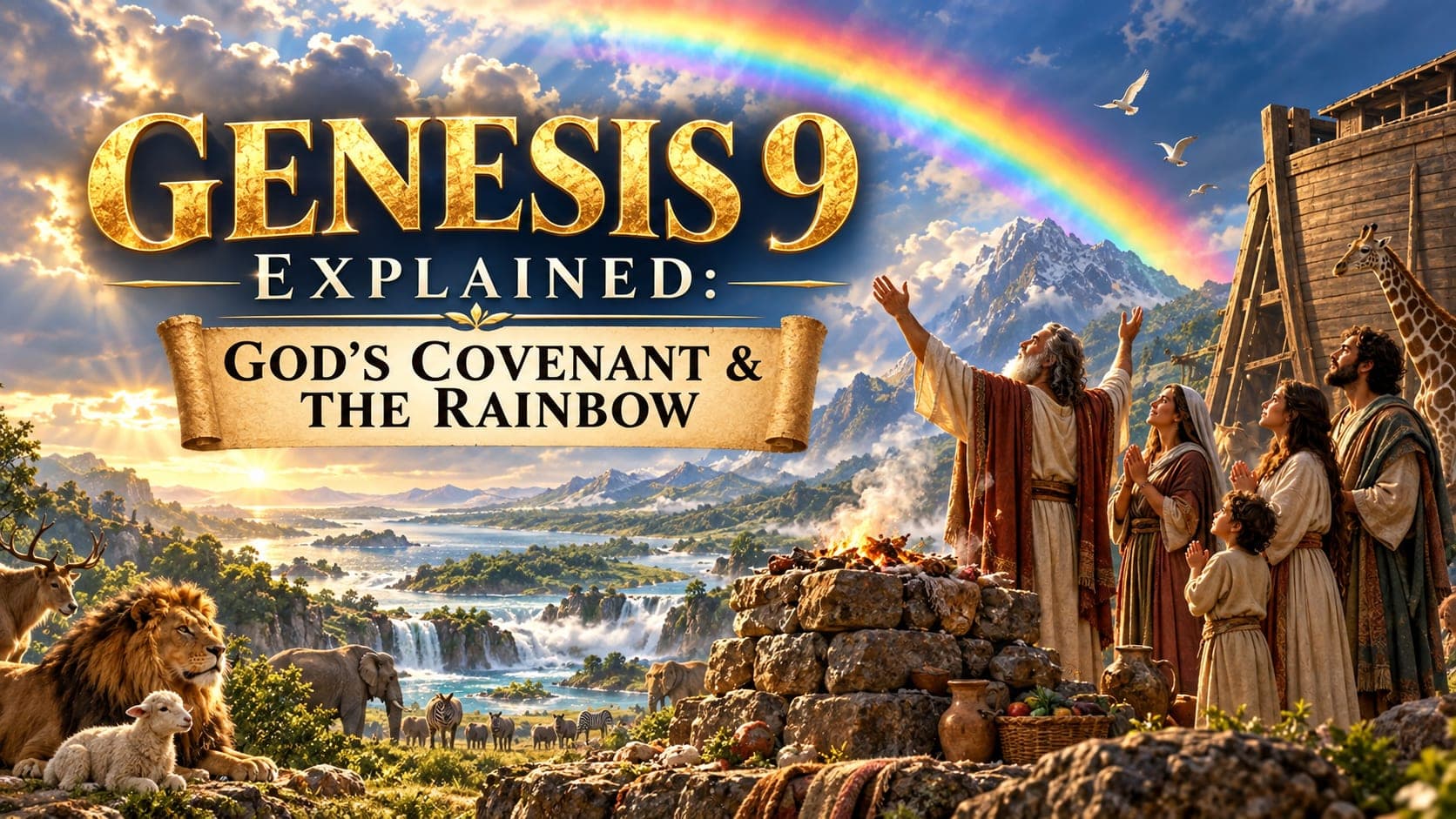
"And God said, This is the token of the covenant which I make between me and you and every living creature that is with you, for perpetual generations: I do set my bow in the cloud, and it shall be for a token of a covenant between me and the earth."
"My bow" is the same Hebrew word used elsewhere in the Old Testament for a weapon, a war bow. Whether or not rainbows existed in the sky before the flood, Genesis 9 gives this one a specific meaning it did not carry before: a weapon set down, pointed away from the earth rather than at it.
"And it shall come to pass, when I bring a cloud over the earth, that the bow shall be seen in the cloud: And I will remember my covenant, which is between me and you and every living creature of all flesh; and the waters shall no more become a flood to destroy all flesh."
"And the bow shall be in the cloud; and I will look upon it, that I may remember the everlasting covenant between God and every living creature of all flesh that is upon the earth."
📌 "That I may remember" does not mean God needs a reminder. Genesis 8:1 already used the same idea about God remembering Noah, describing His attention turning to act, not His memory failing. The sign is for the relationship, a fixed point both God and every generation after Noah can look at and know the promise still stands.
The section ends by repeating the point a final time, in case anyone missed it.
"And God said unto Noah, This is the token of the covenant, which I have established between me and all flesh that is upon the earth."
6. Noah's Vineyard and a Family Exposed (verses 18 to 23)
The chapter turns sharply from cosmic promise to a single, uncomfortable family scene.
"And the sons of Noah, that went forth of the ark, were Shem, and Ham, and Japheth: and Ham is the father of Canaan. These are the three sons of Noah: and of them was the whole earth overspread."
"And Noah began to be an husbandman, and he planted a vineyard: And he drank of the wine, and was drunken; and he was uncovered within his tent."
The man who obeyed every detail God gave him about an ark now stumbles over ordinary wine in his own tent. Scripture does not soften it or explain it away. It simply states what happened, the same directness it used for Adam's sin and Cain's.
"And Ham, the father of Canaan, saw the nakedness of his father, and told his two brethren without."
"And Shem and Japheth took a garment, and laid it upon both their shoulders, and went backward, and covered the nakedness of their father; and their faces were backward, and they saw not their father's nakedness."
📌 The contrast is the whole point of these two verses. Ham sees his father exposed and goes to talk about it. Shem and Japheth deliberately look away, walk in backward, and cover their father without ever seeing what Ham saw. One response spreads shame. The other protects dignity.
7. Blessing, Curse, and the Last Word on Noah (verses 24 to 29)
Noah wakes up, and his response reshapes the rest of the chapter.
"And Noah awoke from his wine, and knew what his younger son had done unto him. And he said, Cursed be Canaan; a servant of servants shall he be unto his brethren."
"And he said, Blessed be the LORD God of Shem; and Canaan shall be his servant."
"God shall enlarge Japheth, and he shall dwell in the tents of Shem; and Canaan shall be his servant."
⚠️ Noah curses Canaan, not Ham. The text never explains why the consequence lands on Ham's son rather than Ham himself, and any confident answer beyond that is filling a gap the Bible leaves open. What later chapters of Genesis do show is Canaan's own descendants becoming the peoples of the land God later gives to Israel, a nation Scripture repeatedly describes as sunk in the same kind of moral corruption on display here.
The chapter, and Noah's story, close on two short, quiet verses.
"And Noah lived after the flood three hundred and fifty years."
"And all the days of Noah were nine hundred and fifty years: and he died."
📌 "And he died" is the same closing line that ended nearly every name in the genealogy before the flood. Noah walked with God, built an ark no one else believed in, and outlived the flood by three hundred and fifty years. He still could not outlive being human. Death, the last enemy introduced back in Eden, reaches even the man grace saved from the water.
Hard Questions Genesis 9 Raises
Was eating meat actually forbidden before the flood? Genesis 1:29 and 30 give Adam and every animal only plants for food, with no mention of meat. Genesis 9:3 is the first place in the Bible where God explicitly grants permission to eat animals, which is why most readers take this as a genuine change rather than simply restating an old rule.
Does Genesis 9:6 mean the death penalty is commanded for today? The verse states a principle, that taking a human life made in God's image carries a consequence at the hand of other people, and many Christians read it as the foundation for government's authority to punish serious crime, a point Paul later echoes in Romans 13 about rulers bearing the sword. Other Christians read Genesis 9:6 as establishing the weight of human life rather than prescribing a specific modern policy, and point to New Testament mercy toward offenders as reason for caution applying it directly. This is a genuine point where sincere believers differ, and Genesis 9 alone does not settle every detail of how it should be applied today.
What exactly did Ham do to Noah? The text says only that Ham saw his father's nakedness and told his brothers about it instead of covering him. Some later traditions speculate about something worse, but nothing in Genesis 9 itself describes more than that. The contrast with Shem and Japheth's careful, respectful response is what the text actually emphasizes, not a hidden crime the passage never states.
Why was Canaan cursed instead of Ham, who actually did wrong? Genesis 9 does not explain this directly. What is clear is that the curse falls on one specific line of descendants, the Canaanites, whose later history in Scripture is repeatedly marked by the same kind of corruption this chapter shows in their ancestor.
Has the curse of Canaan been misused to justify slavery or racism? Yes, and honestly it must be said plainly. For centuries some used this passage to justify the enslavement of Black Africans, claiming Ham or his descendants were marked by skin color or destined for servitude because of it. Genesis 9 names one line, Canaan, whose descendants Scripture identifies as the peoples of ancient Canaan, not a continent, a race, or a skin color the text never mentions at all. That historical use of this chapter was a distortion of the text, not a fair reading of it.
Top 5 Bible Verses From Genesis 9
1. Genesis 9:6
"Whoso sheddeth man's blood, by man shall his blood be shed: for in the image of God made he man."
The reason human life carries such weight in Scripture, stated as plainly as anywhere in the Bible: people are made in God's image.
2. Genesis 9:13
"I do set my bow in the cloud, and it shall be for a token of a covenant between me and the earth."
The origin of the rainbow as a promise, not just weather. A weapon set down and pointed away from the earth it once judged.
3. Genesis 9:11
"And I will establish my covenant with you; neither shall all flesh be cut off any more by the waters of a flood; neither shall there any more be a flood to destroy the earth."
A promise wide enough to cover every living creature, sealed before Noah ever asked for reassurance.
4. Genesis 9:3
"Every moving thing that liveth shall be meat for you; even as the green herb have I given you all things."
The first time God explicitly permits eating meat, a change from the plant only diet given at creation.
5. Genesis 9:25
"And he said, Cursed be Canaan; a servant of servants shall he be unto his brethren."
A verse with a painful history of misuse, and a reminder that reading Scripture carefully matters as much as reading it at all.
Frequently Asked Questions About Genesis 9
What does Genesis 9 mean?
It records the terms God gives Noah for life after the flood: a renewed blessing to fill the earth, permission to eat meat with a limit on blood, the basis for valuing human life, an everlasting covenant sealed by the rainbow, and the sad scene of Noah's drunkenness that leads to Canaan being cursed.
Why did God allow people to eat meat in Genesis 9?
Genesis 9:3 is the first explicit permission to eat animals anywhere in the Bible. Before this, Genesis 1:29 and 30 describe a plant only diet for both people and animals. Scripture does not explain the change beyond stating it plainly.
Why does the Bible forbid eating blood?
Genesis 9:4 ties blood to life itself. Leviticus 17:11 later explains that blood was given for atonement on the altar, and the apostles in Acts 15 still told new believers to abstain from it, showing the principle carried weight for a long time after Noah.
What does "in the image of God" mean in Genesis 9:6?
It is the same phrase Genesis 1:27 uses to describe how God made humanity, distinct from animals. Genesis 9:6 uses that same identity as the reason taking a human life demands accountability that killing an animal does not.
Does Genesis 9:6 support the death penalty today?
Christians disagree on how directly this verse applies to modern criminal justice. Some see it as the biblical basis for government's authority to punish murder with death, others emphasize it as establishing the value of life rather than a fixed modern policy. Genesis 9 alone does not fully resolve the debate.
What is the sign of the covenant God made in Genesis 9?
The rainbow. Genesis 9:13 calls it "my bow," the same word used elsewhere for a war bow, set in the cloud as a token that God will never again destroy the earth with a flood.
Was there a rainbow before the flood?
Genesis 9 does not say whether rainbows physically existed before this moment. What it does say is that God gave this sign new meaning here, as a token of His covenant not to flood the whole earth again.
What did Ham do to Noah in Genesis 9?
Genesis 9:22 says Ham saw his father's nakedness while Noah was drunk and told his two brothers about it instead of covering him. Shem and Japheth responded by covering Noah without looking at him.
What is the curse of Canaan?
After Noah learns what happened, he curses Canaan, Ham's son, to be a servant to his brothers, in Genesis 9:25. The text does not explain why the consequence lands on Canaan rather than Ham directly.
Was the curse of Canaan ever used to justify slavery?
Yes. For centuries this passage was misused to justify enslaving Black Africans, claiming they descended from a cursed line marked by skin color. Genesis 9 mentions no skin color and names one specific ancient people group, the Canaanites, not a race or continent. That historical use of the text does not match what the passage actually says.
Final Thoughts
Genesis 9 is really two chapters stitched into one: a covenant big enough for the whole earth, and a family scene small enough to happen in anyone's living room.
📌 Human life carries weight because of who made it, not because of what it does. Genesis 9:6 grounds the value of every person in God's image, not in usefulness or behavior.
📌 God's promises do not depend on people getting better. The rainbow covenant comes right before Noah's worst recorded moment, the same pattern of grace arriving ahead of failure seen since Cain and Abel.
📌 A text can be twisted far from what it actually says. The history behind Genesis 9:25 is proof that reading Scripture carefully, and refusing to let it be misused, matters as much as reading it at all.
You will not outrun being human either, no matter how much grace has already carried you through.
So here is your one next step.
Read Genesis 9:6 slowly today, and let it change how you see the value of every person you talk to this week, not just the ones who have earned your respect.