📖 Genesis 8 Explained: The Flood Ends and Noah Leaves the Ark
The rain has already stopped by the time this chapter opens. Nobody inside the ark knows it yet.
Genesis 8 explained is the long, quiet middle of the flood story, the months after the door in Genesis 7 sealed shut and before anyone sets foot on solid ground again. Nothing dramatic happens here. That is exactly the point.
Maybe you know what it is like to be past the crisis and still stuck waiting for it to actually be over.
- ❓ Why does Noah send a raven before he ever sends a dove?
- ❓ Why does the dove come back twice, then never a third time?
- ❓ Why does Noah wait to leave the ark even after he can see dry ground with his own eyes?
- ❓ What does God's promise about seedtime and harvest actually guarantee?
📌 Genesis 8 is the chapter where Noah learns that seeing dry ground and being told to leave it are two different things.
This walkthrough goes through the whole chapter in order: a wind that starts undoing the flood, a bird that never comes home, a dove that finally does, and a sacrifice that changes how God relates to the earth from this point forward.
The water is gone by the end of this chapter. The waiting is not, not quite yet.
What Happened Just Before This Chapter
Genesis 7 ended on the bleakest sentence in early Genesis: every living thing outside one boat was destroyed, and the waters stood over the whole earth for a hundred and fifty days.
That chapter closed with judgment finished and Noah's family the only people left alive, floating on water that had erased every other trace of a corrupt world.
📌 Genesis 7 is the flood arriving. Genesis 8 is the flood leaving, and it leaves far slower than it came. Forty days of rain undid an entire world. It takes most of a year for the water to actually go back down.
Genesis 8 Explained Verse by Verse
1. God Remembered Noah (verses 1 to 3)
The chapter opens with the one word that turns the whole flood around.
"And God remembered Noah, and every living thing, and all the cattle that was with him in the ark: and God made a wind to pass over the earth, and the waters asswaged;"
📌 "God remembered" does not mean God had forgotten. Scripture uses this same word elsewhere to describe God turning His full attention toward someone to act on their behalf, not correcting a memory lapse. The waiting was real for Noah. It was never a gap in God's awareness of him.
A wind passes over the earth and the water begins to go down. It is a quiet echo of a much bigger moment, when something moved over the face of the waters at the very start of Genesis 1. The flood undid creation's order. This wind is the first sign of that order being put back together.
"The fountains also of the deep and the windows of heaven were stopped, and the rain from heaven was restrained; And the waters returned from off the earth continually: and after the end of the hundred and fifty days the waters were abated."
Notice the reversal. Genesis 7 described the fountains of the great deep breaking up and the windows of heaven opening. Genesis 8 uses almost the same two images and shuts them both. Stopped. Restrained. The exact forces that flooded the earth are the ones God closes off first.
2. The Ark Rests, the Mountains Reappear (verses 4 and 5)
Five months pass in two short verses.
"And the ark rested in the seventh month, on the seventeenth day of the month, upon the mountains of Ararat."
📌 The math lines up with the last verse of Genesis 7. The flood began in Noah's six hundredth year, second month, seventeenth day. The ark comes to rest on the seventeenth day of the seventh month, exactly five months later, the same hundred and fifty days Genesis 7:24 already counted out.
Notice also what the text does not say. It says the ark rested on the mountains of Ararat, a mountain range in what is now eastern Turkey, not one named peak. The tradition of a single mountain called Ararat comes much later. Genesis 8 only claims a region, not a summit.
"And the waters decreased continually until the tenth month: in the tenth month, on the first day of the month, were the tops of the mountains seen."
Two more months pass before there is anything at all to see. The water has to drop far enough for even the tallest peaks in that range to break the surface. Whatever Noah could see from inside the ark, it was still all water for a long time after the boat itself had already stopped moving.
3. The Raven That Never Comes Home, and the Dove That Finally Does (verses 6 to 12)
Forty more days pass before Noah does anything but wait.
"And it came to pass at the end of forty days, that Noah opened the window of the ark which he had made: And he sent forth a raven, which went forth to and fro, until the waters were dried up from off the earth."
Forty days show up here again just like they did before the flood ever started, one more appearance of a number Scripture keeps circling back to whenever testing and waiting are the whole point of a passage.
📌 A raven is not a strange first choice. Ravens scavenge and eat carrion, and they can rest on floating debris without ever needing dry land or a clean branch. Its going "to and fro" and never settling back in the ark tells Noah almost nothing about how dry the earth actually is. It only proves the bird can survive out there, which a raven could do even with water everywhere.
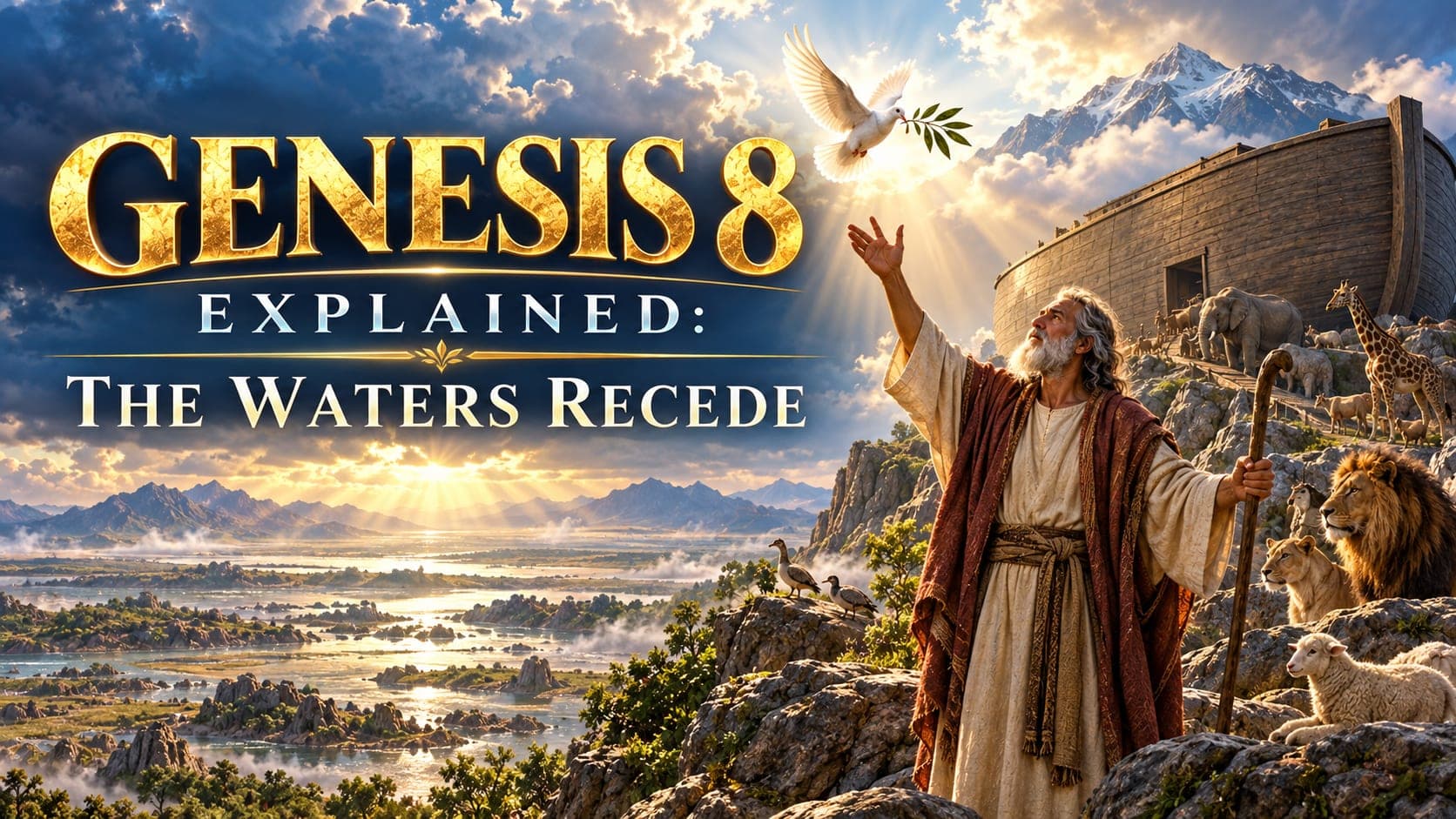
"Also he sent forth a dove from him, to see if the waters were abated from off the face of the ground; But the dove found no rest for the sole of her foot, and she returned unto him into the ark, for the waters were on the face of the whole earth: then he put forth his hand, and took her, and pulled her in unto him into the ark."
A dove is a different kind of test. Doves need solid, clean ground to land on. When she comes back with nothing, unable to find a place to rest her foot, that is real information: the earth is still covered.
"And he stayed yet other seven days; and again he sent forth the dove out of the ark; And the dove came in to him in the evening; and, lo, in her mouth was an olive leaf pluckt off: so Noah knew that the waters were abated from off the earth."
📌 An olive leaf, freshly pulled, is the first solid evidence in the whole chapter that anything is alive out there again. Olive trees do not grow underwater, and a leaf pulled off rather than simply found floating means the trees themselves had already started breaking the surface. "So Noah knew" is the turning point of the whole chapter, and it comes from a small leaf in a bird's mouth, not a survey Noah could ever have taken himself.
"And he stayed yet other seven days; and sent forth the dove; which returned not again unto him any more."
The third time the dove does not come back at all. She has finally found somewhere better to be than a wooden boat. Three tests, three different answers: no information, partial information, then an answer clear enough that Noah stops sending birds out altogether.
4. A Year of Waiting to Actually Leave (verses 13 to 19)
Noah can already see the ground is dry. He still does not move.
"And it came to pass in the six hundredth and first year, in the first month, the first day of the month, the waters were dried up from off the earth: and Noah removed the covering of the ark, and looked, and, behold, the face of the ground was dry."
📌 Verse 13 is easy to read past too fast. Noah removes the covering of the ark and looks with his own eyes at dry ground. By any normal measure the flood is over. And Noah does not walk out.
"And in the second month, on the seven and twentieth day of the month, was the earth dried."
Almost two more months pass between Noah seeing dry ground in verse 13 and the earth being fully "dried" here in verse 14. Counting from the date given for when the flood began, Noah's six hundredth year, second month, seventeenth day, to this date, the six hundred and first year, second month, twenty seventh day, exactly one year and ten days have passed.
"And God spake unto Noah, saying, Go forth of the ark, thou, and thy wife, and thy sons, and thy sons' wives with thee. Bring forth with thee every living thing that is with thee, of all flesh, both of fowl, and of cattle, and of every creeping thing that creepeth upon the earth; that they may breed abundantly in the earth, and be fruitful, and multiply upon the earth."
Only after that does the actual command come.
"And Noah went forth, and his sons, and his wife, and his sons' wives with him: Every beast, every creeping thing, and every fowl, and whatsoever creepeth upon the earth, after their kinds, went forth out of the ark."
📌 Noah waited for a word he did not strictly need to wait for. He had eyes. He had dry ground. What he did not have yet was a word from God telling him to go, so he stayed. That is the same obedience Genesis 6 already showed in one line about doing exactly as commanded, now stretched out over months instead of a single verse.
5. The Altar and the Sweet Savour (verses 20 and 21)
The very first thing Noah does once he is finally free to move is not build a house or plant a field.
"And Noah builded an altar unto the LORD; and took of every clean beast, and of every clean fowl, and offered burnt offerings on the altar."
The word "altar" shows up here for the first time anywhere in the Bible. Genesis 7 already explained why Noah brought seven of every clean animal instead of only two, extra animals kept alive without any species being wiped out through sacrifice. This is the moment that extra math finally gets used. Every clean animal on that ark was never only cargo. Some of it was always meant for this altar.
"And the LORD smelled a sweet savour; and the LORD said in his heart, I will not again curse the ground any more for man's sake; for the imagination of man's heart is evil from his youth; neither will I again smite any more every thing living, as I have done."
📌 Watch the exact words God uses to explain His own patience. "The imagination of man's heart is evil from his youth" is almost the same diagnosis Genesis 6:5 already gave, that every thought of the human heart was only evil, continually. The same verdict on the human heart that justified destroying the world in Genesis 6 is now, in nearly the same words, the reason God commits not to do it again. Nothing about people has changed between the two chapters. What changes is what God decides to do about it.
6. Seedtime and Harvest Will Not Cease (verse 22)
The chapter closes with a promise about ordinary time itself.
"While the earth remaineth, seedtime and harvest, and cold and heat, and summer and winter, and day and night shall not cease."
📌 Before this chapter there was no seedtime or harvest, no ordinary day and night as anyone on earth could track it. Water had covered everything. This verse is God guaranteeing the ordinary rhythm of life will keep running for as long as the earth exists, seasons, weather, and the difference between day and night included.
✅ That is a promise still holding, in every planting season and every sunrise since.

Hard Questions Genesis 8 Raises
Did God actually forget Noah before verse 1? No. The Bible uses "remembered" elsewhere to describe God turning to act on someone's behalf, not recalling something He had lost track of. What changes in verse 1 is not God's knowledge. It is the moment His attention turns from judgment to rescue in a visible way, with a wind that actually starts moving the water back.
Is the "mountains of Ararat" the same peak people visit today? Genesis 8:4 names a region, not one summit. The modern tradition of a single mountain called Ararat, in what is now eastern Turkey, developed centuries after this text was written. The chapter itself only says the ark came to rest somewhere in that mountain range, which is a real place, without pointing at one specific peak.
Does God's promise not to curse the ground or destroy life again conflict with judgments later in the Bible? Genesis 8:21 is specific about what it promises: no repeat of this exact kind of judgment, wiping out all life on earth at once by water. It is not a promise that sin will never be judged again. Peter later draws exactly that line, describing a future judgment by an entirely different means:
"For this they willingly are ignorant of, that by the word of God the heavens were of old, and the earth standing out of the water and in the water: Whereby the world that then was, being overflowed with water, perished: But the heavens and the earth, which are now, by the same word are kept in store, reserved unto fire against the day of judgment and perdition of ungodly men."
Water was the method once. Genesis 8:21 promises that method will not repeat. It says nothing about judgment itself being finished.
Top 5 Bible Verses From Genesis 8
1. Genesis 8:1
"And God remembered Noah, and every living thing, and all the cattle that was with him in the ark: and God made a wind to pass over the earth, and the waters asswaged;"
The single word that turns the whole chapter around. Not a change in what God knew, but the moment His attention toward Noah becomes visible again.
2. Genesis 8:11
"And the dove came in to him in the evening; and, lo, in her mouth was an olive leaf pluckt off: so Noah knew that the waters were abated from off the earth."
The first real proof of life outside the ark, delivered by a small bird carrying a single leaf. Noah's certainty comes from something this ordinary.
3. Genesis 8:21
"And the LORD smelled a sweet savour; and the LORD said in his heart, I will not again curse the ground any more for man's sake; for the imagination of man's heart is evil from his youth; neither will I again smite any more every thing living, as I have done."
The same diagnosis of the human heart that led to the flood now becomes the reason for God's patience instead. Judgment does not repeat because people got better.
4. Genesis 8:22
"While the earth remaineth, seedtime and harvest, and cold and heat, and summer and winter, and day and night shall not cease."
A guarantee that ordinary time itself will keep running, spoken right after a year where it did not, for as long as the earth exists.
5. Isaiah 54:9
"For this is as the waters of Noah unto me: for as I have sworn that the waters of Noah should no more go over the earth; so have I sworn that I would not be wroth with thee, nor rebuke thee."
Centuries later, God points back to this exact promise as proof of how firmly He keeps His word, using the flood as the standard for His own faithfulness.
Frequently Asked Questions About Genesis 8
What happens in Genesis 8?
The floodwaters recede over months, the ark rests on the mountains of Ararat, Noah sends out a raven and then a dove to test the ground, and once God tells him to leave, he builds the first altar in the Bible and God promises never to flood the whole earth again.
How long was Noah on the ark?
Genesis 7:11 dates the flood's start to Noah's six hundredth year, second month, seventeenth day. Genesis 8:14 dates the earth being fully dried to the six hundred and first year, second month, twenty seventh day, exactly one year and ten days later.
Why did Noah send a raven first?
A raven scavenges and can rest on floating debris without needing dry land, so its refusal to come back to the ark did not prove anything about how dry the earth was. It only proved the bird could survive outside.
Why does the dove not return the third time?
Genesis 8:12 says she simply did not come back, which Noah reads as proof the ground was finally dry and livable enough for her to stay. Unlike the raven, a dove needs solid, clean ground to land on, so her staying away meant something real.
What does the olive leaf in Genesis 8 mean?
Genesis 8:11 says the dove returned with a freshly pulled olive leaf, proof that trees had already started growing back above the waterline. It is the first solid evidence in the chapter that the earth was recovering.
Where did Noah's ark land?
Genesis 8:4 says the mountains of Ararat, a mountain range in what is now eastern Turkey. The text names a region, not a single peak, so identifying one exact modern mountain goes beyond what Genesis 8 itself states.
What does "God remembered Noah" mean?
It describes God turning His attention toward Noah to act on his behalf, not God recovering a forgotten memory. Scripture uses the same word elsewhere the same way, marking the moment rescue becomes visible rather than the moment God first cared.
What was the first altar in the Bible?
Genesis 8:20 records Noah building an altar and offering burnt offerings from the clean animals, the first time the word "altar" appears anywhere in Scripture.
What does "seedtime and harvest shall not cease" mean?
Genesis 8:22 promises that the ordinary cycles of planting, harvest, seasons, and day and night will keep running for as long as the earth exists, restoring the rhythm the flood had completely interrupted.
Does Genesis 8 mean God will never judge the earth again?
No. Genesis 8:21 promises specifically not to repeat a worldwide flood. 2 Peter 3:5 to 7 describes a future judgment by fire rather than water, showing the promise limits the method, not whether judgment happens at all.
Final Thoughts
Genesis 8 is not really about a boat drying out. It is about what it looks like to wait well.
📌 God's remembering was never a gap in His attention. The waiting was real for Noah, but nothing about his situation had slipped God's notice while it lasted.
📌 Seeing dry ground and being told to leave it were two different things. Noah had eyes enough to know the flood was over almost two months before he actually walked out, and he stayed anyway.
📌 The same verdict that once justified judgment became the reason for patience. Nothing about the human heart changed between Genesis 6 and Genesis 8. What God decided to do about it did.
You have probably seen the dry ground in some part of your own life already, proof enough that a hard season is ending, and still felt stuck waiting for the actual word to move.
So here is your one next step.
Read Genesis 8:15 to 17 again, and notice that Noah's obedience did not start the moment things got easier. It started the moment God spoke.