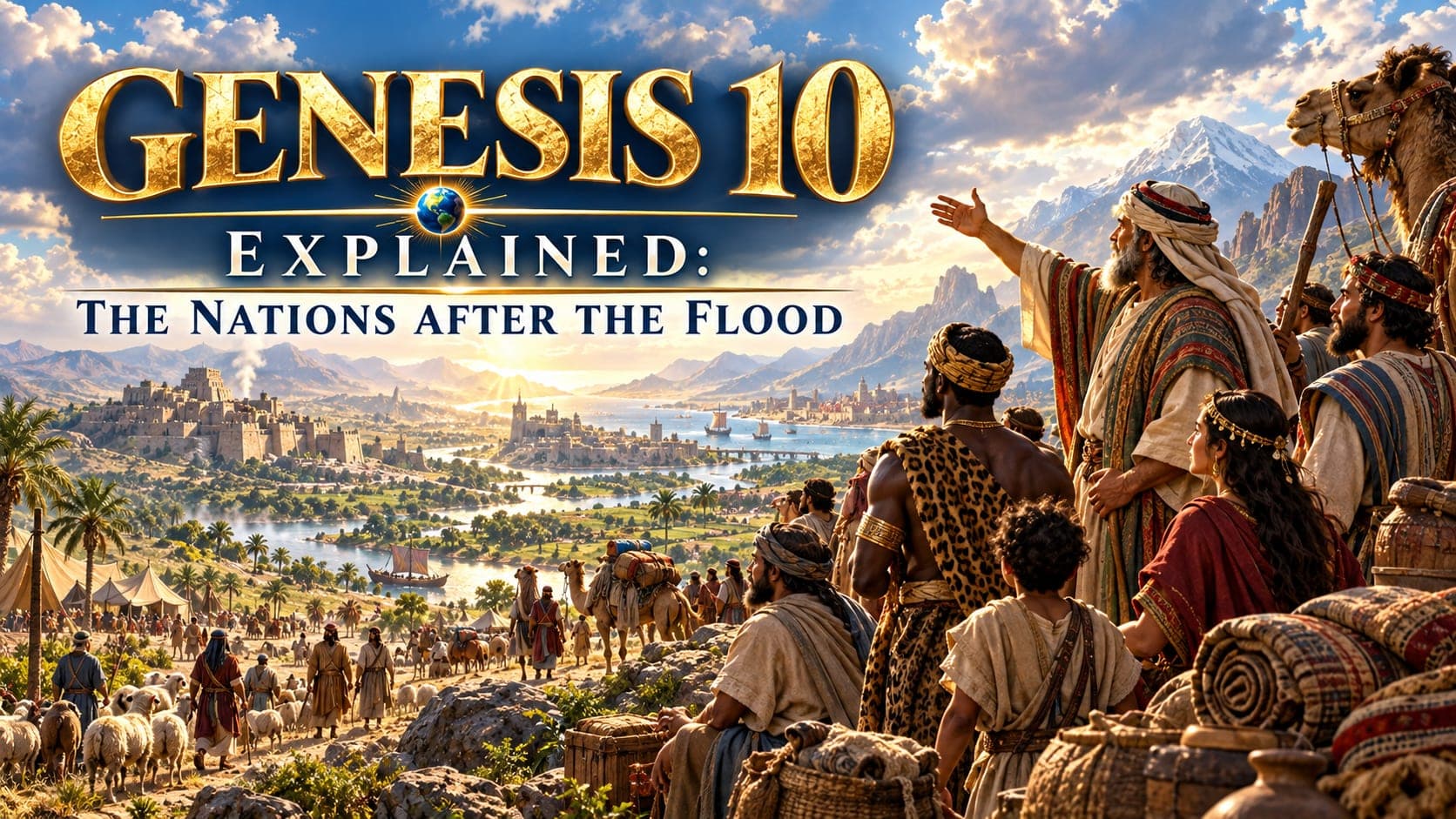
📖 Genesis 10 Explained: The Table of Nations After the Flood
One family gets off a boat. A whole world of nations comes out of it.
Genesis 10 explained is a list of names, seventy something of them, tracing every branch of Noah's three sons out into the nations that fill the rest of the Bible. It reads like a list to skim. It is actually a map.
Maybe you have never made it past the first few names before your eyes glazed over.
- ❓ Why does the Bible bother listing dozens of ancient names most people cannot pronounce?
- ❓ Who was Nimrod, and why does the text call him a mighty hunter?
- ❓ Where did Babel, Nineveh, and the Canaanites actually come from?
- ❓ Why does this chapter set up the very next one, the Tower of Babel?
📌 Genesis 10 is the only place in the ancient world where every nation, even rival empires and future enemies of Israel, gets traced back to one shared family.
Here is every branch of that family tree, verse by verse: Japheth's scattered coastlands, Ham's line and the rise of Nimrod's kingdoms, Canaan's descendants and the land they would one day lose, and Shem's line, the one the rest of Genesis quietly follows all the way to Abraham.
A family tree has never mattered this much to where the story goes next.
What Happened Just Before This Chapter
Genesis 9 closed on a hard note. Noah, the man who obeyed God through the entire flood, ended his story drunk and exposed in his own tent, and a curse fell on Canaan because of what happened there.
That chapter also named Noah's three sons plainly: Shem, Ham, and Japheth, "of them was the whole earth overspread." Genesis 10 is where that one line finally gets unpacked, name by name, family by family.
📌 Genesis 9 told you Noah had three sons. Genesis 10 tells you what became of them. Every nation named or hinted at anywhere later in Scripture, Egypt, Assyria, Babylon, the Philistines, the Canaanites, has its roots planted somewhere in this one chapter.
Genesis 10 Explained Verse by Verse
1. One Family, Three Directions (verses 1 to 5)
The chapter opens by naming the frame everything else fits inside.
"Now these are the generations of the sons of Noah, Shem, Ham, and Japheth: and unto them were sons born after the flood."
📌 Notice the order: Shem, Ham, Japheth. That is the birth order used elsewhere in Genesis. But the chapter itself covers them in the opposite direction, Japheth first, then Ham, then Shem last. Scripture already used this same pattern with Cain before Seth: the lines that are not being followed get told first and finished, so the line the story actually cares about can close the chapter and carry straight into what comes next.
Japheth's family goes first, and goes quickly.
"The sons of Japheth; Gomer, and Magog, and Madai, and Javan, and Tubal, and Meshech, and Tiras."
Seven sons, then a handful of grandsons through Gomer and Javan. Javan is widely understood as the ancestor of the Greeks, called Ionians in later history, and names from this short list, Magog, Meshech, Tubal, resurface together centuries later in Ezekiel's prophecy about a northern power called Gog. The chapter sums up the whole branch in one closing verse.
"By these were the isles of the Gentiles divided in their lands; every one after his tongue, after their families, in their nations."
💡 "The isles of the Gentiles" points toward the coastlands and islands around the Mediterranean, the direction Japheth's descendants are pictured spreading into. Language, family, and nation are named together here, the same three categories that will repeat at the end of both Ham's and Shem's sections too.
2. Cush, Nimrod, and the First Kingdoms (verses 6 to 12)
Ham's line opens with four names that will matter for the rest of the Bible.
"And the sons of Ham; Cush, and Mizraim, and Phut, and Canaan."
Cush is generally tied to regions south of Egypt, Mizraim is the Hebrew name for Egypt itself, and Canaan will get an entire section of its own further down. Cush's own line gets a quick list of sons, then the text slows down for one name in particular.
"And Cush begat Nimrod: he began to be a mighty one in the earth. He was a mighty hunter before the LORD: wherefore it is said, Even as Nimrod the mighty hunter before the LORD."
📌 Nimrod is the first person in the Bible the text stops to describe as a standout, not just a name in a list. "Mighty one" and "mighty hunter" get repeated three times in two verses. Scripture does not say outright whether that repetition is praise or a warning. What it does next is show exactly what Nimrod built with that strength.
"And the beginning of his kingdom was Babel, and Erech, and Accad, and Calneh, in the land of Shinar. Out of that land went forth Asshur, and builded Nineveh, and the city Rehoboth, and Calah, And Resen between Nineveh and Calah: the same is a great city."
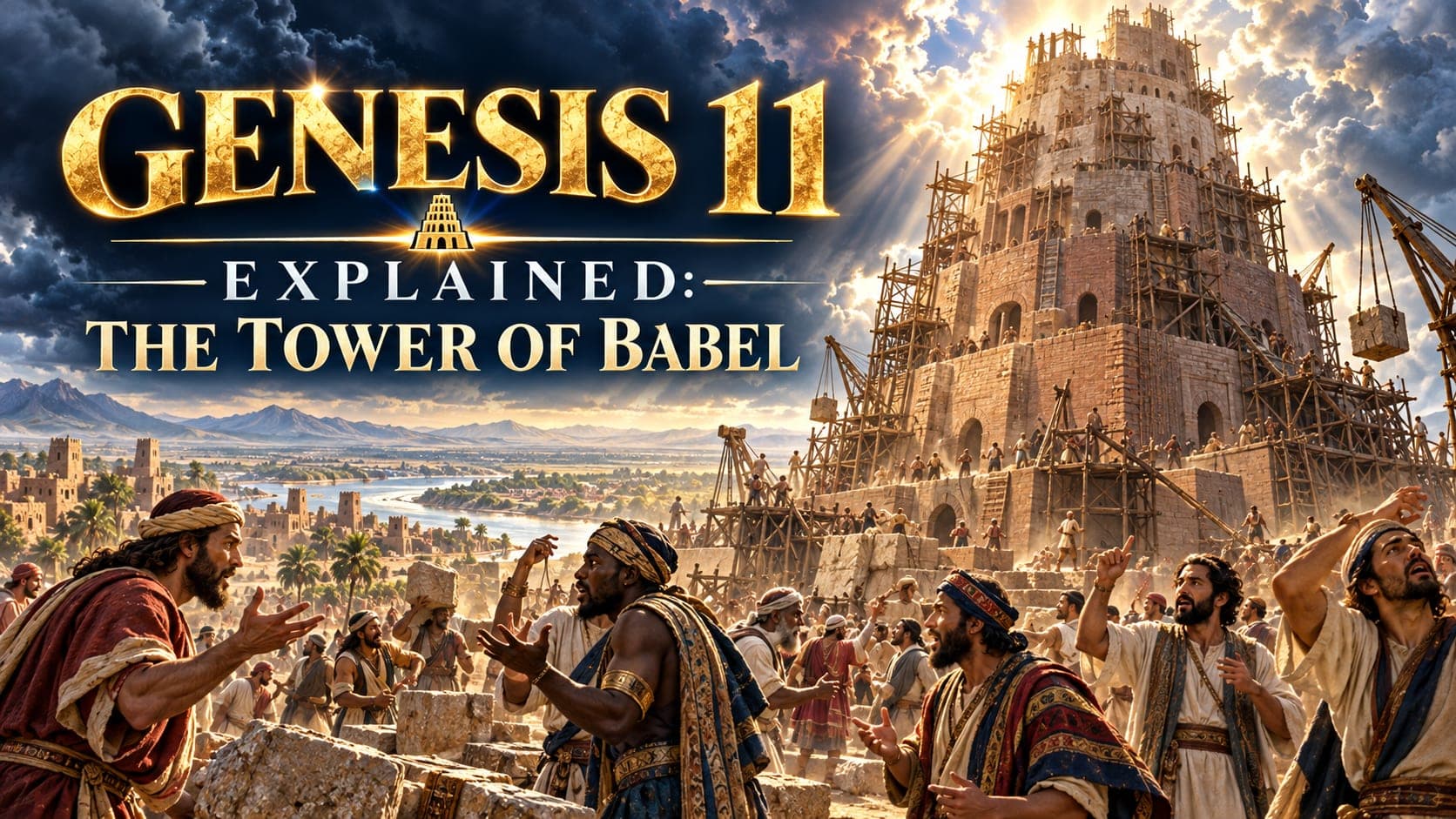
⚠️ Babel, in the land of Shinar, is the same place Genesis 11 is about to make famous for an entirely different reason. This is the first mention of Babel in the Bible, and it is already a kingdom before a single brick gets stacked into a tower.
The KJV names Asshur as the one who went out from Shinar and built Nineveh. Some other translations read the same Hebrew as Nimrod himself pushing north into Assyria, so respected translations genuinely differ on the exact subject of that sentence. Either way, the two cities named here, Babel and Nineveh, become the capitals of Babylon and Assyria, the two empires that will later conquer and exile Israel.
3. Mizraim, Canaan, and a Border Israel Would Later Cross (verses 13 to 20)
Mizraim's line gets a short list of names tied to Egypt and its neighbors, including one detail worth pausing on.
Verse 14 notes that the Philistines came out of Casluhim, a descendant of Mizraim. That single line quietly answers a question later books never stop to explain: the Philistines who fight Israel throughout Judges and Samuel trace back to Egypt's branch of this family tree, not Canaan's, even though they end up living inside Canaan's borders.
Then the text turns to Canaan, and slows all the way down.
"And Canaan begat Sidon his first born, and Heth, And the Jebusite, and the Amorite, and the Girgasite,"
📌 Almost every name in Canaan's list shows up again later as a people group Israel is told to drive out of the promised land. The Jebusites hold Jerusalem until David's time. The Amorites and Hivites appear across Joshua and Judges. This genealogy is quietly listing the exact nations Israel's conquest will be fought against, generations before Israel exists.
"And the border of the Canaanites was from Sidon, as thou comest to Gerar, unto Gaza; as thou goest, unto Sodom, and Gomorrah, and Admah, and Zeboim, even unto Lasha."
💡 That border, running from Sidon in the north down through Gaza and out to Sodom and Gomorrah, is roughly the land God later promises Abram. Canaan's descendants are occupying it here, long before any promise about it is ever spoken.
4. Shem, Eber, and the Line the Story Follows (verses 21 to 31)
The chapter finally turns to Shem, and the very first verse about him already points somewhere specific.
"Unto Shem also, the father of all the children of Eber, the brother of Japheth the elder, even to him were children born."
📌 Shem is not simply introduced as Noah's son here. He is called "the father of all the children of Eber." Eber has not even been named yet in this chapter, but the text already flags him as the reason Shem's line matters. Many scholars connect Eber's name to the word "Hebrew," the term that will eventually describe Abraham and his descendants.
Shem's sons are named, then his grandson Arphaxad's own line narrows fast.
"And Arphaxad begat Salah; and Salah begat Eber. And unto Eber were born two sons: the name of one was Peleg; for in his days was the earth divided; and his brother's name was Joktan."
❓ What does "in his days was the earth divided" actually mean? The chapter does not explain it here. Most readers connect it directly to what happens in the very next chapter, when God confuses one shared language into many and scatters people across the earth. Peleg's own name reflects that word for division. Read this way, Genesis 10 is quietly counting down toward Genesis 11 before that chapter has even started.
Joktan's branch gets thirteen sons of its own, more names than any other single father in the chapter, then Shem's section closes the same way Japheth's and Ham's already did.
5. One Family, Many Nations (verse 32)
The whole chapter closes with a single sentence that says what all those names were for.
"These are the families of the sons of Noah, after their generations, in their nations: and by these were the nations divided in the earth after the flood."
📌 Every nation on earth, according to this verse, shares one set of grandparents. Jewish tradition has long spoken of this chapter as listing seventy nations, a number used elsewhere in Scripture to represent the full spread of humanity. Whatever the exact count, the point stands either way: no nation named here, not Egypt, not Assyria, not even Canaan, gets described as less than fully human or less than fully descended from Noah.
And the very next word after this verse in the Bible is a description of one shared language, right before it gets taken away.

Hard Questions Genesis 10 Raises
Why does the Bible spend a whole chapter on a genealogy nobody can pronounce? Because almost every nation named or implied later in Scripture gets its start here. Egypt, Assyria, Babylon, the Philistines, and the Canaanites all trace back to a name in this list. Readers who skip it miss where half the rest of the Bible's geography comes from.
Was Nimrod a hero or a villain? The text itself does not say outright. "Mighty hunter before the LORD" can read as genuine praise or as pointed irony, and Genesis 10 leaves the description standing without a verdict attached. What is not in doubt is what he built: the kingdom centered on Babel, the very city where Genesis 11 records humanity's next act of open defiance against God.
Did Nimrod or Asshur build Nineveh? The KJV names Asshur as the subject of that sentence, but the underlying Hebrew is genuinely ambiguous, and other respected translations read it as Nimrod extending his own empire into Assyria. Genesis 10 does not resolve which reading is correct, and honest readers hold that uncertainty rather than picking a side with more confidence than the text supports.
Has this chapter ever been misused to rank nations or races? Yes, and it should be said plainly. Some readers over the centuries have tried to tie Ham's descendants to inferiority based on geography or skin color. Genesis 10 itself does the opposite. It traces Japheth, Ham, and Shem with the exact same structure, family by family, tongue by tongue, nation by nation, and never ranks one line above another. The only line singled out for extra attention is Shem's, and that is because of where the story is headed, Abraham, not because of any claim about superiority.
Are these ancient names historically real? Many of them are. Nineveh and Babylon are well documented cities in the archaeological record, and peoples like the Jebusites, Amorites, and Philistines appear repeatedly in later biblical history exactly where Genesis 10 places their ancestors. This chapter is not a myth loosely describing unknown places. It is naming real regions that show up again and again across the rest of Scripture.
Top 5 Bible Verses From Genesis 10
1. Genesis 10:32
"These are the families of the sons of Noah, after their generations, in their nations: and by these were the nations divided in the earth after the flood."
The verse the whole chapter has been building toward: every nation on earth, without exception, shares one family tree.
2. Genesis 10:8 and 9
"And Cush begat Nimrod: he began to be a mighty one in the earth. He was a mighty hunter before the LORD: wherefore it is said, Even as Nimrod the mighty hunter before the LORD."
The first individual in this whole chapter singled out for description, and the man whose kingdom becomes the setting for the Tower of Babel in the very next chapter.
3. Genesis 10:25
"The name of one was Peleg; for in his days was the earth divided; and his brother's name was Joktan."
A single line dropped in the middle of a genealogy, quietly pointing forward to the scattering of nations Genesis 11 is about to describe.
4. Genesis 10:21
"Unto Shem also, the father of all the children of Eber, the brother of Japheth the elder, even to him were children born."
The verse that quietly marks which branch of this huge family tree the rest of the Bible is about to follow, all the way to Abraham.
5. Genesis 10:1
"Now these are the generations of the sons of Noah, Shem, Ham, and Japheth: and unto them were sons born after the flood."
The opening line that turns one surviving family into the starting point for every nation named anywhere else in Scripture.

Frequently Asked Questions About Genesis 10
What does Genesis 10 mean?
It traces the descendants of Noah's three sons, Shem, Ham, and Japheth, into the nations that fill the rest of the Bible, including Egypt, Assyria, Babylon, the Philistines, and the Canaanites, before Genesis 11 explains why those nations ended up speaking different languages.
Why is Genesis 10 called the Table of Nations?
Because it lists nations rather than only individuals, organized by which of Noah's three sons they descended from. It is often called the oldest surviving document of its kind that traces so many ancient peoples back to a single shared ancestry.
Who was Nimrod in the Bible?
A descendant of Ham through Cush, described in Genesis 10:8 and 9 as a mighty hunter and the first person the Bible calls a mighty one on earth. He founded a kingdom centered on Babel in the land of Shinar, the same city where the Tower of Babel is built in Genesis 11.
Why does the order go Japheth, Ham, and Shem instead of birth order?
Genesis often lists side branches of a family before turning to the line it actually follows, the same pattern used with Cain before Seth in Genesis 4 and 5. Shem's line closes Genesis 10 because it is the line Genesis 11 and the rest of the Bible continue, leading eventually to Abraham.
Where did the Philistines come from?
Genesis 10:14 traces them to Casluhim, a descendant of Mizraim, the line associated with Egypt. That makes the Philistines part of Ham's family through Egypt, not through Canaan, even though they later settle inside Canaan's borders.
What does "in his days was the earth divided" mean?
It describes Peleg, a descendant of Shem in Genesis 10:25. Most readers connect it to the scattering of languages and peoples at the Tower of Babel in Genesis 11, since Peleg's own name reflects the idea of division.
How many nations are listed in Genesis 10?
Jewish tradition has long spoken of seventy nations coming from this chapter, a number Scripture elsewhere uses to represent the complete family of humanity. The exact count depends on how names that appear more than once across the three lines get counted.
Does Genesis 10 connect to the curse of Canaan in Genesis 9?
Yes. Genesis 10 lists Canaan's actual descendants, the Jebusites, Amorites, and others, the same peoples Israel is later told to drive out of the promised land, giving names and geography to the line Genesis 9's curse already pointed toward.
How does Genesis 10 set up the Tower of Babel?
It names Babel as the beginning of Nimrod's kingdom in Genesis 10:10, before Genesis 11 ever describes what gets built there. It also introduces Peleg, whose name marks a division of the earth, right at the hinge point between the two chapters.
Is Genesis 10 historically accurate?
Many of the places and peoples named here, Nineveh, Egypt, the Philistines, the Jebusites, are well documented in later Scripture and the wider historical record. The chapter names real regions that keep reappearing throughout the rest of the Bible.
Final Thoughts
Genesis 10 looks like a list to skip past. It is actually a promise being kept in real time.
📌 Every nation traces back to one family. Egypt, Assyria, Canaan, Babylon, and every name in between all descend from the same three brothers who once stood together on dry ground.
📌 The nations Israel would later fight are named here first, as family, not strangers. Long before conquest or exile, this chapter refuses to describe any of them as less than fully human.
📌 One line quietly gets set apart, not because it is better, but because of where the story is going. Shem's line closes the chapter and carries straight into Genesis 11, then all the way to Abraham.
You come from a long, tangled family tree too, full of names you will never fully trace. Genesis 10 says God was never confused about any branch of it.
So here is your one next step.
Open Genesis 11 next. The family you just met here, still united, still speaking one language, is about to build something God will not let stand.