📖 Numbers 18 Explained: Aaron's Priesthood and the Levites' Reward
A whole camp just cried out that getting near the tabernacle meant dying.
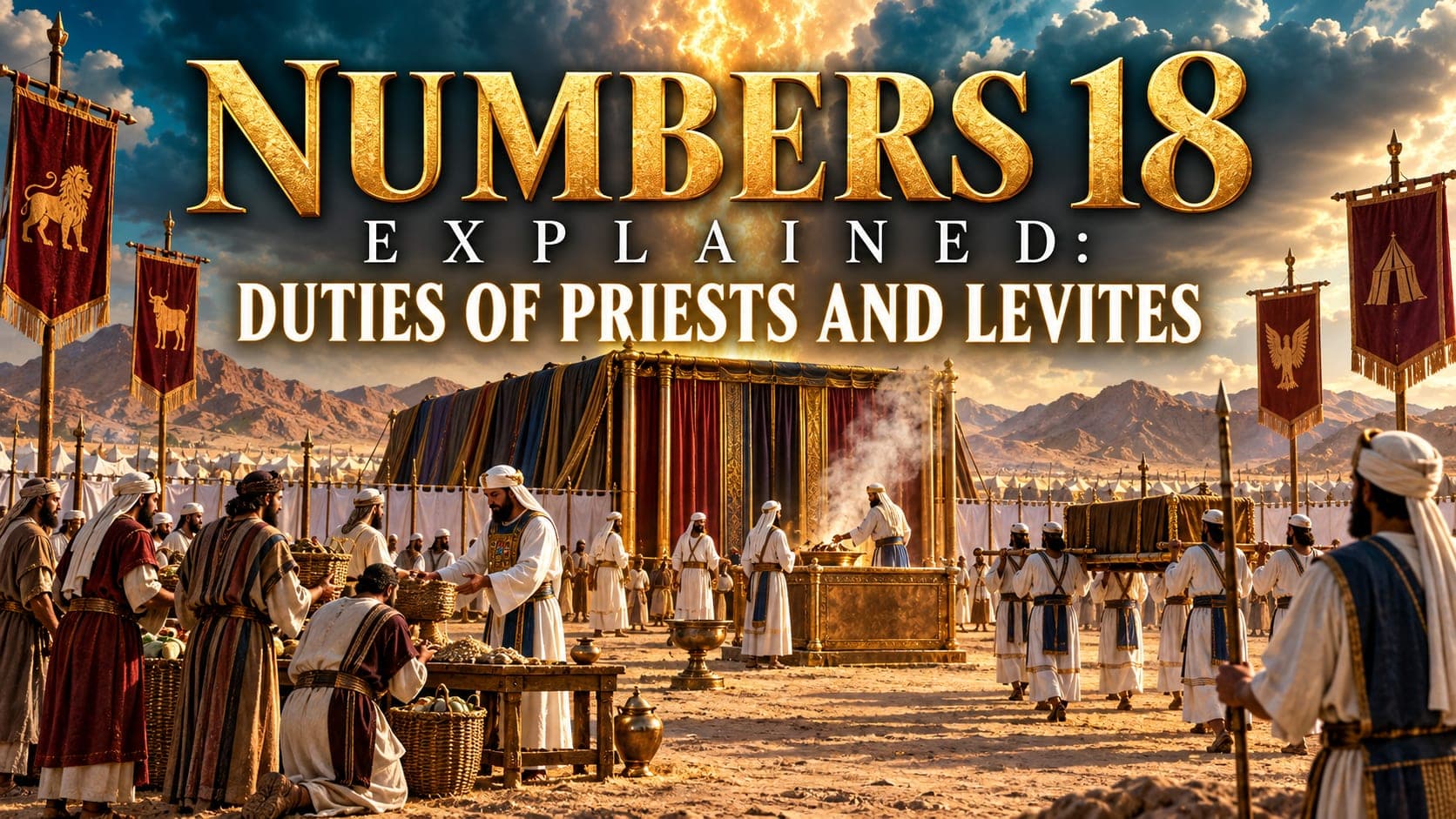
Numbers 18 explained is God's direct answer to that fear, and this time the LORD does not speak to Moses first. He speaks to Aaron. The chapter lays out, in plain legal terms, exactly who carries the danger of serving at the tabernacle, what that job costs them, and what they get paid for carrying it. No earthquake here. No fire. Just a careful, permanent arrangement so ordinary Israelites never have to risk what Korah risked again.
Maybe you have wondered what it actually costs someone to stand between you and danger so you never have to.
- ❓ Why does God speak to Aaron here instead of Moses?
- ❓ What does it mean to "bear the iniquity of the sanctuary"?
- ❓ Who exactly is the "stranger" this chapter keeps warning about?
- ❓ Why do the Levites have to pay a tithe out of the tithe they already collected?
📌 Numbers 18 trades a wall of fear for a wall of people. Aaron and the Levites step into the danger zone permanently, so the rest of Israel never has to stand there again.
This walkthrough goes through the whole chapter in order: the charge handed to Aaron and his sons, the portion they are given to live on, the firstborn that must be redeemed or sacrificed, the inheritance Aaron receives instead of land, and the tithe of the tithe that keeps the whole system honest.
A chapter of law. Written to answer a cry of fear with a working plan.
What Happened Just Before This Chapter
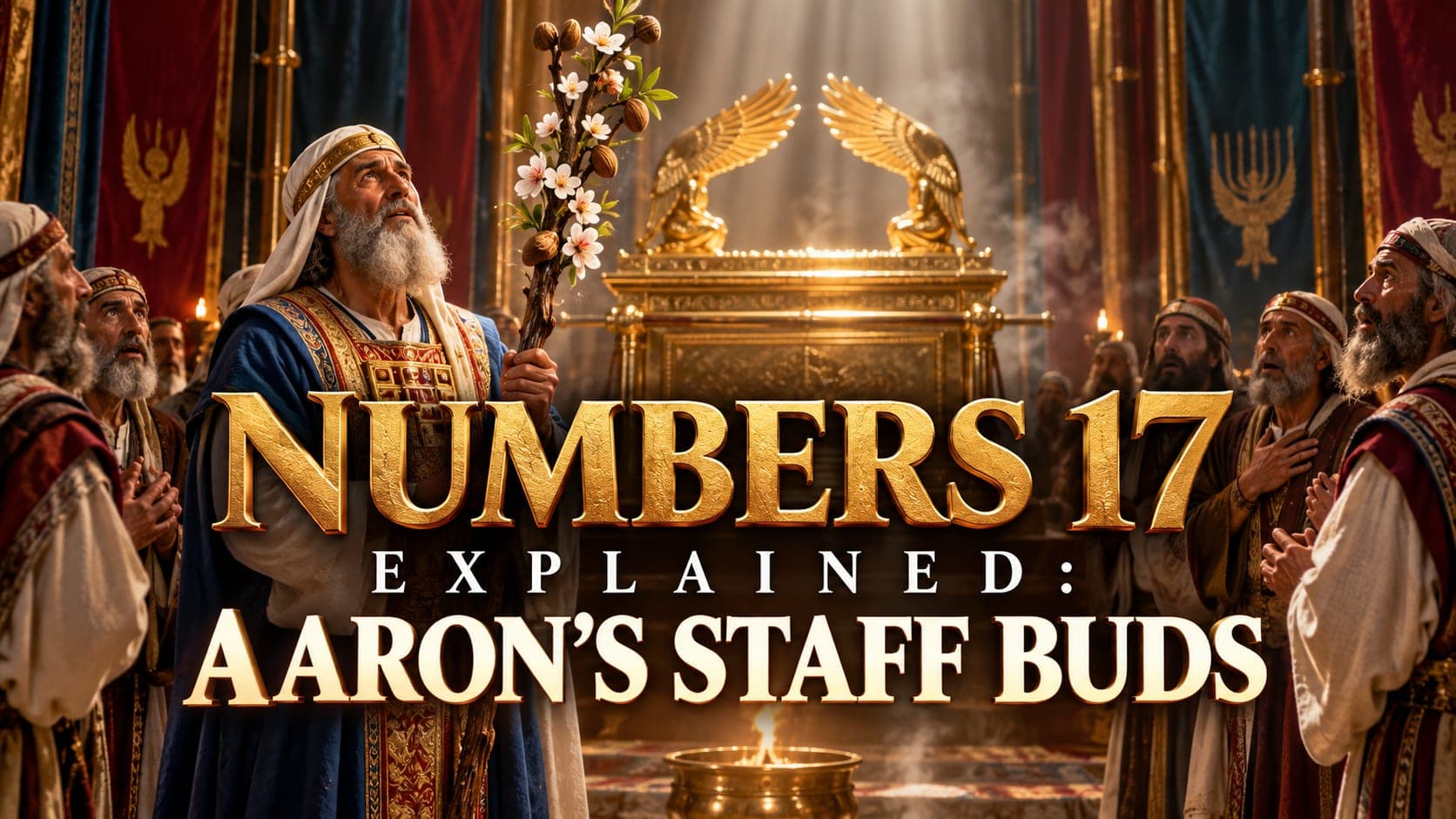
Numbers 17 ended with Aaron's rod budding, blooming, and bearing almonds overnight, the gentlest sign in a book that had just seen the ground swallow men alive and fire fall from heaven in Numbers 16. Even a peaceful sign could not calm the camp. The people cried out that coming near the tabernacle at all now meant death, and that nobody, themselves included, could survive it.
Numbers 18 is God's direct reply to that cry. Not a comforting word. A working system. If ordinary Israelites are too afraid to come near the tabernacle, then ordinary Israelites will not have to. Aaron and the Levites will stand in that gap instead, permanently, and this chapter spells out exactly what that costs them and what they receive for it.

Numbers 18 Explained Verse by Verse
1. God Speaks to Aaron Directly, Not Moses (verses 1 to 7)
The chapter opens with something this book almost never does.
"And the LORD said unto Aaron, Thou and thy sons and thy father's house with thee shall bear the iniquity of the sanctuary: and thou and thy sons with thee shall bear the iniquity of your priesthood."
📌 Almost every instruction in Numbers comes to Moses first. This one comes to Aaron. After two chapters where Aaron's right to the priesthood was openly challenged and then confirmed by a budding rod, God now speaks to him personally about what that priesthood actually requires. "Bear the iniquity of the sanctuary" means Aaron and his sons personally answer for anything that goes wrong in how the holy things are handled. The job is not only honor. It is legal exposure.
The next verses bring the Levites in to help carry that weight, with limits.
"And thy brethren also of the tribe of Levi, the tribe of thy father, bring thou with thee, that they may be joined unto thee, and minister unto thee: but thou and thy sons with thee shall minister before the tabernacle of witness. And they shall keep thy charge, and the charge of all the tabernacle: only they shall not come nigh the vessels of the sanctuary and the altar, that neither they, nor ye also, die."
The Levites get real work and real risk, guarding and serving the tabernacle grounds. But a line still exists even inside that assignment. They cannot touch the altar or the sanctuary vessels themselves. That line is not red tape. It is the same line Korah died crossing in Numbers 16, now written down so clearly that nobody has an excuse to cross it by accident.
"And they shall be joined unto thee, and keep the charge of the tabernacle of the congregation, for all the service of the tabernacle: and a stranger shall not come nigh unto you. And ye shall keep the charge of the sanctuary, and the charge of the altar: that there be no wrath any more upon the children of Israel."
💡 Read that last line slowly. "That there be no wrath any more upon the children of Israel." The whole arrangement exists to stop the kind of death Numbers 16 and 17 just put on display. Aaron and the Levites absorbing the risk is not a punishment. It is the plan that protects everyone else.
Then comes a warning aimed at anyone outside this arrangement who tries to step in anyway.
"Therefore thou and thy sons with thee shall keep your priest's office for everything of the altar, and within the vail; and ye shall serve: I have given your priest's office unto you as a service of gift: and the stranger that cometh nigh shall be put to death."
⚠️ "Stranger" here does not mean a foreigner off the street. It means anyone, Israelite or not, who is not from Aaron's own line trying to do the priest's specific work at the altar and inside the veil. Verse 6 calls the Levites themselves "a gift" to Aaron, given by God. The priesthood is also called a gift, not a prize Aaron fought for. Two gifts, handed down from the same hand, both carrying a death penalty attached if anyone outside the gift tries to take it by force.
2. The Priests' Portion: What Aaron and His Sons Receive (verses 8 to 14)
Having laid out the danger, God moves straight into the reward.
"And the LORD spake unto Aaron, Behold, I also have given thee the charge of mine heave offerings of all the hallowed things of the children of Israel; unto thee have I given them by reason of the anointing, and to thy sons, by an ordinance for ever. This shall be thine of the most holy things, reserved from the fire: every oblation of theirs, every meat offering of theirs, and every sin offering of theirs, and every trespass offering of theirs which they shall render unto me, shall be most holy for thee and for thy sons."
📌 The word "heave offering" appears nine times across this one chapter. It describes a portion lifted up and set apart for God, which God then hands straight to the priests as their food and income. Aaron is not scavenging leftovers. He eats from what was actually offered to the LORD, because he and his sons are the ones who represent Israel in offering it.
Verses 11 through 14 widen the list further: the regular wave offerings, the best of the oil, wine, and wheat, the firstfruits, and anything devoted outright to God. Unlike the most holy things in verses 9 and 10, which only priests could eat, these could be shared with their whole household, "every one that is clean in thy house shall eat of it," a provision generous enough to support an entire family, not just the man who served at the altar that week.
3. Redeeming the Firstborn, Sacrificing the Firstlings (verses 15 to 19)
This section reaches back to a claim God made long before this chapter.
"And I, behold, I have taken the Levites from among the children of Israel instead of all the firstborn that openeth the matrix among the children of Israel: therefore the Levites shall be mine; Because all the firstborn are mine; for on the day that I smote all the firstborn in the land of Egypt I hallowed unto me all the firstborn in Israel, both man and beast: mine shall they be: I am the LORD."
Numbers 3 already set up the Levites as a stand in for every firstborn Israelite, going back to the night God spared Israel's firstborn sons in Egypt. Numbers 18 applies the same principle going forward, to every future birth.
"Every thing that openeth the matrix in all flesh, which they bring unto the LORD, whether it be of men or beasts, shall be thine: nevertheless the firstborn of man shalt thou surely redeem, and the firstling of unclean beasts shalt thou redeem."
A firstborn son is not sacrificed. He is redeemed, bought back, for five shekels of silver at a month old, according to verse 16. An unclean animal's firstborn is redeemed the same way. Clean livestock gets a different treatment entirely.
"But the firstling of a cow, or the firstling of a sheep, or the firstling of a goat, thou shalt not redeem; they are holy: thou shalt sprinkle their blood upon the altar, and shalt burn their fat for an offering made by fire, for a sweet savour unto the LORD."
💡 The firstborn of a cow, sheep, or goat cannot be bought back with money because it was already fit to be an actual sacrifice. A human life or an unclean animal could not be offered on the altar at all, so money stood in for them instead. The system treats each category by what it actually was, not by a flat rule applied to everything equally.
This whole arrangement is sealed with a phrase this book has used only once before.
"All the heave offerings of the holy things, which the children of Israel offer unto the LORD, have I given thee, and thy sons and thy daughters with thee, by a statute for ever: it is a covenant of salt for ever before the LORD unto thee and to thy seed with thee."
Leviticus had already required salt in every grain offering, calling it "the salt of the covenant of thy God."
"And every oblation of thy meat offering shalt thou season with salt; neither shalt thou suffer the salt of the covenant of thy God to be lacking from thy meat offering: with all thine offerings thou shalt offer salt."
📌 Salt does not spoil, and in the ancient world a shared meal sealed with salt was treated as a binding, lasting bond between the people at the table. Calling Aaron's portion "a covenant of salt for ever" is God's way of saying this arrangement is not a temporary ration. It is a permanent agreement, as durable as the salt that never breaks down.
4. No Land, Just God Himself: Aaron's Inheritance (verses 20 and 21)
Right after describing everything Aaron receives, God states plainly what Aaron will never receive.
"And the LORD spake unto Aaron, Thou shalt have no inheritance in their land, neither shalt thou have any part among them: I am thy part and thine inheritance among the children of Israel."
📌 Every other tribe will eventually get a measured piece of ground in Canaan. Aaron gets none. Instead, God Himself is named as the inheritance, not as a poetic flourish but as the actual replacement for the farmland and property every other family will hold. Years later, the same promise is repeated to the whole tribe of Levi, not just Aaron's line.
"The priests the Levites, and all the tribe of Levi, shall have no part nor inheritance with Israel: they shall eat the offerings of the LORD made by fire, and his inheritance. Therefore shall they have no inheritance among their brethren: the LORD is their inheritance, as he hath said unto them."
The Levites themselves still need to eat, so God hands them a different kind of inheritance entirely.
"And, behold, I have given the children of Levi all the tenth in Israel for an inheritance, for their service which they serve, even the service of the tabernacle of the congregation."
Every other tribe inherits soil. The Levites inherit a tenth of everyone else's harvest, tied directly to the work they do at the tabernacle rather than to any ground they own.
5. The Tithe of the Tithe: What the Levites Owe Aaron (verses 22 to 32)
The chapter closes by answering the camp's fear directly, then closing one more loop the Levites might otherwise have missed.
"Neither must the children of Israel henceforth come nigh the tabernacle of the congregation, lest they bear sin, and die. But the Levites shall do the service of the tabernacle of the congregation, and they shall bear their iniquity: it shall be a statute for ever throughout your generations, that among the children of Israel they have no inheritance."
📌 This is the exact fix for the fear Israel voiced at the end of Numbers 17. Ordinary Israelites are told plainly not to come near the tabernacle at all. The Levites carry that danger instead, in exchange for the tithe that replaces the land inheritance they will never hold.
But the Levites receiving a tenth of Israel's crops does not mean they keep all of it. God closes the loop with one more instruction.
"Thus speak unto the Levites, and say unto them, When ye take of the children of Israel the tithes which I have given you from them for your inheritance, then ye shall offer up an heave offering of it for the LORD, even a tenth part of the tithe."
💡 A tenth of a tenth. The Levites collect the tithe from eleven other tribes, then hand a tenth of what they collected straight to Aaron and his sons. Nobody in this chain gets to keep everything they receive. Israel gives to the Levites, and the Levites give out of what they were just given, so the whole system stays accountable all the way up.
"Out of all your gifts ye shall offer every heave offering of the LORD, of all the best thereof, even the hallowed part thereof out of it."
Not the worst or the leftover portion. The best of what they received is what goes back out. The chapter ends with one last warning that this is not optional generosity.
"And ye shall bear no sin by reason of it, when ye have heaved from it the best of it: neither shall ye pollute the holy things of the children of Israel, lest ye die."
A chapter that opened with Aaron bearing the risk of the whole sanctuary closes with the Levites facing the same kind of warning if they treat their own tithe carelessly. Nobody in this arrangement is simply collecting a reward with no responsibility attached.

Hard Questions Numbers 18 Raises
Why does God speak to Aaron directly here instead of going through Moses? Verses 1, 8, and 20 all open with God addressing Aaron by name, something this book almost never does elsewhere. Scripture does not explain the shift, but the content fits the audience. This chapter spells out what the priesthood personally costs and pays Aaron, and God delivers that word to the man it is actually about.
Is the "stranger" in this chapter a foreigner? No. In verses 4 and 7, "stranger" means any Israelite who is not a descendant of Aaron trying to do the priest's specific work at the altar or inside the veil. Foreigners are not the subject here at all. The line this chapter draws runs inside Israel's own family, not between Israel and the nations.
Why are some firstborn animals redeemed with money and others sacrificed outright? Verses 15 through 17 draw the line by what the animal actually was. Unclean animals could never be offered on the altar, so a price substituted for them. Clean livestock like cattle, sheep, and goats were already fit to be sacrificed, so no substitute was needed or allowed. The rule follows the nature of each creature rather than treating every firstborn the same.
Does the tithe of the tithe mean Levites were taxed twice? Not exactly. Verse 21 gives the Levites the whole tenth as their inheritance, their actual pay for tabernacle service. Verse 26 then has them setting apart a tenth portion out of what they already received, the same way any Israelite set apart a portion of a harvest as an offering. The Levites are not losing income so much as practicing the same kind of giving everyone else in Israel practiced with their own produce.
Top Verses From Numbers 18
1. Numbers 18:1
"And the LORD said unto Aaron, Thou and thy sons and thy father's house with thee shall bear the iniquity of the sanctuary: and thou and thy sons with thee shall bear the iniquity of your priesthood."
God speaks to Aaron directly, naming the real weight behind the priesthood. Serving at the tabernacle meant personally answering for how the holy things were handled.
2. Numbers 18:7
"Therefore thou and thy sons with thee shall keep your priest's office for everything of the altar, and within the vail; and ye shall serve: I have given your priest's office unto you as a service of gift: and the stranger that cometh nigh shall be put to death."
The priesthood is called a gift, not a prize Aaron won by fighting for it. The same chapter that gives it to him also sets the penalty for anyone outside the gift who tries to take it.
3. Numbers 18:20
"And the LORD spake unto Aaron, Thou shalt have no inheritance in their land, neither shalt thou have any part among them: I am thy part and thine inheritance among the children of Israel."
Every other tribe eventually gets measured land. Aaron gets God Himself as his portion instead, named as the actual replacement for property he will never hold.
4. Numbers 18:22 and 23
"Neither must the children of Israel henceforth come nigh the tabernacle of the congregation, lest they bear sin, and die. But the Levites shall do the service of the tabernacle of the congregation, and they shall bear their iniquity: it shall be a statute for ever throughout your generations, that among the children of Israel they have no inheritance."
The direct fix for the fear Israel cried out at the end of Numbers 17. Ordinary Israelites stay back. The Levites carry the risk instead, by permanent arrangement.
5. Numbers 18:26
"Thus speak unto the Levites, and say unto them, When ye take of the children of Israel the tithes which I have given you from them for your inheritance, then ye shall offer up an heave offering of it for the LORD, even a tenth part of the tithe."
A tenth of a tenth. Even the tribe set apart to collect Israel's offerings still gives out of what it receives, keeping the whole system honest from top to bottom.

Frequently Asked Questions About Numbers 18
What is Numbers 18 about?
Numbers 18 lays out the duties, risks, and pay of Aaron's priesthood and the Levites who assist them. It covers what they are given to live on, the firstborn redemption laws, and the tithe system that supports them instead of land.
Why did God speak to Aaron instead of Moses in this chapter?
Verses 1, 8, and 20 all address Aaron by name directly, something rare in Numbers. The content fits the audience: this chapter is about what the priesthood personally costs and pays Aaron, so God delivers it to him.
What does "bear the iniquity of the sanctuary" mean?
Numbers 18:1 means Aaron and his sons personally answer for anything handled wrongly in the sanctuary. The priesthood carried real legal and spiritual exposure, not just honor.
Who is the stranger in Numbers 18?
Not a foreigner. Verses 4 and 7 use "stranger" for any Israelite outside Aaron's family who tries to do the priest's specific work at the altar or inside the veil.
What inheritance did the Levites and priests receive?
No land. Numbers 18:20 and 21 name God Himself as Aaron's portion, and the tithe from the other eleven tribes as the Levites' inheritance, tied to their service rather than to soil.
Why did the Levites have to tithe their own tithe?
Numbers 18:26 has the Levites setting apart a tenth of the tithe they collected from Israel and giving it to Aaron. It kept the system accountable from the people, to the Levites, to the priests.
What is a covenant of salt?
Numbers 18:19 calls Aaron's priestly portion a covenant of salt, language also used in Leviticus 2:13. Salt does not break down, so the phrase marks the agreement as permanent rather than temporary.
Why were some firstborn animals redeemed instead of sacrificed?
Numbers 18:15 through 17 redeems unclean animals and human firstborn sons with money, since neither could be offered on the altar. Clean livestock like cattle, sheep, and goats were sacrificed directly, since they were already fit for the altar.
How does Numbers 18 connect to Numbers 17?
Numbers 17 ended with Israel crying out that coming near the tabernacle meant death. Numbers 18:22 and 23 answers that fear directly, telling ordinary Israelites to stay back while the Levites carry that risk instead, permanently.
Does the heave offering system still apply today?
No. The heave offerings and tithe laws in Numbers 18 were tied to Israel's priesthood and tabernacle worship under the old covenant. Christians read this chapter for what it shows about God's care for those who serve Him, not as a system still in force.
Final Thoughts
Numbers 18 never raises its voice, and it still answers one of the loudest fears in the whole book.
📌 Someone bearing risk for you is never free. Aaron and the Levites did not simply get a safer seat. They took on the exact danger Israel was afraid of, by name, permanently, in exchange for being supported by the people they protected.
📌 A gift can still come with a cost attached. Verse 7 calls the priesthood a gift, and verse 1 calls it a burden Aaron personally bears. Both are true about the same office at the same time.
📌 Nobody in God's arrangement just collects without also giving. Israel gave a tenth to the Levites. The Levites gave a tenth of that tenth to the priests. Every link in the chain both received and released.
You are probably not counting tithes of tithes this week. But someone in your life is likely carrying a weight so that you do not have to.
So here is your one next step.
Name that person, and thank them specifically for the exact thing they are bearing on your behalf, instead of letting their cost stay invisible to you.