📖 Deuteronomy 11 Explained: Your Own Eyes Have Seen
Moses looks at the crowd in front of him and says something strange. I am not talking to your children.
Deuteronomy 11 explained is Moses pressing the argument of the last two chapters into one plain appeal: love God, because you personally watched what He did, and the land you are about to enter runs on a different fuel than the one you just left.
Maybe you have skimmed this chapter as a warm up before the laws start in Deuteronomy 12.
- ❓ Why does Moses say he is not speaking to Israel's children?
- ❓ Why does Egypt get described as a land you water with your foot?
- ❓ Why does Moses repeat the frontlets and doorposts command he already gave in Deuteronomy 6?
- ❓ What is the blessing and curse set on two different mountains?
📌 Deuteronomy 11 is Moses making one last appeal to eyewitnesses before the eyewitnesses are gone and only the stories remain.
Start to finish, the chapter moves from what this generation personally saw, to the kind of land waiting for them, to the choice that land will actually come down to: a blessing or a curse, with nothing left vague about which is which.
Thirty two verses, and almost none of them are new information. They are all urgency.
What Happened Just Before This Chapter
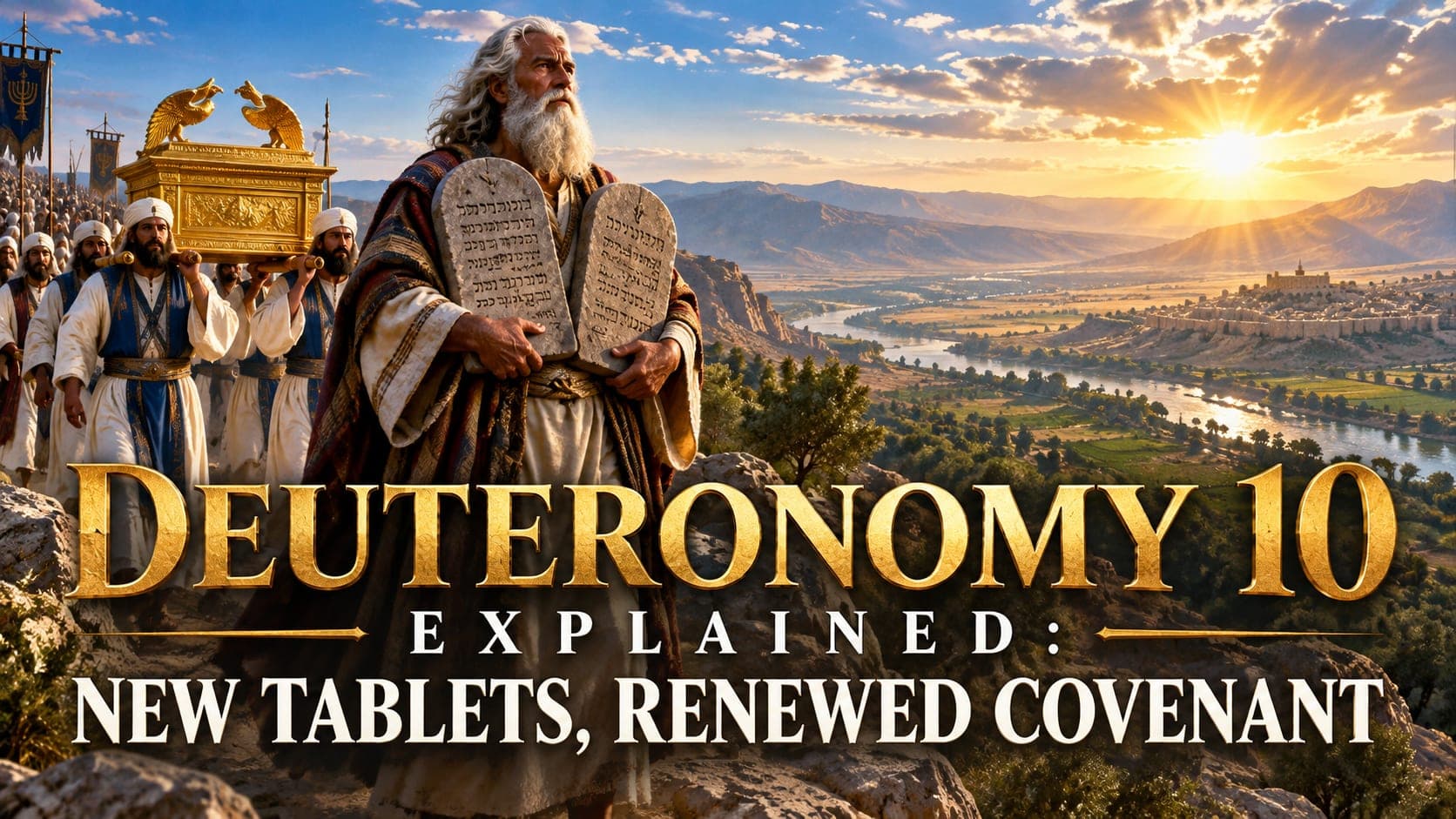
Deuteronomy 10 closed the golden calf story with new stone tables, an ark to carry them, and the Levites set apart with no land of their own. That chapter ended on a short list of what God actually requires, fear, walk, love, serve, keep, and a command to circumcise the heart instead of just the flesh.
Deuteronomy 11 keeps building on that same word, love. Where chapter 10 told Israel what loving God looks like in general terms, this chapter grounds it in something specific: a generation that watched God act with their own eyes, standing at the edge of a land that will test whether that memory holds.

Deuteronomy 11 Explained Verse by Verse
1. Not Your Children's Memory, Yours (verses 1 to 7)
Moses opens with the command that the rest of the chapter unpacks.
"Therefore thou shalt love the LORD thy God, and keep his charge, and his statutes, and his judgments, and his commandments, alway."
Then he says something that stops the flow of the sermon to make a point about who he is actually talking to.
"And know ye this day: for I speak not with your children which have not known, and which have not seen the chastisement of the LORD your God, his greatness, his mighty hand, and his stretched out arm, And his miracles, and his acts, which he did in the midst of Egypt unto Pharaoh the king of Egypt, and unto all his land; And what he did unto the army of Egypt, unto their horses, and to their chariots; how he made the water of the Red sea to overflow them as they pursued after you, and how the LORD hath destroyed them unto this day;"
📌 Moses is talking to the generation that was actually there. The crowd in front of him lived through the plagues, watched Pharaoh's army and its horses and chariots go under the Red Sea, the same crossing Exodus 14 records in detail. Their children, born in the wilderness afterward, know the story only as a story. This is the last sermon where Moses can say to his audience, your own eyes have seen this, and mean it literally.
He widens the memory one more time before moving on.
"And what he did unto you in the wilderness, until ye came into this place; And what he did unto Dathan and Abiram, the sons of Eliab, the son of Reuben: how the earth opened her mouth, and swallowed them up, and their households, and their tents, and all the substance that was in their possession, in the midst of all Israel: But your eyes have seen all the great acts of the LORD which he did."
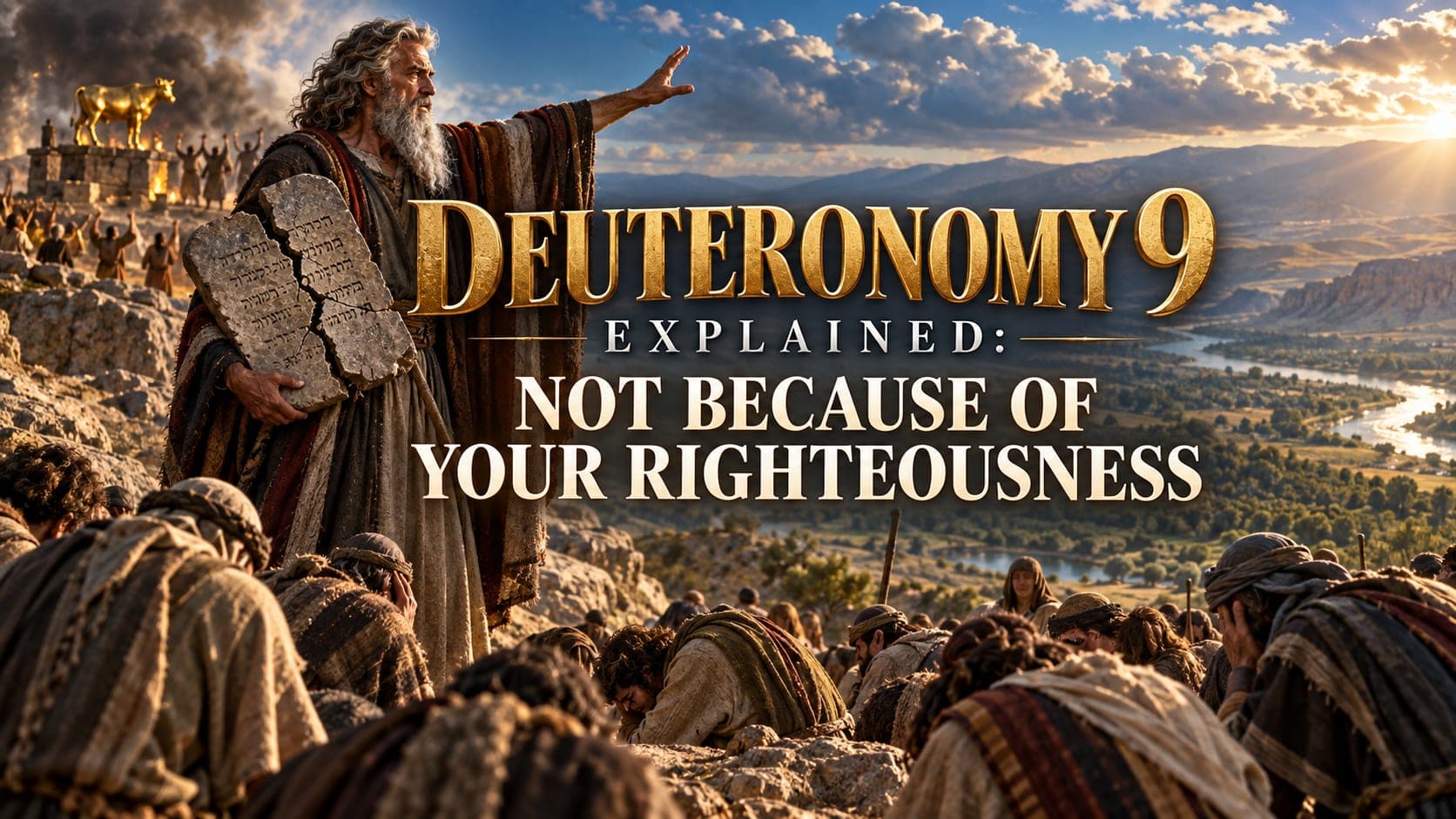
⚠️ Dathan and Abiram's rebellion is told in full in Numbers 16, where they joined Korah in challenging Moses and Aaron and the ground opened under the whole company. Notice who Moses names here and who he leaves out. Korah is not mentioned. Numbers 26 explains why: it records that Dathan and Abiram's line ended that day, but adds one line most readers miss, "the children of Korah died not." Moses is not softening the story. He is simply naming the two families whose line this crowd would have actually known as gone.
2. A Land Watered by Heaven, Not by Your Own Foot (verses 8 to 12)
Moses ties the command to keep the commandments directly to the land ahead.
"Therefore shall ye keep all the commandments which I command you this day, that ye may be strong, and go in and possess the land, whither ye go to possess it; And that ye may prolong your days in the land, which the LORD sware unto your fathers to give unto them and to their seed, a land that floweth with milk and honey."
Then he draws a contrast that would have meant far more to this crowd than it means today.
"For the land, whither thou goest in to possess it, is not as the land of Egypt, from whence ye came out, where thou sowedst thy seed, and wateredst it with thy foot, as a garden of herbs: But the land, whither ye go to possess it, is a land of hills and valleys, and drinketh water of the rain of heaven: A land which the LORD thy God careth for: the eyes of the LORD thy God are always upon it, from the beginning of the year even unto the end of the year."
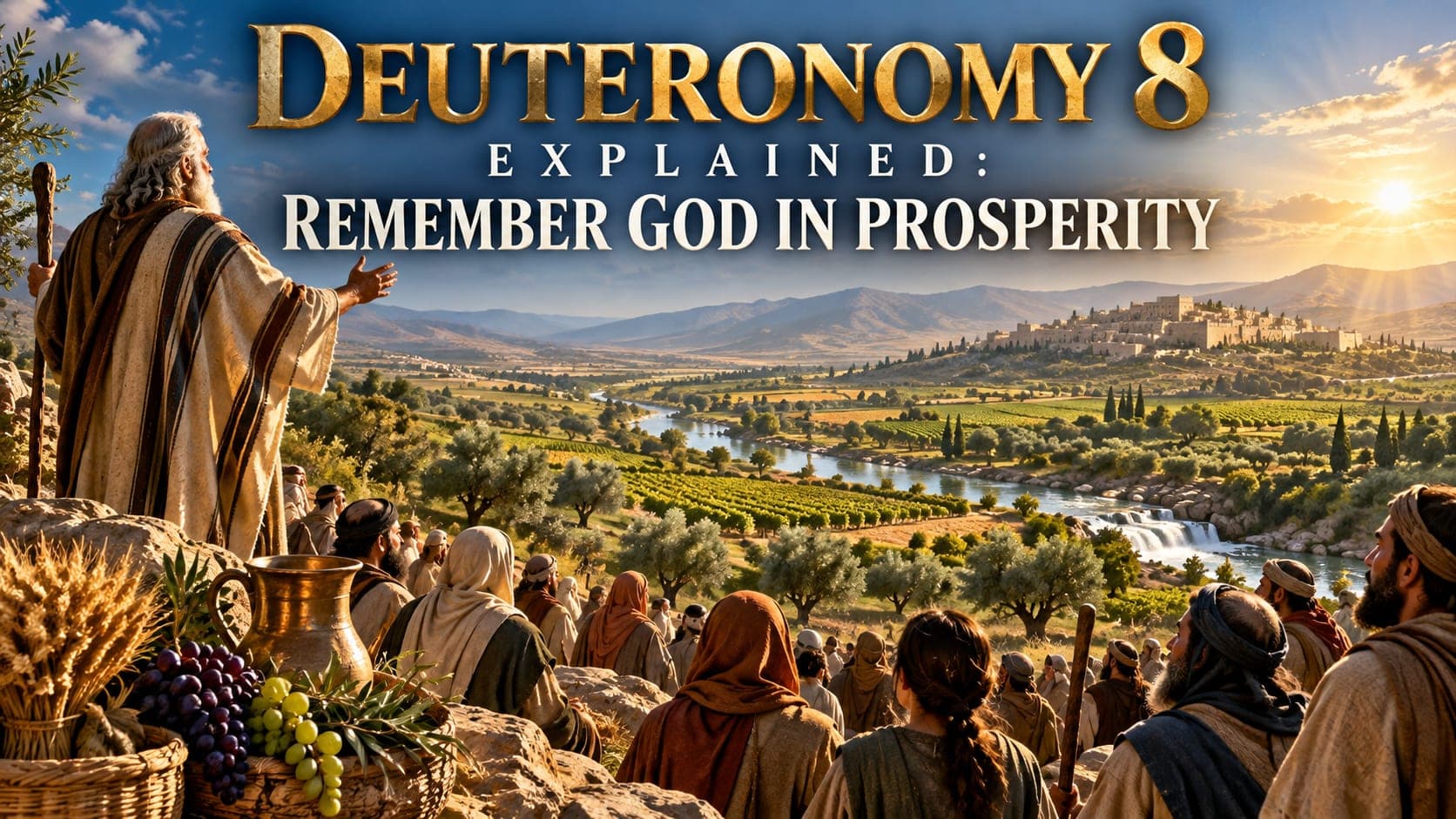
💡 Egypt's farmland sat along the Nile and was worked with foot powered irrigation, channels opened and closed by treading them with your own feet, keeping the water flowing by hand without ever needing to look up. Canaan has no river like that running through it. Its fields live or die on rain falling when it is supposed to fall.
📌 Egypt let a farmer manage his own water supply. Canaan does not. The very geography of the promised land was built to keep Israel looking up instead of down at their own feet.
3. Obedience Tied to Rain (verses 13 to 17)
Having just said the land depends on rain, Moses tells Israel exactly what controls it.
"And it shall come to pass, if ye shall hearken diligently unto my commandments which I command you this day, to love the LORD your God, and to serve him with all your heart and with all your soul, That I will give you the rain of your land in his due season, the first rain and the latter rain, that thou mayest gather in thy corn, and thy wine, and thine oil. And I will send grass in thy fields for thy cattle, that thou mayest eat and be full."
Then the warning that matches the promise, point for point.
"Take heed to yourselves, that your heart be not deceived, and ye turn aside, and serve other gods, and worship them; And then the LORD's wrath be kindled against you, and he shut up the heaven, that there be no rain, and that the land yield not her fruit; and lest ye perish quickly from off the good land which the LORD giveth you."
⚠️ The danger named here is not open rebellion. It is a deceived heart. Nobody plans to turn aside. Verse 16 pictures a slow drift, a heart talked into something it never would have agreed to outright, and the consequence lands on the one thing the land cannot survive without.
4. Bind Them Again (verses 18 to 21)
Moses answers his own warning with nearly the same words he already used once before.
"Therefore shall ye lay up these my words in your heart and in your soul, and bind them for a sign upon your hand, that they may be as frontlets between your eyes. And ye shall teach them your children, speaking of them when thou sittest in thine house, and when thou walkest by the way, when thou liest down, and when thou risest up. And thou shalt write them upon the door posts of thine house, and upon thy gates:"
📌 This is almost word for word what Moses already commanded in Deuteronomy 6, bind them on your hand, wear them as frontlets, write them on your doorposts. That is not Moses running out of new material. He said in verse 2 that he is speaking to people who saw everything with their own eyes. The next generation will not have that. Repeating the exact instruction for passing faith to children, right here at the edge of the land, is Moses making sure the method survives even after the eyewitnesses do not.
Then he states the stakes of that teaching plainly.
"That your days may be multiplied, and the days of your children, in the land which the LORD sware unto your fathers to give them, as the days of heaven upon the earth."
5. From the Wilderness to the River (verses 22 to 25)
Moses connects obedience to the actual size of the land Israel will hold.
"For if ye shall diligently keep all these commandments which I command you, to do them, to love the LORD your God, to walk in all his ways, and to cleave unto him; Then will the LORD drive out all these nations from before you, and ye shall possess greater nations and mightier than yourselves. Every place whereon the soles of your feet shall tread shall be yours: from the wilderness and Lebanon, from the river, the river Euphrates, even unto the uttermost sea shall your coast be."
💡 "The river, the river Euphrates" names the far northeastern edge of the territory God promised, hundreds of miles past where Israel would actually settle day to day. Moses is not promising comfortable borders. He is promising borders bigger than anything this small, recently enslaved nation could take by its own strength.
"There shall no man be able to stand before you: for the LORD your God shall lay the fear of you and the dread of you upon all the land that ye shall tread upon, as he hath said unto you."
📌 The size of the land was never going to be the hard part. Trusting the God who promised it was.
6. A Blessing and a Curse, Set Before You Today (verses 26 to 32)
Moses closes the chapter by putting the whole choice into one image.
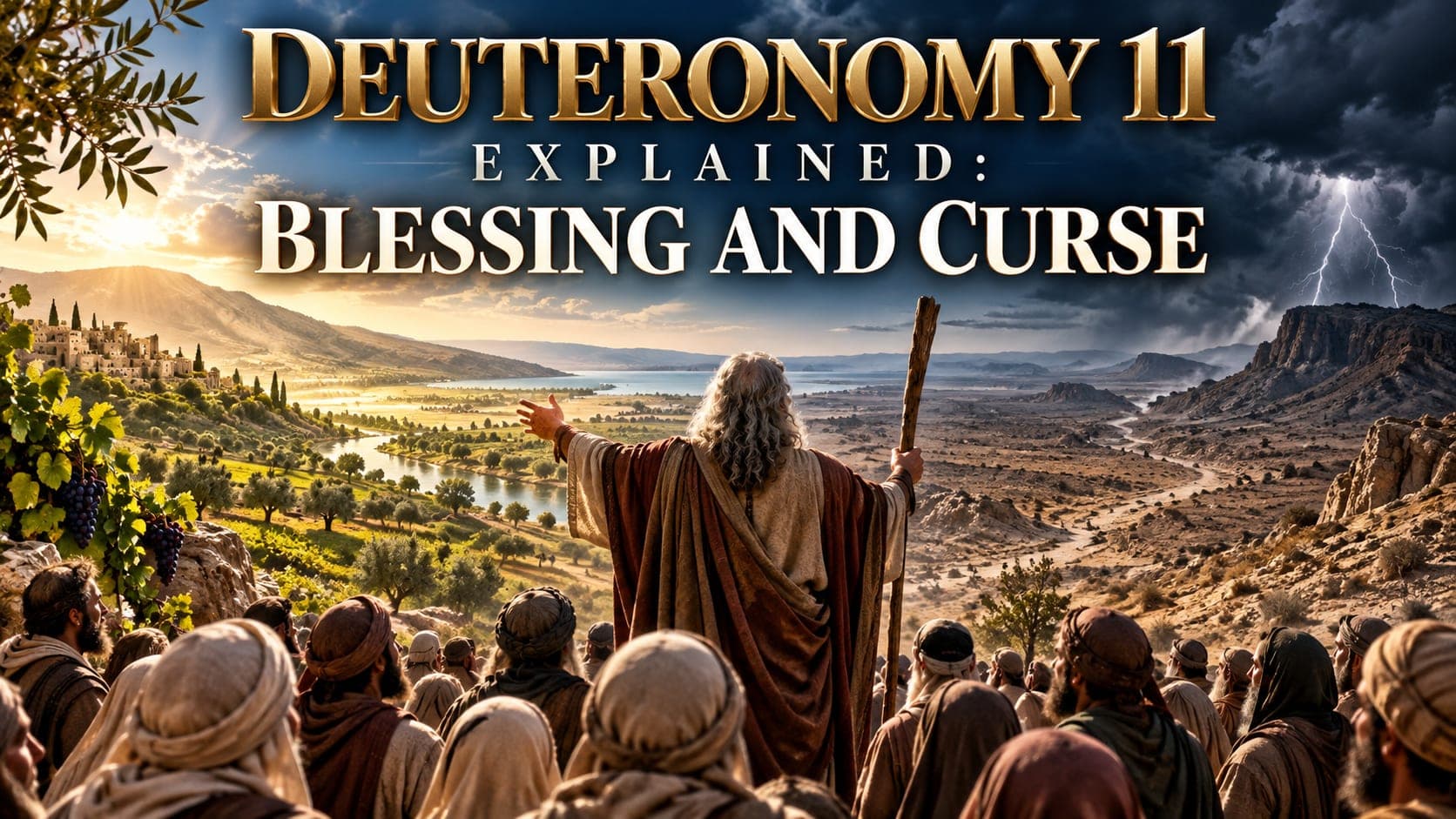
"Behold, I set before you this day a blessing and a curse; A blessing, if ye obey the commandments of the LORD your God, which I command you this day: And a curse, if ye will not obey the commandments of the LORD your God, but turn aside out of the way which I command you this day, to go after other gods, which ye have not known."
Then he gives that blessing and curse an actual address.
"And it shall come to pass, when the LORD thy God hath brought thee in unto the land whither thou goest to possess it, that thou shalt put the blessing upon mount Gerizim, and the curse upon mount Ebal. Are they not on the other side Jordan, by the way where the sun goeth down, in the land of the Canaanites, which dwell in the champaign over against Gilgal, beside the plains of Moreh?"
⚠️ Mount Gerizim and Mount Ebal sit facing each other across a narrow valley near Shechem. Moses is not describing an abstract idea here. He names two real mountains Israel will stand between once they cross the Jordan, and this chapter sets up a ceremony that the rest of Deuteronomy will spell out in detail. The choice is not only going to be preached. It is going to be stood on, physically, between two hillsides.
The chapter ends with the crossing itself, finally named outright.
"For ye shall pass over Jordan to go in to possess the land which the LORD your God giveth you, and ye shall possess it, and dwell therein. And ye shall observe to do all the statutes and judgments which I set before you this day."

Hard Questions Deuteronomy 11 Raises
Why does Moses name Dathan and Abiram but not Korah? Numbers 16 names all three men together in the same rebellion, but Numbers 26:11 adds that Korah's own line did not die with him, while Dathan and Abiram's households did. Moses is speaking to people who would have known exactly whose family line ended that day and whose did not, so naming the two families that were actually wiped out fits the story as his audience actually lived it.
Did Israel's border ever really reach the Euphrates, as verse 24 says? Not as settled, permanently occupied territory. 1 Kings 4:21 records that Solomon reigned over kingdoms "from the river unto the land of the Philistines," meaning those nations paid tribute and recognized his authority that far out, at the height of Israel's power. That is real fulfillment of the promise's reach, but it describes dominion and tribute, not everyday possession of land all the way to the Euphrates the way Israel possessed Canaan itself.
Does this chapter mean sin causes drought for anyone who disobeys God today? The rain and harvest tied to obedience here belong to the specific covenant God made with Israel over this specific land, not a universal rule that any individual Christian's hardship today proves hidden sin. Scripture elsewhere warns directly against that exact assumption. This chapter is describing how one nation's relationship with God was built into the land itself, not a formula to run backward on someone else's weather.
Is the repeated frontlets and doorposts command in verses 18 to 20 just filler left over from Deuteronomy 6? The content is nearly identical on purpose. Moses already explained in verse 2 that he is the last generation who can speak from personal memory. Repeating the exact method for teaching children, right where the chapter turns toward the choice Israel is about to face, makes sure that method does not get lost once eyewitnesses like Moses are gone.
Top Verses From Deuteronomy 11
1. Deuteronomy 11:7
"But your eyes have seen all the great acts of the LORD which he did."
The whole chapter in one sentence. Moses is speaking to witnesses, not to people relying on someone else's account of what God did.
2. Deuteronomy 11:11 and 12
"But the land, whither ye go to possess it, is a land of hills and valleys, and drinketh water of the rain of heaven: A land which the LORD thy God careth for: the eyes of the LORD thy God are always upon it, from the beginning of the year even unto the end of the year."
A land that cannot water itself by hand. Its dependence on rain was never an accident of geography. It was the design.
3. Deuteronomy 11:16 and 17
"Take heed to yourselves, that your heart be not deceived, and ye turn aside, and serve other gods, and worship them; And then the LORD's wrath be kindled against you, and he shut up the heaven, that there be no rain."
A deceived heart, not an outright rebel, is the danger this verse names. The drift is always quieter than the collapse it leads to.
4. Deuteronomy 11:26 to 28
"Behold, I set before you this day a blessing and a curse; A blessing, if ye obey the commandments of the LORD your God, which I command you this day: And a curse, if ye will not obey the commandments of the LORD your God."
No third option is offered. The whole chapter has been building toward this one plain fork in the road.
5. Deuteronomy 11:2
"And know ye this day: for I speak not with your children which have not known, and which have not seen the chastisement of the LORD your God, his greatness, his mighty hand, and his stretched out arm,"
Moses draws a hard line between a generation that watched God act and the generation that will only ever hear about it. Which side of that line a reader stands on changes everything about how a passage like this lands.

Frequently Asked Questions About Deuteronomy 11
What is Deuteronomy 11 about?
Deuteronomy 11 is Moses appealing to the generation that personally witnessed God's acts in Egypt and the wilderness, contrasting Egypt's irrigated farmland with the rain dependent land ahead, and closing with a blessing and curse set before Israel as a real choice tied to obedience.
Why does Moses say he is not speaking to Israel's children in Deuteronomy 11:2?
The adults standing in front of Moses had personally lived through the plagues, the Red Sea, and the wilderness years. Their children, born afterward, only knew those events as secondhand stories. Moses is pointing out that this is the last sermon that can appeal to direct, eyewitness memory.
Who were Dathan and Abiram?
Dathan and Abiram were brothers from the tribe of Reuben who joined Korah's rebellion against Moses and Aaron, told in full in Numbers 16. The ground opened and swallowed them along with their households, and Numbers 26 notes that their family line ended there, unlike Korah's own sons.
What does it mean that Egypt was watered with your foot?
Egypt's farmland along the Nile relied on foot powered irrigation, channels worked open and shut by treading on them, which let a farmer manage his own water supply by hand. Deuteronomy 11:10 uses that image to contrast it with Canaan, which depends entirely on rainfall a person cannot control.
Why does Deuteronomy 11 repeat the frontlets and doorposts command from Deuteronomy 6?
Moses already gave this exact instruction for passing faith to the next generation in Deuteronomy 6. Repeating it in Deuteronomy 11:18 to 20, right after explaining that he is the last generation who can speak from personal memory, makes sure the method for teaching children survives even after the eyewitnesses are gone.
What is the blessing and curse in Deuteronomy 11:26 to 29?
Moses tells Israel that obedience brings blessing and disobedience brings a curse, then assigns each one to a real location: the blessing to Mount Gerizim and the curse to Mount Ebal, two mountains facing each other near Shechem, where a ceremony later in Deuteronomy carries this out physically.
Where are Mount Gerizim and Mount Ebal?
Deuteronomy 11:30 places them on the far side of the Jordan near Shechem, in the land of the Canaanites, facing each other across a narrow valley. Israel would later stand between these two mountains to hear the blessings and curses read aloud.
Did Israel's territory ever actually reach the Euphrates River?
Not as permanently settled land. 1 Kings 4:21 records that Solomon's dominion reached that far at the height of his reign, with surrounding kingdoms paying tribute, but Israel's everyday, continuously occupied territory never extended that far on a lasting basis.
Does Deuteronomy 11 mean God sends drought as punishment for sin today?
This promise and warning belonged to the specific covenant God made with Israel over that specific land. It describes how that one nation's relationship with God was tied to its harvest, not a rule for reading any individual Christian's hardship today as proof of hidden sin.
What is the main lesson of Deuteronomy 11 for today?
That faith passed down secondhand needs more intentional work than faith built on personal memory. Moses spends the chapter making sure a generation that saw everything hands down both the memory and the method for teaching it, before that generation is gone.
Final Thoughts
Deuteronomy 11 is Moses racing against his own absence, and he knows it.
📌 Your own memory of what God has done will not automatically become your children's memory. Verse 2 names that gap honestly instead of pretending it does not exist.
📌 God can build dependence into the very ground you stand on. A land that only drinks rain from heaven keeps a person looking up, long after the miracles that got them there have faded from daily conversation.
📌 A real choice needs a real place to stand. Moses does not leave blessing and curse as ideas. He points at two mountains Israel will actually walk between.
You were not at the Red Sea, and you did not watch the ground open under Dathan and Abiram. Somebody told you those stories, the same way Moses knew somebody would have to tell the next generation of Israel.
So here is your one next step.
Tell someone younger than you one specific thing God has actually done in your own life, the way Moses kept pointing back to what this generation's own eyes had seen.