📖 Deuteronomy 1 Explained: Why Forty Years Replaced Eleven Days
One old man. One camp of people. One last sermon before he can go no further.
That is the whole scene behind the book of Deuteronomy.
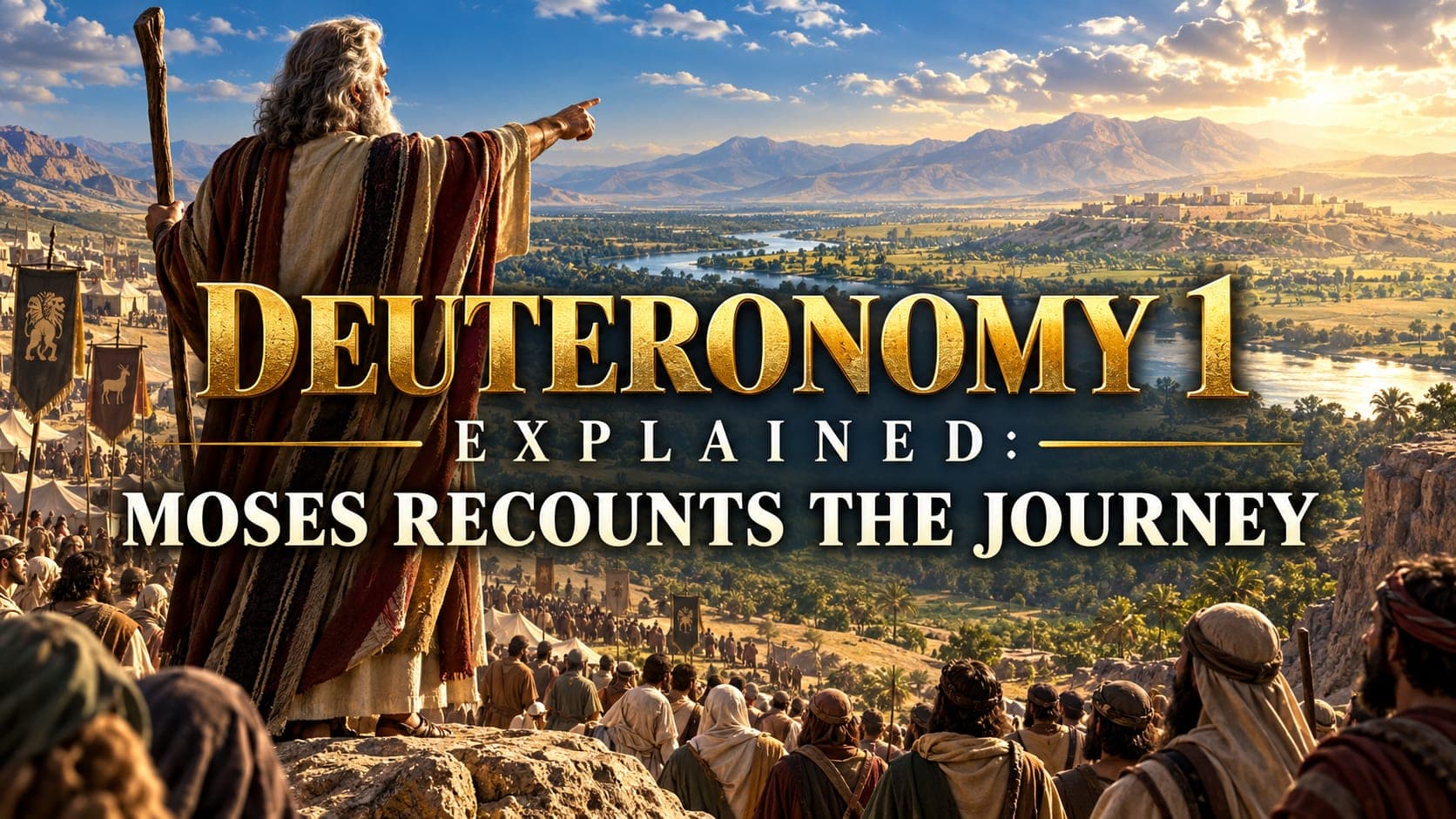
Deuteronomy 1 explained opens the final book of the law with Moses standing on the edge of the promised land he will never enter, retelling the story of how his people got here. Not a new story. The same journey Numbers already told, now aimed straight at a new generation who needs to hear it for themselves.
Maybe you have heard an old story retold by someone who lived through it, and heard it differently the second time.
- ❓ Why does Moses retell a story his listeners already know?
- ❓ How did a journey that should have taken eleven days take forty years?
- ❓ Why does Moses blame the people for his own exclusion from Canaan?
- ❓ What actually went wrong at Kadeshbarnea the first time?
📌 Deuteronomy 1 is Moses handing a new generation the one fact their parents learned the hard way: unbelief costs you the very thing God already promised to give.
This walkthrough goes through the whole chapter in order: where Israel is standing, the command to leave Horeb, the judges Moses appoints, the spies sent into Canaan, the rebellion that followed, and the one failed attack that cost Israel a generation.
Forty six verses, and every one of them is Moses making sure this generation does not repeat the last one's mistake.
What Happened Just Before This Chapter
The book of Numbers ended with Israel camped in the plains of Moab, every border of Canaan already assigned, the law already given, the people simply waiting at the edge of the river. Nearly forty years had passed since they left Egypt. The generation that left Egypt as adults had died in the wilderness, almost to the last person. A new generation, raised entirely outside the promised land, now stands where their parents once stood.
Deuteronomy opens right there, in that same camp, with Moses, now about one hundred and twenty years old and days away from his own death, standing up to speak. He will not cross the Jordan. He knows it. So before he dies, he spends this whole book making sure the people he leads understand exactly how they got here, and exactly what God still expects of them.
Chapter 1 is where that final sermon begins, and it begins by going backward, all the way to a mountain this new generation barely remembers.

Deuteronomy 1 Explained Verse by Verse
1. Setting the Scene: One Sermon, Forty Years in the Making (verses 1 to 5)
The chapter opens by locating the speech precisely, in place and in time.
"These be the words which Moses spake unto all Israel on this side Jordan in the wilderness, in the plain over against the Red sea, between Paran, and Tophel, and Laban, and Hazeroth, and Dizahab."
📌 "Words" is the whole point of this book. Deuteronomy means the second law, not a new law but the same law given again, in sermon form, to a generation who never stood at Sinai themselves. Moses is not introducing new commandments here. He is making sure old commandments survive the handoff to new hearts.
Then comes a detail easy to skip past, and it is the key to the entire book.
"(There are eleven days' journey from Horeb by the way of mount Seir unto Kadeshbarnea.) And it came to pass in the fortieth year, in the eleventh month, on the first day of the month, that Moses spake unto the children of Israel, according unto all that the LORD had given him in commandment unto them;"
⚠️ Read those two verses side by side and the whole chapter sharpens into focus. Horeb to Kadeshbarnea is eleven days on foot. Israel is only now arriving back at this speech in the fortieth year. Moses states the gap without comment, and lets the number do the preaching for him.
Verse 4 adds that Sihon and Og, two kings east of the Jordan, are already defeated. Israel is not weak or stuck. The delay was never about ability. It was about belief, and this chapter is about to show exactly where that belief first failed.
2. The Command That Started Everything: Leave Horeb, Take the Land (verses 6 to 8)
Moses does not start his retelling at Egypt. He starts at Horeb, the same mountain called Sinai, where Israel had been camped for about a year receiving the law.
"The LORD our God spake unto us in Horeb, saying, Ye have dwelt long enough in this mount:"
💡 "Long enough" is a command, not a complaint. Israel was not being punished for staying at Horeb. God had work for them there, the law, the tabernacle, the priesthood. But a mountain where God speaks can quietly become a place you never want to leave, even after its purpose is finished.
The command that follows names the land in full, not in part.
"Turn you, and take your journey, and go to the mount of the Amorites, and unto all the places nigh thereunto, in the plain, in the hills, and in the vale, and in the south, and by the sea side, to the land of the Canaanites, and unto Lebanon, unto the great river, the river Euphrates. Behold, I have set the land before you: go in and possess the land which the LORD sware unto your fathers, Abraham, Isaac, and Jacob, to give unto them and to their seed after them."
📌 The border named here runs all the way to the Euphrates. That is a far larger reach than the actual territory Numbers 34 later marked out for the tribes to divide. The promise to Abraham, Isaac, and Jacob was always bigger than any one generation fully received. Verse 8 ends on that promise on purpose. Before Moses tells the hard part of the story, he reminds everyone the land was never in doubt. Only the people's belief was.
3. Moses Cannot Carry a Nation Alone (verses 9 to 18)
Before the spies and the rebellion, Moses recalls a practical problem that had nothing to do with Canaan at all.
"And I spake unto you at that time, saying, I am not able to bear you myself alone: The LORD your God hath multiplied you, and, behold, ye are this day as the stars of heaven for multitude."
💡 This recalls two separate moments earlier in the journey. Exodus 18 records Jethro first urging Moses to appoint judges for everyday disputes, and Numbers 11 records seventy elders raised up afterward to help carry the weight of leading the people. Moses folds both memories into one simple summary here: he could not do this job alone, and he never pretended otherwise.
The solution he describes is practical, not political.
"So I took the chief of your tribes, wise men, and known, and made them heads over you, captains over thousands, and captains over hundreds, and captains over fifties, and captains over tens, and officers among your tribes."
And the standard he set for them still reads like a courtroom oath today.
"Ye shall not respect persons in judgment; but ye shall hear the small as well as the great; ye shall not be afraid of the face of man; for the judgment is God's: and the cause that is too hard for you, bring it unto me, and I will hear it."
📌 "The judgment is God's" is the reason the favoritism ban exists at all. A judge who tilts toward the powerful is not just being unfair to the poor. He is misrepresenting whose authority the ruling actually carries. That is still true of anyone who has to settle a dispute between two people today.
4. Twelve Spies, and the Report That Split in Two (verses 19 to 33)
Moses now reaches the part of the story everyone listening already knows, and tells it anyway, because it is the whole reason they are forty years behind schedule.
"And when we departed from Horeb, we went through all that great and terrible wilderness, which ye saw by the way of the mountain of the Amorites, as the LORD our God commanded us; and we came to Kadeshbarnea."
At Kadeshbarnea, God repeats the same simple instruction He gave at Horeb.
"Behold, the LORD thy God hath set the land before thee: go up and possess it, as the LORD God of thy fathers hath said unto thee; fear not, neither be discouraged."
Israel's own idea to send spies first was not rebellion by itself. Moses says the idea "pleased me well," and Numbers 13 records the twelve men sent out, one from each tribe, and the cluster of grapes they carried back from Eshcol as proof the land was everything God had said. The spies even agreed on what they saw.
The trouble was never the facts. It was what the people did with them.
"Notwithstanding ye would not go up, but rebelled against the commandment of the LORD your God: And ye murmured in your tents, and said, Because the LORD hated us, he hath brought us forth out of the land of Egypt, to deliver us into the hand of the Amorites, to destroy us."
⚠️ Notice the leap in verse 27. God brought them out of Egypt in love, and in one sentence of fear that gift gets reinterpreted as hatred. Fear does not just make people cautious. It rewrites the whole story of how they got where they are. Numbers 14 records the full scale of that night, the whole camp in tears, ready to pick new leaders and go back to Egypt rather than face giants in Canaan.
Moses answers their fear the same way God had just answered his own earlier worry about leading them.
"The LORD your God which goeth before you, he shall fight for you, according to all that he did for you in Egypt before your eyes; And in the wilderness, where thou hast seen how that the LORD thy God bare thee, as a man doth bear his son, in all the way that ye went, until ye came into this place."
💡 "As a man doth bear his son" is as tender a line as anything in this chapter. Every meal of manna, every pillar of cloud, every year without starving in a wilderness that could not feed them, Moses holds up as proof already in hand. And verse 32 states plainly what happened to that proof anyway.
"Yet in this thing ye did not believe the LORD your God,"
📌 Ten of twelve spies, and an entire camp, did not fail a test of information. They failed a test of trust. Every fact they reported was true. The giants were real, the cities were walled, the land was good. What they lacked was not evidence. It was confidence that the God who had carried them this far would carry them the rest of the way.
5. The Oath, the Exception, and the One Man Still Excluded (verses 34 to 40)
God's response to that unbelief is not a punishment handed out in anger alone. It is a sworn, specific sentence.
"And the LORD heard the voice of your words, and was wroth, and sware, saying, Surely there shall not one of these men of this evil generation see that good land, which I sware to give unto your fathers, Save Caleb the son of Jephunneh; he shall see it, and to him will I give the land that he hath trodden upon, and to his children, because he hath wholly followed the LORD."
📌 "Wholly followed" is the one qualifier that separates Caleb from everyone else in his generation. He was not sinless. He simply did not join the fear when it mattered most, and God names that difference specifically rather than letting Caleb disappear into a single sweeping judgment.
Then Moses says something about himself that is easy to misread if you only know the Numbers account.
"Also the LORD was angry with me for your sakes, saying, Thou also shalt not go in thither. But Joshua the son of Nun, which standeth before thee, he shall go in thither: encourage him: for he shall cause Israel to inherit it."
⚠️ "For your sakes" is not Moses dodging his own responsibility. It is Moses, decades later, choosing to tie his own exclusion to the people he is speaking to, because their unbelief at Kadeshbarnea is the setting that eventually led to his failure at the rock. The verse does not erase what happened; it widens the frame around it.
6. The Battle Nobody Was Told to Fight (verses 41 to 46)
Chastened and frightened by God's sentence, the people suddenly want to fight the very battle they had just refused.
"Then ye answered and said unto me, We have sinned against the LORD, we will go up and fight, according to all that the LORD our God commanded us. And when ye had girded on every man his weapons of war, ye were ready to go up into the hill."
It sounds like repentance. God's answer shows it was only regret over the consequence, not a real change of heart.
"And the LORD said unto me, Say unto them, Go not up, neither fight; for I am not among you; lest ye be smitten before your enemies."
They went anyway, and the result was exactly what God had warned.
"So I spake unto you; and ye would not hear, but rebelled against the commandment of the LORD, and went presumptuously up into the hill. And the Amorites, which dwelt in that mountain, came out against you, and chased you, as bees do, and destroyed you in Seir, even unto Hormah."
📌 Twice in one chapter Israel gets the timing backward. First they refused to go up when God said go. Then they insisted on going up when God said stay. Obedience a day late or a step ahead of God still is not obedience. The chapter closes on the result of that second mistake.
"And ye returned and wept before the LORD; but the LORD would not hearken to your voice, nor give ear unto you. So ye abode in Kadesh many days, according unto the days that ye abode there."

Hard Questions Deuteronomy 1 Raises
Why does Moses blame the people for his own exclusion, when Numbers 20 blames Moses himself? Both are true, and neither cancels the other out. In Numbers 20, Moses strikes the rock in anger instead of speaking to it as God commanded, and God names that act directly.
"And the LORD spake unto Moses and Aaron, Because ye believed me not, to sanctify me in the eyes of the children of Israel, therefore ye shall not bring this congregation into the land which I have given them."
💡 Deuteronomy 1:37 does not contradict that verse. It supplies the setting around it. Moses had spent decades absorbing the pressure of a people who complained, rebelled, and doubted at nearly every turn, going back to this very chapter. His own failure at the rock was his sin, but Moses himself, speaking years later, is honest that it did not happen in a vacuum.
Why retell a story everyone listening already lived through? Because most of the listeners did not live through it. The adults who stood at Horeb and Kadeshbarnea the first time are almost entirely dead by this point. Deuteronomy is not written for the generation that failed. It is written for their children, who need the warning as much as the promise, in their own ears, from the one man who watched the whole thing happen.
Was the eleven day detail meant to be taken as a literal travel time? Almost certainly, and that is exactly why it carries weight. Horeb to Kadeshbarnea by the way of mount Seir really is a short, direct route. Moses is not rounding a vague estimate. He is stating a specific number so the forty years that followed cannot be mistaken for an unavoidable delay. It was avoidable. It was chosen.
Does this chapter blame an entire generation for the failure of some of them? The text is careful here. Verse 36 singles out Caleb by name for his different response, and Joshua is named separately in verse 38. The judgment in verse 35 falls on "this evil generation" as a whole because the rebellion itself was a whole camp weeping and planning a return to Egypt, not a handful of troublemakers the rest quietly disagreed with.
Top Verses From Deuteronomy 1
1. Deuteronomy 1:2
"(There are eleven days' journey from Horeb by the way of mount Seir unto Kadeshbarnea.)"
The number that explains the entire chapter. An eleven day walk became a forty year delay, and the gap between those two numbers is the real subject of everything Moses is about to say.
2. Deuteronomy 1:17
"Ye shall not respect persons in judgment; but ye shall hear the small as well as the great; ye shall not be afraid of the face of man; for the judgment is God's: and the cause that is too hard for you, bring it unto me, and I will hear it."
A standard for judging fairly that still applies to any dispute settled between people today, because the reasoning behind it never changes. The judgment belongs to God first.
3. Deuteronomy 1:21
"Behold, the LORD thy God hath set the land before thee: go up and possess it, as the LORD God of thy fathers hath said unto thee; fear not, neither be discouraged."
The instruction Israel had, in full, before a single spy was ever sent. Every later failure in the chapter is a failure to simply believe this one sentence.
4. Deuteronomy 1:32
"Yet in this thing ye did not believe the LORD your God,"
Nine words that name the real diagnosis behind forty years in the wilderness. Not a lack of evidence. A lack of trust in the God who had already proven Himself.
5. Deuteronomy 1:36
"Save Caleb the son of Jephunneh; he shall see it, and to him will I give the land that he hath trodden upon, and to his children, because he hath wholly followed the LORD."
One man, named individually in the middle of a national judgment, because he wholly followed the LORD when an entire camp did not. God never loses track of the exception.

Frequently Asked Questions About Deuteronomy 1
What is Deuteronomy 1 about?
Deuteronomy 1 opens Moses' final sermon to Israel, delivered in the plains of Moab after nearly forty years in the wilderness. He retells the command to leave Horeb, the appointing of judges, the twelve spies sent to Canaan, Israel's rebellion at Kadeshbarnea, and the failed attack at Hormah that followed it.
Why does Deuteronomy retell events already told in Numbers?
The generation that lived through Horeb and Kadeshbarnea had almost entirely died in the wilderness. Moses is speaking to their children, who need to hear the warning and the promise directly, before he dies and they cross into Canaan without him.
Why did an eleven day journey take Israel forty years?
Deuteronomy 1:2 states that Horeb to Kadeshbarnea is a journey of eleven days. Instead, Israel spent forty years reaching the same region again because of the unbelief described later in the chapter, when the people refused to trust God after hearing the spies' report in Numbers 13 and 14.
Where was Horeb, and why does Deuteronomy use that name instead of Sinai?
Horeb and Sinai refer to the same mountain where Israel received the law. Deuteronomy consistently calls it Horeb, the name used throughout this book, while Exodus and Numbers more often use Sinai.
Who were the judges Moses appointed in Deuteronomy 1?
Moses recalls choosing wise, known men from each tribe as captains over thousands, hundreds, fifties, and tens, and as officers to judge disputes fairly. This recalls the plan Jethro first suggested in Exodus 18 and the burden sharing described again in Numbers 11.
Why was Caleb allowed into the promised land when the rest of his generation was not?
Deuteronomy 1:36 says Caleb "wholly followed the LORD," setting him apart from the rest of the spies and the camp that rebelled. Joshua, named separately in verse 38, was also spared for the same reason.
Did Moses lose the promised land because of the people's sin or his own?
Both are part of the true story. Numbers 20 records Moses striking the rock in disobedience as the direct cause. Deuteronomy 1:37 adds that this happened within the larger pattern of unbelief the people had already shown, which Moses names honestly without using it to excuse his own failure.
What is Kadeshbarnea?
Kadeshbarnea was the camp on the southern edge of Canaan where the twelve spies were sent out and where Israel later rebelled against God's command to go up and take the land. Israel ended up staying in that same region for most of the forty years in the wilderness.
What happened at Hormah in Deuteronomy 1?
After God told Israel not to fight, the people went up into the hill country anyway. The Amorites met them, chased them, and defeated them all the way to Hormah, a direct result of disobeying God a second time within the same chapter.
Final Thoughts
Deuteronomy 1 is a hard chapter to sit with, because the math in it is so plain.
📌 Unbelief does not just delay a promise. It can cost you the chance to see it fulfilled at all. Eleven days became forty years, and an entire generation, Caleb and Joshua excepted, never set foot in the land they were already standing near.
📌 Fear rewrites your own story if you let it. The same God who carried Israel out of Egypt in love got recast, in one night of panic, as a God who hated them. Watch what fear tells you about God's character before you believe it.
📌 Honesty about failure, even your own, does not require hiding the full picture. Moses names his own exclusion from Canaan without pretending it was only the people's fault, and without pretending it happened in isolation from everything they had already put him through.
You are probably not standing at the edge of a literal promised land this week. But you likely have a promise from God you have been circling for longer than it should have taken to reach.
So here is your one next step.
Ask honestly whether the delay in front of you is really God's timing, or your own unbelief wearing timing as a disguise.