📖 Exodus 26 Explained: The Tabernacle's Walls, Coverings, and Veil
No furniture gets built in this chapter. Not one object you could carry out and use.
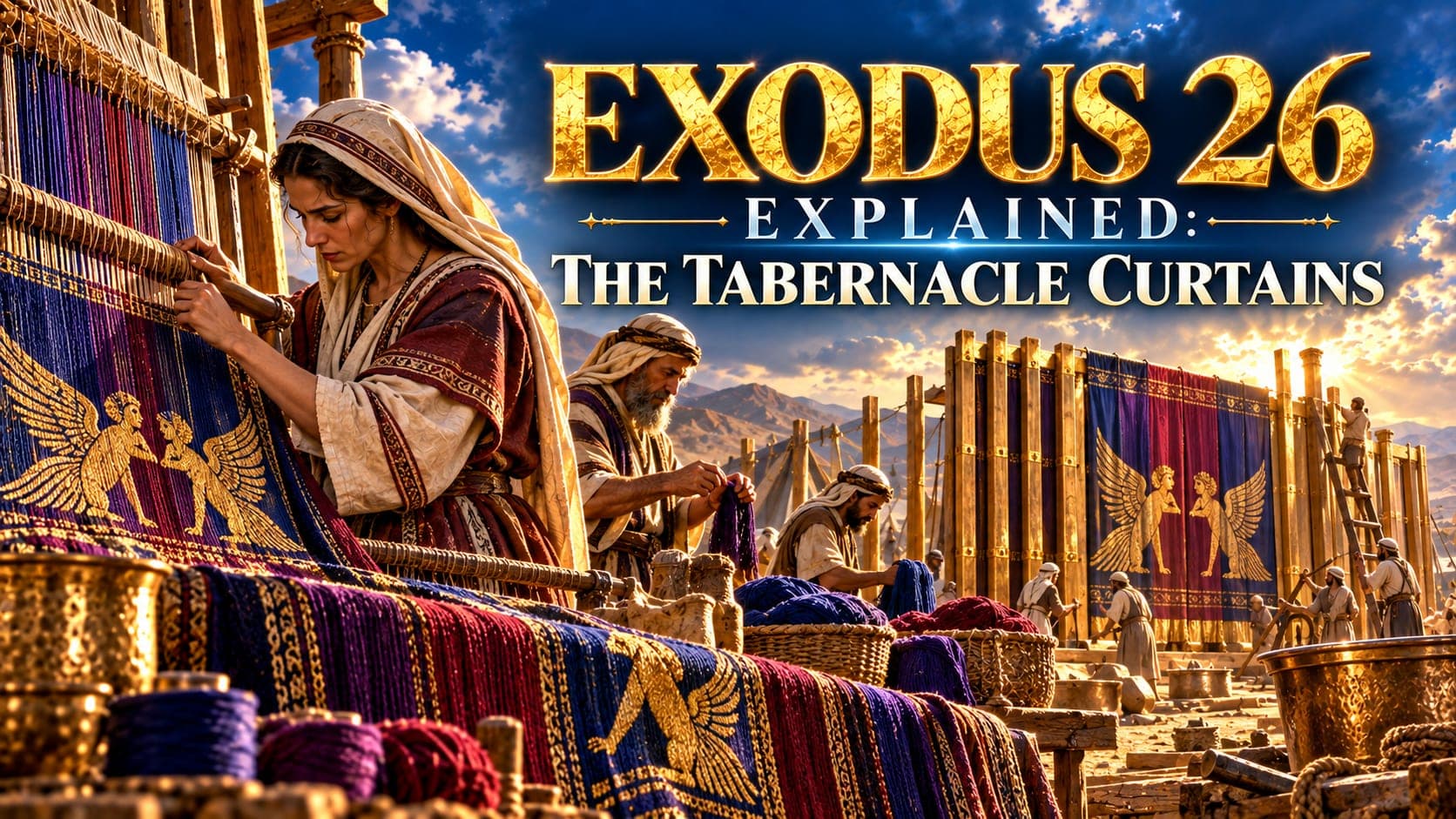
Exodus 26 explained is the chapter where God tells Moses how to build the building itself: four layers of curtains stacked on top of each other, gold plated walls standing in silver sockets, and a single curtain thick enough to separate heaven's address from everyone else's.
Maybe you have pictured the tabernacle as a tent and left it at that.
- ❓ Why does a tent need four separate layers of covering?
- ❓ Why gold on the inside walls and brass on the outside hooks?
- ❓ What exactly was the veil, and why did it matter so much that it had its own cherubim?
- ❓ What happened to that same veil centuries later, on a Friday afternoon in Jerusalem?
📌 Every layer in this chapter answers the same question: how close can sinful people get to a holy God, and where exactly does that closeness stop.
This walkthrough goes through the whole chapter in order: the inner linen curtains woven with cherubim, the rougher coverings laid over them, the gold boards standing on a silver foundation, the bars that locked the walls into one structure, the veil that divided the tabernacle in two, and the plain hanging that marked its only door.
From the outside, this building looked ordinary. Nothing about the outside told you what was folded inside it.
What Happened Just Before This Chapter
Exodus 25 gave Moses the furniture list: the ark and its mercy seat, the table for the bread, and the gold lampstand, each one built "after the pattern" shown to him on the mountain. What that chapter never said was where any of it would actually sit, or what would keep the rain, the wind, and the desert sun off a wooden box covered in gold.
Exodus 26 answers that. This is the architecture chapter. No gold rings, no cherubim statues, no bread. Just curtains, boards, bars, sockets, and one piece of fabric that mattered more than almost anything else in the whole tabernacle.
Exodus 26 Explained Verse by Verse
1. The Inner Curtains, Woven With Cherubim (verses 1 to 6)
The first layer named is also the one no one outside the tabernacle would ever see.
"Moreover thou shalt make the tabernacle with ten curtains of fine twined linen, and blue, and purple, and scarlet: with cherubims of cunning work shalt thou make them."
💡 "Cunning work" does not mean clever trickery. It means skilled craftsmanship, the cherubim woven directly into the linen threads rather than stitched on afterward. Ten curtains, dyed blue, purple, and scarlet, each one carrying the same creatures that once stood guard at Eden.
Two sets of five curtains were joined together, then fastened to each other with loops and clasps.
"And thou shalt make fifty taches of gold, and couple the curtains together with the taches: and it shall be one tabernacle."
📌 Fifty gold clasps turned two separate pieces of fabric into one tabernacle. The seam where the two curtains met was not left loose or hidden. It was closed with gold, inside the one layer closest to the holy objects themselves.
2. The Rougher Layers Laid Over It (verses 7 to 14)
Over that woven linen, God orders a second curtain made from a completely different material.
"And thou shalt make curtains of goats' hair to be a covering upon the tabernacle: eleven curtains shalt thou make."
Eleven goat hair curtains, one more than the ten linen curtains underneath, so the extra length could hang down and cover the back of the structure. This layer was joined the same way as the first, with loops and clasps, except the clasps here were brass, not gold.
"And thou shalt make fifty taches of brass, and put the taches into the loops, and couple the tent together, that it may be one."
📌 Gold clasps stayed inside, out of sight. Brass clasps faced the weather. Nothing in this chapter wastes the more costly metal on a surface nobody holy would ever touch.
Two more layers finish the covering, named in a single short verse.
"And thou shalt make a covering for the tent of rams' skins dyed red, and a covering above of badgers' skins."
💡 The identity of the Hebrew animal behind "badgers' skins" is genuinely disputed among translators, with sea cow or porpoise hide suggested as often as badger. Whatever the animal, its hide formed the outermost, toughest surface, the one layer actually exposed to sun and sand every day.
A visitor walking past the camp would have seen weathered hide and nothing else. Woven linen and gold threaded cherubim sat three layers underneath, completely hidden from view.
3. Gold Covered Walls Standing on Silver (verses 15 to 25)
Curtains need something to hang on. That something turns out to be a wall of standing boards.
"And thou shalt make boards for the tabernacle of shittim wood standing up. Ten cubits shall be the length of a board, and a cubit and a half shall be the breadth of one board."
💡 At roughly eighteen inches to a cubit, each board stood about fifteen feet tall and two and a quarter feet wide, cut from the same acacia wood used for the ark. Each board had two tenons cut into its base, like two pegs, fitted into a matching pair of sockets below.
"And thou shalt make forty sockets of silver under the twenty boards; two sockets under one board for his two tenons, and two sockets under another board for his two tenons."
Twenty boards on the south side, forty silver sockets beneath them. Verses 20 and 21 repeat the exact same count for the north side: twenty boards, forty sockets of silver. The west side, facing the back of the tabernacle, used fewer boards, six in the middle and two built specifically for the corners.
"And they shall be eight boards, and their sockets of silver, sixteen sockets; two sockets under one board, and two sockets under another board."
📌 Every board in every wall stood on silver, never directly on the ground. Then gold covered the boards themselves.
"And thou shalt overlay the boards with gold, and make their rings of gold for places for the bars: and thou shalt overlay the bars with gold."
Gold on the visible surface, silver underneath carrying the weight. A visitor standing inside the holy place, surrounded by walls like this, would have been looking at solid gold on every side, held up by a foundation they could not see.
4. The Bars That Locked the Walls Together (verses 26 to 30)
Standing boards on their own would still sway. God orders horizontal bars to hold the whole wall rigid.
"And thou shalt make bars of shittim wood; five for the boards of the one side of the tabernacle, And five bars for the boards of the other side of the tabernacle, and five bars for the boards of the side of the tabernacle, for the two sides westward."
Five bars, three separate times, for the south wall, the north wall, and the west wall: fifteen bars total, slid through gold rings on the outside face of the boards.
"And the middle bar in the midst of the boards shall reach from end to end."
⚠️ The middle bar on each wall ran the whole length of the wall in one piece, not board by board. That one long bar was what actually kept the gold panels from leaning apart once the tent was raised. Then the chapter repeats a phrase it already used once in Exodus 25.
"And thou shalt rear up the tabernacle according to the fashion thereof which was shewed thee in the mount."
📌 The wall, not only the furniture inside it, was something Moses copied, not something he designed. The same pattern language that framed the ark and the lampstand now covers the boards and bars holding the building up.
5. The Veil That Divided Holy From Most Holy (verses 31 to 35)
One more curtain gets built, and this one is not about keeping out weather.
"And thou shalt make a vail of blue, and purple, and scarlet, and fine twined linen of cunning work: with cherubims shall it be made:"
Same materials as the inner curtains back in verse 1, same cherubim woven into the thread. This fabric hung on four pillars of gold covered acacia wood, standing in their own four sockets of silver, the same silver foundation used under the walls themselves.
Then comes the verse that names exactly what this curtain was for.
"And thou shalt hang up the vail under the taches, that thou mayest bring in thither within the vail the ark of the testimony: and the vail shall divide unto you between the holy place and the most holy."
📌 One curtain, hung in one place, split the entire tabernacle into two rooms with two very different levels of access. The outer room, the holy place, was where the priests worked daily. Past the veil, the most holy place held only the ark, and only the high priest entered there, and only once a year.
"And thou shalt put the mercy seat upon the ark of the testimony in the most holy place. And thou shalt set the table without the vail, and the candlestick over against the table on the side of the tabernacle toward the south: and thou shalt put the table on the north side."
This is where the furniture from Exodus 25 finally gets placed on a map. The ark and mercy seat go behind the veil, alone. The table sits on the north side of the outer room, the candlestick across from it on the south side, lighting a room the ark no longer shares with them.
The cherubim that once guarded the way back into Eden in Genesis 3 are not carved into gold here. They are woven into the one curtain that decides how far anyone, even a priest, is allowed to walk.
6. The Door of the Tent (verses 36 and 37)
The chapter ends at the only entrance the whole structure had.
"And thou shalt make an hanging for the door of the tent, of blue, and purple, and scarlet, and fine twined linen, wrought with needlework."
"And thou shalt make for the hanging five pillars of shittim wood, and overlay them with gold, and their hooks shall be of gold: and thou shalt cast five sockets of brass for them."
💡 Same colors as the veil. Same needlework quality. One detail is missing on purpose: no cherubim are named in this hanging. The creatures guarding sacred space are woven only into the veil deeper inside, never into the curtain the public actually walked past.
⚠️ And the five pillars holding up this door stood in sockets of brass, not silver. The tabernacle had exactly one door, and even its foundation was built from a lesser metal than everything standing further inside it.

Hard Questions Exodus 26 Raises
Why gold near the ark and brass at the door? The text never explains its own reasoning in so many words, but the pattern is consistent and easy to trace: gold clasps and gold overlaid boards surround the most holy place, brass clasps and brass sockets sit at the tabernacle's outer edge. The closer an object stood to where God met with Moses, the more costly the metal used to build it.
What happened to this veil later in Scripture? Exodus 26 only describes the veil's construction and its purpose, dividing the holy place from the most holy place. Centuries later, Matthew's Gospel records what happened to the veil standing in the temple that replaced this tent, at the moment Jesus died on the cross.
"And, behold, the veil of the temple was rent in twain from the top to the bottom; and the earth did quake, and the rocks rent"
The text in Matthew states only what happened: the veil tore, from the top down, at the moment Jesus died. Matthew does not explain why or draw out what it meant. Christians have long read the top down direction as a sign that this was God's own act rather than a human one, and read the timing, at the instant Jesus died, as God opening the access that Exodus 26:33 had closed. The letter to the Hebrews draws that second connection explicitly, calling Jesus's own flesh the new way through.
"Having therefore, brethren, boldness to enter into the holiest by the blood of Jesus, By a new and living way, which he hath consecrated for us, through the veil, that is to say, his flesh"
Why four layers of covering instead of one strong one? Scripture does not give a stated reason, but the layers were not redundant. Each did a different job: the linen and cherubim curtain gave the inside its holiness and beauty, the goat hair curtain added bulk and length, and the skins on top handled sun, rain, and wear that none of the finer fabric underneath was built to survive.
Was the most holy place completely dark? The text does not say directly, but the candlestick is placed outside the veil, in the holy place, lighting the table of shewbread across from it. Exodus 26 gives the most holy place no lamp of its own, only the ark, the mercy seat, and whatever light came from the presence Exodus 25:22 promised would meet Moses there.
Top Verses From Exodus 26
1. Exodus 26:33
"And thou shalt hang up the vail under the taches, that thou mayest bring in thither within the vail the ark of the testimony: and the vail shall divide unto you between the holy place and the most holy."
The verse that explains why this chapter matters at all. One curtain, and it is the difference between the room priests entered daily and the room only one man entered once a year.
2. Exodus 26:30
"And thou shalt rear up the tabernacle according to the fashion thereof which was shewed thee in the mount."
The same pattern language from Exodus 25, now applied to walls and bars instead of furniture. Nothing in this building, down to the bracing, came from Moses' own imagination.
3. Exodus 26:6
"And thou shalt make fifty taches of gold, and couple the curtains together with the taches: and it shall be one tabernacle."
Fifty gold clasps closing a seam nobody outside the priesthood would ever see. Even the hidden joints were built for the glory of God, not for an audience.
4. Matthew 27:51
"And, behold, the veil of the temple was rent in twain from the top to the bottom; and the earth did quake, and the rocks rent"
The curtain Exodus 26:33 commanded to divide holy from most holy, torn top to bottom the moment Jesus died, in the one direction a man standing on the ground could never have torn it.
5. Hebrews 10:19 and 20
"Having therefore, brethren, boldness to enter into the holiest by the blood of Jesus, By a new and living way, which he hath consecrated for us, through the veil, that is to say, his flesh"
The New Testament's own reading of the veil Exodus 26 describes: a barrier Jesus's body replaced, so that entering the most holy place stopped being limited to one priest, one day a year.

Frequently Asked Questions About Exodus 26
What is Exodus 26 about?
Exodus 26 gives Moses the building instructions for the tabernacle itself: the inner linen curtains woven with cherubim, the goat hair and skin coverings over them, the gold covered boards standing on silver sockets, the bars locking the walls together, and the veil dividing the holy place from the most holy place.
How many layers of covering did the tabernacle have?
Four. Ten linen curtains woven with cherubim closest to the inside, eleven goat hair curtains over them, a covering of rams' skins dyed red, and an outer covering of badgers' skins facing the weather.
What was the veil of the tabernacle?
A curtain of blue, purple, and scarlet linen, woven with cherubim, hung on four gold covered pillars. Exodus 26:33 says it divided the holy place, where priests served daily, from the most holy place, where only the ark of the covenant sat.
Why did the veil tear when Jesus died?
Matthew 27:51 records the temple veil tearing from the top to the bottom at the moment Jesus died. Christians read this as God opening the access to His presence that the veil had restricted since Exodus 26, a reading Hebrews 10:19 and 20 supports by calling Jesus's own flesh the new way through.
What were badgers' skins in the Bible?
The exact animal behind the Hebrew word is disputed among translators, with sea cow or porpoise hide suggested as often as badger. Whatever animal it was, Exodus 26:14 uses its hide as the outermost, weatherproof layer of the tabernacle's covering.
Why were the tabernacle boards covered in gold but set in silver sockets?
Exodus 26:19 to 25 commands silver sockets under every board, with the boards themselves overlaid in gold according to verse 29. The visible surfaces nearest the holy place were built from the costlier metal, while the hidden foundation underneath carried the weight in silver.
How big was the tabernacle according to Exodus 26?
Each wall board measured ten cubits tall and a cubit and a half wide, roughly fifteen feet by two and a quarter feet using an eighteen inch cubit. Twenty boards formed the south wall, twenty more the north wall, and eight boards closed the west end at the back.
Where was the ark of the covenant placed inside the tabernacle?
Exodus 26:34 places the ark, with the mercy seat on top of it, in the most holy place, behind the veil described in verse 33. No other object is named in that inner room.
Why did the veil have cherubim woven into it but the door hanging did not?
Exodus 26:31 specifically names cherubim on the veil, the same creatures woven into the inner linen curtains of verse 1. Verse 36 describes the outer door hanging in the same colors and needlework but does not mention cherubim, leaving that detail unique to the barriers nearest the ark.
Who was allowed past the veil into the most holy place?
Exodus 26 itself only describes the veil's construction and its dividing purpose. Later instructions in the Law restrict entry behind it to the high priest alone, and only on the Day of Atonement, making the space Exodus 26:33 creates one of the most restricted in all of Israel's worship.
Final Thoughts
Exodus 26 never mentions God's glory directly. It still builds a whole chapter around the question of how close anyone gets to it.
📌 Glory was hidden under plain layers. Gold thread and woven cherubim sat underneath goat hair, red dyed skin, and whatever tougher hide covered the outside. From a distance, none of it looked like anything special.
📌 One curtain decided how far anyone could walk. The veil of verse 33 was not decoration. It was the line between the room priests worked in daily and the room only one man entered once a year.
📌 That same curtain did not stay closed forever. Centuries later, at the moment Jesus died, Matthew 27:51 records it tearing top to bottom, and Hebrews 10:19 and 20 calls His own body the new way through it.
You are not Moses, building walls out of acacia wood and silver sockets. But you live on the other side of the same question this chapter is asking.
So here is your one next step.
Read Hebrews 10:19 and 20 today, and let it answer what Exodus 26:33 first closed off.