📖 Exodus 28 Explained: The Priestly Garments and the Breastplate
Every object in the tabernacle so far has been made of wood and metal. This chapter finally makes something to be worn.
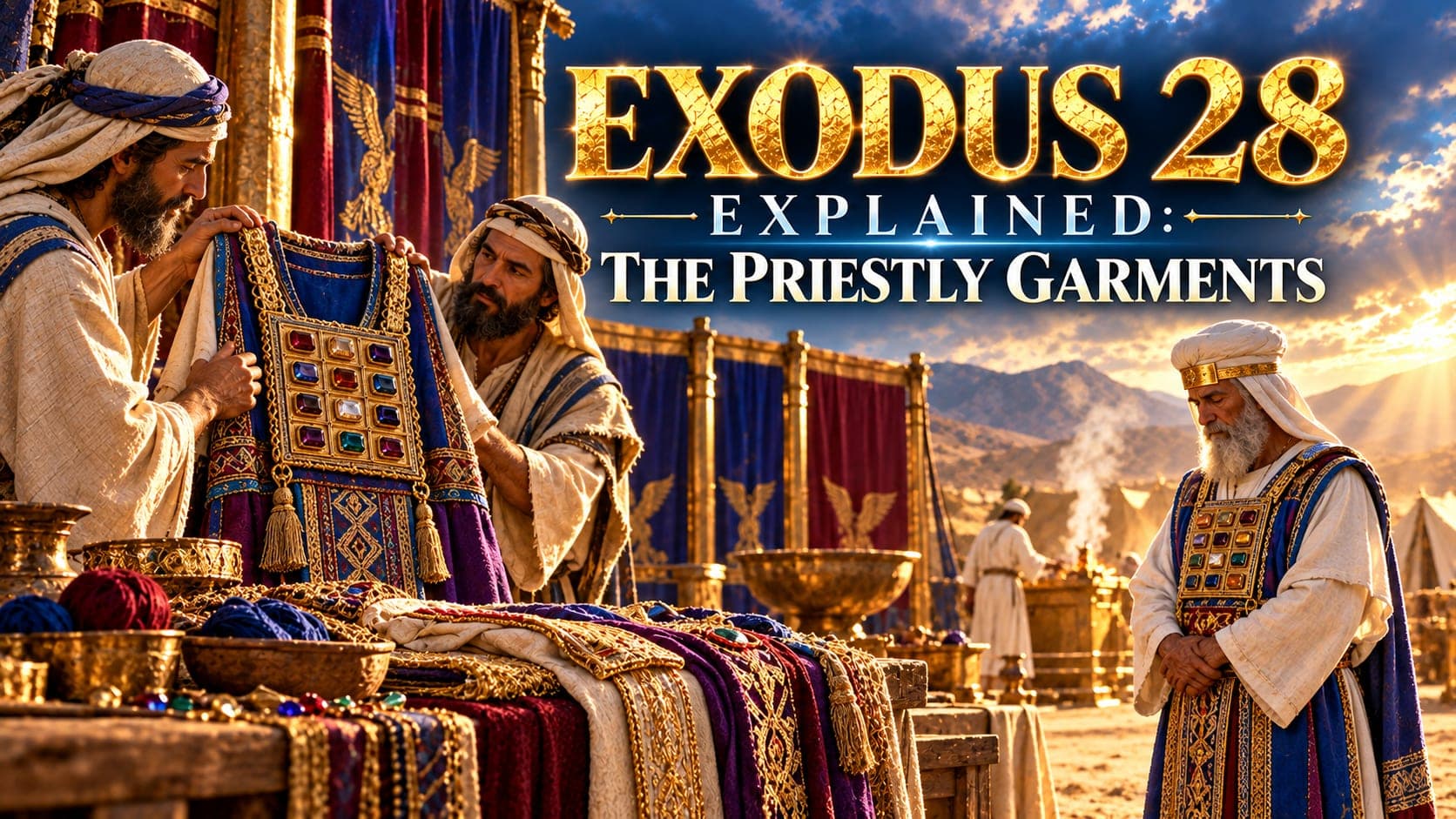
Exodus 28 explained is the chapter where God designs clothing for one man: a gold threaded ephod, a breastplate holding twelve named stones, a blue robe lined with bells, and a plate of pure gold worn on the forehead. Nothing here is Aaron's own idea of what a priest should look like.
Maybe you have pictured Aaron's outfit as simple ceremonial robes and left it there.
- ❓ Why did Aaron carry the names of all twelve tribes on his shoulders and over his heart?
- ❓ What were the Urim and the Thummim, and how did they actually work?
- ❓ Why did the robe need bells sewn around the hem, under threat of death if they went quiet?
- ❓ What did it mean for a gold plate to let Aaron "bear the iniquity of the holy things"?
📌 Every stitch in this chapter answers one question: how does a sinful man stand in front of a holy God on behalf of other sinful people, and survive it?
This walkthrough goes through the whole chapter in order: the garments named all at once, the ephod and the two memorial stones on Aaron's shoulders, the breastplate of judgment with its twelve tribal stones, the gold chains and rings that locked the breastplate in place, the Urim and Thummim carried over Aaron's heart, the blue robe and its bells, the gold plate on his forehead, and the last garments made for his sons.
None of it was for show. Every piece Aaron put on was doing a job that cost him something to carry.
What Happened Just Before This Chapter
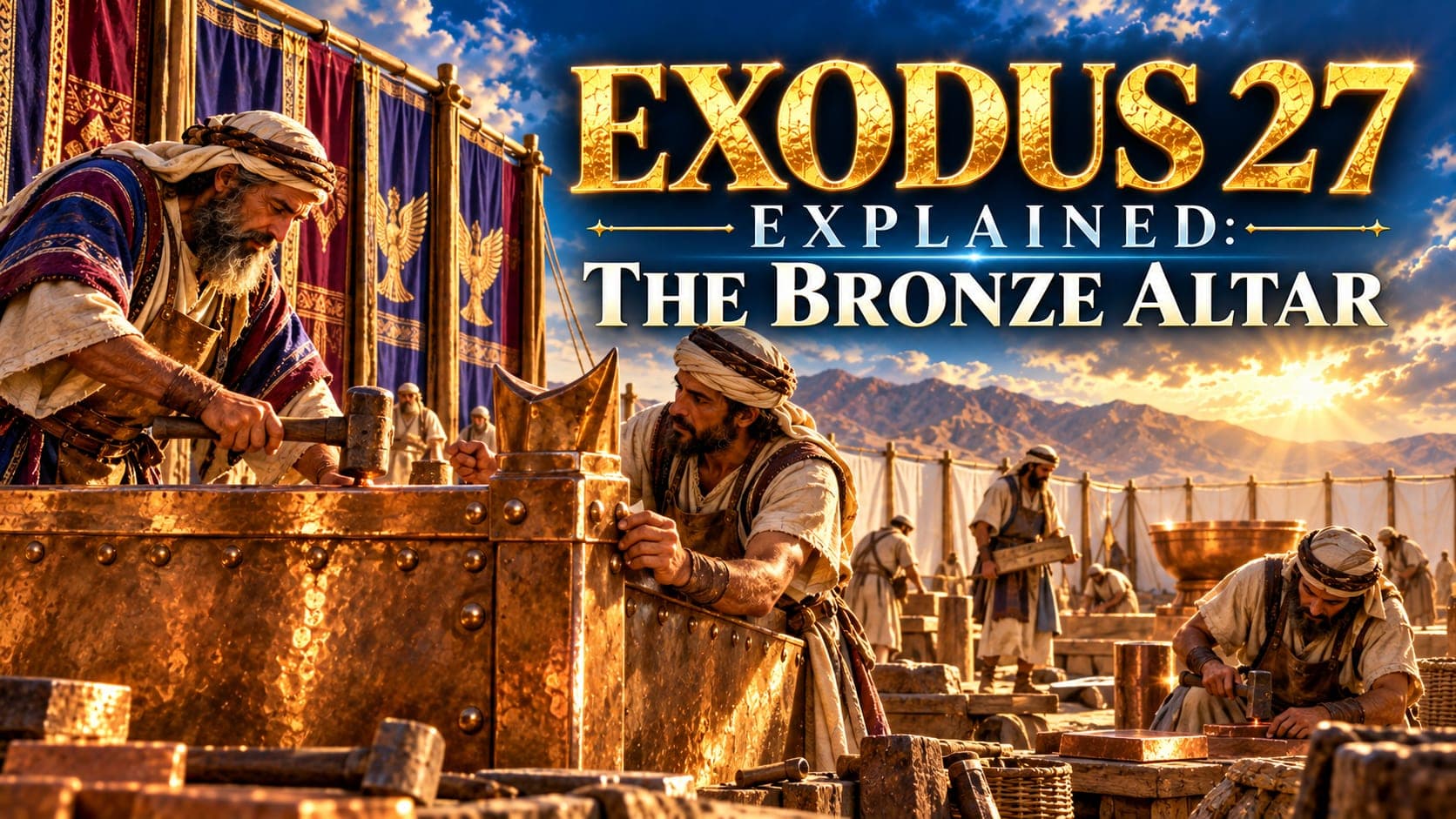
Exodus 27 finished the building Aaron would actually work in: the brass altar where sacrifices burned, the linen court marking off sacred ground, and the lamp his own sons were charged to keep lit every night. The tent, the altar, and the yard around them were all standing by the end of that chapter. One thing was still missing. Nobody had been dressed to go inside and use any of it.
Exodus 28 answers that. Aaron was already Moses' brother and his spokesman, the man God promised back in Exodus 4 would speak for him when his own words failed. Now Aaron gets a different role entirely, one that has nothing to do with speaking for Moses and everything to do with standing before the Lord on behalf of the whole nation.

Exodus 28 Explained Verse by Verse
1. The Garments Named All at Once (verses 1 to 5)
The chapter opens by naming the men first, then the job, then the clothes.
"And take thou unto thee Aaron thy brother, and his sons with him, from among the children of Israel, that he may minister unto me in the priest’s office, even Aaron, Nadab and Abihu, Eleazar and Ithamar, Aaron’s sons."
Nadab and Abihu are not new names. They are the same two sons who climbed partway up Sinai with Aaron in Exodus 24 and saw the God of Israel with their own eyes. Here they are named as priests in training, long before Leviticus 10 records the fire they offered that God never commanded.
God states the reason for every garment that follows before describing a single one of them.
"And thou shalt make holy garments for Aaron thy brother for glory and for beauty."
📌 Glory and beauty are not decoration here. They are the stated purpose. The craftsmen making these clothes are described as people God Himself filled with wisdom for the task, not ordinary tailors guessing at a design.
"And these are the garments which they shall make; a breastplate, and an ephod, and a robe, and a broidered coat, a mitre, and a girdle: and they shall make holy garments for Aaron thy brother, and his sons, that he may minister unto me in the priest’s office."
Six pieces named up front, in the exact order the chapter is about to build them. Nothing invented later gets added to this list, and nothing on this list gets skipped.
2. The Ephod and the Stones on Aaron's Shoulders (verses 6 to 14)
The first garment built is the one everything else attaches to.
"And they shall make the ephod of gold, of blue, and of purple, of scarlet, and fine twined linen, with cunning work."
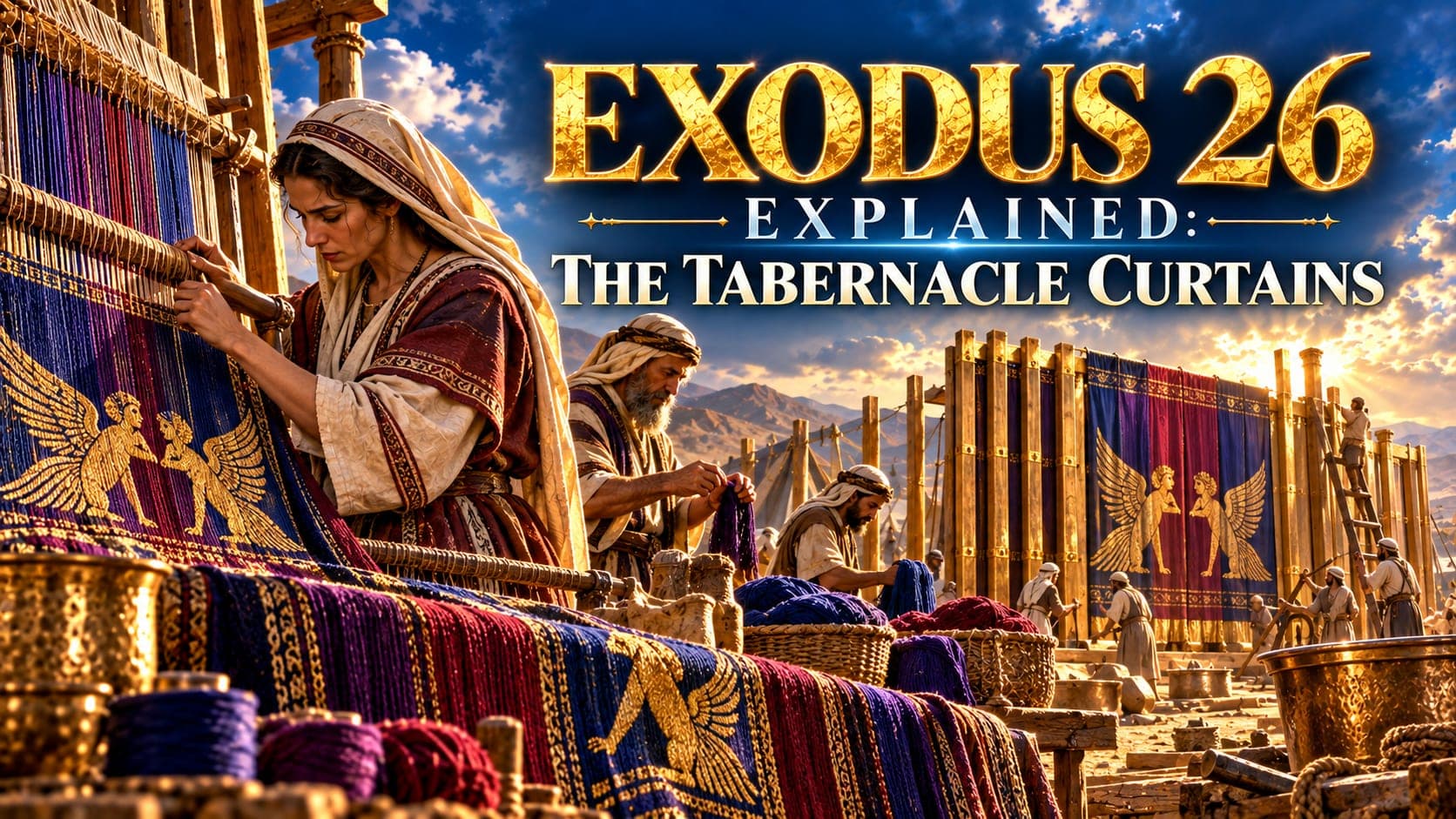
An ephod was a sleeveless, apron like vest, worn over the robe and held on by two shoulder pieces. The same gold, blue, purple, and scarlet used for the tabernacle's inner curtains and the veil back in Exodus 26 now cover the man who would walk in front of them.
Onto each shoulder piece went a single engraved stone.
"And thou shalt take two onyx stones, and grave on them the names of the children of Israel: Six of their names on one stone, and the other six names of the rest on the other stone, according to their birth."
Twelve sons, six names cut into each stone, almost certainly listed in the birth order Genesis already recorded rather than any later tribal arrangement. The next verse says exactly what those stones were for.
"And thou shalt put the two stones upon the shoulders of the ephod for stones of memorial unto the children of Israel: and Aaron shall bear their names before the LORD upon his two shoulders for a memorial."
💡 The shoulders are where a man carries weight. Every time Aaron put the ephod on, he physically carried the full twelve tribes into God's presence, not as a symbol he thought about but as a weight he actually felt.
3. The Breastplate of Judgment: Twelve Stones for Twelve Tribes (verses 15 to 21)
A second piece goes on top of the ephod, built from the same materials but for a different purpose.
"And thou shalt make the breastplate of judgment with cunning work; after the work of the ephod thou shalt make it; of gold, of blue, and of purple, and of scarlet, and of fine twined linen, shalt thou make it."
A span long and a span wide, doubled over to form a square pouch, roughly nine inches on each side. Into that pouch went four rows of precious stones, three stones to a row.
"And thou shalt set in it settings of stones, even four rows of stones: the first row shall be a sardius, a topaz, and a carbuncle: this shall be the first row. And the second row shall be an emerald, a sapphire, and a diamond. And the third row a ligure, an agate, and an amethyst. And the fourth row a beryl, and an onyx, and a jasper: they shall be set in gold in their inclosings."
Twelve stones, one tribe engraved on each, named plainly in the next verse.
"And the stones shall be with the names of the children of Israel, twelve, according to their names, like the engravings of a signet; every one with his name shall they be according to the twelve tribes."
📌 Twelve stones on the breastplate, two stones on the shoulders. Neither one was enough by itself. God designed two separate places to carry the same twelve names, not one place twice.
4. Fastening the Breastplate to the Ephod (verses 22 to 28)
A pouch of twelve stones is heavy, and a loose pouch over a priest's heart is a problem waiting to happen.
"And thou shalt make upon the breastplate two rings of gold, and shalt put the two rings on the two ends of the breastplate."
Gold chains ran from the top corners of the breastplate to the shoulder stones, and a blue lace tied the bottom corners down to the ephod's waistband. Four separate attachment points for one small pouch, which tells you how seriously God took the idea of it staying put.
"And they shall bind the breastplate by the rings thereof unto the rings of the ephod with a lace of blue, that it may be above the curious girdle of the ephod, and that the breastplate be not loosed from the ephod."
⚠️ The text says plainly why all this engineering mattered: the breastplate was never supposed to come loose from the ephod. Whatever the breastplate represented, it was meant to stay fixed to Aaron for as long as he wore the rest of the garment.
5. The Urim and Thummim, Carried on the Heart (verses 29 and 30)
Two short verses explain what the breastplate was actually for, and they are worth slowing down on.
"And Aaron shall bear the names of the children of Israel in the breastplate of judgment upon his heart, when he goeth in unto the holy place, for a memorial before the LORD continually."
The shoulder stones carried the tribes as a weight. The breastplate carried them against the heart, continually, every time Aaron entered. Strength and nearness, in two different places on the same man.
"And thou shalt put in the breastplate of judgment the Urim and the Thummim; and they shall be upon Aaron’s heart, when he goeth in before the LORD: and Aaron shall bear the judgment of the children of Israel upon his heart before the LORD continually."
💡 Urim is widely understood to mean lights, and Thummim to mean perfections, or completeness. Exodus 28 never explains what they physically were or how Aaron used them, only that they went inside the breastplate and that they carried judgment, meaning some kind of decision from God, for the nation.
6. The Robe, the Bells, and the Warning Not to Die (verses 31 to 35)
Underneath the ephod went a robe, and this one had no gold threaded through it at all.
"And thou shalt make the robe of the ephod all of blue. And there shall be an hole in the top of it, in the midst thereof: it shall have a binding of woven work round about the hole of it, as it were the hole of an habergeon, that it be not rent."
One solid color, pulled on over the head through a reinforced opening so it would not tear with use. Then the hem gets something no other garment in the tabernacle has.
"And beneath upon the hem of it thou shalt make pomegranates of blue, and of purple, and of scarlet, round about the hem thereof; and bells of gold between them round about: A golden bell and a pomegranate, a golden bell and a pomegranate, upon the hem of the robe round about."
Gold bells and cloth pomegranates, alternating all the way around the hem. Then the reason for the bells.
"And it shall be upon Aaron to minister: and his sound shall be heard when he goeth in unto the holy place before the LORD, and when he cometh out, that he die not."
⚠️ This is the first time in the tabernacle instructions that failing to follow a detail is tied directly to death. The altar got horns, the court got a fence, but the robe got bells that had to keep sounding, with the highest stakes the text has named yet.
7. The Golden Plate and the Last Garments for Aaron's Sons (verses 36 to 43)
One more piece sits above everything else, worn on the head rather than the body.
"And thou shalt make a plate of pure gold, and grave upon it, like the engravings of a signet, HOLINESS TO THE LORD."
Tied with a blue lace to the front of Aaron's mitre, so that four words sat directly above his face at all times. The next verse explains what that plate was doing there.
"And it shall be upon Aaron’s forehead, that Aaron may bear the iniquity of the holy things, which the children of Israel shall hallow in all their holy gifts; and it shall be always upon his forehead, that they may be accepted before the LORD."
📌 Even Israel's best gifts to God were not clean enough on their own. Aaron's forehead carried whatever fault still clung to an offering the people meant for good, so the gift could still be accepted instead of rejected.
The chapter closes with simpler clothing, made for Aaron's sons rather than Aaron alone.
"And thou shalt make them linen breeches to cover their nakedness; from the loins even unto the thighs they shall reach: And they shall be upon Aaron, and upon his sons, when they come in unto the tabernacle of the congregation, or when they come near unto the altar to minister in the holy place; that they bear not iniquity, and die: it shall be a statute for ever unto him and his seed after him."
Even the plainest garment in the chapter is tied to the same stakes as the bells: cover what needs covering, or carry guilt for failing to. From the gold plate on the forehead down to linen underclothes, nothing a priest wore in this chapter was optional.

Hard Questions Exodus 28 Raises
If Israel was already called a kingdom of priests, why does only one man get these garments? God told the whole nation in Exodus 19 that they would be a kingdom of priests and a holy nation.
"And ye shall be unto me a kingdom of priests, and an holy nation."
Exodus 28 narrows that calling to one family without canceling it. Aaron and his sons minister on the nation's behalf, carrying the twelve tribes on their own bodies, but the wider priestly identity God named in Exodus 19 never disappears from Israel's story. It simply gets a specific, physical representative here.
What exactly were the Urim and the Thummim, and how did Aaron use them? Exodus 28 names them without describing their shape or how a decision was actually read from them. Later Scripture confirms they kept functioning for generations, then stopped.
"And he shall stand before Eleazar the priest, who shall ask counsel for him after the judgment of Urim before the LORD: at his word shall they go out, and at his word they shall come in, both he, and all the children of Israel with him, even all the congregation."
"And when Saul enquired of the LORD, the LORD answered him not, neither by dreams, nor by Urim, nor by prophets."
"And the Tirshatha said unto them, that they should not eat of the most holy things, till there stood up a priest with Urim and with Thummim."
Joshua's generation used them through Eleazar. By Saul's reign, God was silent through them. By the return from exile, Ezra's generation no longer had a priest who could use them at all. Scripture never explains exactly why they went silent, only that by then they had.
What did it mean for Aaron to "bear the iniquity of the holy things"? The text itself only says the plate let Israel's holy gifts be accepted despite whatever fault clung to them. Christians have long read this as an early picture of a greater priest who would carry guilt that was never his own.
"He shall see of the travail of his soul, and shall be satisfied: by his knowledge shall my righteous servant justify many; for he shall bear their iniquities."
Exodus 28 does not mention Isaiah or the cross. It simply states what the gold plate accomplished for Aaron's generation. The pattern of one man bearing guilt so others could be accepted is the part readers keep noticing centuries later.
Top Verses From Exodus 28
1. Exodus 28:12
"And thou shalt put the two stones upon the shoulders of the ephod for stones of memorial unto the children of Israel: and Aaron shall bear their names before the LORD upon his two shoulders for a memorial."
The verse that explains why the shoulder stones existed at all. Aaron did not just represent the twelve tribes in theory. He carried their actual names on his own body, every time he served.
2. Exodus 28:29
"And Aaron shall bear the names of the children of Israel in the breastplate of judgment upon his heart, when he goeth in unto the holy place, for a memorial before the LORD continually."
The companion verse to the shoulders. Strength carried the tribes on Aaron's back. The breastplate carried them against his heart, continually, with nothing about it occasional.
3. Exodus 28:35
"And it shall be upon Aaron to minister: and his sound shall be heard when he goeth in unto the holy place before the LORD, and when he cometh out, that he die not."
The first verse in the tabernacle instructions to tie a missed detail directly to death. The bells were never just decoration on the hem of a robe.
4. Exodus 28:36
"And thou shalt make a plate of pure gold, and grave upon it, like the engravings of a signet, HOLINESS TO THE LORD."
Four words worn above Aaron's face every day he served. A declaration, not a suggestion, sitting directly between the high priest's eyes and everyone he met.
5. Isaiah 53:11
"He shall see of the travail of his soul, and shall be satisfied: by his knowledge shall my righteous servant justify many; for he shall bear their iniquities."
Written centuries after Exodus 28, but read by Christians as the fuller picture behind the gold plate Aaron wore: one man bearing guilt that belonged to someone else.

Frequently Asked Questions About Exodus 28
What is Exodus 28 about?
Exodus 28 gives Moses the instructions for Aaron's priestly garments: the ephod, the breastplate of judgment holding twelve tribal stones, the Urim and Thummim, the blue robe with its gold bells, the golden forehead plate, and the simpler garments made for Aaron's sons.
What was the ephod in the Bible?
A sleeveless, apron like vest worn over the robe, woven from gold thread, blue, purple, scarlet, and fine linen according to Exodus 28:6. Two onyx stones engraved with the names of the twelve tribes were set on its shoulder pieces.
What was the breastplate of judgment?
A square gold pouch, about nine inches on each side, set with twelve precious stones, one for each tribe of Israel. Exodus 28:29 and 30 say Aaron wore it over his heart and that it held the Urim and the Thummim.
What were the Urim and Thummim?
Objects placed inside the breastplate, widely understood from their Hebrew names to mean something like lights and perfections. Exodus 28:30 says they carried judgment for Israel, though the chapter never describes their shape or exactly how Aaron used them.
Why did Aaron's robe have bells on it?
Exodus 28:33 to 35 commands gold bells alternating with cloth pomegranates around the hem of the robe, so Aaron's sound could be heard as he entered and left the holy place. The text ties hearing that sound directly to Aaron not dying while he served.
What did the gold plate "Holiness to the Lord" mean?
A plate of pure gold engraved with that phrase, tied to Aaron's forehead by a blue lace. Exodus 28:38 says it let the holy gifts Israel brought be accepted despite any fault, with Aaron bearing that fault on their behalf.
How many stones were on the breastplate?
Twelve, arranged in four rows of three according to Exodus 28:17 to 20, each one engraved with the name of a tribe of Israel per verse 21.
Why did Aaron carry the tribes on his shoulders and over his heart?
Exodus 28:12 calls the shoulder stones a memorial borne on Aaron's shoulders, and verse 29 calls the breastplate a memorial carried on his heart. God gave two separate places on the same man to represent the same twelve names, not one place repeated twice.
What happened to the Urim and Thummim later in the Bible?
Numbers 27:21 shows Eleazar still using them for Joshua. By 1 Samuel 28:6, God no longer answered Saul through them, and Ezra 2:63 shows that after the exile, Israel had no priest left who could use them at all.
Final Thoughts
Exodus 28 never mentions a single sacrifice. It still describes exactly what it cost to represent sinful people before a holy God.
📌 Aaron carried the twelve tribes in two places at once. Strength on his shoulders, nearness against his heart. Representing people was never meant to be effortless or symbolic only.
📌 A missed detail in this chapter was tied to death for the first time. The bells on the hem were not decoration. They were proof of life while Aaron stood where only he could stand.
📌 Even Israel's best gifts needed a gold plate to be accepted. Nobody in this chapter, not even the high priest himself, approached God on the strength of their own cleanness.
You will never wear an ephod or a breastplate of twelve stones. But you live after a greater priest finished wearing what Aaron's garments only pointed toward.
So here is your one next step.
Read Isaiah 53:11 today, right after Exodus 28:38, and notice how long God had already been showing Israel what one man bearing guilt for others would look like.