📖 Exodus 27 Explained: The Bronze Altar and the Court of the Tabernacle
The gold stops here. Everything in this chapter is covered in brass instead.
Exodus 27 explained is the chapter where God moves Moses out of the tent and into the open yard around it: an altar built to carry fire and blood every single day, a fenced court marking off how far an ordinary Israelite could walk, and a lamp that was never allowed to go dark.
Maybe you have pictured the tabernacle as one tent and stopped there.
- ❓ Why does the altar get brass instead of the gold used just one chapter earlier?
- ❓ What were the horns on the corners of the altar actually for?
- ❓ Why did the altar have no steps leading up to it?
- ❓ And why did one lamp have to stay burning every night without exception?
📌 This chapter builds the parts of the tabernacle that ordinary people actually saw and used, not only the priests who worked behind the veil.
Here is the whole chapter in order: the altar of burnt offering and its brass vessels, the staves built to carry it, the linen fence enclosing the whole courtyard on all four sides, the one gate cut into that fence, and the standing order to keep a lamp burning that the chapter closes on.
None of it was decoration. Every measurement marked out exactly how far a sinful person could come near a holy God, and what it cost to come that far.
What Happened Just Before This Chapter
Exodus 26 built the tabernacle itself: the linen curtains woven with cherubim, the goat hair and skin coverings over them, the gold covered walls standing on silver, and the veil marking off the most holy place where the ark would sit. By the end of that chapter, the building was finished, at least on paper. Moses still had nowhere planned for Israel to actually bring an offering, and no boundary marking where the sacred ground began.
Exodus 27 answers both. This is the chapter that steps outside the tent and builds the yard around it: the altar where sacrifices would actually burn, and the fence that told an ordinary Israelite exactly how far he could walk and no further.

Exodus 27 Explained Verse by Verse
1. The Altar of Burnt Offering (verses 1 and 2)
The chapter opens with the object every sacrifice in Israel would eventually pass over.
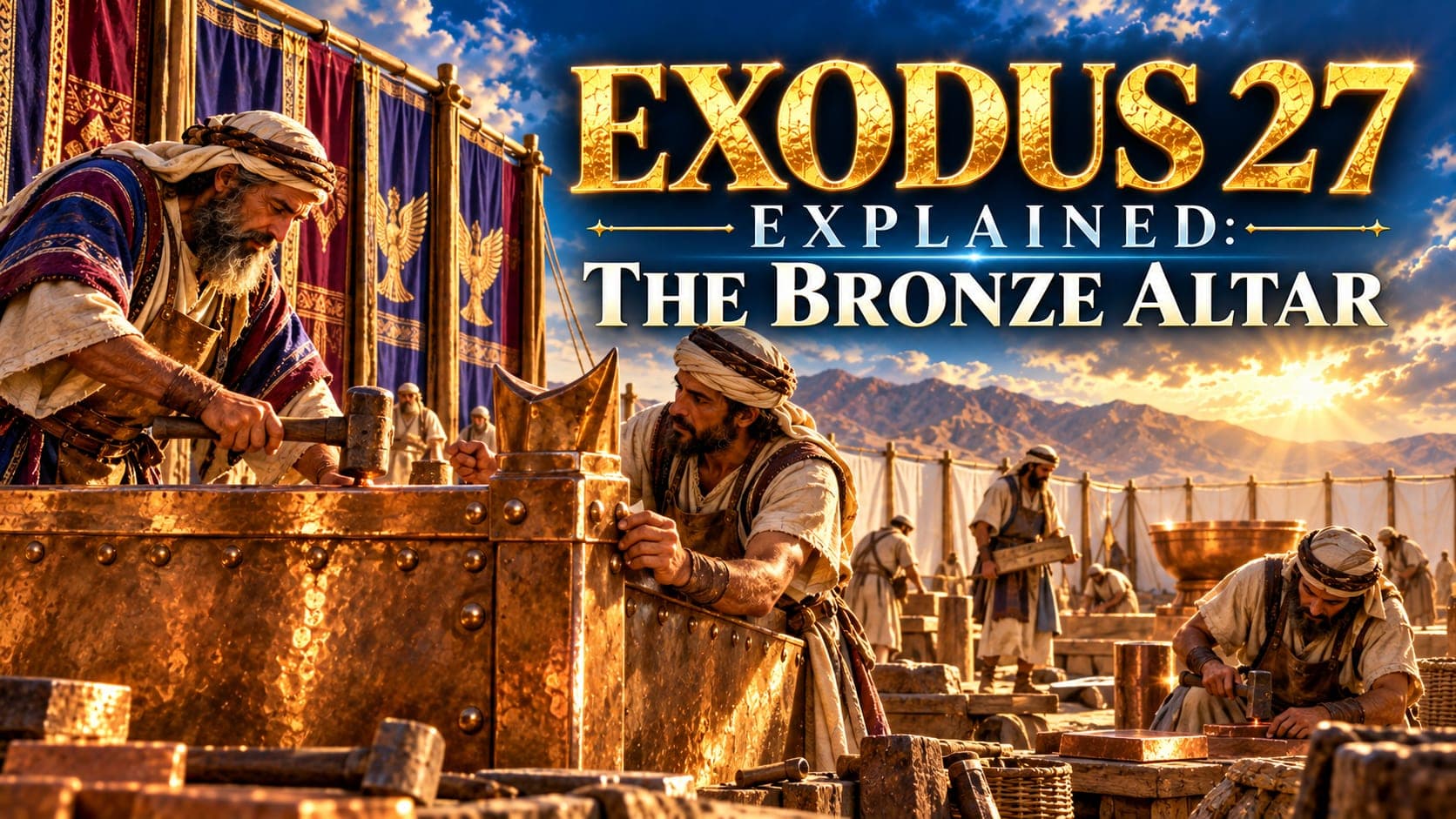
"And thou shalt make an altar of shittim wood, five cubits long, and five cubits broad; the altar shall be foursquare: and the height thereof shall be three cubits. And thou shalt make the horns of it upon the four corners thereof: his horns shall be of the same: and thou shalt overlay it with brass."
Five cubits square and three cubits tall, roughly seven and a half feet wide and four and a half feet high using an eighteen inch cubit. Built from the same shittim wood as the ark, but covered in brass, not gold. This is the altar of burnt offering, the first object anyone walking into the court would meet.
📌 Gold covered the objects nearest the ark. Brass covered the one object that met fire and blood every single day. The costlier metal never goes where it would melt or burn away. Brass can take the heat that gold cannot.
Four horns rose from the corners, cast as one piece with the altar rather than attached afterward. The text does not explain their purpose here, only that they existed and that they were brass, like everything else on this altar.
2. The Vessels and the Brass Grate (verses 3 to 5)
An altar that burns constantly needs tools to clean it, and this one gets a full set.
"And thou shalt make his pans to receive his ashes, and his shovels, and his basons, and his fleshhooks, and his firepans: all the vessels thereof thou shalt make of brass. And thou shalt make for it a grate of network of brass; and upon the net shalt thou make four brasen rings in the four corners thereof."
Five kinds of tool, named one after another: pans for ash, shovels, basins, hooks for handling meat, and firepans. Every one of them brass, with no exception written in. Then comes a detail easy to read past.
"And thou shalt put it under the compass of the altar beneath, that the net may be even to the midst of the altar."
💡 The network sat halfway up inside the altar's hollow frame, not underneath it on the ground. The altar was built hollow, and this brass grate likely held the fire and the offering up off the ground inside that hollow space, with the four rings giving the staves something solid to pass through when the altar had to move.
3. Staves to Carry It, Built the Same Way (verses 6 to 8)
Israel was still traveling. Nothing in the tabernacle, not even the heaviest piece, could stay fixed to one spot.
"And thou shalt make staves for the altar, staves of shittim wood, and overlay them with brass. And the staves shall be put into the rings, and the staves shall be upon the two sides of the altar, to bear it."
Same wood, same brass covering as the altar itself. The staves slid through the four rings from the grate, one on each side, so the priests carrying it never had to touch the altar directly.
Then the chapter repeats a phrase it has used for furniture before.
"Hollow with boards shalt thou make it: as it was shewed thee in the mount, so shall they make it."
📌 The altar standing outside in the open yard was copied from the same pattern as the ark hidden behind the veil. Nothing in this courtyard was any less designed by God than what sat in the most holy place. It was simply built from a different metal for a different job.
4. Fencing the Court: South and North (verses 9 to 11)
With the altar built, the chapter turns to marking off the ground around it.
"And thou shalt make the court of the tabernacle: for the south side southward there shall be hangings for the court of fine twined linen of an hundred cubits long for one side: And the twenty pillars thereof and their twenty sockets shall be of brass; the hooks of the pillars and their fillets shall be of silver."
An hundred cubits of plain white linen, about a hundred and fifty feet, hung on twenty pillars standing in brass sockets. Verse 11 repeats the same count for the north side, word for word: twenty pillars, twenty sockets of brass, hooks and fillets of silver. No blue, purple, or scarlet here, and no cherubim woven in anywhere. Just plain linen marking a boundary.
💡 Silver appears again in the hooks and fillets, the same metal that held up the gold boards inside the tent one chapter earlier. Even out here, at the outer edge of the whole tabernacle, silver still carries something that touches the structure.
5. West, East, and the One Gate In (verses 12 to 16)
The shorter sides get less linen, and the east side gets something the other three do not.
"And for the breadth of the court on the west side shall be hangings of fifty cubits: their pillars ten, and their sockets ten. And the breadth of the court on the east side eastward shall be fifty cubits."
Fifty cubits wide on the west end, ten pillars, ten sockets, half the length of the south and north sides. The east side matches that same fifty cubit width, but it does not get one long stretch of hanging. It gets split into three pieces: fifteen cubits of plain linen on either side of a gate, and the gate itself in the middle.
"And for the gate of the court shall be an hanging of twenty cubits, of blue, and purple, and scarlet, and fine twined linen, wrought with needlework: and their pillars shall be four, and their sockets four."
📌 Every other hanging around the court was plain white linen. Only the gate carried color. The same blue, purple, and scarlet used on the veil and the door of the tent in Exodus 26 marked the one way in, long before anyone reached the tent itself.
There was exactly one gate for the entire court. No back entrance, no side door. Whoever came to offer anything came through that one marked opening or did not come in at all.
6. The Numbers Add Up to One Brass Yard (verses 17 to 19)
The chapter pauses to total what it has just described.
"All the pillars round about the court shall be filleted with silver; their hooks shall be of silver, and their sockets of brass. The length of the court shall be an hundred cubits, and the breadth fifty every where, and the height five cubits of fine twined linen, and their sockets of brass."
An hundred cubits long, fifty cubits wide, about a hundred and fifty feet by seventy five feet, roughly half the size of a football field. Five cubits high, about seven and a half feet, tall enough to block the view in but not so tall it needed to compete with the tent rising behind it.
"All the vessels of the tabernacle in all the service thereof, and all the pins thereof, and all the pins of the court, shall be of brass."
📌 Every pin, every tool, everything touching the ground in this courtyard is brass, without one exception named. Silver shows up in the hooks and fillets above the ground. Gold never shows up out here at all.
7. The Lamp That Was Never Allowed to Go Out (verses 20 and 21)
The chapter ends away from brass and measurements, on a single standing order.
"And thou shalt command the children of Israel, that they bring thee pure oil olive beaten for the light, to cause the lamp to burn always."
"Beaten" oil means olives crushed by hand in a mortar rather than run through a heavy press. That first crushing produced a clearer, purer oil than anything squeezed out afterward, and this verse asks for exactly that grade, not whatever oil was easiest to get.
"In the tabernacle of the congregation without the vail, which is before the testimony, Aaron and his sons shall order it from evening to morning before the LORD: it shall be a statute for ever unto their generations on the behalf of the children of Israel."
📌 This was not a one time instruction for building a lamp. It was a standing law for every generation after Moses. Aaron and his sons were responsible for tending it every single evening, with no mention of a night off.

Hard Questions Exodus 27 Raises
Why brass on the altar instead of the gold used one chapter earlier? Exodus 27 never states its own reasoning, but the pattern already set in Exodus 26 holds here too: the metal gets more costly the closer an object stands to the ark. The altar of burnt offering stood at the far outer edge of that pattern, built to carry fire and the blood of the sacrifices that sealed Israel's covenant every day, a job brass could survive and gold could not.
Why did the altar have no steps? Exodus 27 gives the altar's height as three cubits, roughly four and a half feet, low enough for a priest to work at without climbing. That height matches a rule God had already given in Exodus 20.
"Neither shalt thou go up by steps unto mine altar, that thy nakedness be not discovered thereon."
A staircase would have exposed the priest climbing it from below. Keeping the altar low enough to approach without steps protected that dignity, and the height this chapter sets fits that rule exactly.
What were the horns of the altar for? Exodus 27 only says they were there, cast as one piece with the altar and covered in brass. Later Scripture shows what they came to mean.
"And Adonijah feared because of Solomon, and arose, and went, and caught hold on the horns of the altar."
Centuries after this chapter, a man running for his life grabbed those same horns as a place of refuge. Leviticus later has the priest apply sacrificial blood directly to the horns during sin offerings, making them the point where the altar's purpose was most concentrated.
Was this really the only lamp law God gave, or did it come up again? Exodus 27 states the command once. Leviticus restates the identical instruction almost word for word.
"Command the children of Israel, that they bring unto thee pure oil olive beaten for the light, to cause the lamps to burn continually."
The repetition across two books shows this was never treated as a minor detail Moses could quietly drop. It was law before the tabernacle was even built, and it stayed law long after.
Top Verses From Exodus 27
1. Exodus 27:1 and 2
"And thou shalt make an altar of shittim wood, five cubits long, and five cubits broad; the altar shall be foursquare: and the height thereof shall be three cubits. And thou shalt make the horns of it upon the four corners thereof: his horns shall be of the same: and thou shalt overlay it with brass."
The altar that stood between every Israelite and the tent behind it, built from the same wood as the ark but covered in a metal strong enough to carry fire every day.
2. Exodus 27:8
"Hollow with boards shalt thou make it: as it was shewed thee in the mount, so shall they make it."
The altar standing in the open yard came from the exact same pattern as the furniture hidden behind the veil. Brass or gold, nothing here was Moses' own design.
3. Exodus 27:20 and 21
"And thou shalt command the children of Israel, that they bring thee pure oil olive beaten for the light, to cause the lamp to burn always. In the tabernacle of the congregation without the vail, which is before the testimony, Aaron and his sons shall order it from evening to morning before the LORD: it shall be a statute for ever unto their generations on the behalf of the children of Israel."
The chapter's last word is a light that must never go dark, tended night after night by men who had no permission to let it fail even once.
4. Exodus 20:26
"Neither shalt thou go up by steps unto mine altar, that thy nakedness be not discovered thereon."
A law given before the tabernacle existed, quietly fulfilled by the modest height Exodus 27 sets for the altar it finally builds.
5. 1 Kings 1:50
"And Adonijah feared because of Solomon, and arose, and went, and caught hold on the horns of the altar."
Generations after Exodus 27 built them, the altar's horns had become a known place to run to, proof that nothing in this chapter was built just to be forgotten.

Frequently Asked Questions About Exodus 27
What is Exodus 27 about?
Exodus 27 gives Moses the instructions for the altar of burnt offering and its brass vessels, the staves used to carry it, and the linen court enclosing the whole tabernacle, ending with a standing command to keep a lamp burning every night.
Why was the altar of burnt offering made of brass instead of gold?
Exodus 27:2 commands brass for the altar itself and for every vessel used with it. The tabernacle followed a consistent pattern where gold covered objects nearest the ark and brass covered whatever stood at the outer edge of the courtyard, exposed to daily fire.
What were the horns of the altar?
Four projections cast as one piece with the altar at its corners, named in Exodus 27:2 but not explained there. Later in Scripture, sacrificial blood was applied to them during sin offerings, and 1 Kings 1:50 shows a man grasping them as a place of refuge.
How big was the altar of burnt offering?
Five cubits long and five cubits broad, with a height of three cubits, close to seven and a half feet square and four and a half feet tall using an eighteen inch cubit.
What was the court of the tabernacle?
A rectangle of linen hangings on brass sockets enclosing the tabernacle and its altar, a hundred cubits long and fifty cubits wide according to Exodus 27:18, with one gate on the east side as the only way in.
Why did the altar have no steps leading up to it?
Exodus 20:26 forbids approaching God's altar by steps, to protect the dignity of the priest climbing them. The modest three cubit height Exodus 27 sets for the altar kept it low enough to work at without needing any.
What does oil olive beaten mean in Exodus 27?
It refers to the clearest oil, pressed out by crushing olives in a mortar rather than a heavy press. Exodus 27:20 asks for this purer grade specifically for the lamp, not whatever oil was most convenient.
Why did the lamp have to burn continually?
Exodus 27:21 calls this a statute forever for Israel's generations, not a temporary instruction. Leviticus 24:2 to 4 repeats the same command almost word for word, confirming it was treated as a lasting law rather than a one time detail.
Who was responsible for the lamp in the tabernacle?
Exodus 27:21 names Aaron and his sons, ordering it from evening to morning before the Lord. The responsibility sat with the priesthood specifically, not with the people who brought the oil.
Why did only the gate of the court have color?
Exodus 27:16 commands blue, purple, and scarlet for the gate hanging, while every other side of the court used plain white linen. The same colors marked the veil and the door of the tent in Exodus 26, making color itself a signal of where the one way in actually was.
Final Thoughts
Exodus 27 never leaves the courtyard. It still says something enormous by staying there.
📌 The altar carried the hardest job and got the hardest wearing metal. Brass, not gold, stood where fire burned and blood was poured out every day without a break.
📌 There was exactly one gate in, and no steps up. Access to God was never careless in this courtyard, but it was also never needlessly complicated for the person walking through it.
📌 A lamp that could not be allowed to fail became a law for every generation. Aaron and his sons answered for it nightly, and Leviticus 24 shows Israel never let that responsibility quietly disappear.
You will likely never stand in a linen court or carry oil to a brass lamp. But you live on the other side of a gate this chapter helped build the first outline of.
So here is your one next step.
Read Exodus 20:26 and Exodus 27:1 and 2 side by side today, and notice how one quiet law from Sinai was already being kept before the altar was even built.