📖 Exodus 29 Explained: The Ordination of Aaron and His Sons
The clothes are finished. Nobody is allowed to put them on yet.
Exodus 29 explained is the chapter where Aaron and his sons actually become priests: a bullock killed for their own sin, a ram burned whole on the altar, a second ram whose blood gets smeared on an ear, a thumb, and a big toe, and seven straight days before any of it is considered finished.
Maybe you have pictured ordination as Aaron simply putting on the garments from the chapter before.
- ❓ Why did Aaron need a sacrifice made for his own sin before he could offer anything for anyone else?
- ❓ What was the point of putting blood on an ear, a thumb, and a toe?
- ❓ Why did the whole process have to repeat every day for a week?
- ❓ And why does the chapter end on God talking about where He will live?
📌 Exodus 29 is not a dress rehearsal. It is the chapter that turns Aaron from a man wearing holy clothes into a man actually qualified to wear them.
This walkthrough goes through the whole chapter in order: the washing and the gathered offerings, Aaron dressed and anointed, the bullock killed as a sin offering, the first ram burned whole, the second ram whose blood marks Aaron and his sons for service, the garments handed down to future generations, and the seven days of atonement that end with God naming exactly why He went through all of this.
None of it is decoration. Every single step answers the same question: how does a sinful man get close enough to serve a holy God without being destroyed by the closeness?
What Happened Just Before This Chapter
Exodus 28 designed every garment Aaron and his sons would wear: the ephod, the breastplate of judgment, the robe with its bells, and the gold plate reading "Holiness to the Lord." By the end of that chapter the clothes existed. Nobody had worn them into actual service yet.
Clothes alone were never going to be enough. A man could put on every thread God designed and still be unqualified to stand in front of the Lord, because the problem was never the outfit. The problem was Aaron himself, a sinful man like everyone he would represent. Exodus 29 is God giving Moses the actual ceremony that deals with that problem before a single priest ever lights a lamp or burns an offering.

Exodus 29 Explained Verse by Verse
1. The Offerings Gathered, and Aaron Washed (verses 1 to 4)
Before a single garment goes on, the chapter opens with a shopping list and a bath.
"And this is the thing that thou shalt do unto them to hallow them, to minister unto me in the priest’s office: Take one young bullock, and two rams without blemish,"
One bullock, two rams, and three kinds of unleavened bread, all without blemish. Nothing flawed, nothing second rate, gets brought near this ceremony. Then comes the first physical act Aaron and his sons actually do.
"And Aaron and his sons thou shalt bring unto the door of the tabernacle of the congregation, and shalt wash them with water."
💡 Washing comes before a single garment or a single sacrifice. Before Aaron wears anything holy or offers anything holy, his body gets cleaned first. The order is not an accident. Cleansing always comes before service, never the other way around.
2. Dressed, Crowned, and Anointed (verses 5 to 9)
Only after the washing does Moses start handing Aaron the garments from the previous chapter, piece by piece.
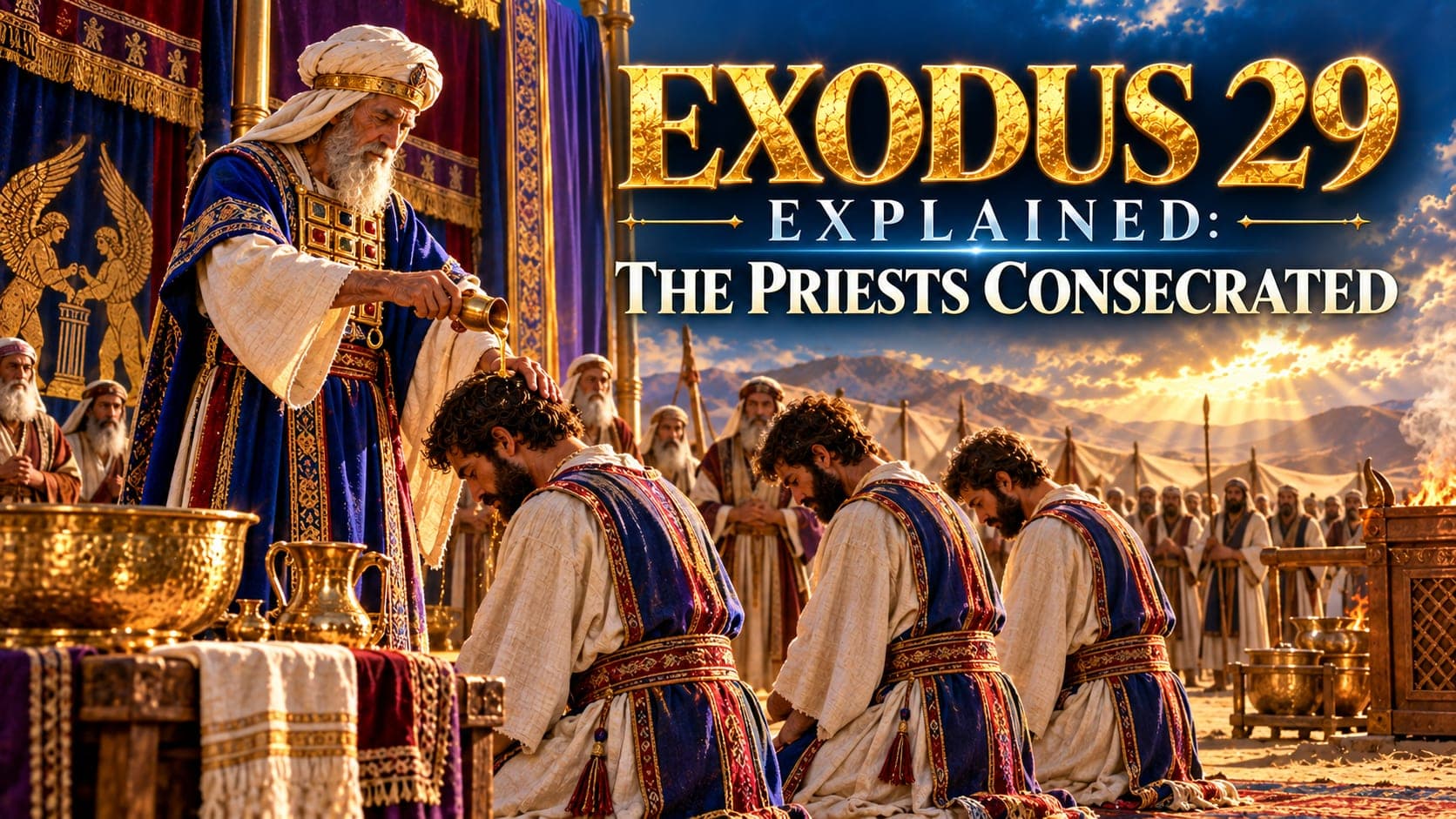
"And thou shalt take the garments, and put upon Aaron the coat, and the robe of the ephod, and the ephod, and the breastplate, and gird him with the curious girdle of the ephod: And thou shalt put the mitre upon his head, and put the holy crown upon the mitre."
Aaron never dresses himself here. Moses does it, piece after piece, in the exact order Exodus 28 listed them. Then one more step, and it is the step that actually sets Aaron apart from every other Israelite in the camp.
"Then shalt thou take the anointing oil, and pour it upon his head, and anoint him."
📌 Oil poured on the head, not rubbed in or sprinkled. This is the act that gives Aaron the standing Leviticus later calls "the priest that is anointed." His sons get simpler coats and girdles, no anointing oil poured on them the same way, and the chapter calls the whole arrangement a lasting rule.
"And thou shalt gird them with girdles, Aaron and his sons, and put the bonnets on them: and the priest’s office shall be theirs for a perpetual statute: and thou shalt consecrate Aaron and his sons."
3. The Sin Offering: a Bullock for Aaron Himself (verses 10 to 14)
Dressed and anointed, Aaron still cannot touch the altar on behalf of anyone else. He needs an offering made for himself first.
"And thou shalt cause a bullock to be brought before the tabernacle of the congregation: and Aaron and his sons shall put their hands upon the head of the bullock."
Hands pressed on the animal's head identified Aaron and his sons with it. Whatever happened to that bullock next was happening in their place.
"And thou shalt take of the blood of the bullock, and put it upon the horns of the altar with thy finger, and pour all the blood beside the bottom of the altar."
"But the flesh of the bullock, and his skin, and his dung, shalt thou burn with fire without the camp: it is a sin offering."
⚠️ The bullock was burned outside the camp, not on the altar. A sin offering was too tied to guilt to be treated like a normal gift to God. The horns got blood, the base got the rest, and the carcass itself was removed entirely from the holy ground.
4. The Burnt Offering: the First Ram Goes Up Whole (verses 15 to 18)
With the sin offering made, a different kind of sacrifice follows, and this one holds nothing back.
"And thou shalt cut the ram in pieces, and wash the inwards of him, and his legs, and put them unto his pieces, and unto his head."
"And thou shalt burn the whole ram upon the altar: it is a burnt offering unto the LORD: it is a sweet savour, an offering made by fire unto the LORD."
💡 A sin offering dealt with guilt. A burnt offering was total surrender. The whole ram burned, nothing kept back and nothing eaten, picturing complete dedication rather than payment for a specific wrong. "Sweet savour" is the text's own description, a sacrifice fully given and fully accepted, not God enjoying violence.
5. The Ram of Consecration: Blood on the Ear, Thumb, and Toe (verses 19 to 28)
A second ram follows, and its blood goes somewhere no offering in the tabernacle instructions has gone yet.
"Then shalt thou kill the ram, and take of his blood, and put it upon the tip of the right ear of Aaron, and upon the tip of the right ear of his sons, and upon the thumb of their right hand, and upon the great toe of their right foot, and sprinkle the blood upon the altar round about."
📌 Three points on the body, and all three matter for a priest's actual job. The ear hears God's instructions. The thumb does the work of the hands, the sacrifices and the handling of holy things. The toe carries him into the holy place and back out. Hearing, doing, and going, all three marked by the same blood.
"And thou shalt take of the blood that is upon the altar, and of the anointing oil, and sprinkle it upon Aaron, and upon his garments, and upon his sons, and upon the garments of his sons with him: and he shall be hallowed, and his garments, and his sons, and his sons’ garments with him."
Blood and oil together, on the men and on the clothes from the previous chapter alike. Even the garments needed hallowing before they counted as holy. Then comes a wave offering, lifted up before the Lord and placed back in Aaron's hands.
"And thou shalt take the breast of the ram of Aaron’s consecration, and wave it for a wave offering before the LORD: and it shall be thy part."
The breast of the ram became Moses' own portion that day, and the chapter sets it up as a standing rule: part of the priest's service would always come with a part of the offering set aside for him to eat.
6. Garments Passed Down, and a Meal Only the Holy Can Eat (verses 29 to 34)
The ceremony pauses to answer a practical question. What happens to these garments after Aaron dies?
"And the holy garments of Aaron shall be his sons’ after him, to be anointed therein, and to be consecrated in them."
The clothes outlive the man. One high priest's garments become the next high priest's garments, generation after generation. Then Aaron and his sons sit down to eat what was offered.
"And they shall eat those things wherewith the atonement was made, to consecrate and to sanctify them: but a stranger shall not eat thereof, because they are holy."
⚠️ This meal was not open to the camp. Only the men being consecrated could eat it, by the door of the tabernacle, because the food itself had become holy through the atonement made with it. Anything left by morning had to be burned, never saved and never shared with anyone outside the ceremony.
7. Seven Days, Two Lambs a Day, and the Reason for All of It (verses 35 to 46)
One day of this ceremony was not enough. God sets a number, and it is not a small one.
"And thus shalt thou do unto Aaron, and to his sons, according to all things which I have commanded thee: seven days shalt thou consecrate them."
Seven straight days, a new bullock for a sin offering every single one of them, cleansing the altar itself as much as the men serving at it. Only after the full week does the chapter move to what daily worship would look like going forward.
"Now this is that which thou shalt offer upon the altar; two lambs of the first year day by day continually."
"The one lamb thou shalt offer in the morning; and the other lamb thou shalt offer at even:"
💡 Every single day, forever, a lamb at sunrise and a lamb at sunset. Not an occasional ceremony. A rhythm built into the beginning and end of every day Israel existed as a nation, the same way the Passover lamb had already marked the night of their freedom.
Then the chapter ends, and it ends by telling you why any of this mattered at all.
"And there I will meet with the children of Israel, and the tabernacle shall be sanctified by my glory. And I will sanctify the tabernacle of the congregation, and the altar: I will sanctify also both Aaron and his sons, to minister to me in the priest’s office. And I will dwell among the children of Israel, and will be their God."
📌 Every bullock, every ram, every drop of blood on every ear and thumb and toe was for this one sentence. "I will dwell among the children of Israel, and will be their God." The whole chapter is the cost of a holy God living next to an unholy people without destroying them.

Hard Questions Exodus 29 Raises
Why did Aaron need a sin offering made for himself before he could serve anyone else? The text states it plainly. Aaron was never exempt from the problem he was ordained to deal with. He was a sinful man representing sinful people, which meant his own sin had to be dealt with before his hands could touch a sacrifice for the nation. Hebrews later points out exactly how unusual it was that one priest would not need this.
"Who needeth not daily, as those high priests, to offer up sacrifice, first for his own sins, and then for the people’s: for this he did once, when he offered up himself."
Every high priest after Aaron, generation after generation, had to repeat verse 10 to 14 before ever representing anyone else. Christians read Hebrews 7:27 as naming the one exception the whole Aaronic system was quietly pointing toward.
Did this ceremony actually happen the way Exodus 29 describes it? Yes. Leviticus 8 records Moses carrying out these exact instructions, down to the same three points on the body.
"And he slew it; and Moses took of the blood of it, and put it upon the tip of Aaron’s right ear, and upon the thumb of his right hand, and upon the great toe of his right foot."
"So Aaron and his sons did all things which the LORD commanded by the hand of Moses."
Nothing in Exodus 29 stayed theoretical. Leviticus shows the same blood landing in the same places, exactly as commanded.
Why does the chapter close on God talking about where He will dwell, instead of ending on the sacrifices? Because the sacrifices were never the point. They were the cost of the point. God names His actual goal in verse 45, to dwell among His people as their God, and every earlier verse in the chapter exists to make that possible without it destroying them.
Top Verses From Exodus 29
1. Exodus 29:20
"Then shalt thou kill the ram, and take of his blood, and put it upon the tip of the right ear of Aaron, and upon the tip of the right ear of his sons, and upon the thumb of their right hand, and upon the great toe of their right foot, and sprinkle the blood upon the altar round about."
The verse that marks a priest in three places that actually matter for his job: what he hears, what his hands do, and where his feet carry him.
2. Exodus 29:33
"And they shall eat those things wherewith the atonement was made, to consecrate and to sanctify them: but a stranger shall not eat thereof, because they are holy."
A meal only the consecrated could eat. What atonement made holy, nobody outside the ceremony was permitted to share.
3. Exodus 29:38
"Now this is that which thou shalt offer upon the altar; two lambs of the first year day by day continually."
A lamb at sunrise and a lamb at sunset, for as long as Israel stood. Not a single event, but a daily rhythm written into the start and end of every day.
4. Exodus 29:45
"And I will dwell among the children of Israel, and will be their God."
The reason the entire chapter exists. Every offering before this verse was the cost of a holy God living next to a people who had no right to His presence on their own.
5. John 1:14
"And the Word was made flesh, and dwelt among us, (and we beheld his glory, the glory as of the only begotten of the Father,) full of grace and truth."
Written centuries after Exodus 29, but Christians read it as the fuller answer to the same promise: God dwelling among His people, this time in a body rather than a tent.

Frequently Asked Questions About Exodus 29
What is Exodus 29 about?
Exodus 29 gives Moses the ceremony for ordaining Aaron and his sons as priests: washing, dressing, anointing, a sin offering, a burnt offering, a ram of consecration with blood placed on the ear, thumb, and toe, a meal eaten at the tabernacle door, seven days of repeated atonement, and the standing order for a lamb offered every morning and every evening.
What was the ram of consecration?
The second of two rams sacrificed in the ceremony, named specifically for this purpose in Exodus 29:22. Its blood marked Aaron and his sons on the ear, thumb, and toe, and part of it was waved before the Lord as an offering before becoming food for the men being ordained.
Why was blood put on Aaron's ear, thumb, and toe?
Exodus 29:20 commands it without explaining the symbolism directly, but the three points correspond to a priest's actual work: hearing God's word, doing the work of his hands, and walking where his service required him to go.
Why did Aaron need a sin offering made for himself?
Because Aaron was a sinful man like everyone he represented. Exodus 29:10 to 14 commands a bullock sacrificed specifically for his own sin before he could minister on behalf of anyone else, a pattern every high priest after him had to repeat.
Why did the ordination ceremony last seven days?
Exodus 29:35 to 37 commands seven full days of consecration, with a fresh sin offering and a fresh atonement for the altar every day. The text does not explain the exact number, only that the process could not be shortened to a single ceremony.
What does "sweet savour" mean in the Bible?
It describes a burnt offering fully given to God and fully accepted by Him, used in Exodus 29:18 for the first ram. It pictures total surrender being welcomed, not God taking pleasure in the violence of the sacrifice itself.
Why couldn't a stranger eat the consecration meal?
Exodus 29:33 says the food had become holy through the atonement made with it, so only the men being consecrated that day could eat it. Anything left by morning was burned rather than kept or shared.
What were the two lambs offered every morning and evening?
Exodus 29:38 and 39 command a continual burnt offering, one lamb at sunrise and one at sunset, every single day Israel existed as a nation under this law. It was never a one time ceremony.
Why does Exodus 29 end by talking about God dwelling with Israel?
Exodus 29:45 and 46 state the purpose behind everything earlier in the chapter. God wanted to live among His people as their God, and the sacrifices, the washing, and the anointing were the way a holy God could do that without an unholy people being destroyed by His presence.
How does Exodus 29 connect to Jesus?
Hebrews 7:27 draws a direct contrast: every priest ordained by Exodus 29 needed sacrifice first for his own sin, then for the people's, over and over. Jesus needed neither, offering Himself once. John 1:14 answers the chapter's closing promise, that God would dwell among His people, this time in a body rather than a tent.
Final Thoughts
Exodus 29 is not about clothes anymore. It is about what it actually costs to qualify a sinful man to represent sinful people before a holy God.
📌 Washing came before dressing, and dressing came before sacrifice. Nothing in this chapter happened out of order. Cleansing always came first.
📌 Aaron could not serve anyone else until his own sin was dealt with. Blood on the ear, thumb, and toe marked a whole man, not just a title.
📌 Every sacrifice in this chapter existed for one closing sentence. God wanted to dwell among His people. That was always the goal, not the blood itself.
You will never need a bullock or a ram to come near God. But you live after a priest who needed no sin offering for Himself, and who finished what every day by day lamb in this chapter could only point toward.
So here is your one next step.
Read Hebrews 7:27 today, right after Exodus 29:38 and 39, and notice how long God had already been showing Israel what one final, sufficient sacrifice would look like.