📖 Exodus 30 Explained: Incense, Ransom Money, and Anointing Oil
An altar nobody ever brings a sacrifice to. A tax that costs the rich man and the poor man the exact same coin. A perfume no one else on earth is allowed to wear.
Exodus 30 explained is the chapter that closes out God's instructions for the tabernacle with four pieces that do not fit neatly together at first glance: a gold altar built only for smoke, a half shekel collected whenever Israel is counted, a bronze basin for washing, and two recipes, one oil and one incense, that it is a crime for anyone else to copy.
Maybe you have skimmed past this chapter assuming it was just more furniture.
- ❓ Why does lighting a lamp require burning incense right alongside it, every single morning and evening?
- ❓ What does counting the population have to do with a ransom for your soul?
- ❓ Why would washing your hands and feet be a matter of life and death for a priest?
- ❓ And why does God care if someone else wants to smell like the tabernacle?
📌 Every law in Exodus 30 protects the same thing: a holiness that cannot be casual, borrowed, or bought at a discount.
This walkthrough goes through the whole chapter in order: the altar of incense and its daily rhythm, the atonement money collected at every census, the bronze laver that stood between the altar and the tent, the holy anointing oil poured on everything that would serve God, and the holy incense that no one outside the tabernacle was permitted to make for themselves.
None of these four pieces are filler before the next big story. Each one answers a question Israel would have actually asked.
What Happened Just Before This Chapter
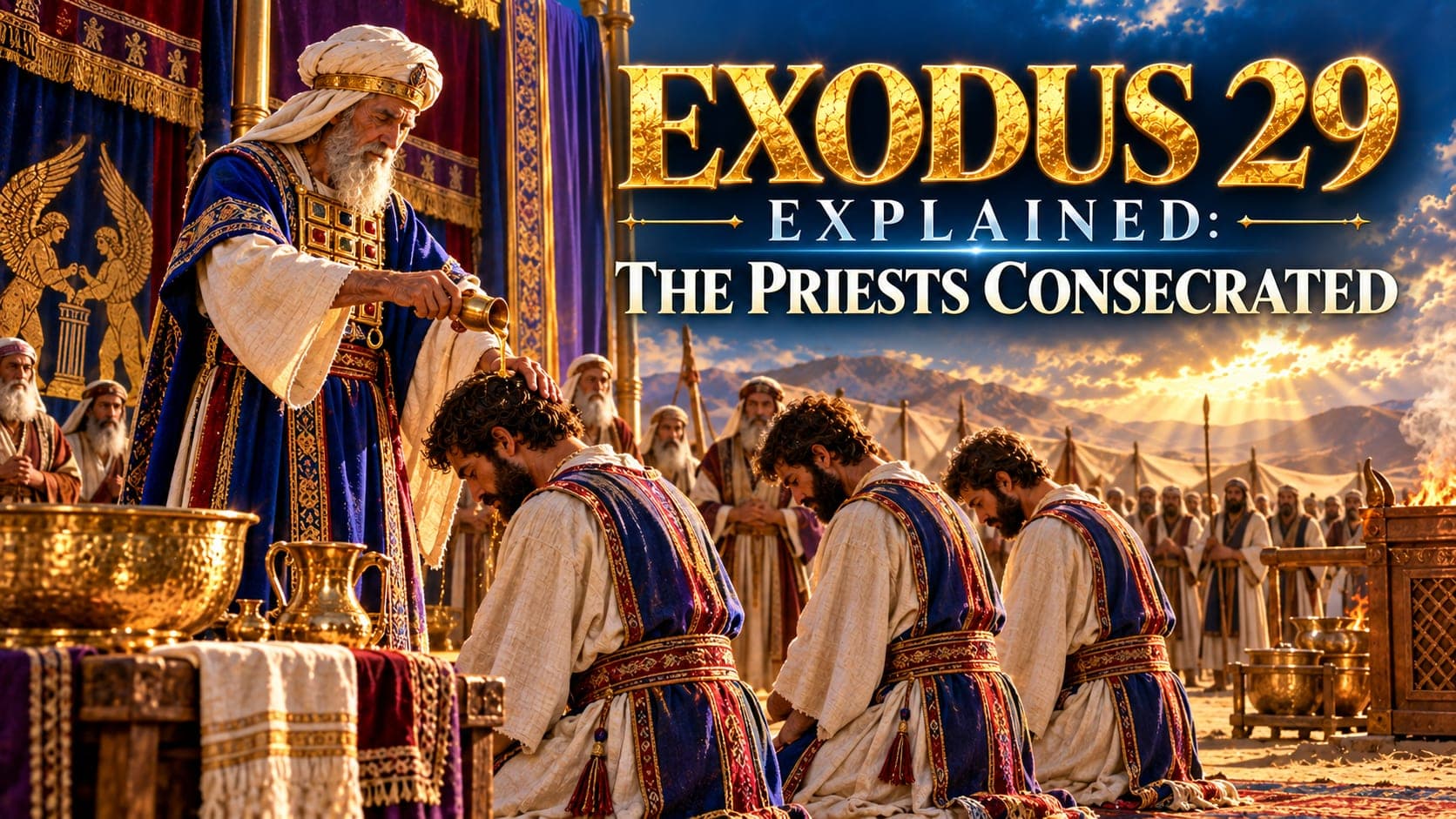
Exodus 29 ordained Aaron and his sons: washed, dressed, anointed, marked with blood on the ear, the thumb, and the toe, and set apart across seven straight days. By the end of that chapter, Israel finally had priests who were qualified to serve.
Qualified priests still needed the rest of the furniture finished and a few questions answered before daily worship could actually begin. What do you burn to fill the tent with a pleasing smell twice a day? What happens when the whole camp gets counted, the way armies and nations always eventually get counted? Where do Aaron and his sons wash before they walk toward the altar God described back in Exodus 27? Exodus 30 answers each one, then closes with two formulas, oil and incense, that only the tabernacle was ever allowed to use.

Exodus 30 Explained Verse by Verse
1. The Altar of Incense (verses 1 to 10)
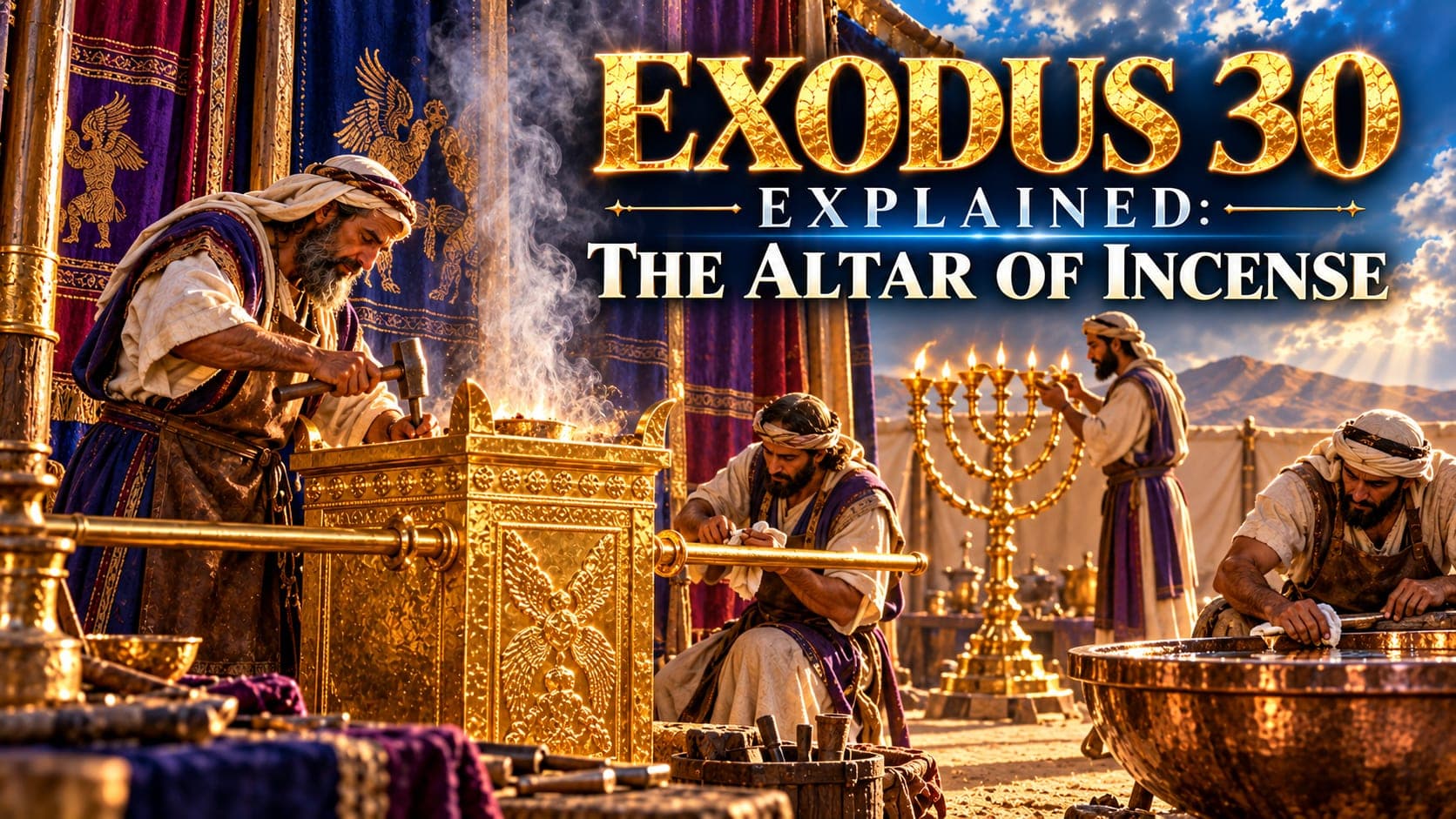
The chapter opens with a small altar, a cubit square and two cubits tall, built for a job none of the other furniture does.
"And thou shalt make an altar to burn incense upon: of shittim wood shalt thou make it."
Wood covered in gold, with horns on its corners like the bronze altar outside, but this one never touches blood or carries a carcass. It has one job, and the chapter says exactly where it stands.
"And thou shalt put it before the vail that is by the ark of the testimony, before the mercy seat that is over the testimony, where I will meet with thee."
As close to the ark and the mercy seat as anything could get without actually being inside the veil. Then comes the rhythm this altar runs on.
"And Aaron shall burn thereon sweet incense every morning: when he dresseth the lamps, he shall burn incense upon it."
"Ye shall offer no strange incense thereon, nor burnt sacrifice, nor meat offering; neither shall ye pour drink offering thereon."
📌 Lighting the lamps and burning incense happen together, morning and evening, for as long as the tabernacle stands. And verse 9 is specific about what this altar is not for. No sacrifice, no grain offering, no drink offering, nothing but the one incense formula God names later in the chapter. Once a year it gets its own atonement.
"And Aaron shall make an atonement upon the horns of it once in a year with the blood of the sin offering of atonements: once in the year shall he make atonement upon it throughout your generations: it is most holy unto the LORD."
That yearly atonement is the day later generations would call the Day of Atonement. Even an altar that never touches blood the rest of the year still needs cleansing once, because nothing holy stays untouched by sin just by standing in a holy place.
2. Atonement Money: A Ransom Counted in Half Shekels (verses 11 to 16)
The scene shifts from the tent to the whole camp, and from incense to a number no one in Israel could avoid.
"When thou takest the sum of the children of Israel after their number, then shall they give every man a ransom for his soul unto the LORD, when thou numberest them; that there be no plague among them, when thou numberest them."
A census was never going to be a neutral headcount in Israel. The text ties numbering the people directly to the danger of a plague, and it names the fix before the counting even starts.
"The rich shall not give more, and the poor shall not give less than half a shekel, when they give an offering unto the LORD, to make an atonement for your souls."
💡 One flat price, for every man twenty years old and up, rich or poor. A ransom for a soul was never going to be sold on a sliding scale. The money itself became a memorial, folded into the service of the tabernacle rather than spent and forgotten.
3. The Bronze Laver: Washing Before Serving (verses 17 to 21)
Next comes a basin, placed in one exact spot for one exact reason.
"Thou shalt also make a laver of brass, and his foot also of brass, to wash withal: and thou shalt put it between the tabernacle of the congregation and the altar, and thou shalt put water therein."
Between the tent and the altar means Aaron and his sons pass it every time they move from one to the other. The chapter is blunt about what happens if they skip it.
"When they go into the tabernacle of the congregation, they shall wash with water, that they die not; or when they come near to the altar to minister, to burn offering made by fire unto the LORD: So they shall wash their hands and their feet, that they die not: and it shall be a statute for ever to them, even to him and to his seed throughout their generations."
⚠️ Twice in two verses the text repeats the same stakes: that they die not. This was never a hygiene rule about dusty feet. Approaching a holy God unwashed was dangerous, and the laver stood as the one checkpoint no priest, not even Aaron himself, was allowed to walk past.
4. The Holy Anointing Oil (verses 22 to 33)
God hands Moses a recipe next, and it is specific down to the shekel.
"Take thou also unto thee principal spices, of pure myrrh five hundred shekels, and of sweet cinnamon half so much, even two hundred and fifty shekels, and of sweet calamus two hundred and fifty shekels, And of cassia five hundred shekels, after the shekel of the sanctuary, and of oil olive an hin."
Myrrh, cinnamon, calamus, cassia, and a full hin of olive oil, measured out and mixed into one formula. Then this one oil touches nearly everything in the tent.
"And thou shalt anoint the tabernacle of the congregation therewith, and the ark of the testimony, And the table and all his vessels, and the candlestick and his vessels, and the altar of incense, And the altar of burnt offering with all his vessels, and the laver and his foot."
Every single piece this chapter and the ones before it described gets touched by the same oil before it counts as holy. Then the oil moves from furniture to men.
"And thou shalt anoint Aaron and his sons, and consecrate them, that they may minister unto me in the priest’s office."
📌 One oil, poured on the ark, the altar, the laver, and Aaron himself, puts the furniture and the man under the exact same word: holy. Then God draws a hard line around that formula.
"Upon man’s flesh shall it not be poured, neither shall ye make any other like it, after the composition of it: it is holy, and it shall be holy unto you."
Ordinary skin never gets this oil, and the recipe itself is off limits to copy. The penalty for ignoring that line is stated plainly a verse later: being cut off from the people.
5. The Holy Incense, Off Limits to Everyone Else (verses 34 to 38)
The chapter ends the same way it opened, back at the altar of incense, this time with the formula that goes on top of it.
"And the LORD said unto Moses, Take unto thee sweet spices, stacte, and onycha, and galbanum; these sweet spices with pure frankincense: of each shall there be a like weight:"
Four spices in equal weight, ground fine and placed before the ark, and the chapter repeats the same restriction it just placed on the oil.
"And as for the perfume which thou shalt make, ye shall not make to yourselves according to the composition thereof: it shall be unto thee holy for the LORD."
💡 The last word of the chapter is the same penalty as the oil: cut off from his people. Something made to sit before the Lord alone was never meant to double as a personal fragrance. Holiness in this chapter is never only about what something is made of. It is about what it is kept for.

Hard Questions Exodus 30 Raises
Why would a simple headcount of the population need a ransom to avoid a plague? The text does not explain the mechanism, only the command. Scripture later shows exactly how seriously that connection was taken. Years afterward, David took a census of Israel without this kind of atonement in view, and the result was devastating.
"And again the anger of the LORD was kindled against Israel, and he moved David against them to say, Go, number Israel and Judah."
"So the LORD sent a pestilence upon Israel from the morning even to the time appointed: and there died of the people from Dan even to Beersheba seventy thousand men."
Exodus 30:12 names the exact danger a census carried and gives Moses a way to meet it. That danger was not hypothetical, as David's own census centuries later shows in painful detail.
Why were the oil and the incense so strictly off limits to copy? Exodus 30:9 already warned against "strange incense," and the warning was not decoration. Leviticus records what happened the very first time two priests ignored it.
"And Nadab and Abihu, the sons of Aaron, took either of them his censer, and put fire therein, and put incense thereon, and offered strange fire before the LORD, which he commanded them not."
"And there went out fire from the LORD, and devoured them, and they died before the LORD."
Two of Aaron's own sons, the same men consecrated in Exodus 29, died for exactly the kind of substitution Exodus 30 had already forbidden. The strict line around the recipe was never about keeping a secret. It was about keeping something set apart from being treated as ordinary.
Does the half shekel ransom connect to anything in the New Testament? It likely sits behind a story much later in Israel's history, the annual temple tax collected from Jewish men, which Jesus addresses directly in Matthew's Gospel.
"And when they were come to Capernaum, they that received tribute money came to Peter, and said, Doth not your master pay tribute?"
"Notwithstanding, lest we should offend them, go thou to the sea, and cast an hook, and take up the fish that first cometh up; and when thou hast opened his mouth, thou shalt find a piece of money: that take, and give unto them for me and thee."
Jesus pays it rather than disputing it, even while making the larger point that He, as the Son, owed nothing. The one time flat ransom of Exodus 30 had grown by Jesus' day into a yearly expectation, and He meets it without making a scene.
Top Verses From Exodus 30
1. Exodus 30:12
"When thou takest the sum of the children of Israel after their number, then shall they give every man a ransom for his soul unto the LORD, when thou numberest them; that there be no plague among them, when thou numberest them."
The verse that ties a census directly to a ransom for the soul, a connection 2 Samuel 24 shows was anything but symbolic.
2. Exodus 30:15
"The rich shall not give more, and the poor shall not give less than half a shekel, when they give an offering unto the LORD, to make an atonement for your souls."
A flat price for every soul, with no discount for poverty and no premium for wealth. Atonement in this chapter was never for sale by the size of a bank account.
3. Exodus 30:20 and 21
"When they go into the tabernacle of the congregation, they shall wash with water, that they die not; or when they come near to the altar to minister, to burn offering made by fire unto the LORD: So they shall wash their hands and their feet, that they die not: and it shall be a statute for ever to them, even to him and to his seed throughout their generations."
The clearest statement in the chapter that approaching God was never casual. The same warning repeats twice in two verses: that they die not.
4. Exodus 30:32
"Upon man’s flesh shall it not be poured, neither shall ye make any other like it, after the composition of it: it is holy, and it shall be holy unto you."
The line drawn around the anointing oil, a line Leviticus 10 shows was not a bluff when Aaron's own sons crossed something similar with the incense.
5. Mark 10:45
"For even the Son of man came not to be ministered unto, but to minister, and to give his life a ransom for many."
The same word Exodus 30 uses for the half shekel, ransom, reappears centuries later in Jesus' own description of why He came, this time paid in full rather than collected once a census.

Frequently Asked Questions About Exodus 30
What is Exodus 30 about?
Exodus 30 covers four separate instructions: the gold altar of incense and its morning and evening rhythm, the half shekel atonement money collected whenever Israel was counted, the bronze laver Aaron and his sons washed at before serving, and the exact recipes for the holy anointing oil and the holy incense, both of which no one outside the tabernacle was permitted to copy.
What was the altar of incense used for?
It stood just outside the veil, nearest the ark and the mercy seat, and carried only one offering: sweet incense burned by Aaron every morning and evening. Exodus 30:9 forbids any sacrifice, grain offering, or drink offering on it, keeping its one purpose from ever being blurred.
What was the atonement money in Exodus 30?
A half shekel collected from every Israelite man twenty years old and up whenever the nation was numbered, described in Exodus 30:12 to 16 as a ransom for the soul meant to prevent a plague. The money itself went toward the service of the tabernacle.
Why did the rich and the poor pay the same amount?
Exodus 30:15 states it directly: the rich were not to give more, and the poor were not to give less. A ransom for a soul was priced the same for every soul, regardless of what a person could afford.
What was the bronze laver for?
A basin of water placed between the tabernacle and the altar where Aaron and his sons washed their hands and feet before entering the tent or approaching the altar. Exodus 30:20 and 21 ties skipping this wash directly to death, making it a required step rather than a suggestion.
What spices were in the holy anointing oil?
Myrrh, sweet cinnamon, sweet calamus, and cassia, mixed into a full hin of olive oil according to Exodus 30:23 and 24. This same oil anointed the tabernacle, its furniture, and Aaron and his sons.
Why couldn't anyone else use the holy anointing oil or incense?
Exodus 30:32 and 37 both forbid copying the formulas or putting the oil on ordinary skin, with the penalty of being cut off from the people. Leviticus 10 shows the seriousness behind that line when two of Aaron's own sons offered incense God had not commanded and died for it.
Is the atonement money related to the temple tax in the New Testament?
It likely stands behind it. By the time of Matthew 17:24 to 27, Jewish men paid an annual tribute that traces back to this same half shekel principle. Jesus pays it rather than disputing the custom, even while making clear He personally owed nothing.
What is the Day of Atonement mentioned in Exodus 30?
Exodus 30:10 commands a yearly atonement on the horns of the incense altar using the blood of a sin offering, the earliest mention of the day Israel would later observe as the Day of Atonement.
How does Exodus 30 connect to Jesus?
Mark 10:45 uses the same word Exodus 30 uses for the half shekel, ransom, to describe why Jesus came. Psalm 141:2 and Revelation 5:8 both later picture incense as prayer rising to God, the same image this chapter attaches to Aaron's morning and evening offering.
Final Thoughts
Exodus 30 reads like a list of loose ends. Underneath the list, every piece is protecting the same thing.
📌 Holiness in this chapter is never about what something is made of. Gold, spices, and olive oil are ordinary materials. What made the altar, the oil, and the incense holy was that God set them apart for one use only.
📌 A ransom for a soul was never priced by income. Rich and poor paid the exact same half shekel, because what the money bought was never for sale on a sliding scale to begin with.
📌 Nothing in this chapter was casual, and Leviticus 10 shows what happened when two priests treated it that way. Washing before entering, burning only the commanded incense, keeping the holy oil off ordinary skin, every rule protected the same line between common and set apart.
You will never carry a half shekel to a census or wash at a bronze laver. But you live after a ransom that was paid once, for everyone, by a Savior who met the full cost Himself rather than asking you to.
So here is your one next step.
Next time you are tempted to treat something holy as ordinary, a habit, a convenience, a shortcut, stop and ask what line you might be stepping over without even noticing.
Aaron's sons found out the hard way that the line was real. You get to take it seriously before you ever have to find out the same way.