📖 Exodus 34 Explained: God Proclaims His Name and Moses' Shining Face
Moses asked to see God's glory. This chapter is where he finally gets an answer.
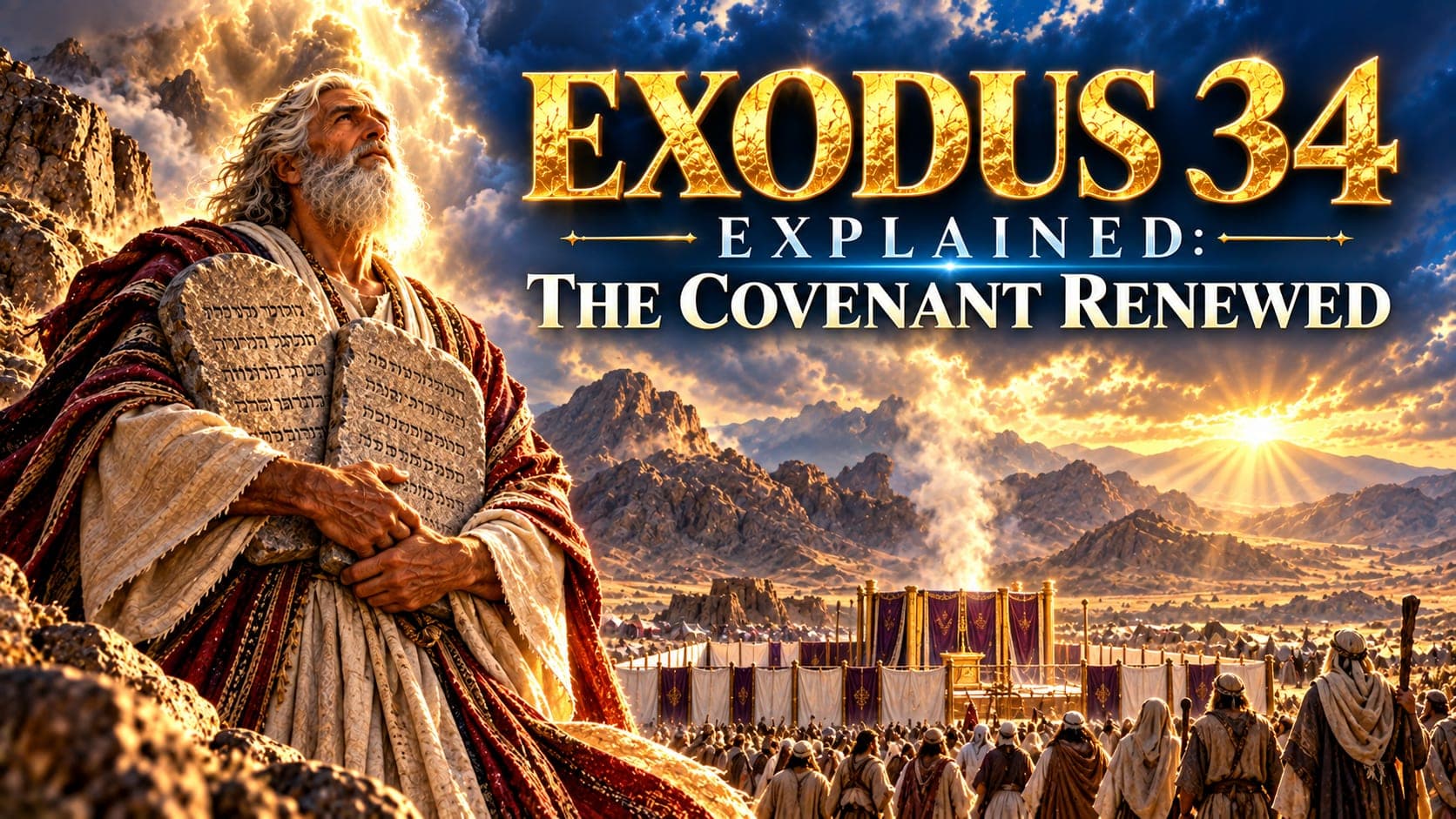
Exodus 34 explained is the chapter where Moses climbs the mountain a third time, carrying two blank stones he had to cut himself, and comes down with something no one had ever seen before: a face that glowed from being near God, and a covenant written fresh on tables that replaced the ones his own anger had broken.
Maybe you remember the golden calf story but never read what happened right after it.
- ❓ What did God actually say when He passed in front of Moses?
- ❓ Why does God call Himself jealous in the same breath as merciful?
- ❓ Why did Moses have to cut new stone tables himself this time?
- ❓ What was the veil on Moses' face actually covering?
📌 Exodus 34 is the chapter where God answers "show me thy glory" with words, not just light. He speaks His own name out loud, and that name becomes the most quoted description of His character in the rest of the Bible.
This walkthrough goes through the whole chapter in order: the new tables Moses had to carve himself, the proclamation of God's name on the mountain, Moses bowing and asking again, the covenant renewed with a hard warning about compromise, the feasts repeated one more time, and the glow on Moses' face that would not fade and had to be covered.
Read slowly. The words God speaks here are quoted more than almost any other verse in the Old Testament.
What Happened Just Before This Chapter
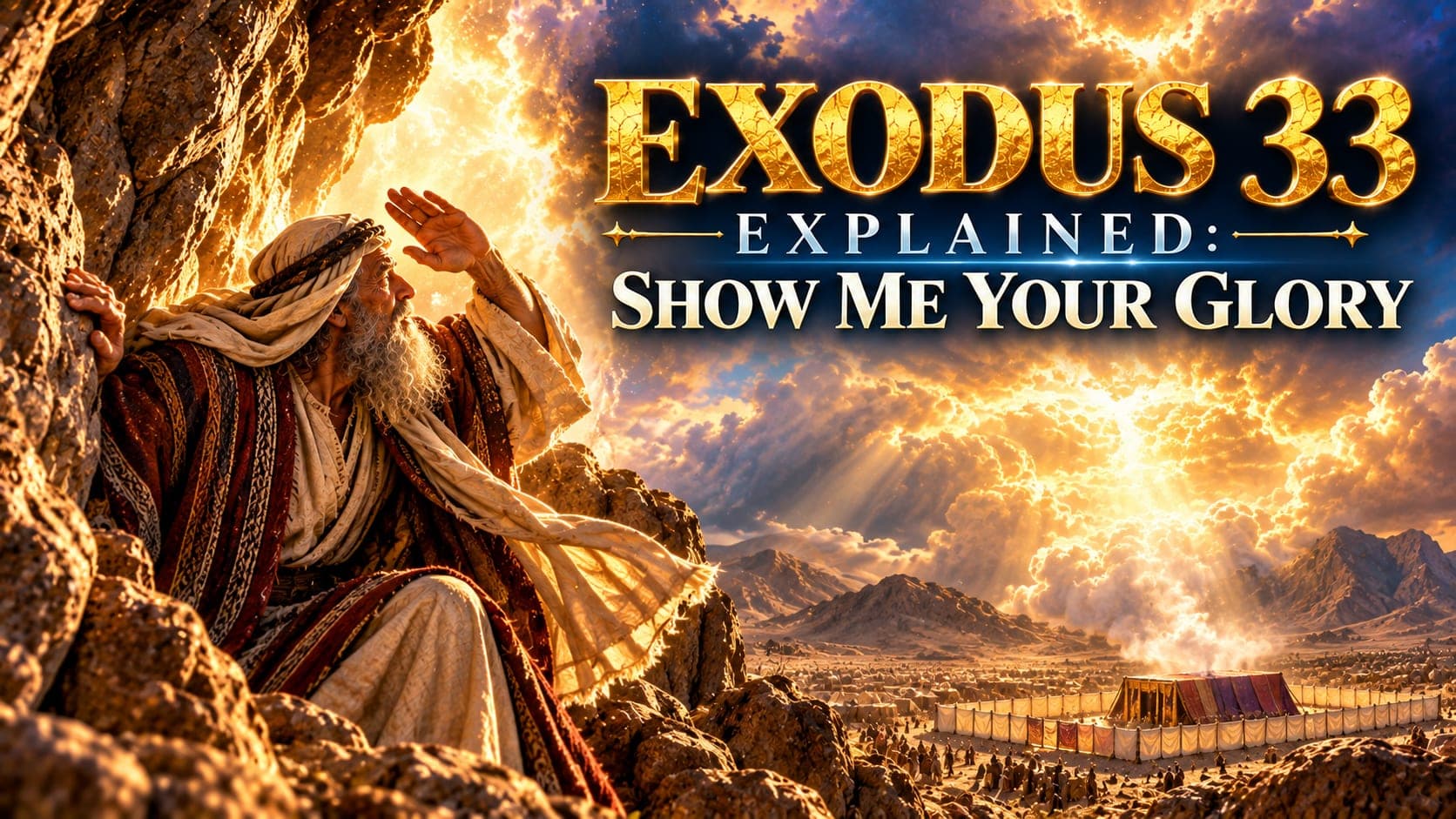
Exodus 33 ended with a request that could not be granted exactly as asked. Moses had refused to move another step without God's own presence, and once that was settled, he pushed further still: "I beseech thee, shew me thy glory." God answered that no living person could survive seeing His unveiled face, but promised something real anyway. He would hide Moses in a cleft of the rock, cover him with His own hand, and let Moses see His back as His glory passed by.
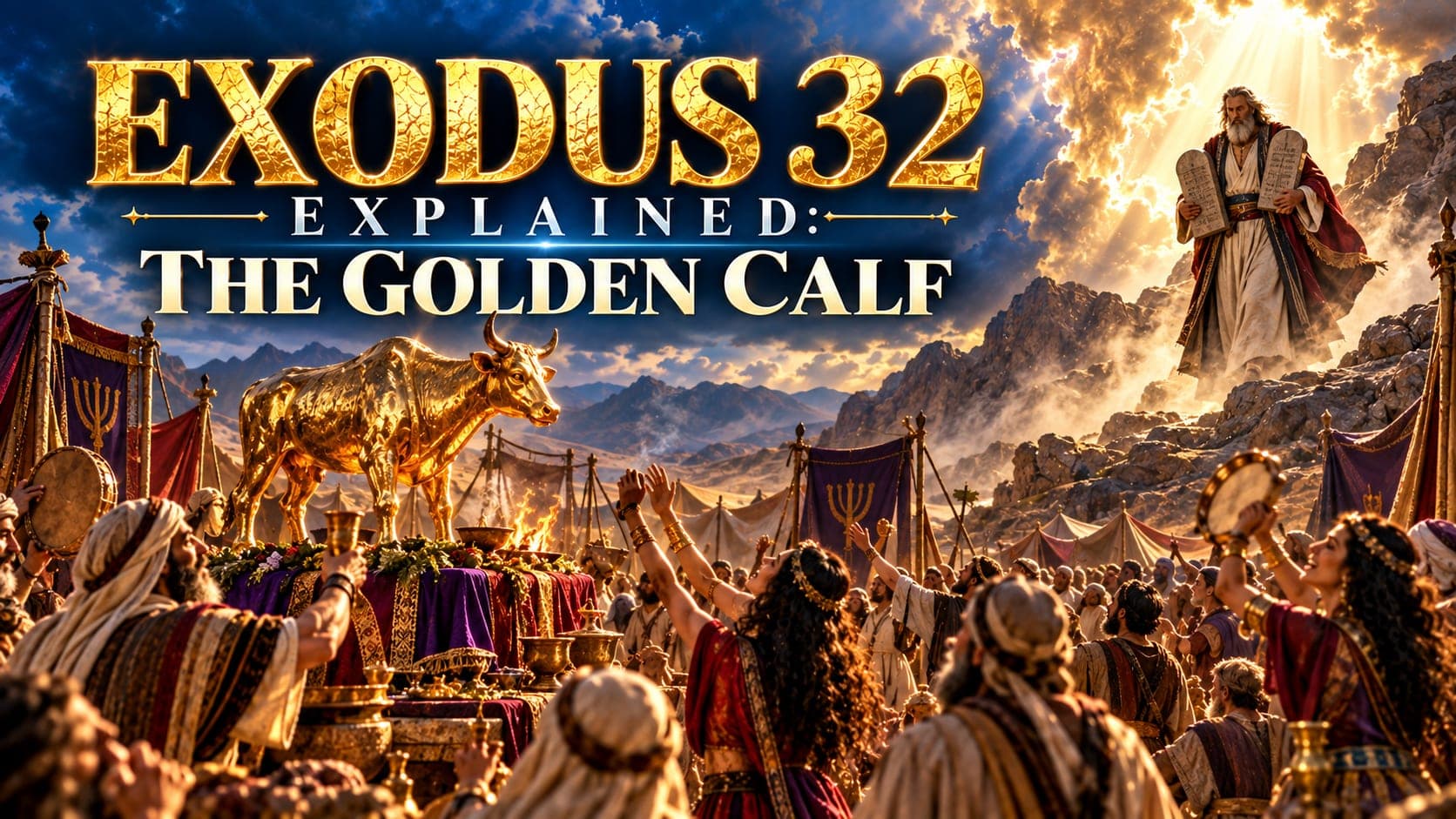
That promise was still unfulfilled when Exodus 33 closed. The chapter ended on the mountain, with the sight still ahead of Moses. Exodus 34 opens by finally showing what Moses actually saw, and it starts with a problem left over from Exodus 32: there were no tables left to write on. Moses had broken the first set, written by God's own finger, when he came down the mountain and found the golden calf.

Exodus 34 Explained Verse by Verse
1. New Tables for a Broken Covenant (verses 1 to 4)
God tells Moses to replace what he destroyed, and this time the work is not entirely God's own.
"And the LORD said unto Moses, Hew thee two tables of stone like unto the first: and I will write upon these tables the words that were in the first tables, which thou brakest."
📌 Notice the division of labor. Moses has to hew the stone himself this time. God will still do the writing, but the raw material is Moses' own effort, cut by his own hands, the same hands that threw the first tables to the ground in anger.
The instructions that follow are strict about who gets to witness this. No one else climbs the mountain this time, not even Joshua, who had waited at the tent of meeting back in Exodus 33. Not even the flocks are allowed to graze near its base.
"And he hewed two tables of stone like unto the first; and Moses rose up early in the morning, and went up unto mount Sinai, as the LORD had commanded him, and took in his hand the two tables of stone."
💡 Moses does not delay this time. He rises early and climbs with the stones already in his hand, carrying up the mountain the very thing he had smashed at the bottom of it.
2. The LORD Proclaims His Own Name (verses 5 to 7)
This is the answer to the request Moses made at the end of the last chapter.
"And the LORD descended in the cloud, and stood with him there, and proclaimed the name of the LORD."
"And the LORD passed by before him, and proclaimed, The LORD, The LORD God, merciful and gracious, longsuffering, and abundant in goodness and truth, Keeping mercy for thousands, forgiving iniquity and transgression and sin, and that will by no means clear the guilty; visiting the iniquity of the fathers upon the children, and upon the children's children, unto the third and to the fourth generation."
📌 Moses asked to see glory. What he receives is a description of character. No physical detail is recorded here at all, no shape, no color, no light. What passes by Moses on that mountain is a list of who God is, spoken out loud in His own words.
These two verses get quoted or echoed more than almost any other single passage in the Old Testament. Numbers 14:18 repeats the same formula almost word for word, and later writers lean on it again and again.
"The LORD is longsuffering, and of great mercy, forgiving iniquity and transgression, and by no means clearing the guilty, visiting the iniquity of the fathers upon the children unto the third and fourth generation."
⚠️ Mercy and justice sit in the same breath, and neither one cancels the other. "Merciful and gracious" and "will by no means clear the guilty" are not two competing gods. They are the same God, described fully, refusing to be reduced to only His kindness or only His holiness.
💡 "Keeping mercy for thousands" likely means mercy extended to a thousand generations, not merely a thousand people. Set beside the warning about the third and fourth generation in the very next clause, the weight leans heavily toward mercy. Consequence reaches a few generations forward. Mercy reaches thousands.
3. Moses Worships and Asks Again (verses 8 and 9)
Moses does not respond to this proclamation with a question. He responds with his face on the ground.
"And Moses made haste, and bowed his head toward the earth, and worshipped."
"And he said, If now I have found grace in thy sight, O LORD, let my LORD, I pray thee, go among us; for it is a stiffnecked people; and pardon our iniquity and our sin, and take us for thine inheritance."
📌 Moses just heard God name Israel's sin in advance, then asks God to forgive the exact thing He just named. He does not argue that Israel deserves better. He calls them "a stiffnecked people" himself, the same word God used for them back in Exodus 32, and asks for mercy anyway, on the strength of the character God had just proclaimed.
4. A Covenant Renewed, With a Hard Warning About Compromise (verses 10 to 17)
God answers by renewing the covenant, and then spends more verses warning Israel about one danger than any other.
"And he said, Behold, I make a covenant: before all thy people I will do marvels, such as have not been done in all the earth, nor in any nation: and all the people among which thou art shall see the work of the LORD: for it is a terrible thing that I will do with thee."
The promise of the land and the nations driven out ahead of them comes next, almost word for word what God had already said at the start of Exodus 33. What is new is the length of the warning that follows it.
"Take heed to thyself, lest thou make a covenant with the inhabitants of the land whither thou goest, lest it be for a snare in the midst of thee: But ye shall destroy their altars, break their images, and cut down their groves: For thou shalt worship no other god: for the LORD, whose name is Jealous, is a jealous God:"
"And thou take of their daughters unto thy sons, and their daughters go a whoring after their gods, and make thy sons go a whoring after their gods. Thou shalt make thee no molten gods."
⚠️ The specific danger named is not war. It is intermarriage leading to shared worship. The concern is never about ancestry for its own sake. It is that a daughter raised to worship another god does not stop worshipping that god just because she marries into Israel, and a household split between two altars eventually settles on one. The last line, "thou shalt make thee no molten gods," lands exactly where it has to, one chapter after a molten calf nearly ended everything.
📌 "Jealous" here is not pettiness. It describes the exclusive claim a husband has on a wife, the same word used elsewhere for a marriage covenant. God speaking of Himself as jealous for Israel is the language of a relationship, not a rival keeping score.
5. The Appointed Times, Repeated One More Time (verses 18 to 26)
With the covenant renewed, God runs back through the calendar of feasts and offerings, most of it already given earlier in Exodus.
"The feast of unleavened bread shalt thou keep. Seven days thou shalt eat unleavened bread, as I commanded thee, in the time of the month Abib: for in the month Abib thou camest out from Egypt."
"Six days thou shalt work, but on the seventh day thou shalt rest: in earing time and in harvest thou shalt rest."
💡 "Earing time" is an old word for plowing, not for listening. Even at the two busiest points on a farmer's calendar, planting and harvest, the sabbath still holds. The same rest already commanded with the manna, at Sinai, and right before the tabernacle work in Exodus 31 gets repeated here with no exception carved out for the two seasons a farmer could least afford to stop.
"Thrice in the year shall all your menchildren appear before the LORD God, the God of Israel."
"Thou shalt not offer the blood of my sacrifice with leaven; neither shall the sacrifice of the feast of the passover be left unto the morning. The first of the firstfruits of thy land thou shalt bring unto the house of the LORD thy God. Thou shalt not seethe a kid in his mother's milk."
📌 None of this is new information. Every law in this section had already been given earlier in Exodus. Repeating it here, right after the covenant breaks and gets renewed, says plainly that the relationship God is restoring is the same one, with the same terms, not a second, lesser arrangement.
6. Forty Days Again, and the Words Written Down (verses 27 and 28)
Two short verses close out the mountain scene, and this time Moses himself does some of the writing.
"And the LORD said unto Moses, Write thou these words: for after the tenor of these words I have made a covenant with thee and with Israel."
"And he was there with the LORD forty days and forty nights; he did neither eat bread, nor drink water. And he wrote upon the tables the words of the covenant, the ten commandments."
💡 Verse 27 has Moses writing "these words," the covenant terms God had just spoken. Verse 1 had already promised that God Himself would write "the words that were in the first tables" onto the new stone. The chapter holds both: God restoring the ten commandments onto the tables exactly as before, and Moses recording the covenant renewal God spoke alongside them. Forty days and nights without food or water is the same length of time Moses spent on the mountain before, now repeated for a covenant that had to be rebuilt.
7. The Shining Face and the Veil (verses 29 to 35)
Moses comes down the mountain carrying more than stone this time, and he does not know it yet.
"And it came to pass, when Moses came down from mount Sinai with the two tables of testimony in Moses' hand, when he came down from the mount, that Moses wist not that the skin of his face shone while he talked with him."
"And when Aaron and all the children of Israel saw Moses, behold, the skin of his face shone; and they were afraid to come nigh him."
📌 Moses has no idea his own face is glowing. The nearness he just had with God left a visible mark on him that he could not see on himself and could not turn off. Everyone else sees it before he does.
He calls the people closer, and once the message is delivered, a new habit begins.
"And till Moses had done speaking with them, he put a vail on his face."
"But when Moses went in before the LORD to speak with him, he took the vail off, until he came out. And he came out, and spake unto the children of Israel that which he was commanded."
⚠️ Read the order carefully. Moses goes in before the LORD unveiled, comes out and speaks to the people unveiled, and only then covers his face until the next time he goes back in. The veil was not there to hide the glow from God. It went on after the message was delivered, not before it.
💡 Paul reads this scene centuries later and draws out what the glow itself did not say outright: it was fading.
"And not as Moses, which put a vail over his face, that the children of Israel could not stedfastly look to the end of that which is abolished: But their minds were blinded: for until this day remaineth the same vail untaken away in the reading of the old testament; which vail is done away in Christ."
Paul's reading is that the veil hid a glory that was already fading between visits to the mountain, which is also why Moses had to keep going back in. Exodus 34 itself never states that the glow faded. It only records the pattern repeating: in unveiled, out to speak, then veiled again until the next time.
Hard Questions Exodus 34 Raises
Does "visiting the iniquity of the fathers upon the children" mean children are punished for their parents' sin? The text states it plainly in Exodus 34:7, and the same formula repeats in Numbers 14:18 and in the Ten Commandments themselves back in Exodus 20. A later chapter of Scripture states the opposite principle just as plainly.
"The soul that sinneth, it shall die. The son shall not bear the iniquity of the father, neither shall the father bear the iniquity of the son: the righteousness of the righteous shall be upon him, and the wickedness of the wicked shall be upon him."
Both statements stand in Scripture without either one erasing the other. The most natural way to hold them together is to separate guilt before God, which Ezekiel insists is always personal and never inherited, from the real, visible consequences a family or a nation keeps living with for generations after a sin, which Exodus 34 and Numbers 14 both describe. A parent's idolatry does not count as a child's own sin before God. It can still shape the home, the habits, and the choices that child grows up inside.
Why does God call Himself jealous right after describing Himself as merciful and gracious? Exodus 34:14 names it directly: "the LORD, whose name is Jealous, is a jealous God." In Scripture's own vocabulary, jealousy describes the exclusive claim of a covenant relationship, the same word used for a husband's claim on his wife, not insecurity or rivalry. A God who has just bound Himself to Israel by covenant has every right to object when that covenant gets shared with another god.
Why does the warning against intermarriage focus so heavily on the Canaanite nations? Exodus 34:15 and 16 name the specific danger: daughters raised to worship other gods who would not stop worshipping them after marrying into Israel. The text's own stated concern is religious compromise, a household split between two altars, not ancestry for its own sake. The same chapter commands destroying altars and images, never destroying people for who their parents were.
Why did Moses have to cut the new stone tables himself, when the first ones were entirely God's work? Exodus 34:1 and 4 record the instruction and Moses' obedience without explaining the reason. The text does not say. What it does make unmistakable is that Moses' own effort and God's own writing both belong in the same renewed covenant, neither one replacing the other.
Top Verses From Exodus 34
1. Exodus 34:6 and 7
"The LORD, The LORD God, merciful and gracious, longsuffering, and abundant in goodness and truth, Keeping mercy for thousands, forgiving iniquity and transgression and sin, and that will by no means clear the guilty; visiting the iniquity of the fathers upon the children, and upon the children's children, unto the third and to the fourth generation."
God's own description of His character, spoken out loud on the mountain. The most repeated formula for who God is anywhere in the Old Testament, echoed in Numbers, the Psalms, and the prophets.
2. Exodus 34:9
"And he said, If now I have found grace in thy sight, O LORD, let my LORD, I pray thee, go among us; for it is a stiffnecked people; and pardon our iniquity and our sin, and take us for thine inheritance."
Moses names Israel's exact failure in the same breath he asks for mercy, without softening the charge or hiding behind an excuse.
3. Exodus 34:14
"For thou shalt worship no other god: for the LORD, whose name is Jealous, is a jealous God:"
A jealousy rooted in covenant, the same exclusive claim a marriage carries, given right after Israel had already broken that claim once with a golden calf.
4. Exodus 34:28
"And he was there with the LORD forty days and forty nights; he did neither eat bread, nor drink water. And he wrote upon the tables the words of the covenant, the ten commandments."
A second forty days on the mountain, for a covenant that had to be rebuilt after it was broken once already.
5. Exodus 34:29 and 30
"And it came to pass, when Moses came down from mount Sinai with the two tables of testimony in Moses' hand, when he came down from the mount, that Moses wist not that the skin of his face shone while he talked with him. And when Aaron and all the children of Israel saw Moses, behold, the skin of his face shone; and they were afraid to come nigh him."
Nearness to God left a visible mark Moses could not see on his own face. Everyone else noticed it before he did.

Frequently Asked Questions About Exodus 34
What is Exodus 34 about?
Exodus 34 records Moses cutting new stone tables after breaking the first ones, God proclaiming His own name and character on the mountain, Moses interceding for Israel again, the covenant renewed with a warning against compromise with the Canaanite nations, the feasts repeated, and Moses coming down with a face that shone from being with God.
What did God say when He proclaimed His name to Moses?
Exodus 34:6 and 7 record God describing Himself as merciful, gracious, longsuffering, abundant in goodness and truth, forgiving of sin, and yet never clearing the guilty without consequence. It is the fullest self description of God's character anywhere in the Old Testament.
Why did Moses have to make new stone tables?
Moses had broken the first tables, written entirely by God, when he came down the mountain and found Israel worshipping the golden calf in Exodus 32. Exodus 34:1 records God instructing Moses to hew two new tables himself so the covenant words could be written on them again.
Does God punish children for their parents' sins?
Exodus 34:7 says God visits the iniquity of the fathers on the children to the third and fourth generation, describing real consequences that outlast a sin. Ezekiel 18:20 states just as plainly that personal guilt before God is never inherited. The two together describe lasting consequence without inherited guilt.
What does it mean that God is a jealous God?
In Exodus 34:14, jealousy describes the exclusive claim of a covenant relationship, the same word used elsewhere for a husband's claim on his wife. It is not insecurity. It is the right a covenant partner has to object when that covenant is shared with another god.
Why did God warn Israel so strongly against marrying the Canaanites?
Exodus 34:15 and 16 name the specific danger as daughters raised to worship other gods who would not stop after marrying into Israel. The stated concern is a household split between two forms of worship, not ancestry, and the same passage commands destroying religious objects, not people.
Why did Moses' face shine after being on the mountain?
Exodus 34:29 and 30 record that the skin of Moses' face shone from being with the LORD, and that he did not know it himself until Aaron and the people were afraid to come near him. The text never explains the mechanism, only that real closeness with God left a visible, physical mark.
Why did Moses wear a veil?
Exodus 34:33 to 35 describe Moses removing the veil to speak with God, keeping it off while he delivered God's words to the people, and putting it on only afterward until his next time before the LORD. 2 Corinthians 3:13 adds that the glory itself was fading, which the veil covered up between those visits.
How does Exodus 34 connect to Jesus?
2 Corinthians 3:13 to 18 reads Moses' fading glory and veiled face as a picture of the old covenant itself, contrasted with a glory in Christ that does not need to be hidden or renewed every few days. Where Moses' glow faded and had to be covered, Paul says believers now behold the Lord's glory with an open face.
Final Thoughts
Exodus 34 answers a request made in the last chapter, and the answer is bigger than a sight.
📌 God revealed His glory as a character, not a spectacle. Moses asked to see something. What passed by him was a description of who God actually is, mercy and justice both spoken in full, neither one hiding the other.
📌 Renewal after failure still looked like the same covenant. The feasts, the sabbath, the warnings against idolatry, all of it repeated here word for word from earlier chapters. God did not lower the terms for a people who had just broken them.
📌 Time with God leaves a mark you may not see on yourself. Moses had no idea his own face was shining. The people saw it before he did.
You will not come down a mountain with a glowing face. But the same pattern holds: real time spent close to God tends to show up in you before you notice it yourself.
So here is your one next step.
Read Exodus 34:6 and 7 slowly today, out loud if you can, and let it be your own definition of who God is the next time you are tempted to shrink Him down to only one of His attributes.