📖 Exodus 33 Explained: Moses Pleads for God's Presence and Glory
The golden calf is already ground to dust. The three thousand are already buried. Israel has already heard, in the last words of the chapter before this one, that the LORD forgives and the journey keeps going.
Exodus 33 explained is the chapter that asks the question the golden calf story never actually settled. Forgiven and moving forward, yes, but moving forward with whom? God opens the chapter by offering Israel an escort, an angel sent ahead of them. Moses spends the rest of the chapter refusing to settle for that, and asking for something far more dangerous instead.
Maybe you have read this chapter and only remembered the ending, the rock and the hand over Moses' eyes, without noticing everything he had to argue through to get there.
- ❓ Why did God offer to send only an angel instead of going with Israel Himself?
- ❓ Why did the people strip off their jewelry the moment they heard that news?
- ❓ How can Moses speak with God "face to face" in a chapter that also says no one can see God's face and live?
- ❓ What was Moses actually asking for when he asked to see God's glory?
📌 Exodus 33 is the chapter where Moses discovers that being forgiven and being accompanied are two different gifts, and refuses to walk away with only the first one.
This walkthrough goes through the whole chapter in order: God's warning that He will send an angel rather than travel among a stiffnecked people, the tent of meeting pitched outside the camp where Moses talked with God as a friend, Moses refusing to take another step without God's own presence, the request to see God's glory and the name God proclaims in answer, and the rock where Moses finally sees as much of God as a living person can survive seeing.
Read slowly. What Moses argues for here is still the same thing you are actually asking for every time you pray.
What Happened Just Before This Chapter
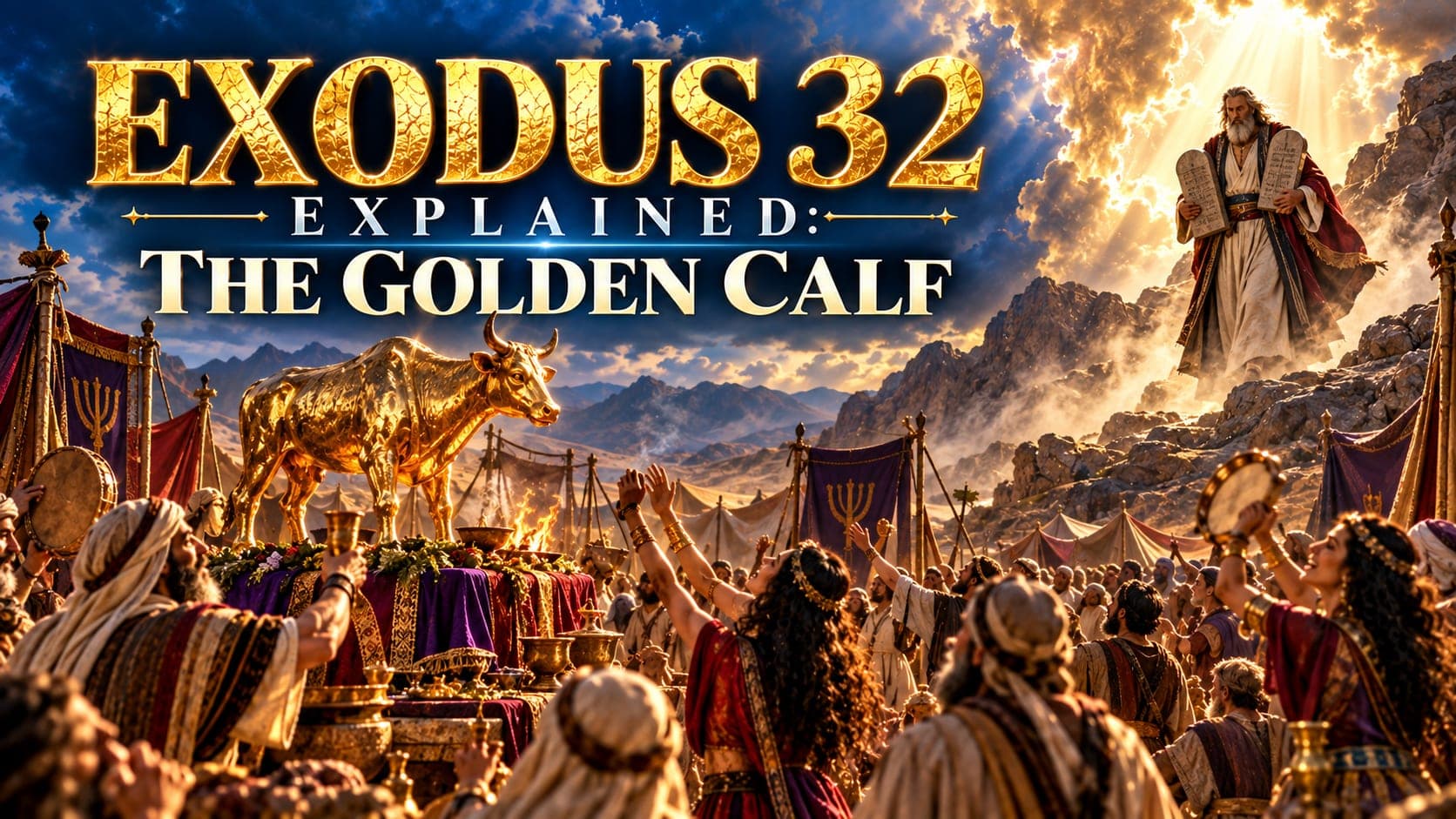
Exodus 32 ended without quiet. The golden calf had been burned, ground to powder, and forced down the throats of the people who worshipped it. Three thousand lay dead at the hands of the sons of Levi. Moses had climbed the mountain a second time, offered to be erased from God's own book in Israel's place, and heard God answer that each person would still answer for their own sin, and that His Angel would go ahead of the nation regardless.
That should have sounded like good news. The journey toward the land God had promised was still on. An angel was still going ahead of them. Only a handful of chapters earlier, in Exodus 24, Israel had heard that same covenant read aloud and promised with one voice to keep every word of it. An escort to Canaan was not nothing. Exodus 33 opens by naming exactly what that arrangement was still missing.

Exodus 33 Explained Verse by Verse
1. God Offers an Angel, Not Himself (verses 1 to 6)
The chapter opens with a command to move, and a reason why God will not be the one walking in front.
"And the LORD said unto Moses, Depart, and go up hence, thou and the people which thou hast brought up out of the land of Egypt, unto the land which I sware unto Abraham, to Isaac, and to Jacob, saying, Unto thy seed will I give it: And I will send an angel before thee; and I will drive out the Canaanite, the Amorite, and the Hittite, and the Perizzite, the Hivite, and the Jebusite: Unto a land flowing with milk and honey: for I will not go up in the midst of thee; for thou art a stiffnecked people: lest I consume thee in the way."
Every promise still stands. The land, the seed of Abraham, the nations driven out ahead of them. What changes is who makes the trip. "I will not go up in the midst of thee" is God stepping back, for Israel's own protection, because a people who keep pulling away from the direction He points them cannot survive Him walking that close.
📌 This is not God abandoning Israel. It is God warning Israel what His own nearness would cost them while they are still this kind of people. An angel can lead them to the land. Only God Himself walking among them could destroy them for the next failure exactly like this one.
The people understand the weight of what they just heard.
"And when the people heard these evil tidings, they mourned: and no man did put on him his ornaments. For the LORD had said unto Moses, Say unto the children of Israel, Ye are a stiffnecked people: I will come up into the midst of thee in a moment, and consume thee: therefore now put off thy ornaments from thee, that I may know what to do unto thee. And the children of Israel stripped themselves of their ornaments by the mount Horeb."
⚠️ Notice what they take off. Ornaments, the same category of gold that had just been melted into a calf a chapter earlier. Stripping it away is not decoration. It is the camp admitting, without a single word recorded from anyone, that the last thing they built with their jewelry cost them almost everything.
2. The Tent of Meeting Outside the Camp (verses 7 to 11)
Moses answers the crisis by moving somewhere new to meet with God.
"And Moses took the tabernacle, and pitched it without the camp, afar off from the camp, and called it the Tabernacle of the congregation. And it came to pass, that every one which sought the LORD went out unto the tabernacle of the congregation, which was without the camp."
This cannot be the gold covered sanctuary described back in Exodus 26. That structure has not been built yet; Bezaleel has not lifted a tool. This is evidently a simple, provisional tent, pitched outside the camp rather than in the center of it, the opposite of where the real tabernacle will one day stand. Distance, for now, is the point.
"And it came to pass, when Moses went out unto the tabernacle, that all the people rose up, and stood every man at his tent door, and looked after Moses, until he was gone into the tabernacle. And it came to pass, as Moses entered into the tabernacle, the cloudy pillar descended, and stood at the door of the tabernacle, and the Lord talked with Moses."
💡 The whole camp watches Moses walk there, every single time. They cannot go themselves yet, but they can watch the cloud come down and know something real is happening on their behalf.
"And the LORD spake unto Moses face to face, as a man speaketh unto his friend. And he turned again into the camp: but his servant Joshua, the son of Nun, a young man, departed not out of the tabernacle."
📌 "As a man speaketh unto his friend" is about as close a description of relationship with God as the Old Testament ever offers. Moses was already no stranger to this voice from the burning bush in Exodus 3, but this verse describes an ongoing friendship, not a single encounter. One small detail closes the scene: while Moses walks back to the camp to deal with the people, Joshua stays behind at the tent. Long before he leads a nation into Canaan, Joshua is already the kind of man who does not rush away from the presence of God the moment he is allowed to leave.
3. Moses Refuses to Move Without God's Presence (verses 12 to 16)
Inside that tent, Moses raises the one problem an angel cannot solve.
"And Moses said unto the LORD, See, thou sayest unto me, Bring up this people: and thou hast not let me know whom thou wilt send with me. Yet thou hast said, I know thee by name, and thou hast also found grace in my sight. Now therefore, I pray thee, if I have found grace in thy sight, shew me now thy way, that I may know thee, that I may find grace in thy sight: and consider that this nation is thy people."
Moses does not ask for comfort or an easier road. He asks to know God better, and he reminds God, gently but pointedly, that this is still "thy people," not a burden handed off to Moses alone. God answers with a promise.
"And he said, My presence shall go with thee, and I will give thee rest."
That should have settled it. Moses is not finished.
"And he said unto him, If thy presence go not with me, carry us not up hence. For wherein shall it be known here that I and thy people have found grace in thy sight? is it not in that thou goest with us? so shall we be separated, I and thy people, from all the people that are upon the face of the earth."
⚠️ Moses names the one thing that would actually set Israel apart from every other nation on earth, and it is not their law code, their history, or their numbers. It is God physically present among them. Take that away and Canaan would just be one more nation among many, led by a capable man with good laws. Moses would rather stay in the wilderness forever than trade God's presence for an angel's.
4. Show Me Thy Glory (verses 17 to 19)
God grants the request, and Moses immediately asks for more.
"And the LORD said unto Moses, I will do this thing also that thou hast spoken: for thou hast found grace in my sight, and I know thee by name."
"And he said, I beseech thee, shew me thy glory."
💡 Presence was not the ceiling of what Moses wanted. Having secured that God would travel with Israel, he now asks to see the weight and brightness of who God actually is, not just know that God is near.
"And he said, I will make all my goodness pass before thee, and I will proclaim the name of the LORD before thee; and will be gracious to whom I will be gracious, and will shew mercy on whom I will shew mercy."
📌 God answers a request to see glory with a promise to reveal goodness, a name, and mercy. Moses asked for a sight. God offers a character. The freedom in "gracious to whom I will be gracious" is not God being unpredictable. It is God stating plainly that His mercy toward Israel after the golden calf was never something they had earned, and never something He owed.
5. The Rock, the Hand, and the Back Parts (verses 20 to 23)
Before the promise can happen, God sets one hard limit.
"And he said, Thou canst not see my face: for there shall no man see me, and live."
⚠️ The request Moses just made, if granted exactly as asked, would kill him. God does not refuse the request out of unwillingness. He refuses it because Moses, in his body, cannot survive an unveiled sight of the thing he is asking for.
What God provides instead is a way to see as much as a living person can carry.
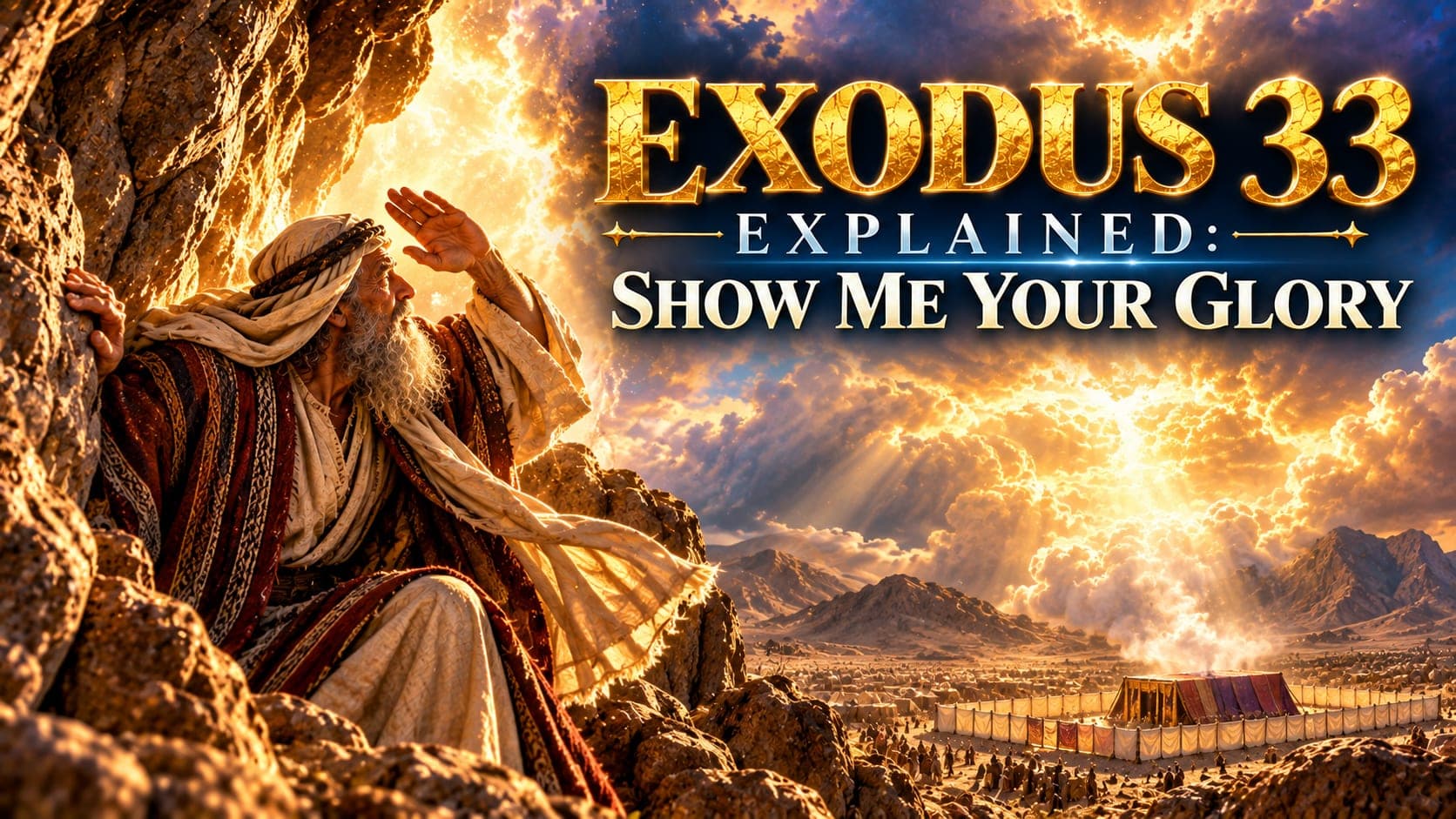
"And the LORD said, Behold, there is a place by me, and thou shalt stand upon a rock: And it shall come to pass, while my glory passeth by, that I will put thee in a clift of the rock, and will cover thee with my hand while I pass by: And I will take away mine hand, and thou shalt see my back parts: but my face shall not be seen."
The King James spells it "clift," an older form of the word you likely know as cleft, a split or crack in the rock. God Himself positions Moses inside it, covers him with His own hand while His glory passes, then lifts the hand just enough for Moses to see what has already gone by.
📌 Every part of this scene is protection, not withholding. The rock, the cleft, God's own hand, the timing of when it lifts: all of it exists so that a man who asked to see God's glory could survive asking for it. The chapter ends there, on the mountain, with the sight still ahead of Moses and the next chapter waiting to show what he actually saw.

Hard Questions Exodus 33 Raises
Does verse 11 saying Moses spoke with God "face to face" contradict verse 20 saying no one can see God's face and live? The text itself seems to use the same phrase two different ways within this one chapter. Verse 11 describes the quality of the conversation, open and direct, "as a man speaketh unto his friend," not a claim that Moses looked at God's unveiled essence. Verse 20, a few verses later, is specifically about that kind of sight, the one Moses is asking for and cannot survive. A later passage about Moses makes the same distinction in different words.
"My servant Moses is not so, who is faithful in all mine house. With him will I speak mouth to mouth, even apparently, and not in dark speeches; and the similitude of the LORD shall he behold: wherefore then were ye not afraid to speak against my servant Moses?"
"The similitude of the LORD," not the LORD's unveiled face, is what even Moses is said to behold. Scripture describes his closeness with God as uniquely direct among the prophets, while still holding the line Exodus 33:20 draws.
Jacob said he saw God face to face at Peniel and lived. Does that conflict with Exodus 33:20?
"And Jacob called the name of the place Peniel: for I have seen God face to face, and my life is preserved."
Genesis does not fully explain what Jacob wrestled with that night in Genesis 32, only that Jacob himself named it an encounter with God. Most readers understand this as an appearance God chose to take, not the unveiled glory Exodus 33:20 refuses Moses, the same way the voice from the burning bush was real contact with God without Moses seeing anything he could not survive seeing. The text leaves the exact mechanics unexplained in both places, but neither account claims a person looked directly at God's unveiled being and lived.
Does "I will be gracious to whom I will be gracious" mean God chooses who receives mercy for no reason at all? Paul quotes this exact line centuries later, in a passage Christians have debated for a very long time.
"For he saith to Moses, I will have mercy on whom I will have mercy, and I will have compassion on whom I will have compassion. So then it is not of him that willeth, nor of him that runneth, but of God that sheweth mercy."
In Exodus 33, the statement answers a specific moment: Israel had just broken the covenant with the golden calf and had no claim on forgiveness, yet received it anyway. The point in context is that God's mercy toward them was never owed or earned. Paul widens the same principle into a larger argument about God's freedom in showing mercy, and Christians genuinely disagree over how far that freedom reaches into who is ultimately saved. Some read it as God's sovereign right to choose apart from anything in the person; others read it as God's freedom to show mercy on His own terms rather than on a system of earned merit, without settling every question about human choice. Exodus 33:19 does not resolve that debate on its own. What it states plainly, in its own setting, is that Israel's forgiveness after the calf was a free decision, not a payment.
Top Verses From Exodus 33
1. Exodus 33:11
"And the LORD spake unto Moses face to face, as a man speaketh unto his friend."
One of the most direct descriptions of friendship with God anywhere in the Old Testament, set right after Israel's worst failure to show that forgiveness had not ended the relationship.
2. Exodus 33:14
"And he said, My presence shall go with thee, and I will give thee rest."
The verse that answers the entire crisis of the chapter. Not an angel, not a policy, but God's own presence, promised in response to Moses' refusal to settle for less.
3. Exodus 33:19
"And will be gracious to whom I will be gracious, and will shew mercy on whom I will shew mercy."
The verse Paul quotes word for word in Romans 9, centuries later, to describe the same freedom God exercised toward Israel right after the golden calf.
4. Exodus 33:20
"Thou canst not see my face: for there shall no man see me, and live."
The hard limit behind every theophany in Scripture. Not God refusing closeness, but God protecting a mortal body from a glory it cannot physically survive looking at directly.
5. Exodus 33:22 and 23
"That I will put thee in a clift of the rock, and will cover thee with my hand while I pass by: And I will take away mine hand, and thou shalt see my back parts: but my face shall not be seen."
God Himself builds the safeguard around the very request He is granting, down to the exact moment His hand lifts. Mercy and protection arrive in the same gesture.

Frequently Asked Questions About Exodus 33
What is Exodus 33 about?
Exodus 33 records God offering to send an angel ahead of Israel instead of traveling among them Himself after the golden calf, Moses pitching a tent of meeting outside the camp where he spoke with God as a friend, Moses refusing to move forward without God's own presence, and Moses asking to see God's glory, which God grants in a limited way from a cleft in a rock.
Why did God say He would not go with Israel Himself?
Exodus 33:3 gives the reason directly: Israel was "a stiffnecked people," and God traveling in their midst while they stayed that way risked their destruction the next time they failed Him. Sending an angel was a protective step back, not a punishment.
What does "stiffnecked" mean in the Bible?
It describes an animal pulling against the direction it is being led rather than turning the way its owner steers it. Exodus 33:3 and 5 both use it for a people who kept resisting the direction God had already clearly shown them.
Why did the Israelites take off their jewelry in Exodus 33?
Exodus 33:4 to 6 records the people mourning and stripping off their ornaments at God's command after hearing He would not travel among them. The same category of gold had just been melted into the golden calf one chapter earlier, making the gesture an acknowledgment of what that gold had already cost them.
What was the tent of the congregation in Exodus 33?
A temporary tent Moses pitched outside the camp, described in Exodus 33:7, where anyone seeking the LORD could go. It is distinct from the gold covered tabernacle described earlier in Exodus, which had not been built yet at this point in the story.
Did Moses really speak with God face to face?
Exodus 33:11 says the LORD spoke with Moses "face to face, as a man speaketh unto his friend," describing the directness and warmth of their conversation. Numbers 12:8 clarifies this as speaking "mouth to mouth" and beholding "the similitude of the LORD," not the unveiled glory Exodus 33:20 says no living person can survive seeing.
What did Moses mean by asking to see God's glory?
In Exodus 33:18, Moses asks for more than the assurance of God's presence he had already received. He wanted to see the weight and brightness of who God actually is, not merely know that God was near.
What does "I will be gracious to whom I will be gracious" mean?
In Exodus 33:19, it states that God's forgiveness of Israel after the golden calf was a free decision, not something they had earned. Romans 9:15 quotes the same line in a wider discussion of God's freedom in showing mercy, a passage Christians have long debated the full reach of.
Why could no one see God's face and live?
Exodus 33:20 states it as a fact about human survival, not a threat: a direct, unveiled sight of God's glory is more than a mortal body can withstand. Verses 21 to 23 then show God protecting Moses from exactly that danger while still giving him a real, limited sight of His glory.
How does Exodus 33 connect to Jesus?
John 1:18 answers Exodus 33:20 almost directly: "No man hath seen God at any time; the only begotten Son, which is in the bosom of the Father, he hath declared him." Where Moses saw only God's back as His glory passed, Christians read Jesus as making the Father fully known in a way Moses himself could not receive face to face.
Final Thoughts
Exodus 33 never once raises its voice, and it may be the boldest chapter in the whole book.
📌 Forgiveness and presence are not the same gift. God had already forgiven Israel by the end of Exodus 32. Exodus 33 shows that being accompanied by Him still had to be specifically asked for.
📌 What actually sets God's people apart has never been a rulebook or an escort. Moses said it plainly: without God's own presence, Israel was just one more nation walking toward a piece of land.
📌 Even the closest friendship with God this side of eternity still has a limit. Moses spoke with God as a friend and still could only see His back. Something was still being held back for later.
You will likely never stand in a cleft of rock waiting for God's hand to lift. But you ask for the same thing Moses asked for every time you pray for God to actually go with you, not just bless you from a distance.
So here is your one next step.
Read Exodus 33:15 again today, and let Moses' refusal become your own: do not move forward with anything today that does not carry God's own presence in it.