📖 Exodus 32 Explained: The Golden Calf and Moses' Plea for Israel
Forty days was not a long wait. It only felt that way to the people standing at the bottom of the mountain.
Exodus 32 explained is the chapter where the covenant Israel swore to keep just two chapters earlier breaks while Moses is still on the mountain receiving the very law that forbids what they are about to do. Gold earrings melt into a calf. An altar goes up in front of it. And God tells Moses plainly that He is ready to start over without them.
Maybe you have heard this story told as a strange detour, a golden cow and some dancing, before the real history resumes.
- ❓ Why did Israel turn to an idol after everything they had just watched God do for them?
- ❓ Did God really offer to destroy His own people and start a new nation from Moses alone?
- ❓ Why did three thousand people die in a single day?
- ❓ What did Moses mean when he asked to be blotted out of God's own book?
📌 Exodus 32 is the first time Israel breaks the covenant, and the first time Moses stands between a holy God and a guilty people to keep that covenant from ending right there.
This walkthrough goes through the whole chapter in order: the calf made from melted jewelry, God naming exactly what He sees and what He is willing to do about it, Moses pleading before a single step is taken down the mountain, the tables broken and the calf ground to powder, Aaron's excuse, the sons of Levi carrying out a hard judgment, and Moses climbing back up to plead a second time for people who had already failed him once.
Read slowly. This chapter is not a detour. It is the moment the whole rest of Israel's story has to answer for.
What Happened Just Before This Chapter
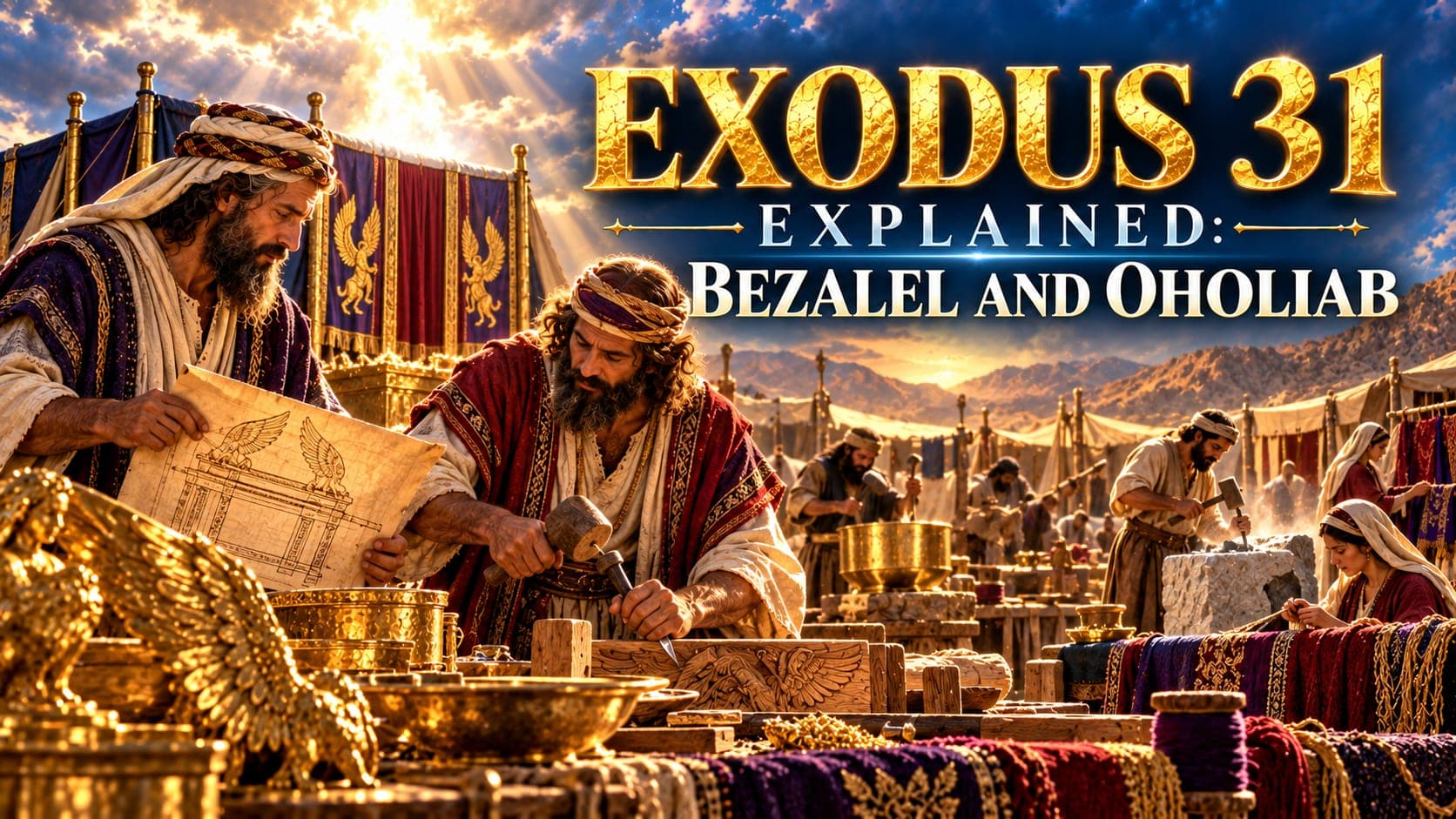
Exodus 31 ended on the calmest note in the whole book: Bezaleel and Aholiab named and equipped to build, the sabbath renewed as a sign, and two tables of stone handed to Moses, written by the finger of God. That peace was the end of an extended stretch on the mountain. Moses had been there forty days and forty nights, receiving the law and every tabernacle instruction God intended to give.
None of that silence reached the camp below. Just one chapter earlier, in Exodus 24, the people had heard the covenant read aloud and answered with one voice that they would do everything the LORD commanded. The blood of that covenant had been sprinkled on them. Forty days is not a long time to wait for a leader. It was long enough, apparently, for a promise made with one voice to be forgotten by the same mouths that made it.

Exodus 32 Explained Verse by Verse
1. The People Demand a God They Can See (verses 1 to 6)
The chapter opens with impatience, and the impatience has a target.
"And when the people saw that Moses delayed to come down out of the mount, the people gathered themselves together unto Aaron, and said unto him, Up, make us gods, which shall go before us; for as for this Moses, the man that brought us up out of the land of Egypt, we wot not what is become of him."
📌 Notice what they ask for and what they call Moses. Not "where is the LORD," but "make us gods." And the man who carried every plague, every parted sea, and every word of the law they just agreed to keep gets reduced to "this Moses," as if his absence erased everything he had done. Aaron does not argue.
"And Aaron said unto them, Break off the golden earrings, which are in the ears of your wives, of your sons, and of your daughters, and bring them unto me."
Aaron, the man anointed and consecrated as high priest only a short time before this in Exodus 29, is the one who collects the gold and does the work.
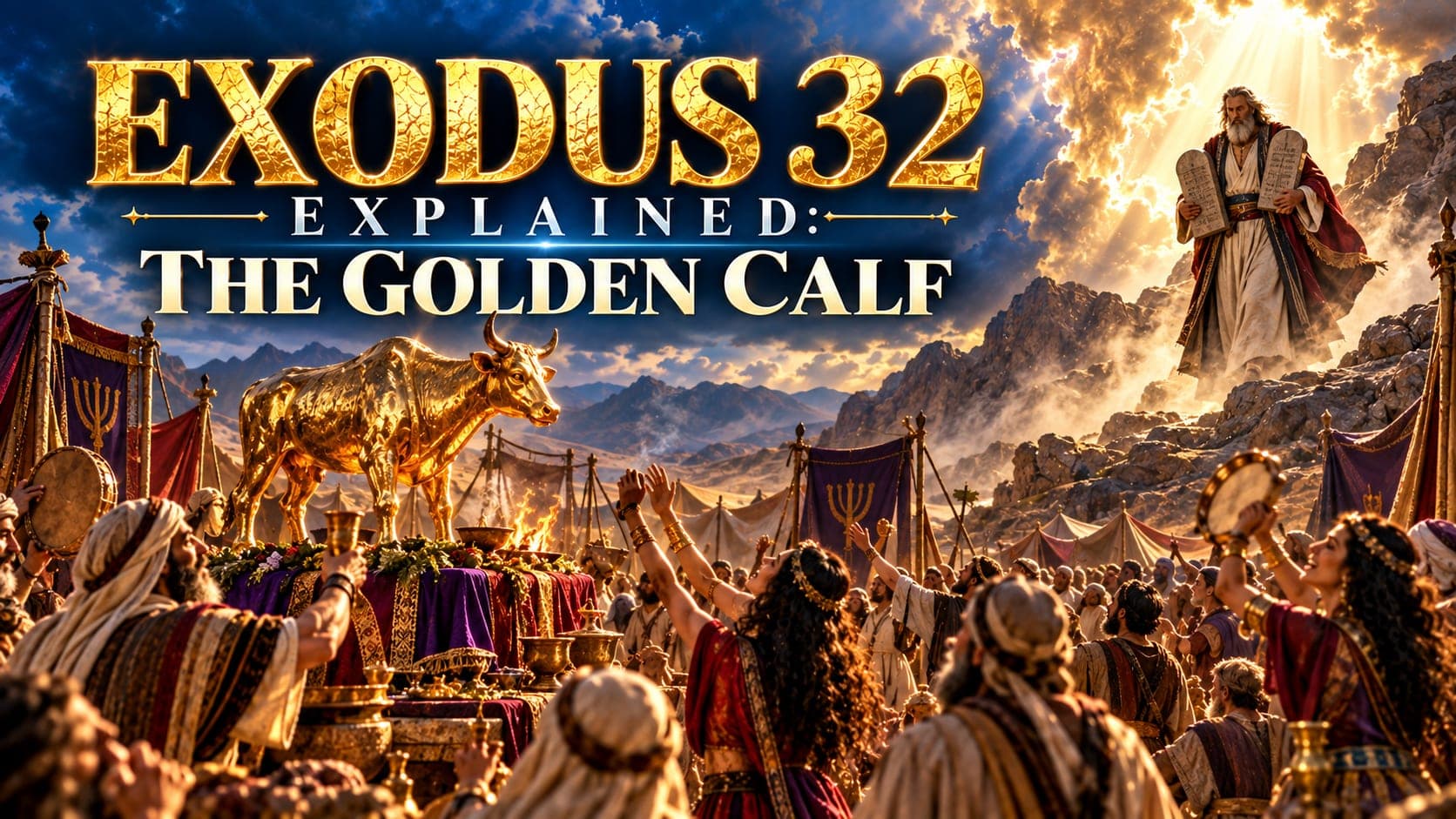
"And he received them at their hand, and fashioned it with a graving tool, after he had made it a molten calf: and they said, These be thy gods, O Israel, which brought thee up out of the land of Egypt."
⚠️ A calf was not a random choice. Young bulls were a common image of strength and fertility across Egypt and the wider ancient Near East. Israel did not invent a new god. They borrowed a familiar shape and pointed it at the LORD who had just rescued them, which makes what happens next even stranger.
"And when Aaron saw it, he built an altar before it; and Aaron made proclamation, and said, To morrow is a feast to the LORD. And they rose up early on the morrow, and offered burnt offerings, and brought peace offerings; and the people sat down to eat and to drink, and rose up to play."
💡 Aaron calls it a feast "to the LORD." This was never announced as worship of a foreign god instead of the LORD. It was an attempt to worship the LORD through an image He had already forbidden, which is exactly the lie underneath every golden calf since. The sin was not choosing a different god on paper. It was deciding the true God could be approached on their own terms, through something they built and could see.
2. God Tells Moses What He Sees, and What He Is Willing to Do (verses 7 to 10)
While the feast is still going on below, the scene cuts back to the mountain.
"And the LORD said unto Moses, Go, get thee down; for thy people, which thou broughtest out of the land of Egypt, have corrupted themselves: They have turned aside quickly out of the way which I commanded them: they have made them a molten calf, and have worshipped it, and have sacrificed thereunto, and said, These be thy gods, O Israel, which have brought thee up out of the land of Egypt."
📌 God calls them "thy people," speaking to Moses, not "my people." The distance in that one phrase says as much as the report itself. Then comes language that sounds almost final.
"And the LORD said unto Moses, I have seen this people, and, behold, it is a stiffnecked people: Now therefore let me alone, that my wrath may wax hot against them, and that I may consume them: and I will make of thee a great nation."
Stiffnecked pictures an ox straining against the yoke instead of turning where it is led, a people who have been shown the right direction and keep pulling away from it anyway. "Let me alone" and "I will make of thee a great nation" together read like an offer, not just an announcement. God states what He could justly do, and leaves room in the very next breath for Moses to respond. He does not act while Moses is still standing there listening.
3. Moses Intercedes Before Taking a Single Step Down (verses 11 to 14)
Moses does not move toward the camp first. He argues with God first.
"And Moses besought the LORD his God, and said, LORD, why doth thy wrath wax hot against thy people, which thou hast brought forth out of the land of Egypt with great power, and with a mighty hand? Wherefore should the Egyptians speak, and say, For mischief did he bring them out, to slay them in the mountains, and to consume them from the face of the earth? Turn from thy fierce wrath, and repent of this evil against thy people."
📌 Moses hands God's own words back to Him. God had just called Israel "thy people" to distance Himself from them. Moses answers by calling them "thy people" right back, refusing to accept the hand off. His first argument is God's own reputation among the watching nations, not Israel's merit, because Israel had none to offer.
Then he reaches further back than Egypt.
"Remember Abraham, Isaac, and Israel, thy servants, to whom thou swarest by thine own self, and saidst unto them, I will multiply your seed as the stars of heaven, and all this land that I have spoken of will I give unto your seed, and they shall inherit it for ever."
💡 Moses' second argument is not Israel's behavior at all. It is a promise God made to Abraham generations earlier, sworn by God's own name, before this generation had done anything to deserve or forfeit it.
"And the LORD repented of the evil which he thought to do unto his people."
Israel is spared, and the text says so plainly, before Moses has even left the mountain or confronted a single person below.
4. Broken Tables and a Calf Ground to Powder (verses 15 to 20)
Only now does Moses actually start down the mountain, carrying what he had just been given.
"And Moses turned, and went down from the mount, and the two tables of the testimony were in his hand: the tables were written on both their sides; on the one side and on the other were they written. And the tables were the work of God, and the writing was the writing of God, graven upon the tables."
The text repeats whose work this is twice in two verses. God made the tables, and God wrote on them. Nothing about them came from Moses' own hands. As he gets close enough to hear the camp, Joshua mistakes the sound for battle, and Moses corrects him before either of them can see what is actually happening.
"And it came to pass, as soon as he came nigh unto the camp, that he saw the calf, and the dancing: and Moses' anger waxed hot, and he cast the tables out of his hands, and brake them beneath the mount."
⚠️ The same man who had just talked God out of destroying Israel now smashes the very tables that recorded the covenant they had broken. Pleading for mercy on the mountain and burning with anger in the camp are not opposite reactions here. Both come from the same love for what the covenant was supposed to be.
"And he took the calf which they had made, and burnt it in the fire, and ground it to powder, and strawed it upon the water, and made the children of Israel drink of it."
📌 Burned, ground to dust, scattered on water, and swallowed. Moses does not simply remove the idol. He makes the people physically consume what they had just worshipped, turning the object of their sin into something they could taste going down. There is no mistaking, after that, what had actually happened to their god.
5. Moses Confronts Aaron (verses 21 to 24)
The next conversation is not with the crowd. It is with the man who built the calf.
"And Moses said unto Aaron, What did this people unto thee, that thou hast brought so great a sin upon them?"
Aaron answers, and his answer shrinks with every sentence.
"And I said unto them, Whosoever hath any gold, let them break it off. So they gave it me: then I cast it into the fire, and there came out this calf."
💡 Compare this to what actually happened three verses earlier in the chapter. Aaron himself fashioned it with a graving tool and announced the feast. By the time he explains it to Moses, the calf simply "came out" of the fire on its own, as if his own hands were never involved. Blame that shrinks the truth is not a new instinct in Scripture, and it is not a new instinct in Aaron either.
6. The Sons of Levi and the Day's Judgment (verses 25 to 29)
Moses looks at the camp and sees something beyond the calf itself.
"Then Moses stood in the gate of the camp, and said, Who is on the LORD's side? let him come unto me. And all the sons of Levi gathered themselves together unto him."
One tribe answers the call as a body. What Moses commands them to do next is the hardest verse in the chapter.
"And the children of Levi did according to the word of Moses: and there fell of the people that day about three thousand men."
⚠️ This was not a mob acting out of anger. It was carried out at Moses' direct word, aimed at those still openly committed to the idolatry after the covenant had already named exactly that sin as deserving death. The number is specific, not exaggerated for effect, and the text does not celebrate it. It simply records what the day cost.
7. Moses Pleads a Second Time, and Offers Himself (verses 30 to 35)
With the camp finally quiet, Moses climbs back up the mountain he had just come down.
"And it came to pass on the morrow, that Moses said unto the people, Ye have sinned a great sin: and now I will go up unto the LORD; peradventure I shall make an atonement for your sin."
He does not know yet whether it will work. "Peradventure" means perhaps. Moses goes back without a guarantee, which makes the next words some of the most exposed in the whole book.
"And Moses returned unto the LORD, and said, Oh, this people have sinned a great sin, and have made them gods of gold. Yet now, if thou wilt forgive their sin--; and if not, blot me, I pray thee, out of thy book which thou hast written."
📌 Moses offers to trade his own place for theirs. He does not finish the sentence about what forgiveness would look like. He simply states the alternative: if Israel is not forgiven, erase him instead. God's answer draws a line Moses' offer could not cross.
"And the LORD said unto Moses, Whosoever hath sinned against me, him will I blot out of my book. Therefore now go, lead the people unto the place of which I have spoken unto thee: behold, mine Angel shall go before thee: nevertheless in the day when I visit I will visit their sin upon them."
Moses could not simply be blotted out in place of the guilty. Each person would still answer for their own sin. The journey continues, the Angel still goes ahead of them, but the chapter closes without pretending the matter is fully settled.
"And the LORD plagued the people, because they made the calf, which Aaron made."

Hard Questions Exodus 32 Raises
Did God actually intend to destroy Israel, or was this a test of Moses? The text states plainly that God told Moses He would consume the people and build a new nation from him alone, and that Moses' prayer changed the outcome. Scripture does not explain exactly how a God who knows the end from the beginning relates to a real exchange like this one. What it does say clearly is that the prayer mattered and the outcome moved. A psalm written much later remembers this moment the same way.
"They made a calf in Horeb, and worshipped the molten image. Thus they changed their glory into the similitude of an ox that eateth grass. They forgat God their saviour, which had done great things in Egypt; Wondrous works in the land of Ham, and terrible things by the Red sea. Therefore he said that he would destroy them, had not Moses his chosen stood before him in the breach, to turn away his wrath, lest he should destroy them."
"Stood before him in the breach" is the psalm's own picture of what Exodus 32:11 to 14 records: a gap opened by Israel's sin, and one man standing in it so judgment could not pass through.
Why did three thousand people die, and was that judgment fair? Exodus 32:28 gives the number without commentary, but the law Israel had just agreed to keep had already named this exact sin as deserving death.
"He that sacrificeth unto any god, save unto the LORD only, he shall be utterly destroyed."
That command had been given before the golden calf, in the same block of law Israel heard and swore to obey in Exodus 24. The Levites' action was not improvised anger. It applied a penalty the covenant itself had already set.
Why does Aaron face no direct punishment in this chapter, when he built the calf with his own hands? Exodus 32 itself does not record a punishment for Aaron. Moses' own retelling of this event years later fills in a detail Exodus 32 leaves out.
"And the LORD was very angry with Aaron to have destroyed him: and I prayed for Aaron also the same time."
Aaron was not overlooked. Moses interceded for him specifically, the same way he had just interceded for the whole nation, and that second intercession simply never made it into the Exodus account itself.
What did Moses mean by asking to be blotted out of God's book? The phrase points to a record of who belongs among God's people, and Moses offers his own place in it as payment for Israel's forgiveness. God's answer in verse 33 is clear that the offer could not be accepted as a substitute. Centuries later, Paul reaches for almost the same willingness toward his own people.
"For I could wish that myself were accursed from Christ for my brethren, my kinsmen according to the flesh:"
Moses could not actually trade places with a guilty nation, and the chapter does not pretend otherwise. Christians read that unfinished sentence in verse 32 as pointing toward a mediator who finally could make the trade Moses only offered.
Top Verses From Exodus 32
1. Exodus 32:1
"And when the people saw that Moses delayed to come down out of the mount, the people gathered themselves together unto Aaron, and said unto him, Up, make us gods, which shall go before us; for as for this Moses, the man that brought us up out of the land of Egypt, we wot not what is become of him."
The verse where waiting curdles into demand. Forty days of silence was enough for Israel to ask for a god they could see instead of the one who had already saved them.
2. Exodus 32:4
"And he received them at their hand, and fashioned it with a graving tool, after he had made it a molten calf: and they said, These be thy gods, O Israel, which brought thee up out of the land of Egypt."
The high priest himself does the shaping. A reminder that spiritual office is never automatic protection against the exact failure a person is supposed to guard others from.
3. Exodus 32:9 and 10
"And the LORD said unto Moses, I have seen this people, and, behold, it is a stiffnecked people: Now therefore let me alone, that my wrath may wax hot against them, and that I may consume them: and I will make of thee a great nation."
A verse that leaves room for exactly what happens next. God names the justice Israel deserved, and does not act while Moses is still standing there to respond.
4. Exodus 32:26
"Then Moses stood in the gate of the camp, and said, Who is on the LORD's side? let him come unto me. And all the sons of Levi gathered themselves together unto him."
A line drawn in the open, in front of the whole camp. Loyalty here was not a private feeling. It was a choice that had to be made visible by actually walking toward Moses.
5. Exodus 32:31 and 32
"And Moses returned unto the LORD, and said, Oh, this people have sinned a great sin, and have made them gods of gold. Yet now, if thou wilt forgive their sin--; and if not, blot me, I pray thee, out of thy book which thou hast written."
Moses offers to be erased rather than let the people he led be destroyed. The offer could not be accepted as written, but the willingness behind it echoes all the way to the New Testament.

Frequently Asked Questions About Exodus 32
What is Exodus 32 about?
Exodus 32 records Israel building and worshipping a golden calf while Moses is still on the mountain, God's anger and His willingness to destroy the nation, Moses interceding before coming down, the broken tables and the calf ground to powder, Aaron's excuse, the Levites' judgment on three thousand people, and Moses pleading a second time and offering his own place for Israel's.
Why did the Israelites make a golden calf?
Exodus 32:1 says Moses "delayed" coming down and the people gathered demanding a god they could see. A young bull was a common image of strength in the surrounding cultures, and Israel borrowed that shape and pointed it at the LORD rather than choosing a different god outright.
Why did Aaron help make the golden calf?
Exodus 32:2 to 5 shows Aaron collecting the gold, fashioning the calf himself with a graving tool, and announcing a feast "to the LORD" around it. The text gives no excuse for his role, and his own later account to Moses in verse 24 shrinks what he actually did.
What does stiffnecked mean in the Bible?
It pictures an ox that strains against the yoke instead of turning where it is led. Exodus 32:9 uses it for a people who had already been shown the right direction and kept pulling away from it anyway.
Did God really plan to destroy Israel?
Exodus 32:10 states that God told Moses He would consume the people and build a new nation from him alone. Verse 14 then says the LORD repented of that evil after Moses interceded, a real change in what Scripture says would otherwise have happened.
Why did Moses break the stone tables?
Exodus 32:19 says his anger burned hot the moment he actually saw the calf and the dancing, and he threw down the tables God had just written, breaking them at the foot of the mountain. The covenant they recorded was the same covenant Israel had just broken.
How many people died because of the golden calf?
Exodus 32:28 records about three thousand men killed by the sons of Levi at Moses' command, applying a penalty for idolatry the law had already set in Exodus 22:20, before the calf was ever made.
What did Moses mean by asking to be blotted out of God's book?
In Exodus 32:32, Moses offers his own place among God's people as payment for Israel's forgiveness. God's answer in verse 33 makes clear that each person would still answer for their own sin, so the trade Moses offered could not be accepted as he proposed it.
Was Aaron ever punished for building the golden calf?
Exodus 32 itself records no punishment for Aaron. Deuteronomy 9:20 fills in that God was very angry with Aaron too, and that Moses prayed specifically for him at the same time he was pleading for the nation.
How does Exodus 32 connect to Jesus?
Moses offers to be blotted out in Israel's place, and God's answer shows that offer could not actually settle the debt. Christians read that unfinished trade as pointing toward a mediator who could take what Moses only volunteered for, the way Romans 9:3 echoes the same willingness centuries later.
Final Thoughts
Exodus 32 is the chapter Israel's whole later history has to answer for. It does not end there.
📌 Impatience with God's timing does not stay quiet for long. Forty days was all it took for a people who had sworn to obey to melt their own jewelry into something they could see and control.
📌 Intercession happened before judgment, not after it. Moses argued with God on the mountain before he ever confronted a single person in the camp below.
📌 Mercy and consequence both stayed real in this chapter. Israel was spared from total destruction, and the sin still cost three thousand lives and a plague. Forgiveness in Exodus 32 never meant the sin was treated as nothing.
You will likely never build an idol out of jewelry. But impatience with God's timing still looks for something you can see and manage instead of trusting what you cannot yet see finished.
So here is your one next step.
Read Exodus 32:11 to 14 again today, and notice that Moses prayed before he ever saw the problem up close. Pray about whatever you are waiting on before your own patience runs out.