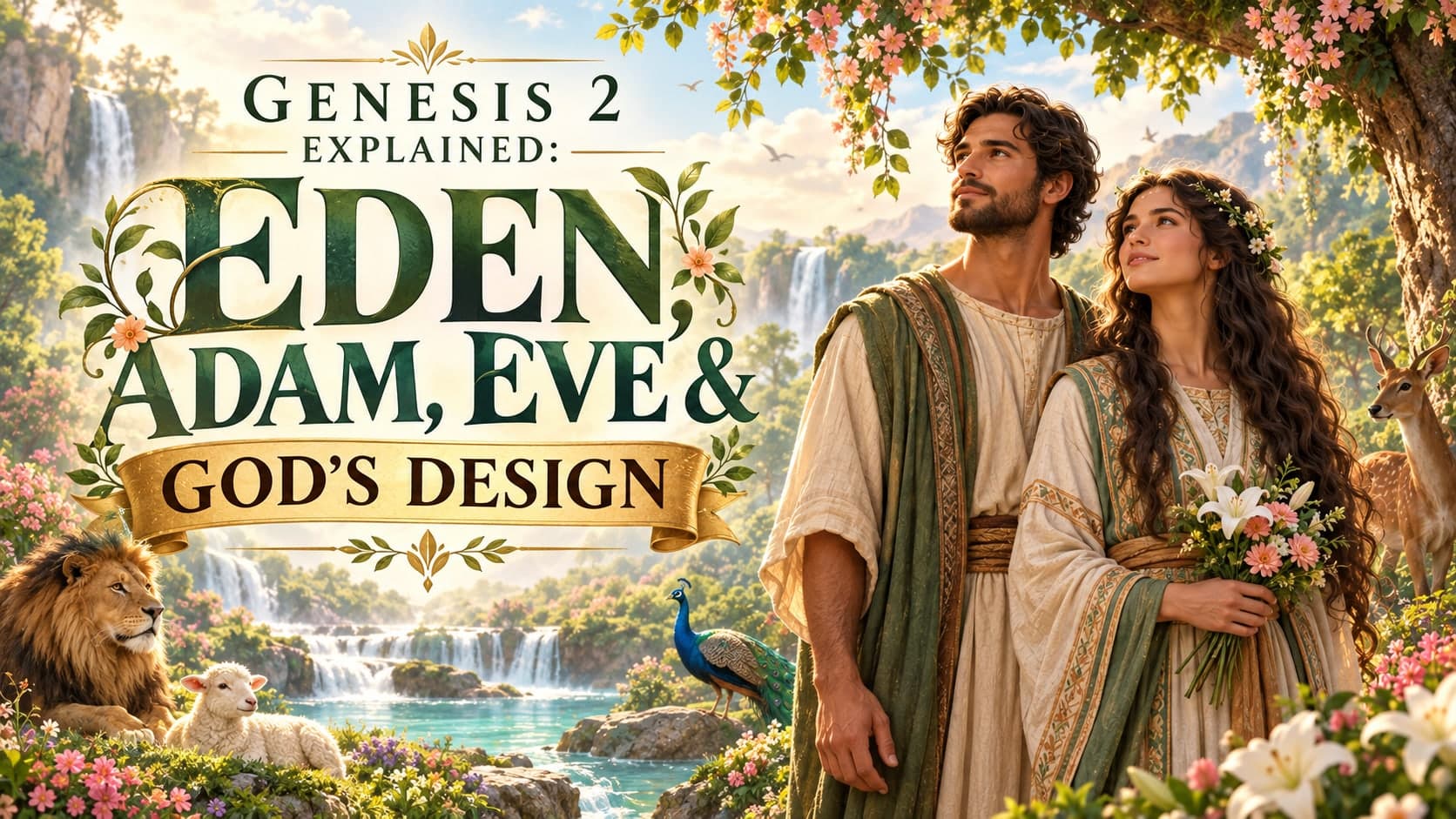
📖 Genesis 2 Explained: Eden, Adam, Eve & God's Design
Genesis 1 gives you the wide shot.
Six days. Light, land, sea, stars, animals, and finally, on day six, a man and a woman made in God's image.
Genesis 2 pulls the camera in close.
This is where Genesis 2 explained actually matters, because this chapter answers the questions Genesis 1 leaves open.
- ❓ How exactly did God form the first man?
- ❓ What was he actually supposed to do in Eden?
- ❓ What was the one command he was given?
- ❓ And why did God make a woman at all?
Maybe you clicked over here because someone in your life quoted this chapter to you. About marriage. About work. About what it means to be made in God's image.
Maybe you are single and tired of hearing this chapter used against you.
Maybe you are married and wondering if leave, cleave, and one flesh actually mean anything for the mess your marriage feels like right now.
You want the actual text before you take anyone's word for it.
Good instinct.
Not a paraphrase. Not the version that gets passed around in memes. The chapter itself, walked through in order, verse by verse, so you understand what it actually says and why it still matters for your life today.
Why Genesis 2 Matters for Your Faith
You could skip Genesis 2 and go straight to Genesis 3, where sin enters the world.
A lot of people do exactly that.
But if you skip this chapter, you skip the blueprint. You lose the picture of what your work, your marriage, and your need for other people were actually supposed to look like before anything ever broke.
⚠️ The world has its own answers to these same three questions.
The world tells you your job is where you find your worth. Genesis 2 tells you work was a gift handed to you by God, not a scoreboard.
The world tells you marriage is a contract you can rewrite whenever it stops working for you. Genesis 2 tells you marriage is a pattern God Himself designed, one flesh, not two roommates with shared bills.
The world tells you loneliness is just a mood to manage with more hobbies or more scrolling. Genesis 2 tells you companionship is part of how God built you, so deeply that He called your aloneness "not good" before sin ever existed.
📌 That is what is actually at stake here. Not historical curiosity about a garden. Your understanding of what your work is for, what your marriage is for, and what you were made for.
Get this chapter right, and you get a truer foundation under all three. Skip it, and you end up borrowing the world's answers instead.

Where Genesis 2 Fits
Genesis 2 opens by closing out the seven days. God finishes His work, rests on the seventh day, and blesses it.
📌 Worth pausing on: a popular claim says Genesis 2 institutes the Sabbath. It does not, not yet. The word "Sabbath" never appears, and no one is commanded to rest. That command comes later, at Sinai. Here, God simply rests.
Then verse 4 turns the camera around. Genesis 1 said humanity was made, male and female, on day six, in one summary line. Genesis 2 is not a second, contradicting account. It is that same event, slowed down, with the details Genesis 1 skipped. Tradition holds Moses wrote it down.
What Happens in Genesis 2
1. God Forms Man From Dust and Breathes Life Into Him
Genesis 1 said God created man. Genesis 2 shows you how.
"And the LORD God formed man of the dust of the ground, and breathed into his nostrils the breath of life; and man became a living soul."
Two actions. Both intimate.
📌 God formed him. The word pictures a potter shaping clay by hand, not a word spoken from a distance like the rest of creation.
📌 God breathed into him. Not into an animal, not into a tree. Into a man's own nostrils, His own breath.
That is the difference between dust and a living soul. Dust is everywhere. The breath of God in it is what made the first man different from everything else God had made that week.
2. God Plants a Garden and Gives Adam a Job and a Command
God does not leave the man standing in an empty field. He plants him a home.
Eden had a tree of life and a tree of the knowledge of good and evil growing in the middle of it, and a river flowing out to water it. The chapter spends several verses naming the four rivers that branched from it, but that geography is its own study, worth exploring on its own.
What matters for the chapter's flow is what God gave the man to do there.
"And the LORD God took the man, and put him into the garden of Eden to dress it and to keep it."
💡 Work is not a punishment in this chapter. It comes before anything ever went wrong. Adam had real responsibility in paradise. Tending it, guarding it. That is worth noticing before you ever get to a curse.
Then God gives him one command.
"And the LORD God commanded the man, saying, Of every tree of the garden thou mayest freely eat: But of the tree of the knowledge of good and evil, thou shalt not eat of it: for in the day that thou eatest thereof thou shalt surely die."
⚠️ Notice how generous this is before it is restrictive. Every tree in the garden was open to him. One tree, out of all of them, was fenced off. Freedom was the rule. Restriction was the exception.
That single command is also the first place Scripture shows a person able to trust God with something, or not. That same kind of test still shows up in your own life, long after Eden.
3. God Says It Is Not Good for Man to Be Alone
Adam has a job. Adam has a command. Adam has God's own presence in the garden.
And God still says something is missing.
"And the LORD God said, It is not good that the man should be alone; I will make him an help meet for him."
📌 "Not good" is the first negative statement in the entire Bible. Everything up to this point was called good, or very good. Aloneness is the first thing God names as not good.
Notice what this is not.
It is not a rebuke of Adam. It is not a flaw in how God made him.
It is God diagnosing a real gap before Adam even knows to feel it.
❓ Have you ever had everything that should satisfy you and still felt like something was missing?
Adam had Eden itself, and it still was not enough by itself.
💡 Companionship was never a backup plan. It was built into the design from the very beginning.
4. Adam Names the Animals and Discovers He Is Alone
Right after God says it is not good for man to be alone, He does something that looks, at first, like a strange next step.
He brings the animals to Adam.
"And out of the ground the LORD God formed every beast of the field, and every fowl of the air; and brought them unto Adam to see what he would call them: and whatsoever Adam called every living creature, that was the name thereof."
📌 Naming is an act of authority. In Scripture, the one who names something is the one with dominion over it. Adam naming every creature is Adam living out the rule over creation God already gave humanity back in Genesis 1.
Cattle, birds, every beast of the field. Adam works through the whole list.
"And Adam gave names to all cattle, and to the fowl of the air, and to every beast of the field; but for Adam there was not found an help meet for him."
And in the middle of all that naming, Adam notices something.
Every animal has a mate. Every animal has its own kind walking beside it.
⚠️ Adam does not.
God could have simply told Adam he needed a wife. Instead, God let Adam feel the gap for himself first, through this long parade of paired creatures.
💡 Sometimes God lets you see what is missing with your own eyes before He provides it. The naming was not wasted time. It was preparation.
5. God Creates Eve From Adam's Rib
No animal, out of everything Adam named, was a fit match for him.
So God does something no other creation moment in Genesis looks like.
"And the LORD God caused a deep sleep to fall upon Adam, and he slept: and he took one of his ribs, and closed up the flesh instead thereof; And the rib, which the LORD God had taken from man, made he a woman, and brought her unto the man."
Adam's response is the first recorded human words in Scripture.
"And Adam said, This is now bone of my bones, and flesh of my flesh: she shall be called Woman, because she was taken out of Man."
📌 Bone of my bones, flesh of my flesh. That is not a legal phrase. It is closer to poetry. Adam is not describing an assistant. He is recognizing someone who is fully his own kind, taken from his own body.
One popular graphic adds that the rib shows Eve was taken from Adam's side to stand equal beside him, not his head to rule him or his foot to be trampled. That line is a well known preaching illustration, not something Genesis 2 itself says.
What the text does say is plain enough on its own. She is called an "help meet," a helper who matches him, not a lesser creature. Eve is Adam's equal in nature, formed from his own side, not built from separate dust the way the animals were.
6. Leave, Cleave, One Flesh: God's Design for Marriage
Then the chapter steps back from the story and states the pattern for every marriage after it.
"Therefore shall a man leave his father and his mother, and shall cleave unto his wife: and they shall be one flesh."
Three actions. Read them slowly.
📌 Leave. A new priority takes first place. A husband and wife build a new household, not a satellite orbiting either set of parents.
📌 Cleave. This means to stick fast, to hold on with a commitment that does not come loose under pressure. It is glue language, not roommate language.
📌 One flesh. Not two lives running side by side. One united life, joined the same way Adam and Eve were literally joined by that same rib.
This is not a throwaway line. Centuries later, Paul quotes this exact verse when he teaches on marriage and the church.
"For this cause shall a man leave his father and mother, and shall be joined unto his wife, and they two shall be one flesh."
Paul is not adding a new idea. He is pointing straight back to Genesis 2 and saying this pattern was never just advice for one ancient family. It was a design for marriage itself, one Paul then compares to how Christ loves the church.
💡 That means your marriage, or the marriage you hope for one day, is not just a legal arrangement or a feeling that comes and goes. It is meant to picture something bigger than the two people in it.
The chapter closes on one final line.
"And they were both naked, the man and his wife, and were not ashamed."
💡 No shame yet. No hiding, no blame, no fear. Genesis 2 ends in complete openness between the man, the woman, and God. Remembering that is what makes Genesis 3, when it all breaks, hit as hard as it does.

What Genesis 2 Teaches You to Do
Genesis 2 is not just history. It hands you real, doable direction for how you work, love, and see yourself today.
Here are seven ways to actually live out what this chapter says.
- Remember you were formed on purpose, not as an afterthought. The image is a potter with dust and His own breath. When you doubt your worth, come back to that image.
- Treat your work as a calling, not a curse. Adam had a job before sin ever entered the picture. Ask God to show you the purpose inside what you already do.
- Respect the boundaries God sets, even the ones that feel restrictive. One tree was off limits out of an entire garden that was freely his. Practice trusting God with the "one tree" areas in your own life this week.
- Do not do life completely alone. God called isolation "not good" before anything had gone wrong yet. Take one small step toward real community this week.
- Bring your loneliness to God before you bring it to a screen. Adam's ache for companionship was seen and answered by God, not by more distraction.
- If you are married, practice leave, cleave, and one flesh on purpose. A strong marriage keeps choosing cleave daily, not just on the wedding day.
- Let Genesis 2 shape how you see the person in front of you. Every person you meet is formed the same way Adam was, by God's own hand and breath.
None of these require a seminary degree.
They just require actually believing what this chapter says about you.
Top Bible Verses From Genesis 2
If you want a few verses from this chapter to actually carry with you, start with these four.
1. Genesis 2:7
"And the LORD God formed man of the dust of the ground, and breathed into his nostrils the breath of life; and man became a living soul."
This is the verse that answers where you came from.
Not an accident of chemistry that happened to gain consciousness.
A God who knelt down, formed you by hand, and breathed His own life into you.
Every breath you take is living proof of a gift God gave on purpose.
2. Genesis 2:18
"And the LORD God said, It is not good that the man should be alone; I will make him an help meet for him."
This is the verse for anyone who has ever felt like their loneliness was their own fault.
It was not Adam's sin that created this problem. Nothing had gone wrong yet.
📌 If God cared enough to name your need for people, you can stop being ashamed of it.
This is the verse for the season when you need permission to reach out instead of carrying it alone.
3. Genesis 2:24
"Therefore shall a man leave his father and his mother, and shall cleave unto his wife: and they shall be one flesh."
This is the verse marriage counselors, pastors, and Jesus Himself keep coming back to.
Three words carry the whole verse. Leave. Cleave. One flesh.
It is short enough to memorize and heavy enough to build a marriage on.
If you are engaged or married, pray this verse over your relationship, not just quote it at a wedding.
4. Ephesians 5:31
"For this cause shall a man leave his father and mother, and shall be joined unto his wife, and they two shall be one flesh."
This is Genesis 2:24, quoted word for word centuries later by Paul.
It proves this was never just an ancient custom for one couple in one garden.
Paul then compares that same union to how Christ loves the church, giving Himself for it.
This is the verse for remembering that your marriage was designed to point at something bigger than either spouse.

Frequently Asked Questions About Genesis 2
Does Genesis 2 contradict Genesis 1?
No. Genesis 1 gives the six day overview and states that God made man, male and female, on day six. Genesis 2 is not a competing timeline. It zooms into that same sixth day and fills in how the man and woman were actually formed. Summary, then detail, same story.
Is Genesis 2 a second, contradictory creation account?
Some claim Genesis 1 and 2 come from two sources that disagree with each other. But the text itself does not read that way. Genesis 1 answers when and in what order everything was made. Genesis 2 answers how the man and woman were formed. Different focus, not a competing claim.
What is the tree of the knowledge of good and evil?
It was one specific tree growing in the middle of Eden, alongside the tree of life. God commanded Adam not to eat from it, with a clear warning attached. The chapter itself does not explain what would have happened if Adam had obeyed forever. It simply records the one command and the one warning, and leaves what comes next for Genesis 3.
Why did God say it was not good for man to be alone?
It is the first thing in the Bible God calls not good, even though everything He had made up to that point was good or very good. Adam had God's presence and a job, and it still was not enough on its own. Human companionship was part of the original design, not a fix added after something broke.
Why did God make Eve from Adam's rib?
God could have formed Eve from the dust the same way He formed Adam. Instead He built her from Adam's own side, so Adam would recognize her instantly as bone of his bones and flesh of his flesh. It pictures shared origin and equal nature, not a separate, lesser creation.
What does "help meet" mean?
"Help meet" is old English for a helper who is suited to him, a genuine match, not a servant or an assistant. The same Hebrew phrase behind it is used elsewhere in Scripture to describe God Himself helping His people. Being called a helper here is not a lesser role.
Does the rib mean Eve was inferior to Adam?
No. The text calls her an "help meet," meaning a helper suited to him, matching him, not beneath him. Adam himself recognizes her as bone of his bones and flesh of his flesh, the language of someone equal in kind, not a lesser creature. The rib shows shared origin, not rank.
Did Genesis 2 establish the Sabbath?
The chapter opens with God resting on the seventh day and blessing it, but it never uses the word Sabbath and gives no command to anyone to keep that day. That specific command to Israel comes later, at Mount Sinai. Genesis 2 shows God's own rest, not yet a law for man.
What did Adam naming the animals mean?
Naming something in Scripture is an act of authority over it, not just a label. When Adam named the animals, he was living out the dominion God gave humanity back in Genesis 1. It also showed Adam, in real time, that no animal was a companion suited to him.
Final Thoughts
Genesis 2 is a short chapter that answers big questions.
📌 You were formed with intention, given real purpose, handed one clear boundary, and never meant to walk through life alone.
You also just watched a marriage pattern get written into Scripture before sin ever showed up. Leave, cleave, one flesh, a pattern Paul was still teaching centuries later in Ephesians 5.
That is the picture this chapter paints before anything ever went wrong, and it is worth returning to whenever you need to remember what your work, your relationships, and your own life were actually made for.
💡 Whatever season you are in right now, single, married, exhausted at work, or just lonely tonight, Genesis 2 says none of that is outside what God already designed for.
This chapter comes alive verse by verse inside Bible Buddy, and it is completely free to start.