📖 Exodus 38 Explained: The Bronze Altar, the Laver, and the Final Count of Gold
Bezaleel just finished the holiest objects Israel will ever own. Now the text walks back outside, to the things an ordinary worshipper would actually see first.
Exodus 38 explained is the chapter where the tabernacle's outer furniture gets built: the bronze altar where every sacrifice would burn, a bronze basin made out of something nobody expected, and a linen wall marking off the whole courtyard. Then, with no warning, the chapter stops being a construction report and turns into a full financial accounting, naming the exact weight of every ounce of gold, silver, and brass the project used.
Maybe you have read the tabernacle chapters before and always skimmed straight past the numbers at the end.
- ❓ What is a laver, and why was this one made out of women's mirrors?
- ❓ Why does the Bible bother naming the exact weight of the gold used, down to the shekel?
- ❓ What was the half shekel every man had to pay, and why was a census dangerous without it?
- ❓ Why does Ithamar show up here, when he has barely been mentioned in Exodus before now?
📌 Exodus 38 is the chapter where worship gets audited, and the audit itself becomes part of Scripture.
This walkthrough goes through the whole chapter in order: the altar built to burn every sacrifice Israel would ever bring, a basin made from something the women gave up willingly, the linen court that marked off sacred ground, and the closing accounting that names Bezaleel, Aholiab, and Ithamar by role and totals every pound of metal that passed through their hands.
Read slowly. The numbers at the end are not filler. They check out, and the chapter wants you to notice that they do.
What Happened Just Before This Chapter
Exodus 37 ended with Bezaleel working alone, hammering the ark, the mercy seat, the table, the lampstand, and the incense altar out of gold God had already described to Moses, item for item, years earlier. Every object in that chapter belonged inside the tent, in rooms only the priests would ever enter.
Exodus 38 steps back outside the tent itself, into the open courtyard where ordinary Israelites would actually bring their sacrifices. The furniture built here is plainer than gold cherubim and a hammered lampstand, but it is the furniture most people in the camp would actually touch, see, or stand in front of.

Exodus 38 Explained Verse by Verse
1. The Bronze Altar Everyone Would See First (verses 1 to 7)
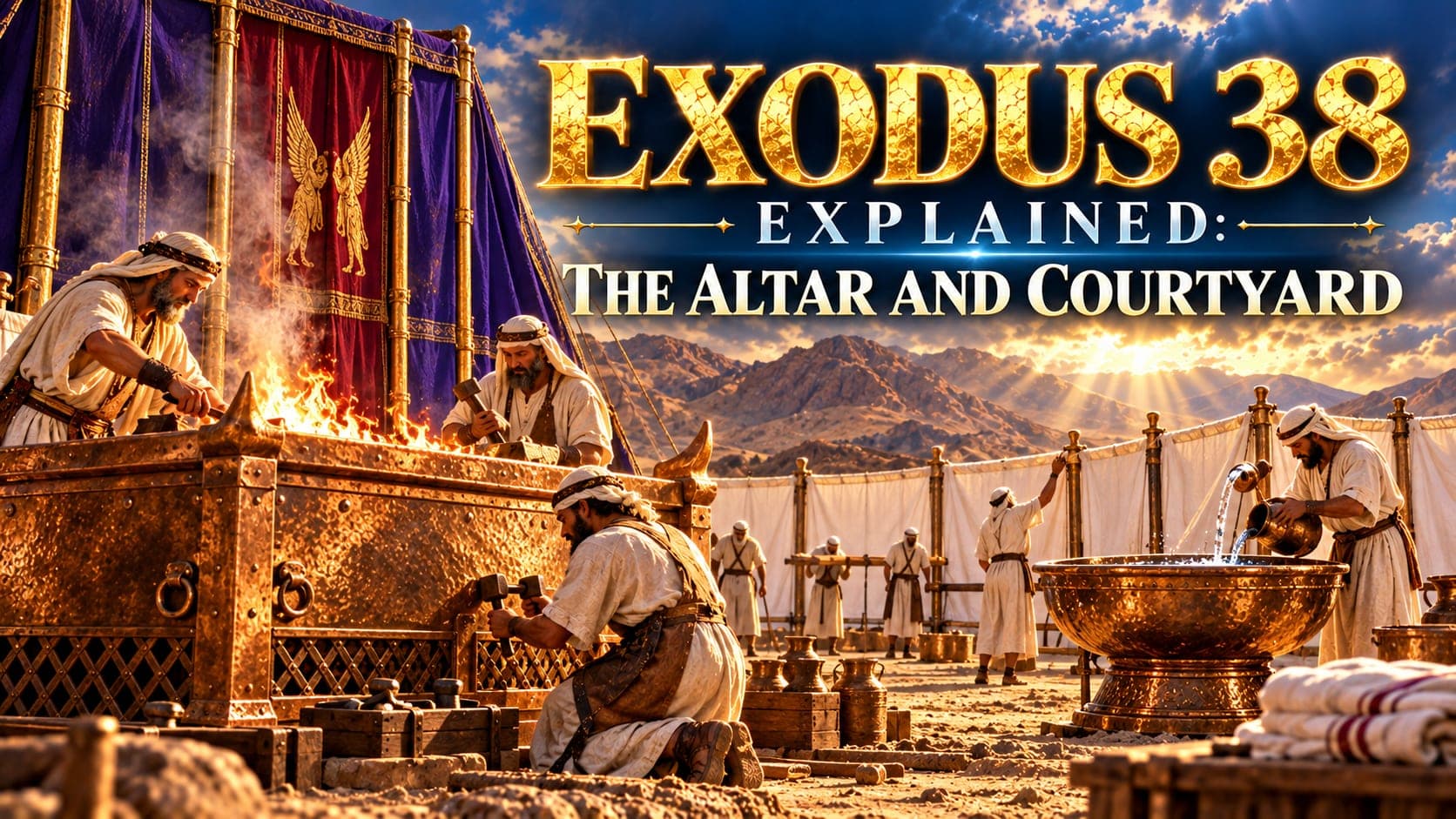
The chapter opens with the altar that stood at the courtyard entrance, the first thing anyone bringing an offering would reach.
"And he made the altar of burnt offering of shittim wood: five cubits was the length thereof, and five cubits the breadth thereof; it was foursquare; and three cubits the height thereof."
Compare that to the command God gave Moses alone on the mountain, back in Exodus 25 and the chapters after it:
"And thou shalt make an altar of shittim wood, five cubits long, and five cubits broad; the altar shall be foursquare: and the height thereof shall be three cubits."
📌 Same wood, same shape, same measurements, down to the cubit. A cubit was roughly a forearm's length, so this altar came out close to seven and a half feet square and four and a half feet tall, a real centerpiece, not a side table. Shittim wood is acacia, the same hard desert timber behind every other piece of tabernacle furniture.
Unlike the ark or the table, this altar is overlaid in brass, not gold. It would hold fire and blood every single day, and brass was the material built to take that kind of wear.
"And he put the staves into the rings on the sides of the altar, to bear it withal; he made the altar hollow with boards."
💡 Hollow with boards means the altar was not a solid block of wood and metal. It was a brass covered wooden frame, light enough to carry on its staves through the wilderness, filled with earth or stones once it stood in place, the same practical design God had specified chapters earlier.
2. A Basin Made From Women's Mirrors (verse 8)
One verse holds the strangest detail in the whole chapter, easy to read past if you are not looking for it.
"And he made the laver of brass, and the foot of it of brass, of the lookingglasses of the women assembling, which assembled at the door of the tabernacle of the congregation."
Laver is a wash basin, set between the altar and the tabernacle entrance so Aaron and his sons could wash their hands and feet before they ministered. God had already commanded the laver itself back in Exodus 30, though without naming what it would be made from.
"Thou shalt also make a laver of brass, and his foot also of brass, to wash withal: and thou shalt put it between the tabernacle of the congregation and the altar, and thou shalt put water therein."
📌 "Lookingglasses" means bronze mirrors, polished metal women would have used to see their own reflection. This chapter never explains why they gave them up, only that they did. The mirrors did not go into the tabernacle as scrap material chosen at random. They went into the one object a priest would look into before approaching God, a basin for washing rather than a surface for checking your own appearance.
⚠️ These same women reappear, by the same description, much later in Israel's story, and not in a good light.
"Now Eli was very old, and heard all that his sons did unto all Israel; and how they lay with the women that assembled at the door of the tabernacle of the congregation."
Scripture does not connect these two verses directly, and centuries separate them. What is worth noticing is only this: the same phrase, women gathered at the tabernacle door, describes a willing gift in Exodus 38 and a corrupted practice generations later in 1 Samuel. The location stayed holy. What happened there did not always stay faithful to it.
3. A Linen Wall Around the Whole Camp's Worship (verses 9 to 20)
With the altar and the laver finished, the chapter turns to the boundary marking off the whole courtyard.
"And he made the court: on the south side southward the hangings of the court were of fine twined linen, an hundred cubits: Their pillars were twenty, and their brasen sockets twenty; the hooks of the pillars and their fillets were of silver."
Fillets were the silver connecting bands wrapped around the tops of the pillars, and chapiters, named a few verses later, were the decorative caps crowning each pillar. The court ran a hundred cubits long on the south and north sides, fifty cubits wide on the east and west, all of it linen walls roughly seven and a half feet high, standing on brass sockets with silver trim.
📌 These numbers match God's instructions in Exodus 27 exactly, cubit for cubit. A hundred cubits by fifty, pillars and sockets counted out one side at a time, the same gate hanging of blue, purple, scarlet, and fine linen marking the one entrance in.
Only the entrance gate used color. Everything else was plain white linen.
"And the hanging for the gate of the court was needlework, of blue, and purple, and scarlet, and fine twined linen: and twenty cubits was the length, and the height in the breadth was five cubits, answerable to the hangings of the court."
💡 A visitor circling the camp would see plain white linen on every side except one. Color marked the single way in, the same pattern the veil and the inner door already used to set apart how close a person could come.
4. The Builders Named by Role, Not Just by Skill (verses 21 to 23)
The construction report ends, and a different kind of record begins.
"This is the sum of the tabernacle, even of the tabernacle of testimony, as it was counted, according to the commandment of Moses, for the service of the Levites, by the hand of Ithamar, son to Aaron the priest."
📌 Ithamar, Aaron's youngest son, has barely appeared in Exodus before this verse. He is not named as a craftsman anywhere in Exodus 35 through 37. Here he is given a specific job: counting. Someone had to track what came in and what it became, separate from the men who actually built it, and Exodus 38:21 credits that accounting to him by name.
Bezaleel and Aholiab are named once more, each with the exact gifting God first described for them.
"And Bezaleel the son of Uri, the son of Hur, of the tribe of Judah, made all that the LORD commanded Moses. And with him was Aholiab, son of Ahisamach, of the tribe of Dan, an engraver, and a cunning workman, and an embroiderer in blue, and in purple, and in scarlet, and fine linen."
⚠️ Three different roles close this project out: a builder, a weaver, and a counter. Skilled hands were never the whole story. Someone kept the books on what every hand actually used, and the text treats that job as worth naming right alongside the gold work itself.
5. Every Ounce Named: The Final Count of Gold, Silver, and Brass (verses 24 to 31)
The chapter closes with numbers, and they are worth actually reading rather than skimming past.
"All the gold that was occupied for the work in all the work of the holy place, even the gold of the offering, was twenty and nine talents, and seven hundred and thirty shekels, after the shekel of the sanctuary."
By the common reckoning used in most study Bibles, a talent weighed somewhere around seventy five pounds, the same figure used for the lampstand alone back in Exodus 37. Twenty nine talents of gold, plus a smaller change of shekels on top, comes to just over a ton of gold poured into the ark, the mercy seat, the table, the lampstand, and every gold overlay in the building.
Silver comes next, and the text ties it to something specific: not a free offering, but a required payment.
"And the silver of them that were numbered of the congregation was an hundred talents, and a thousand seven hundred and threescore and fifteen shekels, after the shekel of the sanctuary: A bekah for every man, that is, half a shekel, after the shekel of the sanctuary, for every one that went to be numbered, from twenty years old and upward, for six hundred thousand and three thousand and five hundred and fifty men."
Bekah is simply the word for half a shekel. This silver was not a willing gift like the gold and thread in Exodus 35. It was the ransom money God had already commanded back in Exodus 30, a half shekel required of every man counted in a census, rich or poor, paid the same amount.
"The rich shall not give more, and the poor shall not give less than half a shekel, when they give an offering unto the LORD, to make an atonement for your souls."
📌 The arithmetic actually checks out, if you do it yourself. Using the standard conversion of three thousand shekels to a talent, a hundred talents plus one thousand seven hundred and seventy five shekels comes to exactly three hundred and one thousand, seven hundred and seventy five shekels. Divide that by half a shekel per man, and you land on six hundred and three thousand, five hundred and fifty, the exact number of men the text names in the very same verse. The census total and the silver total confirm each other.
That same number, six hundred and three thousand, five hundred and fifty, shows up again later in Israel's story, counted a second time in the wilderness.
"Even all they that were numbered were six hundred thousand and three thousand and five hundred and fifty."
💡 Two separate books, two separate countings, the same number. The tabernacle's silver foundation and the army roll call in Numbers are describing the same generation of men.
"And of the hundred talents of silver were cast the sockets of the sanctuary, and the sockets of the vail; an hundred sockets of the hundred talents, a talent for a socket."
⚠️ Every single board in the tabernacle's frame stood on a socket cast from a full talent of silver, roughly seventy five pounds each. The ransom money paid for every man counted in the census became the literal foundation the whole building rested on. Nobody walked into that tent without the ground floor underneath it being made out of money every living man had paid.
"And the brass of the offering was seventy talents, and two thousand and four hundred shekels. And therewith he made the sockets to the door of the tabernacle of the congregation, and the brasen altar, and the brasen grate for it, and all the vessels of the altar, And the sockets of the court round about, and the sockets of the court gate, and all the pins of the tabernacle, and all the pins of the court round about."
📌 Gold for the holiest furniture inside, silver for the frame closest to the ark, brass for the altar, the outer sockets, and the tent pegs holding the whole camp's worship to the ground. The same pattern noticed back in Exodus 36, costlier material nearer God's presence, holds all the way through this final accounting too.

Hard Questions Exodus 38 Raises
Why does the Bible include a financial accounting at all? Does Scripture need to prove nothing was stolen? The text never accuses Bezaleel, Aholiab, or Ithamar of anything. What Exodus 38:21 to 31 does is make the project checkable. Every talent and shekel that came in from the people is matched to where it ended up, sockets, altar, pins, hooks. The accounting protects the builders rather than suspecting them, since nobody afterward could claim gold or silver had quietly gone missing.
Why were the women's mirrors specifically chosen for the laver, instead of any other piece of brass available? Exodus 38:8 states the fact without explaining the reason. The text does not say the mirrors were melted down out of necessity, since plenty of other brass passed through this project. What is observable is only that this basin, the one object a priest looked into before washing and entering God's presence, was built from something women had used to look at themselves. Any further meaning beyond that connection is an inference a reader can draw, not something the text states directly.
Was the half shekel census tax the same thing as regular temple giving? No. Exodus 30:12 to 16 ties this payment specifically to a census, a counting of men for military or civil purposes, and calls it a ransom "that there be no plague among them." It was a flat, required payment tied to one event, not an ongoing offering like the willing gifts described in Exodus 35.
Why would counting the people require a ransom to avoid a plague? Exodus 30:12 states the danger plainly without fully explaining it: a census without the ransom risked a plague among the people. Scripture elsewhere records a census going wrong when David numbered Israel without this kind of atonement, in 2 Samuel 24, which did end in a plague. Exodus 38 itself does not draw that comparison, but the later story shows the warning in Exodus 30 was not an empty one.
Top Verses From Exodus 38
1. Exodus 38:8
"And he made the laver of brass, and the foot of it of brass, of the lookingglasses of the women assembling, which assembled at the door of the tabernacle of the congregation."
A wash basin built from the one object women once used to check their own reflection, now holding water a priest needed before he could approach God.
2. Exodus 38:21
"This is the sum of the tabernacle, even of the tabernacle of testimony, as it was counted, according to the commandment of Moses, for the service of the Levites, by the hand of Ithamar, son to Aaron the priest."
A name almost unmentioned until now, given sole credit for keeping an honest count of what every skilled hand actually used.
3. Exodus 38:26
"A bekah for every man, that is, half a shekel, after the shekel of the sanctuary, for every one that went to be numbered, from twenty years old and upward, for six hundred thousand and three thousand and five hundred and fifty men."
A flat ransom, the same for rich and poor, that becomes the literal silver foundation the whole tabernacle would stand on.
4. Exodus 38:27
"And of the hundred talents of silver were cast the sockets of the sanctuary, and the sockets of the vail; an hundred sockets of the hundred talents, a talent for a socket."
Every man in Israel's ransom money, turned into the exact ground the tabernacle's frame rested on.

Frequently Asked Questions About Exodus 38
What is Exodus 38 about?
Exodus 38 records the building of the bronze altar of burnt offering, the bronze laver made from women's mirrors, the linen court surrounding the tabernacle, and closes with a full accounting of every talent and shekel of gold, silver, and brass the whole project used.
What is a laver in the Bible?
A laver was a bronze wash basin set between the altar and the tabernacle entrance. Exodus 38:8 says this one was made from bronze mirrors the women brought, and Aaron and his sons washed their hands and feet at it before ministering, so they would not die.
Why was the laver made from women's mirrors?
Exodus 38:8 states the fact without giving a reason. The women who assembled at the tabernacle door gave up their bronze lookingglasses, and that bronze became the basin a priest looked into before washing to approach God, rather than a surface for checking one's own appearance.
What was the half shekel tax in Exodus 38?
It was a required ransom payment commanded in Exodus 30:12 to 16, a half shekel from every man twenty years old and up whenever Israel was counted in a census. Exodus 38:25 and 26 record that this payment, not a free will offering, supplied all the silver used in the tabernacle.
How much gold, silver, and brass did the tabernacle use?
Exodus 38:24 to 29 names twenty nine talents and seven hundred thirty shekels of gold, a hundred talents and seventeen hundred seventy five shekels of silver, and seventy talents and twenty four hundred shekels of brass. By the common reckoning used in most study Bibles, a talent weighed around seventy five pounds, putting the gold alone at well over a ton.
Who was Ithamar?
Ithamar was Aaron's youngest son. Exodus 38:21 credits him specifically with the accounting of the tabernacle's materials, a role distinct from Bezaleel and Aholiab's building and weaving work named in the same chapter.
Why were six hundred three thousand five hundred fifty men counted?
Exodus 38:26 gives this as the number of men twenty years old and older who paid the half shekel ransom. The same exact figure appears again in Numbers 1:46, from a separate census taken later in the wilderness, of what was largely the same generation.
What does "fillets" and "chapiters" mean in Exodus 38?
Fillets were silver connecting bands wrapped around the court's pillars, and chapiters were the decorative caps on top of each pillar. Exodus 38:17 describes both as silver, set on sockets of brass.
Why does Exodus 38 end with numbers instead of a summary sentence?
The text does not explain its own method, but the effect is a project that can be checked rather than simply taken on trust. Every talent of silver is matched to a specific use, a hundred sockets from a hundred talents, which lets a reader confirm nothing was unaccounted for.
How does Exodus 38 connect to Jesus?
The ransom silver in this chapter bought atonement for a body count, paid the same for every man. Peter later describes a far greater ransom, one silver and gold could never buy.
"Forasmuch as ye know that ye were not redeemed with corruptible things, as silver and gold, from your vain conversation received by tradition from your fathers; But with the precious blood of Christ, as of a lamb without blemish and without spot:"
Final Thoughts
Exodus 38 is not the chapter anyone remembers. It might be the one that proves everything else was real.
📌 Worship and accounting are not opposites. The same chapter that records a basin made from women's mirrors also records a precise audit of every pound of metal spent. Neither one undercuts the other.
📌 The numbers were never decoration. They check out. Six hundred three thousand five hundred fifty men, a half shekel each, lands exactly on the silver total the chapter gives, and that same silver became the literal ground every board in the tabernacle stood on.
📌 An ordinary gift can end up somewhere holy. A mirror a woman once used for herself became the basin a priest needed to approach God. Nothing brought to this project stayed what it started as.
You will probably never cast a silver socket or total a nation's offering. But you likely have something ordinary, your own time, your own money, your own skill, that could end up further from yourself and closer to God than you expect.
So here is your one next step.
Read Exodus 38:27 again today, and ask what ordinary thing in your own life God might already be using as a foundation, even if you have never thought to call it that.